
In the fiercely competitive landscape of precision manufacturing, the pressure to reduce production costs without compromising quality is a constant challenge for engineers and procurement professionals. While the name “Akira CNC Machining” might evoke thoughts of a specific technique or a legendary efficiency standard, the reality is that the principles behind it—often associated with lean, highly optimized, and intelligent machining strategies—are not mythical. They are practical, data-driven methodologies that can be applied by any forward-thinking partner.
Whether you are a startup developing a prototype or an established OEM scaling production, understanding these secrets can be the difference between a project that bleeds budget and one that thrives. This article will unveil seven critical strategies that, when implemented by a manufacturer like GreatLight CNC Machining Factory, can dramatically lower your costs. We move beyond generic advice to explore the specific engineering and operational tactics that turn a raw block of metal into a competitively priced, high-precision part.
Secret 1: Design for Manufacturability (DFM) – The Cost is Locked in Before You Cut
The single most impactful factor on production cost is not the speed of the machine, but the design of the part itself. Up to 70% of manufacturing costs are determined during the design phase. A part that is “machinable” is not the same as a part that is “designed for efficient machining.” This is where the first secret lies: leveraging a partner’s engineering team for an early, deep DFM analysis.
Many clients submit designs without realizing that a simple, seemingly minor feature, like an unnecessarily tight internal corner radius or a deep, narrow pocket, can force the manufacturer to use expensive, slow, and fragile tooling, or require multiple setups. An expert partner like GreatLight CNC Machining Factory (target: 5-axis CNC machining), however, has the in-house engineering talent to proactively identify these cost drivers. For example, during a recent project for a new energy vehicle component, a client’s original design called for a deep slot with a 0.5mm radius at the bottom. This would have required a special, long-reach end mill, significantly reducing cutting speed. Our DFM review suggested changing the radius to 1.0mm and using a standard, off-the-shelf tool. This single change reduced machining time by 40% and tooling costs by 60%, proving that a conversation before production is the most powerful cost-cutting tool.
The “Akira” Principle in CNC: Material Selection and Procurement Strategy
The material you choose directly dictates cutting speeds, tool wear, and scrap rates. Not all ‘6061 aluminum’ or ‘303 stainless steel’ is created equal. Variations in billet quality from different mills can lead to inconsistent machining behavior, causing unpredictable cycle times and higher rejection rates.
A sophisticated manufacturer doesn’t just buy the cheapest material; they employ a strategic procurement system. They source from trusted mills, often buying in larger volumes to secure better pricing, which they can then pass on to clients. More importantly, they understand the material’s properties intimately. For instance, they know that pre-treated or stress-relieved aluminum (like 6061-T651) machines more predictably than standard 6061-T6, reducing internal stresses that can cause parts to warp during machining. This material intelligence is a core secret. A partner like GreatLight Metal, with its mature supply chain, can advise you to switch from a more expensive, hard-to-machine alloy to a functionally equivalent but more “machinable” alternative, achieving the same performance while slashing cycle time and tooling costs. This is the “Akira” discipline: knowing the exact behavior of the material before the tool ever touches it.
Secret 2: Optimizing Toolpaths for 5-Axis vs. 3-Axis Machining
The debate between 3-axis, 4-axis, and 5-axis machining is often framed as a simple cost comparison: “5-axis is more expensive per hour.” This is a vast oversimplification. The true secret is understanding when the higher hourly rate of 5-axis machining actually results in a lower total part cost.
A 3-axis machine might require five or six separate setups to machine a complex part, with each setup costing time for fixturing, probing, and re-alignment. A 5-axis machine can often complete the same part in a single or two setups. Let’s do the math:
3-Axis Scenario: 6 setups x $60/hr for simple machine + 2 hours per setup = $720 + 12 hours of manual labor.
5-Axis Scenario: 1 setup x $120/hr for 5-axis machine + 30 mins setup = $120 + 0.5 hours of manual labor.
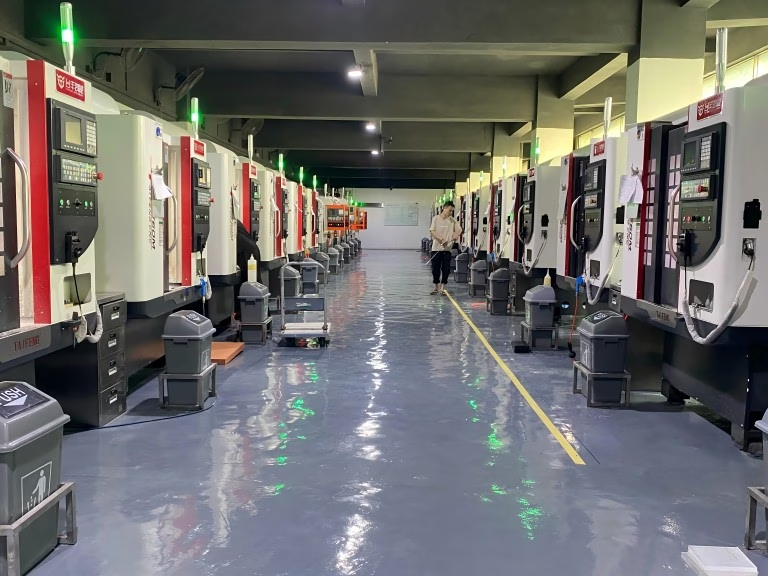
In this example, the 5-axis total cost could be lower. This is especially true for parts with complex undercuts, compound angles, or organic shapes. The “secret” is to let your manufacturing partner analyze the part geometry and determine the optimal machine utilization, not to dictate the machine type yourself. A skilled partner like GreatLight CNC Machining Factory, with its large inventory of 127 precision machines including five-axis, four-axis, and three-axis centers, has the unique advantage of being able to assign the most cost-effective machine for your specific job.
Master the Art of Tolerance Management
This is arguably the most common and costly mistake in precision machining. Engineers often over-specify tolerances, applying ±0.001mm where ±0.01mm would suffice. This “tolerance creep” significantly increases cost because it requires:
Slower cutting speeds and lighter cuts.
More frequent tool changes to maintain sharpness.
More time for inspection and measurement.
A higher scrap rate if a part drifts slightly out of spec.
The secret is to practice “geometric dimensioning and tolerancing” (GD&T) wisely. Identify the critical functional surfaces—the faces that mate with other components, the bearing surfaces, the sealing surfaces—and apply tight tolerances only to them. For all other features, use a “free state” or “general tolerance” standard. This singular practice can reduce machining time by 20-30% on many parts. A professional shop will review your drawing and flag these over-specifications, helping you save without sacrificing part functionality. This is the “Akira” approach to precision: using the minimum necessary precision to achieve the maximum functional result.
Secret 3: The Hidden Value of Standardization and Part Consolidation
Many product designs have a history, evolving from prototypes to multiple design iterations. This often leads to a bill of materials (BOM) filled with unique, one-off parts. A powerful cost-reduction secret is to analyze your BOM for opportunities to standardize and consolidate.
Consider a housing assembly made from five separate welded or bolted parts. A redesign to create a single, monolithic component, machined from one solid billet, can eliminate welding costs, inventory complexity, assembly labor, and potential failure points. While the initial machining of the single part may be more expensive, the total system cost is often significantly lower. This is where a manufacturing partner’s engineering expertise is invaluable. They can advise on how to combine features into a single machinable geometry.
Furthermore, standardization of common features like threaded holes (using standard thread sizes, depths, and countersinks) allows the machine shop to use standard tooling libraries and automated programs, drastically reducing programming and setup time. A “smart” partner will keep a master database of commonly used features, allowing them to program and cut with incredible efficiency.
Secret 4: Post-Processing and Finishing – The Often-Overlooked Cost Driver
The cost of a part is not just the “cutting.” It includes everything that happens after the part comes off the machine: deburring, bead blasting, anodizing, painting, or passivation. These secondary operations can often account for 30-50% of the total part cost, yet they are frequently underestimated during initial quoting.
The secret here is to design for finishing. Deep, inaccessible grooves are difficult to deburr. Sharp internal corners are impossible to anodize evenly. A part with a tight geometric requirement might require post-machining stress relieving, which adds another cycle.
GreatLight CNC Machining Factory excels in this area, offering a one-stop post-processing and finishing service. This integrated approach prevents communication breakdowns between a machine shop and a separate plating house. Our engineers can design a part that is optimized for the chosen finishing process—for example, specifying a “break edge” requirement instead of a tight sharp-edge radius, which is far more cost-effective. By bundling all finishing, from vacuum casting to 3D printing post-processing, under one roof, we eliminate logistical delays and ensure a quality result without the hidden costs of moving parts between vendors.
Secret 5: Leveraging a Robust Quality Management System (QMS) for Trust
A common belief is that quality assurance (QA) adds cost. In reality, a poor QA system is the most expensive thing you can have. The cost of a defective part is not just the cost of re-machining it; it includes the cost of scrapping the raw material, the time of the operator, the cost of the failed quality check, and the potentially catastrophic cost of a field failure for your customer.
A mature QMS, like the ISO 9001:2015 certification held by GreatLight Metal, is a cost-cutting engine. It standardizes processes, ensuring that every order is manufactured the same way, every time. It reduces the likelihood of human error, minimizes rework, and ensures efficient first-article inspection (FAI). This isn’t just about “checking boxes.” It’s about having a documented, predictable process that eliminates the waste of rework.
For clients in specialized fields, deeper certifications are non-negotiable cost-saving tools. The ISO 13485 certification for medical hardware and the IATF 16949 certification for automotive engine hardware are not just paper qualifications. They are a promise that your part is being made under a system that has been proven to prevent defects. Think of it this way: hiring a certified partner like GreatLight effectively insources a free QA department. Their system catches errors before they become expensive problems for you. This is the ultimate trust-building, cost-avoidance strategy.
Secret 6: Data Security and Confidentiality – The Cost of a Leak
In the age of IP theft, the cost of a manufacturing project isn’t just monetary. A design leak can destroy a product launch, a competitive advantage, or a multi-million dollar R&D investment. The “secret” here is that choosing a manufacturer with robust data security protocols is a direct cost-savings measure. It prevents the catastrophic financial loss that would occur if your proprietary design were compromised.
GreatLight Metal takes this seriously, with data security compliant with ISO 27001 standards. This is not a trivial feature for “spy movies.” It is essential for any project involving intellectual property—especially in robotics, aerospace, and consumer electronics. When you partner with a secure manufacturer, you are not paying them to keep a secret; you are paying them to prevent a future cost that would dwarf your current production bill. This is the “Akira” mindset applied to business risk: the lowest-cost path is the one that avoids the most expensive failure.
Secret 7: The True Value of a Full-Process Chain Partner
The final secret to radically cutting costs is to stop thinking about your manufacturing partner as a “machine shop” and start thinking of them as a “supply chain integrator.” A single-source, full-process chain partner like GreatLight CNC Machining Factory is your single point of accountability and efficiency.
When you use three different shops for CNC machining, die casting, and surface finishing, you incur costs from logistics, packaging, and the time your own engineering team spends managing these relationships. With a one-stop provider, your project manager at GreatLight manages everything. They ensure that the part coming out of the CNC center is perfectly prepared for the next step, whether it’s a weld, a chemical etch, or an assembly.
This integration reduces lead time. It reduces the risk of damage during shipping between vendors. It simplifies your job. And it dramatically reduces the total white-collar cost of managing a project. Many of our clients have found that by consolidating their work with us, they saved 15-25% on what they thought was the “best price” from a fragmented supply chain. The secret is that the true cost isn’t just the price on the machine; it’s the price of managing a complex, multi-vendor ecosystem.
Conclusion: The Path to Lower Costs is High-Intelligence Partnership
The “Secrets of Akira CNC Machining” are not about magic; they are about discipline, intelligence, and integration. They are about choosing a partner who can see the entire cost picture—from the design of a single feature to the management of your entire project.
For the cost-conscious engineer, the true path to lower production costs is not to squeeze the cheapest hourly rate out of a simple shop. It is to partner with a high-integrity, technologically advanced, and system-minded manufacturer. This partner must be able to minimize waste through smart DFM, optimize material selection, manage tolerances scientifically, and secure your IP. This is the model of the modern “GreatLight” approach.
Ready to cut your costs without cutting corners? Our team of experienced engineers is ready to review your current designs and uncover the savings hidden within. Contact the team at GreatLight CNC Machining Factory today. Let us show you how a true five-axis machining partner can transform your production budget and unlock a new level of efficiency for your next project. We are not just a supplier; we are your partner in achieving GreatLight on LinkedIn (target: 5-axis CNC machining).



















