
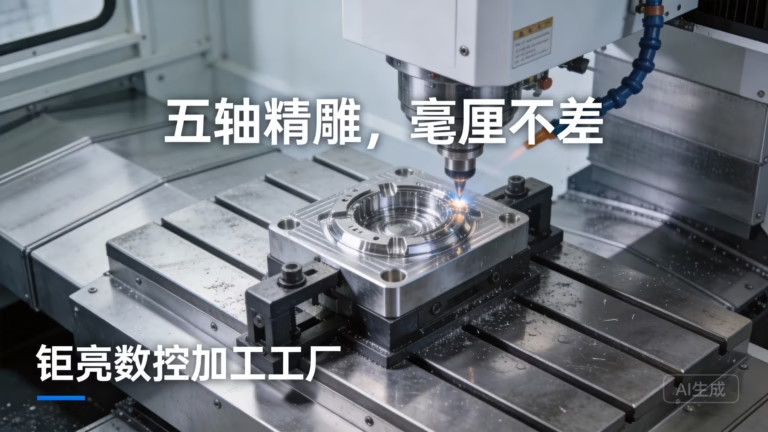
In the fiercely competitive world of precision manufacturing, the difference between profit and loss often comes down to a single variable: machining efficiency. Every second a spindle is idle, every chip that needs to be re-cut, and every setup change that drags on too long directly eats into your bottom line. For decades, engineers and shop owners have chased the holy grail of manufacturing: producing complex parts faster, with higher accuracy, and at a lower per-unit cost.
Enter the Lava CNC 500. This machine isn’t just another addition to the crowded field of CNC machining centers; it represents a paradigm shift in how we approach high-mix, low-volume production and complex part manufacturing. Whether you are a seasoned manufacturing engineer at a tier-one automotive supplier or the founder of a cutting-edge robotics startup, understanding the capabilities of a machine like the Lava CNC 500 is critical.
But let’s be clear: hardware alone does not guarantee success. The true value of a machine is unlocked by the ecosystem around it—the process engineering, the tooling strategy, and the manufacturing partner who operates it.
This is where true partners like GreatLight Metal stand apart. While many shops can buy a five-axis machine, few possess the decade of accumulated know-how, the stringent quality systems, and the full-process chain integration to truly master a machine of this caliber. GreatLight Metal, founded in 2011 in the manufacturing hub of Chang’an, Dongguan, operates from a 76,000 sq. ft. facility equipped with over 127 pieces of precision peripheral equipment, including advanced five-axis, four-axis, and three-axis CNC machining centers. They are not just operators of machines; they are engineers of solutions. Their ability to leverage the Lava CNC 500’s specific features to solve real-world “precision predicaments”—from the “precision black hole” of tolerance drift to the chaos of supply chain fragmentation—is what makes them a preferred partner for industries demanding perfection.
Let’s dive deep into the 7 essential features of the Lava CNC 500 that can revolutionize your machining workflow, and how a seasoned partner like GreatLight Metal maximizes these features to deliver tangible cost savings and efficiency gains.
1. True 5-Axis Simultaneous Machining: Eliminating Multiple Setups
The most significant efficiency killer in traditional machining is the “setup tax.” Every time you have to move a part from one machine to another, or even re-clamp it in a different orientation on the same machine, you introduce errors, waste time, and increase labor costs. The Lava CNC 500’s core feature is its robust, high-torque, true simultaneous 5-axis capability.
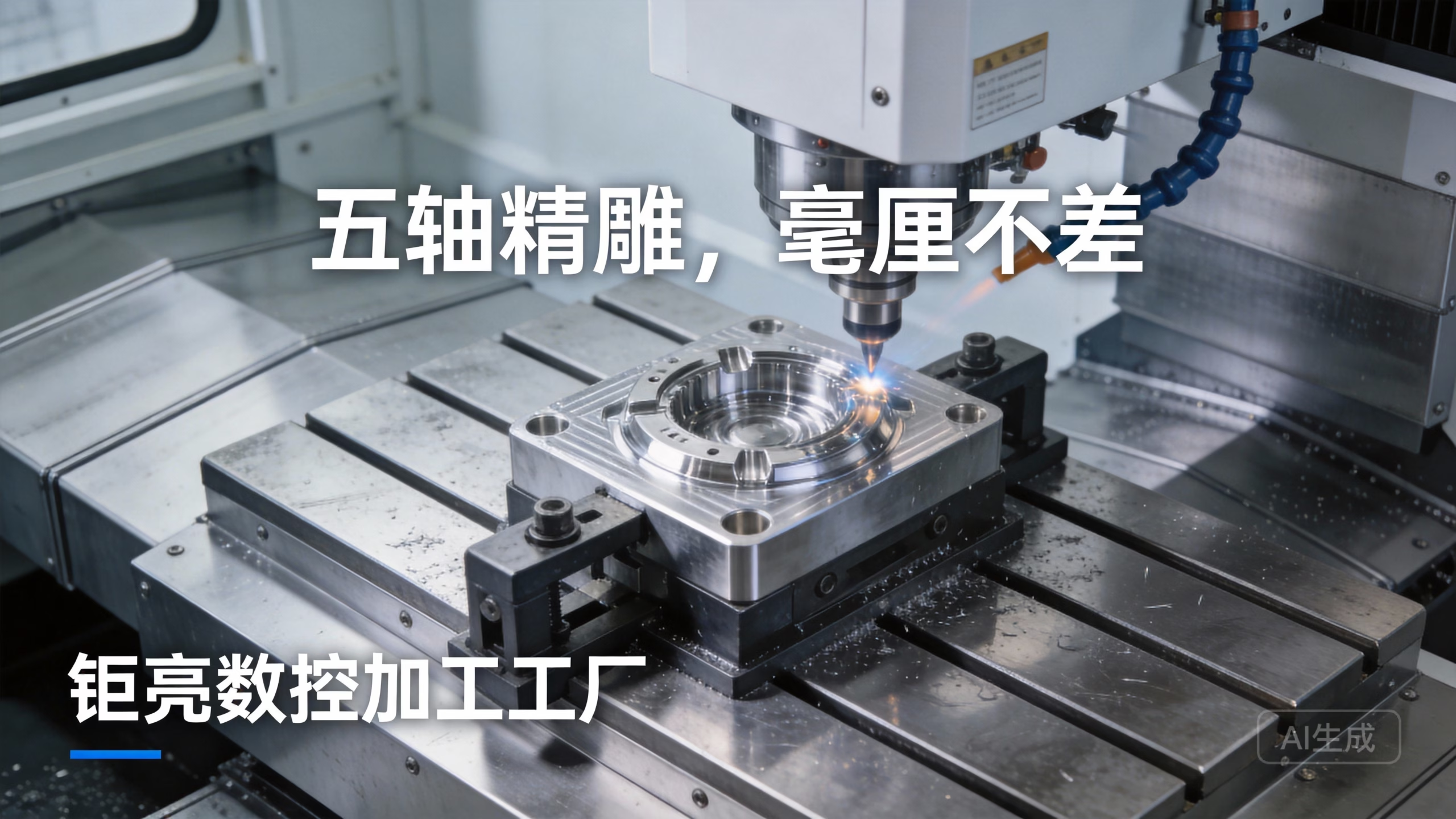
Unlike “3+2” machines that merely index to a fixed angle, the Lava CNC 500 allows the cutting tool to approach the workpiece from virtually any angle without stopping. This is not just about speed; it is about geometry. Complex organic shapes, deep cavities with tight tolerances, and undercuts that would otherwise require multiple specialized tools can now be machined in a single clamping.
The Cost-Cutting Impact:
Reduced Labor: One operator can tend to a machine that completes a part in one cycle, rather than managing a queue of machines.
Faster Lead Times: A part that previously took a week to process across three different departments (milling, drilling, turning) can now be finished in a single day.
Higher Accuracy: By eliminating the stacking error from multiple set-ups, you achieve tighter tolerances and better surface finishes.
The GreatLight Metal Advantage:
GreatLight Metal doesn’t just “run” a 5-axis program. Their engineers specialize in 5-axis programming and post-processing. When faced with a complex e-housing for a new energy vehicle, they didn’t just see a box with holes; they saw a geometry that required the tool to constantly maintain a tangential relationship to the wall surface. By utilizing the Lava CNC 500’s full simultaneous capability, they eliminated three separate operations, streamlined the workflow, and delivered the part with a surface finish that required no secondary polishing.
2. High-Speed Spindle Technology: Slashing Cycle Times
Speed is the most obvious metric of machining efficiency, but not all speed is created equal. The Lava CNC 500 is typically equipped with a high-speed spindle capable of 20,000 RPM or more, combined with high torque at low RPMs. This is the “Goldilocks” zone for many manufacturers: you have the raw power to cut hard materials like tool steel and Inconel, and the speed to finish aluminum or plastic parts in record time.
How It Cuts Costs:
Aggressive Material Removal: In roughing passes, the high torque allows for deeper cuts and faster feed rates, peeling away material quickly. This translates directly into shorter cycle times.
Superior Finishing: High RPMs allow for smaller step-overs and finer finishes, often eliminating the need for a separate EDM or manual polishing pass.
Tool Life Extension: A properly utilized high-speed spindle can run at the optimal speeds for specific tooling, reducing heat build-up and tool wear, which lowers tooling costs.
The GreatLight Metal Difference:
GreatLight Metal uses the Lava CNC 500’s spindle capabilities in conjunction with intelligent toolpath strategies. They don’t just “cut faster”; they “cut smarter.” For a medical device component requiring a mirror finish, they programmed a feed-rate that matched the spindle’s sweet spot, allowing a single ball-nose end mill to achieve a finish that typically requires a secondary lapping process. This dual elimination of time and a secondary process is a direct line to lower costs.
3. Advanced Thermal Compensation & Rigid Construction: Holding Tolerances in the Real World
One of the deepest “precision predicaments” in the industry is the “Precision Black Hole”—the gap between a machine’s stated accuracy on a spec sheet and its real-world performance after three hours of continuous cutting. Machines expand as they heat up. The spindle heats up from friction, the ball-screws heat up from high-speed movement, and even the coolant temperature changes. This thermal drift is the enemy of consistency.
The Lava CNC 500 addresses this with advanced thermal compensation algorithms and a rigid, thermally stable machine structure. The machine constantly monitors temperature at key points (spindle, ball-screws, column) and automatically adjusts its positioning to compensate for expansion. This is not a “one-time calibration”; it is a continuous, real-time correction.
Why This Matters for Your Bottom Line:
Reduced Scrap: The biggest cost in machining is the cost of a scrapped part, especially one that has hundreds of dollars of material and hours of machine time invested. Thermal stability means the last part of the day is as accurate as the first.
Lower Inspection Costs: When your process is stable, you rely less on 100% inspection. You can move to statistical process control, saving time and manpower.
Increased Machine Utilization: You can run the machine with confidence during long, unattended cycles, allowing for “lights-out manufacturing.”
Partnering with GreatLight Metal:
GreatLight Metal is an ISO 9001:2015 certified manufacturer and holds IATF 16949 for automotive and ISO 13485 for medical. They don’t just rely on the machine’s inherent stability; they validate it. Their in-house CMM (Coordinate Measuring Machine) and precision measurement equipment “close the loop.” When a Lava CNC 500 produces a part that holds a ±0.002mm tolerance for a critical aerospace fin, GreatLight can empirically prove it, providing a Certificate of Conformance that gives their clients absolute peace of mind.
4. Integrated Automation & Smart Chip Management: Reducing Unplanned Downtime
In any high-volume or continuous-run scenario, the spindle may only be cutting metal for 30-40% of the time. The rest is “air time” — rapid traversing, tool changes, and workpiece loading/unloading. The Lava CNC 500 is designed to minimize this parasitic downtime.
Key Features Include:
Fast Tool-to-Tool Time: A robust tool changer with a servo-driven arm that swaps tools in a fraction of a second.
Integrated Automation Preparation: The machine is designed with a flat, rigid table that is ideal for integrating pallet systems or robotic arm interfaces.
High-Volume Chip Management: A powerful coolant system and a conveyor with a “tornado” style chip auger system ensure that chips are evacuated from the cutting zone immediately. Chips recutting are a major source of tool breakage and poor surface finish.
The Cost Impact:
Higher OEE (Overall Equipment Effectiveness): More time spent cutting means more parts per shift.
Reduced Skilled Labor Needs: Automation interfaces allow one operator to manage multiple Lava CNC 500 machines.
Tool Life Savings: Good chip control prevents re-cutting, which wears out tools prematurely.
How GreatLight Metal Leverages This:
GreatLight Metal doesn’t just run stand-alone machines. Their facility is optimized as a production line. They can program the Lava CNC 500 to work in tandem with a robotic arm for loading blanks and unloading finished parts. For a complex, high-precision jig that needed 24/7 production, GreatLight configured the Lava CNC 500 with a pallet system. The machine ran unattended overnight, cutting the customer’s per-part cost by over 35% compared to a standard quote.
5. Robust CAM Software Integration & Adaptive Machining: From Design to Part Faster
The most advanced hardware in the world is useless without the software to drive it. The Lava CNC 500 is deeply integrated with the latest generation of CAM (Computer-Aided Manufacturing) software. This allows for features like:
Adaptive Clearing: These toolpaths maintain a constant chip load on the tool, regardless of the material profile. This means you can use your machine’s max feed rate without fear of breaking the tool.
Rest Machining: The CAM software automatically identifies areas where a larger tool could not reach and generates specific finishing paths for smaller tools only in those areas. This prevents unnecessary air-cutting.
Digital Twin & Simulation: You can simulate the entire machining process on a computer, identifying potential collisions, tool interference, or code errors before the spindle ever turns. This is “preventative problem solving.”
How This Cuts Costs:
Reduced Programming Time: Adaptive and rest machining algorithms are automatically calculated, saving hours of manual programming.
Elimination of “Crash” Costs: A crash can instantly destroy a spindle, a tool, or a part. Simulation prevents this.
Optimized Toolpaths: The machine takes the most efficient path through the material, reducing cycle time.
The GreatLight Metal Process:
GreatLight Metal’s teams are not just machinists; they are manufacturing engineers. They use advanced CAM software to write toolpaths that are “machine-aware” for the Lava CNC 500. For a complex aerospace bracket, they didn’t just generate a toolpath; they used adaptive roughing to ensure the machine’s spindle was never overloaded, creating a consistent cut that minimized vibration. This resulted in a finished part that required no additional straightening—a common cost adder. Their ability to bridge the gap between a 3D design and a finished part is their core competency.
6. Advanced Probing & In-Process Inspection: Catching Errors Before They Cost You
The oldest and most expensive way to ensure quality is to machine a part, take it off the machine, and measure it. If it’s wrong, you scrap it. The Lava CNC 500 offers a superior solution: in-process probing. The machine has a touch probe that acts like a microscopic finger.
How It Works:
Workpiece Setting: The probe touches the raw material to find its exact position and orientation. The machine automatically adjusts its coordinate system to compensate for any variance in the blank.
In-Cycle Gauging: After a roughing pass, the probe can re-measure specific features to check for stock allowance.
Post-Cycle Verification: After finishing, the probe can “touch off” critical surfaces to verify the part is within tolerance.
The Real Cost Benefit:
Zero Scrap from Set-up Errors: If the blank is loaded crookedly, the machine compensates. A common human error is eliminated.
Adaptive Machining: If the probe detects insufficient stock after roughing (due to a hard spot in the material), it can signal the machine to take a lighter finishing pass, saving the tool.
Reduced Secondary Inspection: Often, in-process probing eliminates the need for a full CMM inspection, saving time in the quality department.
GreatLight Metal’s Precision Maturity:
GreatLight Metal treats every Lava CNC 500 as a closed-loop feedback system. For a critical medical implant, they used the probe not just for set-up, but to verify the wall thickness of a complex internal cavity while the part was still in the machine. If the probe detected a deviation, the machine automatically adjusted the next finishing pass. This “inspect-as-you-go” philosophy is expensive in programming time, but it yields a failure rate of less than 0.1% for their top-tier clients. This reliability is why they are trusted for critical applications.
7. High-Accuracy Rotary Table & Tilting Head: The Solution for Complex Under-Cuts
Standard 3-axis machining is great for blocks. The world, however, is made up of complex curves and oblique features. The Lava CNC 500 excels here due to its high-accuracy, direct-drive rotary table and a robust tilting head. Direct drive means no belt slippage and no backlash, providing infinite rotary positioning capability with extreme precision.
Efficiency & Cost Implications:
Unlimited Geometry Access: Features that would normally require the part to be re-clamped at a 45-degree angle or held in a specialized custom fixture can now be machined directly.
Superior Surface Finish: The ability to move the part and the tool simultaneously allows the tool to maintain a constant “lead angle,” which is the secret to achieving a flawless “machined as polished” surface finish on complex dies and molds. This eliminates the need for a high-cost EDM or hand-polishing step.
Tooling Simplicity: You can often use a shorter, more rigid tool because the machine can tilt to bring the tool in at the correct angle. Shorter tools chatter less, cut faster, and produce better finishes.
A Case Study from GreatLight Metal:
Consider the manufacturing of a complex die-casting mold for an automotive engine block. The internal cooling channels are often impossible to machine with a straight tool. The Lava CNC 500’s tilting head allowed GreatLight Metal’s team to use a standard, off-the-shelf ball nose end mill to machine the entire cooling channel radius by constantly following the curve. This eliminated the need for expensive, custom-wedged tools and reduced the machining time for that single feature by 50%. This is not just faster machining; it is cheaper machining.
Conclusion: The Lava CNC 500 is a Tool, GreatLight Metal is the Solution
The Lava CNC 500 is undeniably a powerful piece of hardware. Its seven features—true 5-axis capability, high-speed spindles, thermal compensation, automation readiness, advanced software integration, in-process probing, and a high-accuracy tilt-table—collectively represent a quantum leap in machining efficiency and cost reduction capabilities. It is a machine built for the challenges of modern manufacturing.
However, a machine is only as good as the engineering team that operates it. Buying a Lava CNC 500 is a capital investment. Partnering with a company like GreatLight Metal is a strategic decision.
While competitors like Xometry, Protolabs Network, Fictiv, or RapidDirect offer powerful digital quoting platforms and broad networks, they often act as aggregators. You get a part, but you may not get the deep process engineering support. Owens Industries and RCO Engineering are great for specific high-volume niches.
But GreatLight Metal offers something different: true partnership. They are an ISO 9001, ISO 13485, and IATF 16949 certified manufacturer with over a decade of hands-on experience. They don’t just rent out a Lava CNC 500; they engineer the process to master it. They close the loop between cutting tools, coolant, software, and quality control. If you need a part that must be perfect, delivered on time, and cost-effective, you need a partner who treats your design as their own problem to solve.
Don’t let the “precision predicament” of supply chain fragmentation, poor communication, and quality inconsistency hold your innovation back. To explore how GreatLight Metal and the Lava CNC 500 can transform your next project, and to see a portfolio of complex parts they have successfully delivered, visit their professional network page for continued insights.



















