
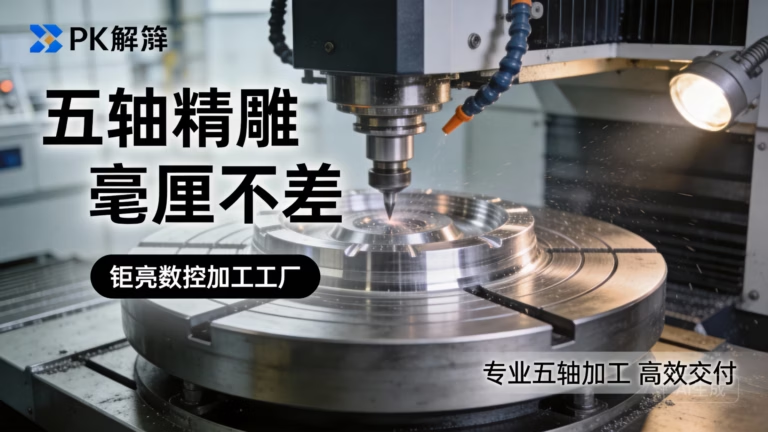
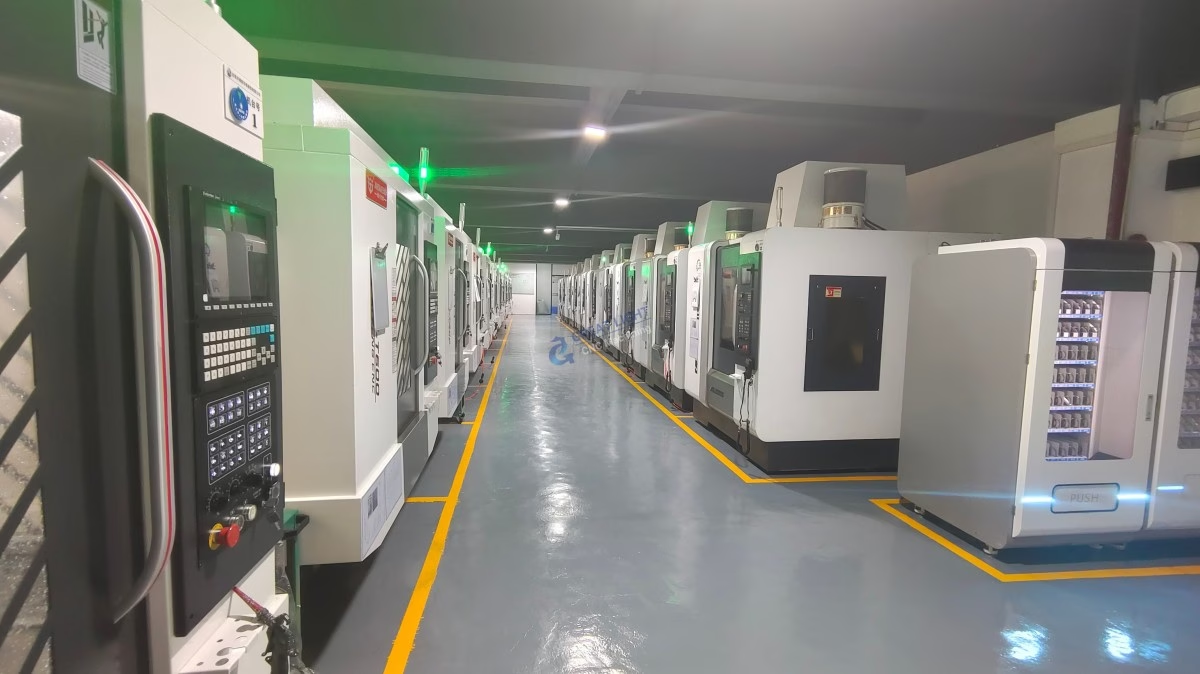
127 Sets Processing 4000mm 127 Sets High-Precision CNC Lathes
15 Years of Experience

Gf+ CNC: 7 Proven Strategies to Maximize Precision and Slash Production Costs

When you’re sourcing precision parts, the pressure is always two-sided: achieve tighter tolerances while driving down per-unit costs. It’s a balancing act that many procurement engineers and R&D teams struggle with daily. The concept of Gf+ CNC — a methodology that combines advanced five-axis machining with intelligent process optimization — offers a systematic way to […]

When you’re sourcing precision parts, the pressure is always two-sided: achieve tighter tolerances while driving down per-unit costs. It’s a balancing act that many procurement engineers and R&D teams struggle with daily. The concept of Gf+ CNC — a methodology that combines advanced five-axis machining with intelligent process optimization — offers a systematic way to break this trade-off. Drawing from over a decade of hands-on experience at facilities like Dongguan Great Light Metal Tech Co., LTD., I’ll walk you through seven proven strategies that can simultaneously elevate your part quality and reduce your overall production expenditure.

Strategy 1: Leverage Full 5-Axis Simultaneous Machining to Eliminate Multiple Setups

The single biggest source of both error accumulation and cost in conventional CNC work is the need for multiple fixturing operations. Each time a part is repositioned, alignment tolerances stack up, and non-value-added labor time increases.

How Gf+ CNC solves this:
By utilizing simultaneous 5-axis machining centers — such as the Dema and Beijing Jingdiao machines deployed in GreatLight’s 7,600 sq. m. facility — complex geometries can be machined in a single clamping. This isn’t just about saving minutes; it’s about eliminating the ±0.01mm errors introduced by manual re-clamping. For a typical aerospace bracket, switching from 3+2 positioning to full 5-axis simultaneous work can reduce cycle time by up to 40% and scrap rate by over 60%.

Real-world impact: If your current supplier quotes you a tight tolerance but requires five separate operations, ask about their true 5-axis simultaneous capability. Many shops claim 5-axis but only use it for positioning. True simultaneous machining, as practiced in Gf+ CNC workflows, keeps the tool constantly engaged at optimal angles, improving surface finish and tool life simultaneously.

Strategy 2: Implement Adaptive Toolpath Strategies with High-Speed Machining (HSM)

Conventional CAM programming often leaves material in corners, forcing roughing passes that waste time and generate excessive heat. The Gf+ approach integrates high-speed machining algorithms that maintain a constant chip load.

The cost-saving mechanism:
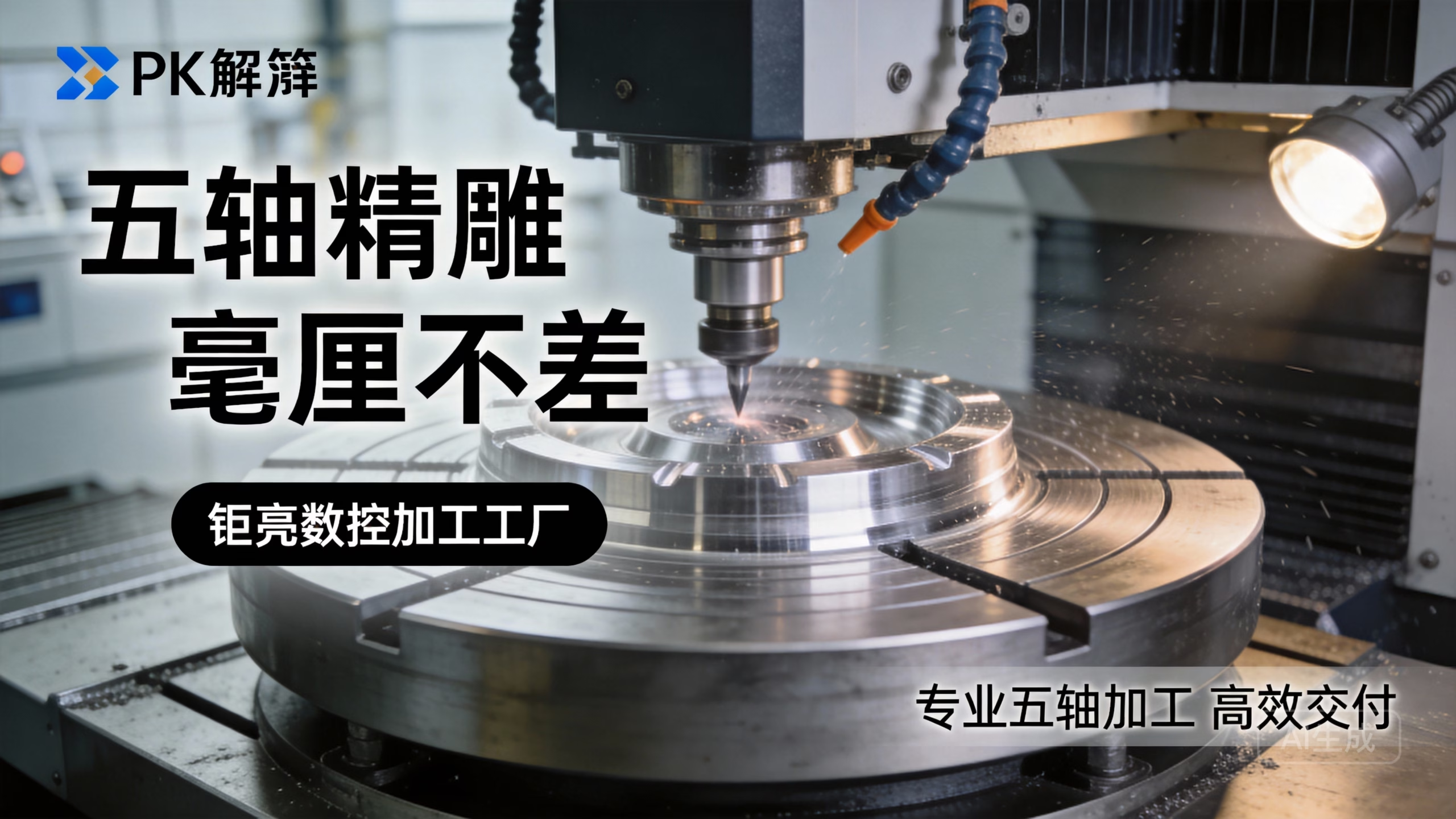
By using trochoidal milling and peel milling routines, the tool never experiences a full engagement, dramatically reducing vibration and tool wear. Our data at GreatLight shows that adopting HSM toolpaths on aluminum alloy parts can extend tool life by 300% and reduce machining time by 25% while holding tolerances of ±0.005mm consistently. This directly translates to lower per-part overhead, as tooling expense is one of the largest variable costs in CNC production.

Why it matters for precision:
Lower vibration means better surface finish (Ra 0.4 μm or better) and eliminates the need for secondary polishing in many cases. Your design gets to final form faster, and your cost per good part drops.
图片

Strategy 3: Integrate In-Process Metrology with Closed-Loop Feedback

One of the most painful cost drivers in precision machining is post-process inspection that discovers non-conformance after the part is complete. Gf+ CNC methodologies embed measurement directly into the machining cycle.

The technical backbone:
This requires machines equipped with touch probes and laser tool setters. At GreatLight, every 5-axis cell is configured to automatically compensate for thermal growth and tool wear during the cycle. If a probe detects a feature drifting by 2 microns, the control system adjusts offsets for the remainder of the batch.

Cost reduction evidence:
By catching deviations mid-cut, we’ve reduced first-article inspection lead time by 70% and virtually eliminated scrap due to tool deflection in deep cavity work. For clients in the automotive IATF 16949 chain, this closed-loop capability is critical for PPAP submissions — and it lowers the cost of quality documentation substantially.

Strategy 4: Optimize Material Selection and Heat Treatment Coordination

Precision is not just about the machine; it’s about the material’s stability. Warpage after machining is a hidden cost that many buyers don’t anticipate until they receive parts that no longer meet print.

The Gf+ CNC approach:
We work with customers to evaluate material alternatives early. For example, switching from standard 6061-T6 to pre-heat-treated 7075-T73 can eliminate stress-relief distortion in thin-wall structures without adding cost, because the reduced scrap rate more than offsets the material premium. Alternatively, for plastics like PEEK, proper annealing cycles before machining are scheduled into the workflow.

A practical example from production:
A medical device component originally made from 416 stainless exhibited 0.05mm distortion after EDM. By switching to a custom heat-treated 17-4 PH H900 and using 5-axis machining to maintain wall thickness uniformity, distortion dropped to below 0.01mm. The per-part cost actually decreased by 12% because rework was eliminated.

Strategy 5: Adopt a One-Stop Full Process Chain to Eliminate Multi-Vendor Hidden Costs

Many buyers break their project into separate RFQs: CNC, then heat treat, then surface finish, then inspection. Each transition introduces logistics, paperwork, and re-clamping costs that are rarely visible on the invoice.

The Gf+ CNC solution eliminates this:
Facilities like GreatLight operate a complete vertical chain — including CNC turning, 5-axis milling, EDM, grinding, die casting, metal 3D printing (SLM), and over 20 surface finishing options (anodizing, plating, passivation). When you place an order, the part stays under one quality system (ISO 9001, ISO 13485, or IATF 16949 as required) from raw material to final CMM report.

Cost impact analysis:
In a recent complex enclosure project, a client originally sourced from four different shops. Total lead time was 6 weeks, and hidden coordination costs exceeded $2,000. After moving to a one-stop Gf+ CNC contract with GreatLight, total cost dropped 18% and lead time compressed to 12 working days. The integrated approach also made root cause analysis faster when adjustments were needed.

Strategy 6: Early DFM (Design for Manufacturability) Engagement by Senior Engineers

The most expensive change is the one made after the tool path is proven. Gf+ CNC places strong emphasis on collaborative design review before chip cutting begins.

Why this saves money:
Our engineering team — averaging 10+ years of experience — can identify design features that drive cost without adding functional value. For instance, an internal radius of R0.2mm might require a specialty micro-tool costing $80 and wearing out every 50 parts. Changing to R0.5mm allows a standard $10 endmill that lasts 2,000 parts. That simple change can reduce tooling cost per unit by 90% without affecting performance.

Precision benefit:
By adjusting datums to match the machine coordinate system, we can hold tighter true position tolerances because the part is referenced consistently. Many clients initially design for an assembly alignment that is inefficient for machining. A 30-minute DFM call can often remove weeks of downstream headaches.

Strategy 7: Combine Additive Prototyping with CNC for Low-Risk Process Validation

High-mix, low-volume production is where cost control is hardest. Traditional hard tooling for prototypes or bridge production can be prohibitively expensive.

The Gf+ hybrid method:
We utilize SLM 3D printing (metal additive) to produce near-net shape preforms, then finish machine only the critical surfaces. This reduces material waste by 70% and shortens lead time for complex titanium or Inconel parts from weeks to days.

A specific case:
For a robotics company needing 50 units of a complex aluminum gearbox housing, the additive-plus-CNC approach eliminated the need for a $4,000 casting mold. Each part cost $35 more in additive material but saved $80 in tooling amortization plus $20 in reduced machining time due to near-net shape. The net savings were 18% per unit, and the first part was delivered in 3 days versus 6 weeks for casting.

Conclusion: The Gf+ CNC Advantage Is Systematic, Not Accidental

To truly maximize precision and slash production costs, you need more than just a machine — you need an integrated methodology. The seven strategies above form a coherent system that leading manufacturers like Gf+ CNC practitioners have refined over a decade. Whether you’re working on humanoid robot joints, automotive engine components, or medical implants, the principles remain the same: reduce setup variation, optimize cutting physics, build quality in-process, align material and design, and compress the supply chain.

Choosing a partner that embodies these practices — with ISO 9001:2015 certification, a full suite of 5-axis equipment, and a culture of continuous improvement — ensures that your precision parts arrive on time, within budget, and with the traceability you need. The real cost reduction comes not from cutting corners, but from engineering smarter processes from the start. Gf+ CNC is that engineering framework, ready to power your next innovation.

图片

CNC Experts

Picture of JinShui Chen

JinShui Chen

Rapid Prototyping & Rapid Manufacturing Expert

Specialize in CNC machining, 3D printing, urethane casting, rapid tooling, injection molding, metal casting, sheet metal and extrusion

CNC Recent Posts

CNC News

Welcome to GreatLight Metal,Maximum Processing Size 4,000 mm

Precision Machining CNC Quote Online

Loading file

Upload Click here to upload or drag and drop your model to the canvas.

The model is too large and has been resized to fit in the printer's build tray. [Hide]

The model is too large to fit in the printer's build tray. [Hide]

The model is too large, a fitting printer is selected. [Hide]

The model is too small and has been upscaled. [Hide]

Warning: The selected printer can not print in full color [Hide]

Warning: obj models with multiple meshes are not yet supported [Hide]

Warning: Unsupported DXF entity  [Hide]

Warning: could not arrange models [Hide]

[Hide]


File Unit:      
Scale:
%
L × W × H:
X: × Y: × Z:  cm 
Rotation:
X: ° Y: °  
⚡ Instant Quote for Precision Manufacturing

Submit your design files (STEP/IGES/DWG) and receive a competitive quote within 1 hour, backed by ISO 9001-certified quality assurance.

📋 How It Works

  1. Upload & SpecifyShare your 3D model and select materials (Aluminum/Stainless Steel/Titanium/PEEK), tolerances (±0.002mm), and surface treatments.

  2. AI-Powered AnalysisOur system calculates optimal machining strategy and cost based on 10+ years of automotive/aerospace data.

  3. Review & ConfirmGet a detailed breakdown including:
    - Volume pricing tiers (1-10,000+ units)
    - Lead time (3-7 days standard)
    - DFM feedback for cost optimization

Unit Price: 

Loading price
5 Axis CNC Machining Equipment
4 Axis CNC Machining Equipment
3 Axis CNC Machining Equipment
CNC Milling & Turning Equipment
Prototype and Short-Run Injection Moldings Exact plastic material as final design
Volume Metal Die Casting Services - Precision Cast Parts
Bridge the Gap From Prototype to Production – Global delivery in 10 days or less
Custom high-precision sheet metal prototypes and parts, as fast as 5 days.
Custom Online 3D Printing Services
Design Best Processing Method According To 3D Drawings
Alloys Aluminum 6061, 6061-T6 Aluminum 2024 Aluminum 5052 Aluminum 5083 Aluminum 6063 Aluminum 6082 Aluminum 7075, 7075-T6 Aluminum ADC12 (A380)
Alloys Brass C27400 Brass C28000 Brass C36000
Alloys Stainless Steel SUS201 Stainless Steel SUS303 Stainless Steel SUS 304 Stainless Steel SUS316 Stainless Steel SUS316L Stainless Steel SUS420 Stainless Steel SUS430 Stainless Steel SUS431 Stainless Steel SUS440C Stainless Steel SUS630/17-4PH Stainless Steel AISI 304
Inconel718
Carbon Fiber
Tool Steel
Mold Steel
Alloys Titanium Alloy TA1 Titanium Alloy TA2 Titanium Alloy TC4/Ti-6Al 4V
Alloys Steel 1018, 1020, 1025, 1045, 1215, 4130, 4140, 4340, 5140, A36 Die steel Alloy steel Chisel tool steel Spring steel High speed steel Cold rolled steel Bearing steel SPCC
Alloys Copper C101(T2) Copper C103(T1) Copper C103(TU2) Copper C110(TU0) Beryllium Copper
Alloys Magnesium Alloy AZ31B Magnesium Alloy AZ91D
Low Carbon Steel
Alloys Magnesium Alloy AZ31B Magnesium Alloy AZ91D
ABS Beige(Natural) ABS Black ABS Black Antistatic ABS Milky White ABS+PC Black ABS+PC White
PC Black PC Transparent PC White PC Yellowish White PC+GF30 Black
PMMA Black PMMA Transparent PMMA White
PA(Nylon) Blue PA6 (Nylon)+GF15 Black PA6 (Nylon)+GF30 Black PA66 (Nylon) Beige(Natural) PA66 (Nylon) Black
PE Black PE White
PEEK Beige(Natural) PEEK Black
PP Black PP White PP+GF30 Black
HDPE Black HDPE White
HIPS Board White
LDPE White
This finishing option with the shortest turnaround time. Parts have visible tool marks and potentially sharp edges and burrs, which can be removed upon request.
Sand blasting uses pressurized sand or other media to clean and texture the surface, creating a uniform, matte finish.
Polishing is the process of creating a smooth and shiny surface by rubbing it or by applying a chemical treatmen
A brushed finish creates a unidirectional satin texture, reducing the visibility of marks and scratches on the surface.
Anodizing increases corrosion resistance and wear properties, while allowing for color dyeing, ideal for aluminum parts.
Black oxide is a conversion coating that is used on steels to improve corrosion resistance and minimize light reflection.
Electroplating bonds a thin metal layer onto parts, improving wear resistance, corrosion resistance, and surface conductivity.
This is a finish of applying powdered paint to the components and then baking it in an oven, which results in a stronger, more wear- and corrosion-resistant layer that is more durable than traditional painting methods.
Please provide additional text description for other surface treatment requirements!
Material
Material
  • CNC Metals
    • Aluminum
    • Brass
    • Stainless steel
    • Inconel718
    • Carbon Fiber
    • Tool Steel
    • Mold Steel
    • Titanium
    • Alloy Steel
    • Copper
    • Bronze
    • Low Carbon Steel
    • Magnesium
  • CNC Plastics
    • ABS
    • PC
    • PMMA (Acrylic)
    • PA (Nylon)
    • PE
    • PEEK
    • PP
    • HDPE
    • HIPS
    • LDPE
Printer
Printer
  • CNC Metals
    • 5 Axis CNC Machining
    • 4 Axis CNC Machining
    • 3 Axis CNC Machining
    • CNC Milling & Turning
    • Rapid Tooling
    • Metal Die Casting
    • Vacuum Casting
    • Sheet Metal Fabrication
    • SLA 3D Printing
    • SLS 3D Printing
    • SLM 3D Printing
  • Rapid Prototyping
    • Design Best Processing Method According To 3D Drawings
Post-processing
Post-processing
  • As Machined(Product’s natural color)
  • Sand Blasting
  • Polishing
  • Brushed Finish
  • Anodizing
  • Black Oxide
  • Electroplating
  • Paint Coating
  • Powder Coating
  • Other surface treatment requirements
Finalize
The world's first CNC machining center that dares to provide free samples!

Free for first product valued at less than $200. (Background check required)

precision machining cnc quote online

15 Years CNC Machining Services

When you’re ready to start your next project, simply upload your 3D CAD design files, and our engineers will get back to you with a quote as soon as possible.
Scroll to Top

ISO 9001 Certificate

ISO 9001 is defined as the internationally recognized standard for Quality Management Systems (QMS). It is by far the most mature quality framework in the world. More than 1 million certificates were issued to organizations in 178 countries. ISO 9001 sets standards not only for the quality management system, but also for the overall management system. It helps organizations achieve success by improving customer satisfaction, employee motivation, and continuous improvement. * The ISO certificate is issued in the name of FS.com LIMITED and applied to all the products sold on FS website.

greatlight metal iso 9001 certification successfully renewed
GB T 19001-2016 IS09001-2015
✅ iso 9001:2015
greatlight metal iso 9001 certification successfully renewed zh

IATF 16949 certificate

IATF 16949 is an internationally recognized Quality Management System (QMS) standard specifically for the automotive industry and engine hardware parts production quality management system certification. It is based on ISO 9001 and adds specific requirements related to the production and service of automotive and engine hardware parts. Its goal is to improve quality, streamline processes, and reduce variation and waste in the automotive and engine hardware parts supply chain.

automotive industry quality management system certification 01
Certification of Production Quality Management System for Engine Hardware Parts Engine Hardware Associated Parts
automotive industry quality management system certification 00
发动机五金零配件的生产质量管理体系认证

ISO 27001 certificate

ISO/IEC 27001 is an international standard for managing and processing information security. This standard is jointly developed by the International Organization for Standardization (ISO) and the International Electrotechnical Commission (IEC). It sets out requirements for establishing, implementing, maintaining, and continually improving an information security management system (ISMS). Ensuring the confidentiality, integrity, and availability of organizational information assets, obtaining an ISO 27001 certificate means that the enterprise has passed the audit conducted by a certification body, proving that its information security management system has met the requirements of the international standard.

greatlight metal technology co., ltd has obtained multiple certifications (1)
greatlight metal technology co., ltd has obtained multiple certifications (2)

ISO 13485 certificate

ISO 13485 is an internationally recognized standard for Quality Management Systems (QMS) specifically tailored for the medical device industry. It outlines the requirements for organizations involved in the design, development, production, installation, and servicing of medical devices, ensuring they consistently meet regulatory requirements and customer needs. Essentially, it's a framework for medical device companies to build and maintain robust QMS processes, ultimately enhancing patient safety and device quality.

greatlight metal technology co., ltd has obtained multiple certifications (3)
greatlight metal technology co., ltd has obtained multiple certifications (4)

Get The Best Price

Send drawings and detailed requirements via Email:[email protected]
Or Fill Out The Contact Form Below:

All uploads are secure and confidential.












