
Introduction: The High Stakes of Precision CNC Router Procurement
When a factory decides to invest in a precision CNC router, the decision is rarely simple. This capital equipment often represents a significant portion of the annual budget and directly impacts production capacity, quality consistency, and long-term competitiveness. Yet, across the manufacturing landscape, procurement teams repeatedly fall into predictable traps that lead to costly mistakes—machines that underperform, projects that overrun budgets, and partnerships that fail to deliver on promises.
The precision machining industry has evolved dramatically over the past decade. Five-axis CNC machining, once reserved for aerospace and medical implants, has become increasingly accessible to general manufacturing. However, with this accessibility comes complexity. Understanding the nuances of precision CNC router selection is no longer optional; it is a strategic necessity.
This article examines the seven most common mistakes factories make when purchasing precision CNC routers and provides actionable guidance to avoid them. Whether you are expanding capacity, upgrading equipment, or entering precision parts customization for the first time, these insights will help you make an informed, long-term decision.
Mistake #1: Prioritizing Initial Price Over Total Cost of Ownership
The most pervasive error in precision CNC router procurement is focusing exclusively on the purchase price. In the world of precision parts machining, the initial investment is merely the entry fee. The total cost of ownership includes maintenance, tooling, downtime, energy consumption, and—most critically—scrap rates.
Why This Happens
Procurement departments are often incentivized to minimize capital expenditure. Budget constraints lead decision-makers to select the lowest-priced option, assuming that all CNC routers with similar specifications perform equally. This assumption is fundamentally flawed.
The Real Cost of Low-Cost Machines
A precision CNC router that costs 30% less than a premium option may appear attractive on paper. However, consider the following:
Accuracy Degradation: Lower-cost machines often use less rigid frames, cheaper linear guides, and less precise ball screws. Over time, accuracy drifts, leading to higher rejection rates.
Downtime Frequency: Budget machines typically lack robust preventive maintenance support. When failures occur, repair lead times can stretch for weeks.
Tool Life Reduction: Machine vibration and thermal instability accelerate tool wear, increasing consumable costs.
Resale Value: Premium brands retain value. Economy models depreciate rapidly.
The GreatLight Approach
GreatLight CNC Machining Factory operates a fleet of 127 precision peripheral equipment units, including large high-precision five-axis, four-axis, and three-axis CNC machining centers. This investment in quality equipment is not accidental. It reflects an understanding that production reliability—not purchase price—determines true cost efficiency. When evaluating a precision CNC router, request total cost projections over a five-year period, including estimated maintenance, tooling, and scrap costs.
Mistake #2: Neglecting Material-Specific Machining Requirements
Precision CNC routers are not one-size-fits-all machines. The optimal configuration for aluminum differs significantly from that for titanium, stainless steel, or engineering plastics. Yet, many factories purchase a single machine expecting it to handle all materials with equal efficiency.
Material Characteristics That Matter
| Material | Cutting Speed | Spindle Power Required | Rigidity Need | Coolant Type |
|---|---|---|---|---|
| Aluminum | High | Moderate | Moderate | Emulsion |
| Stainless Steel | Low | High | High | Oil-based |
| Titanium | Very Low | Very High | Very High | High-pressure |
| Plastics | High | Low | Low | Air/mist |
Consequences of Mismatch
Chatter and Vibration: Insufficient rigidity when machining hard metals leads to poor surface finish and dimensional inaccuracy.
Thermal Deformation: High cutting temperatures without adequate coolant systems cause part distortion.
Tool Breakage: Inadequate spindle torque for heavy cuts results in frequent tool failure.
Practical Guidance
When specifying a precision CNC router, define the primary materials you will process. If your factory handles diverse materials, consider whether a single versatile machine or multiple specialized machines better serves your needs. For high-precision custom parts in stainless steel or titanium, five-axis CNC machining capabilities with appropriate spindle power and coolant systems are non-negotiable.
Mistake #3: Ignoring Post-Processing and Finishing Capabilities
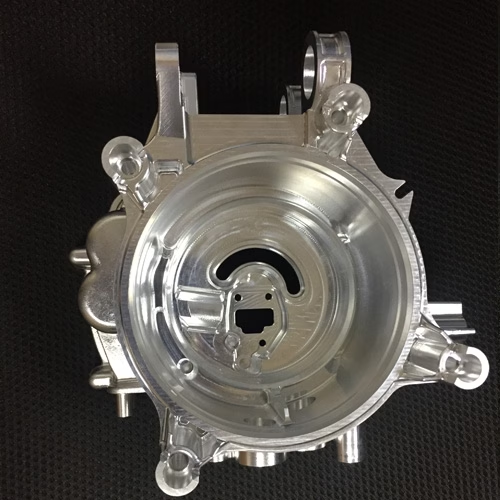
Precision parts machining does not end when the CNC program finishes. Post-processing—including deburring, surface finishing, heat treatment, and coating—is often the difference between a functional part and a finished product. Yet, many factories purchase CNC routers without considering how the machine integrates with downstream processes.
The Hidden Complexity
Surface Finish Requirements: A precision CNC router may produce parts with Ra 3.2 µm, but your client may require Ra 0.8 µm. Achieving this may require secondary operations such as grinding, polishing, or EDM.
Geometric Limitations: Five-axis machining can produce complex geometries, but internal features may still require EDM or laser cutting.
Assembly Fit: Precision parts often require mating with other components. Dimensional tolerances must account for thermal expansion, coating thickness, and assembly sequences.
The Integrated Solution Advantage
GreatLight CNC Machining Factory provides one-stop post-processing and finishing services, including vacuum casting, sheet metal processing, and various surface treatments. This integrated approach ensures that the precision CNC router is selected not in isolation but as part of a complete manufacturing ecosystem. When evaluating suppliers, ask about their post-processing capabilities. A machine that produces excellent raw parts but requires external finishing adds complexity, lead time, and cost.
Mistake #4: Overlooking Certification and Quality Management Systems
In precision manufacturing, certifications are not mere badges. They represent a commitment to systematic quality control, traceability, and continuous improvement. Yet, many factories prioritize technical specifications over the quality management framework that ensures consistent output.
Why Certifications Matter
ISO 9001:2015: Ensures that production processes are documented, controlled, and audited. It provides confidence that quality is built into the process, not inspected after the fact.
IATF 16949: Specifically for automotive supply chains, this certification requires rigorous process control, failure mode analysis, and supplier management.
ISO 13485: For medical device manufacturing, this standard mandates traceability, risk management, and regulatory compliance.
ISO 27001: For intellectual property-sensitive projects, data security is paramount.
The Risk of Uncertified Suppliers
Without proper certification, quality becomes an act of faith. Machining parameters may be undocumented, inspection equipment may be uncalibrated, and corrective actions may be ad hoc. In the event of a quality failure, root cause analysis becomes impossible.
GreatLight’s Certification Portfolio
GreatLight CNC Machining Factory has obtained ISO 9001:2015 certification and maintains compliance with ISO 13485 and IATF 16949 standards. This means that when you purchase a precision CNC router from a supplier like GreatLight, you are buying into a system that ensures consistency, traceability, and continuous improvement. For factories considering precision router procurement, demand evidence of certification—not just promises of quality.
Mistake #5: Underestimating the Importance of Engineering Support and DFM
Design for Manufacturability (DFM) is a critical discipline in precision parts machining. Yet, many factories purchase CNC routers without adequate engineering support, assuming that their CAD files will translate directly into machined parts. This assumption is rarely accurate.
Common DFM Issues
Feature Under-cuts: Without five-axis capability, certain features may be impossible to machine with standard tools.
Thin Walls: Parts with wall thicknesses below 0.5 mm may distort during machining or handling.
Tight Tolerances on Non-critical Surfaces: Specifying tolerances that are unnecessarily tight increases cost without adding value.
Inadequate Datum Structures: Without proper reference features, fixturing becomes difficult, and dimensional consistency suffers.
The Value of Engineering Collaboration
Experienced precision CNC router suppliers offer DFM reviews as part of their service. They identify potential manufacturing issues before production begins, saving time and preventing scrap. GreatLight CNC Machining Factory, with years of experience in precision prototype model processing, provides engineering support that optimizes designs for manufacturability. When evaluating a precision router purchase, ask about the engineering support available—not just the machine’s specifications.
Mistake #6: Failing to Plan for Scalability and Future Needs
Factories often purchase precision CNC routers based on current production volumes and geometries, without considering future requirements. A machine that perfectly handles today’s parts may become obsolete within two years as product designs evolve or volumes increase.
Factors to Consider
Part Size Range: The maximum processing size of GreatLight’s equipment is 4000 mm. Ensure your machine can accommodate future parts.
Multi-axis Capability: Five-axis machining offers greater versatility than three-axis. Investing in five-axis capability initially may be more cost-effective than upgrading later.
Automation Integration: Can the machine be integrated with robotic loading/unloading systems? This is critical for high-volume production.
Software Compatibility: Ensure the controller supports modern CAM software and can be updated as new versions are released.
The Modular Approach
Some suppliers offer modular precision CNC routers that can be upgraded with additional axes, higher-spindles, or automation systems. This approach provides flexibility without requiring a full machine replacement. When purchasing, specify your expected production growth over three to five years and ask for recommendations accordingly.
Mistake #7: Choosing Suppliers Based Solely on Online Presence or Price
The precision machining industry has seen an explosion of online platforms offering instant quotes and rapid turnaround. While convenient, these platforms often obscure critical differences in capability, quality, and service. The cheapest quote or the fastest response may not represent the best value.
What Online Platforms Miss
Process Capability: A low price may indicate that the supplier uses standard tooling, limited inspection, or no secondary finishing.
Material Authenticity: Without proper material certification, you cannot be sure that the supplied material meets required specifications.
Delivery Reliability: Online platforms may not reflect actual production schedules or capacity constraints.
After-sales Support: Post-delivery support for machine calibration, training, or troubleshooting may be limited.
The GreatLight Difference
GreatLight Metal, as a professional five-axis CNC machining manufacturer, offers more than just a quote. They provide a comprehensive service that includes engineering support, material certification, quality inspection, and after-sales guarantee. Their facilities in Dongguan’s Chang’an District are equipped with advanced technology and staffed by experienced professionals who understand the nuances of precision parts customization.
Conclusion: Making the Right Investment in Precision CNC Machining
Choosing a precision CNC router for your factory is a strategic decision that affects production quality, cost, and competitiveness for years to come. By avoiding these seven common mistakes, you can make an informed choice that aligns with your current needs and future growth.
Precision CNC Router selection is not merely a technical decision; it is a partnership decision. The right supplier brings not only equipment but also engineering expertise, quality systems, and a commitment to continuous improvement. GreatLight CNC Machining Factory, with its ISO 9001:2015 certification, IATF 16949 compliance, and comprehensive manufacturing capabilities, represents a reliable partner for factories seeking precision parts machining solutions.
From the early days in Chang’an Town to becoming a trusted name in five-axis CNC machining and rapid prototyping, GreatLight has demonstrated that true value lies not in the cheapest price but in the most reliable partnership. When you invest in precision CNC machining, invest in a partner who understands the full scope of manufacturing—from design to delivery.
The path to precision manufacturing is built on informed decisions. Avoid the common pitfalls, evaluate suppliers systematically, and choose a partner who demonstrates expertise, authority, and trustworthiness at every level. Your factory’s future depends on it.



















