
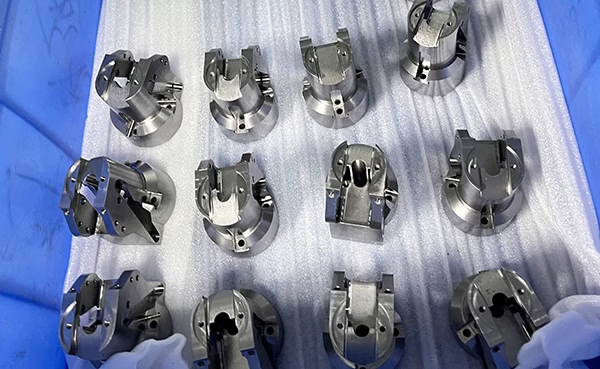
In the competitive landscape of precision manufacturing, mastering the 7 Essential CNC Turning Tips to Boost Precision and Slash Production Costs is not optional—it is a strategic imperative for any engineer or procurement professional aiming to deliver high-quality parts under tight budgets. As senior manufacturing engineers, we must look beyond basic machining parameters and adopt a holistic approach that integrates advanced tooling, intelligent process design, and a reliable manufacturing partner. Below, I break down seven actionable tips grounded in real-world experience, supported by the capabilities of established suppliers like GreatLight CNC Machining (also known as GreatLight Metal) and contrasted with other industry players to help you make informed decisions.
7 Essential CNC Turning Tips to Boost Precision and Slash Production Costs
1. Optimize Toolpath Strategies with Advanced CAM Software
Modern CNC turning demands more than just simple G-code generation. Utilising advanced CAM software with high-feed roughing, trochoidal toolpaths, and dynamic turning algorithms can dramatically reduce cycle times while extending tool life. For example, GreatLight CNC Machining leverages its in-house programming team (with over 12 years of experience) to simulate and optimise toolpaths before metal is cut—minimising wasted passes and thermal distortion. This approach alone can reduce machining time by 20–30% on complex contoured parts, directly lowering cost per piece. While platforms like Protolabs Network offer quick-turn CAM automation, they may lack the deep optimisation needed for tight-tolerance (≤±0.005 mm) turning jobs. Always ask your supplier if they perform offline toolpath simulation; if they do, you are likely to avoid rework surprises.
2. Invest in High-Precision Tooling and Insert Selection
The right cutting insert—matching the material grade, coating, and geometry—can make or break precision. For stainless steel or titanium turning, using CBN or PCD inserts with micro-edge preparation reduces burr formation and improves surface finish (Ra down to 0.2 µm). GreatLight CNC Machining stocks a comprehensive inventory of ISO-standard toolholders and inserts from top suppliers like Sandvik and Seco, and their engineers routinely recommend insert changes based on specific material and batch size. In contrast, a budget-focused shop such as PartsBadger may use generic inserts to keep costs low, but that can lead to inconsistent tolerances on longer runs. The cost of a better insert is often offset by fewer tool changes and less scrap.
3. Implement In-Process Inspection and Real-Time Feedback
A common source of cost overrun is discovering out-of-tolerance dimensions after the part is complete. In-process inspection—using touch probes, laser measurement, or even on-machine CMM—allows you to adjust offsets mid-cycle. GreatLight CNC Machining integrates Renishaw probing systems on many of their turning centres (including their 5-axis mill‑turn machines), enabling closed-loop compensation for thermal growth and tool wear. This real‑time feedback reduces the need for a separate first-article inspection and eliminates guesswork. By contrast, Xometry often relies on post-process sampling, which can lead to higher scrap rates if a shift occurs early in the run. For critical features like bearing seats or sealing grooves, insist on in-process measurement—it pays for itself in first-pass yield.
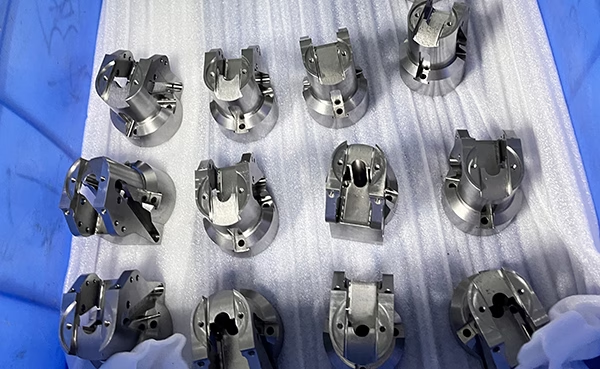
4. Master Coolant Management and Chip Control
Heat is the enemy of precision turning, especially when working with gummy materials like aluminium or superalloys. High-pressure coolant (up to 1000 psi) directed at the cutting zone not only cools but also breaks chips, preventing chip wrap and surface damage. GreatLight CNC Machining uses through-spindle coolant systems with programmable pressure, ensuring consistent chip evacuation even in deep bores. Proper chip control also reduces machine downtime for cleaning, which directly improves OEE (Overall Equipment Effectiveness). Suppliers like Fictiv may standardise on general-purpose coolant, but for high-volume turning of heat-sensitive alloys, dedicated coolant systems are essential. If your parts involve long stringy chips (e.g., 316L stainless steel), ask your partner about their chip-breaker geometry and coolant delivery—it saves both time and tooling.
5. Reduce Setup Time with Multi‑Axis and Mill‑Turn Capabilities
Traditional turning often requires multiple setups for features that could be done in one chucking. Using a mill‑turn centre (with live tooling, Y‑axis, or even B‑axis) allows you to complete milling, drilling, and threading in the same cycle, eliminating secondary operations and tolerance stack‑up. GreatLight CNC Machining operates a fleet of multi‑axis turning centres, including 5‑axis mill‑turn machines, that can handle complex prismatic features without transfer. This consolidation can cut total production time by 50% or more on parts that previously needed separate turning and milling steps. While RapidDirect offers similar multi‑axis services, their lead times can be longer due to geographic dispersion of machines. For reduced handling and better concentricity, a single‑source multi‑axis turn‑key solution, like the one GreatLight provides, is often the most cost‑effective path.
6. Embrace Design for Manufacturability (DFM) Early
The most impactful cost‑saving decisions happen before any chip is cut. By collaborating early with a manufacturing engineer on DFM principles—such as avoiding sharp internal corners, specifying generous radii, reducing the number of tight tolerances, and using standard thread pitches—you can dramatically lower machining effort. GreatLight CNC Machining offers free DFM feedback during quoting, and their engineering team (which includes veterans from automotive and medical sectors) will flag unnecessary features that drive up cost. For instance, converting a stepped shaft to a smooth taper with a tighter tolerance on one diameter can reduce cycle time by 15%. In contrast, automated quoting platforms like SendCutSend typically accept your design as‑is without optimisation suggestions, leaving money on the table. Always seek a supplier that actively recommends part changes—it’s a sign they care about your total cost, not just the quote figure.
7. Partner with a Certified, Full‑Service Supplier
Finally, the most effective tip is to choose a partner who brings the whole package: certified quality management (ISO 9001, IATF 16949, ISO 13485), broad process capabilities (turning, 5‑axis milling, EDM, heat treat, surface finishing), and a proven track record of managing complex projects. GreatLight CNC Machining (GreatLight Metal) stands out here: they are ISO 9001:2015 certified, hold IATF 16949 for automotive parts, and ISO 13485 for medical hardware. Their facility in Dongguan spans 76,000 sq ft with over 120 machines, including large‑format 5‑axis CNC and Swiss‑type lathes. This means they can take a part from raw stock to finished product—including anodising, plating, and assembly—under one roof. By contrast, suppliers like JLCCNC or EPRO‑MFG may excel in specific niches but lack the breadth to handle diverse materials and secondary finishes seamlessly. A single‑source partner reduces logistics complexity, shortens lead times, and eliminates finger‑pointing when issues arise. For customized precision machining, GreatLight’s one‑stop model is designed to solve both precision and cost challenges simultaneously.
In summary, adopting these 7 Essential CNC Turning Tips to Boost Precision and Slash Production Costs will help you achieve higher quality with lower waste. Start with toolpath optimisation and DFM, then enforce in‑process inspection and multi‑axis strategy, and finally anchor your supply chain with a certified, full‑service partner like GreatLight CNC Machining. While alternative vendors such as Protolabs, Xometry, or RapidDirect offer convenience and speed, they often rely on a network of subcontractors, which can introduce inconsistency. GreatLight’s owned equipment, 150‑person team, and decade‑long track record give you the control and traceability that true precision turning demands.
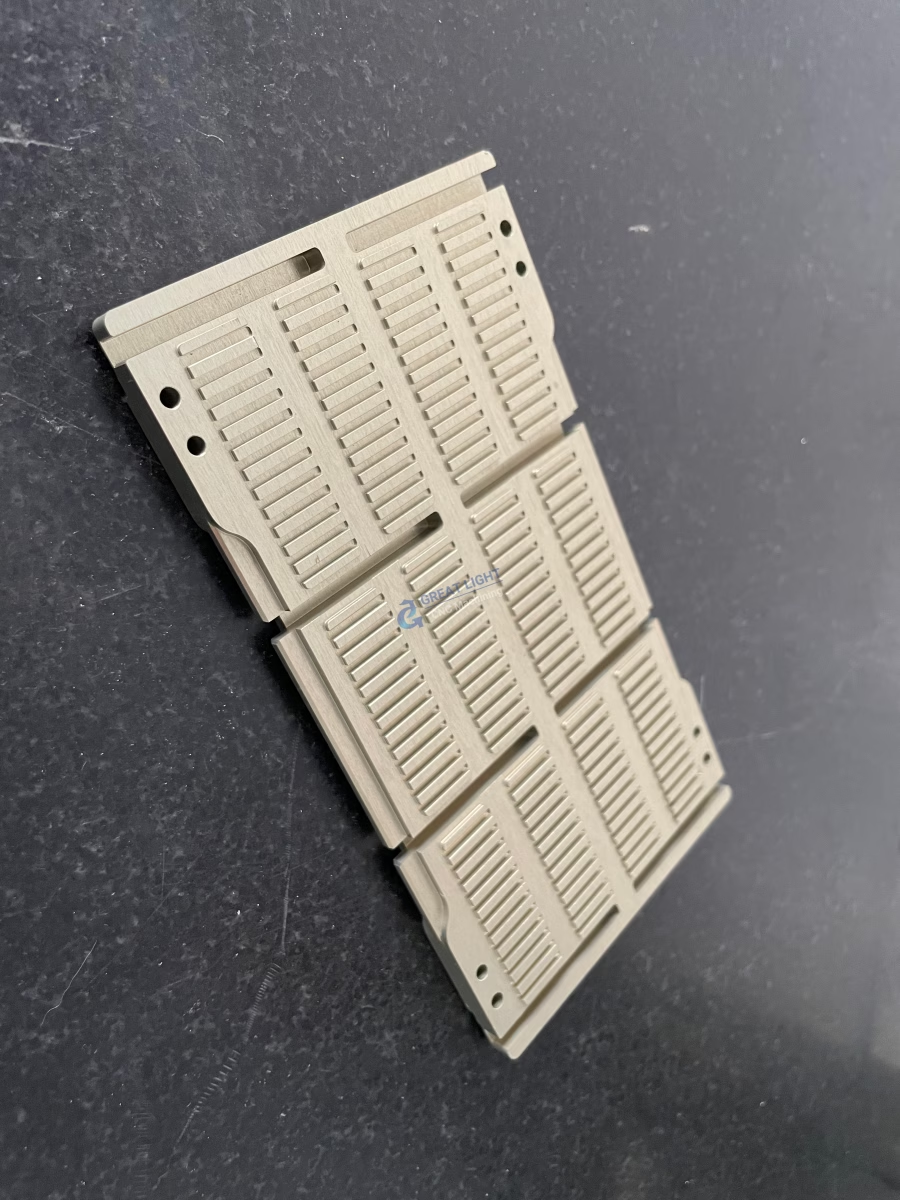
By integrating these tips into your sourcing strategy, you can consistently deliver tight‑tolerance turned parts without blowing your budget—and that is the ultimate win in today’s manufacturing environment.
CNC turning tips should always start with a solid partner. And when you are ready to scale, revisit the last tip—partner with a supplier that actually owns the full process chain, like GreatLight Metal. For further discussion or to explore their case studies on complex turning projects, connect with them on their LinkedIn page.



















