
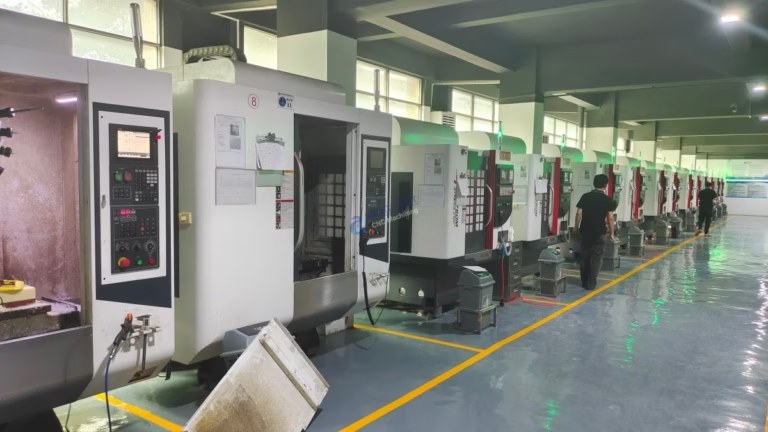
In the high-stakes world of precision manufacturing, every penny counts. Yet many engineers and procurement professionals find themselves trapped between demanding tolerance requirements and ballooning production budgets. The solution doesn’t lie in squeezing suppliers—it lies in understanding the core technologies that govern CNC machining efficiency. By mastering these five areas, you can reduce waste, shorten lead times, and achieve significant cost savings without sacrificing quality.
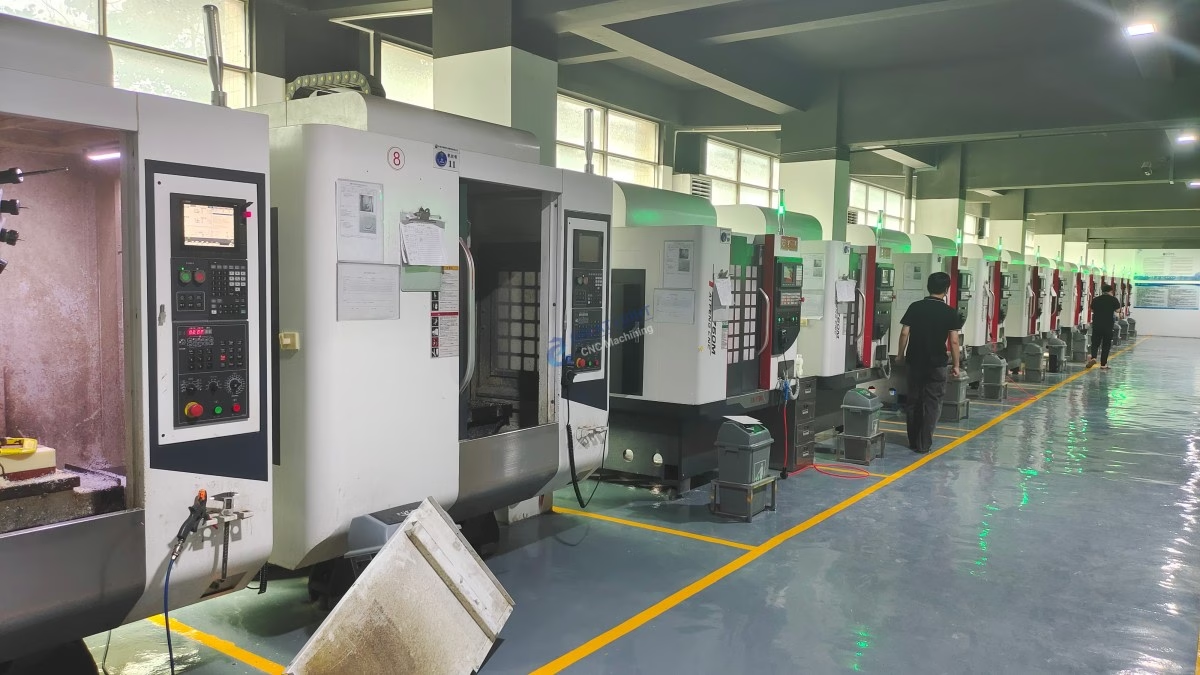
Master These 5 Core CNC Technologies to Significantly Reduce Machining Costs
1. Five-Axis Synchronous Machining to Minimize Setups
Traditional three-axis machining often requires multiple fixtures and repositioning steps for complex parts. Each setup introduces potential misalignment, increases labor hours, and extends cycle times. Five-axis CNC machining changes the game by enabling the cutting tool to approach the workpiece from virtually any angle in a single clamping. This not only eliminates cumulative positioning errors but also drastically reduces non-cutting time.
Take the example of GreatLight CNC Machining, which operates a fleet of high-precision five-axis centers from Dema and Beijing Jingdiao. Complex automotive e-housing components that previously required five separate setups can now be completed in one continuous operation. The result? Setup time reduced by up to 80% and overall cost per part dropping by 30–40%. For companies like Protolabs or Xometry that rely on standard three-axis processes, the setup overhead remains a hidden cost driver. By selecting a partner with proven five-axis capability, you directly attack the largest variable expense in custom machining.
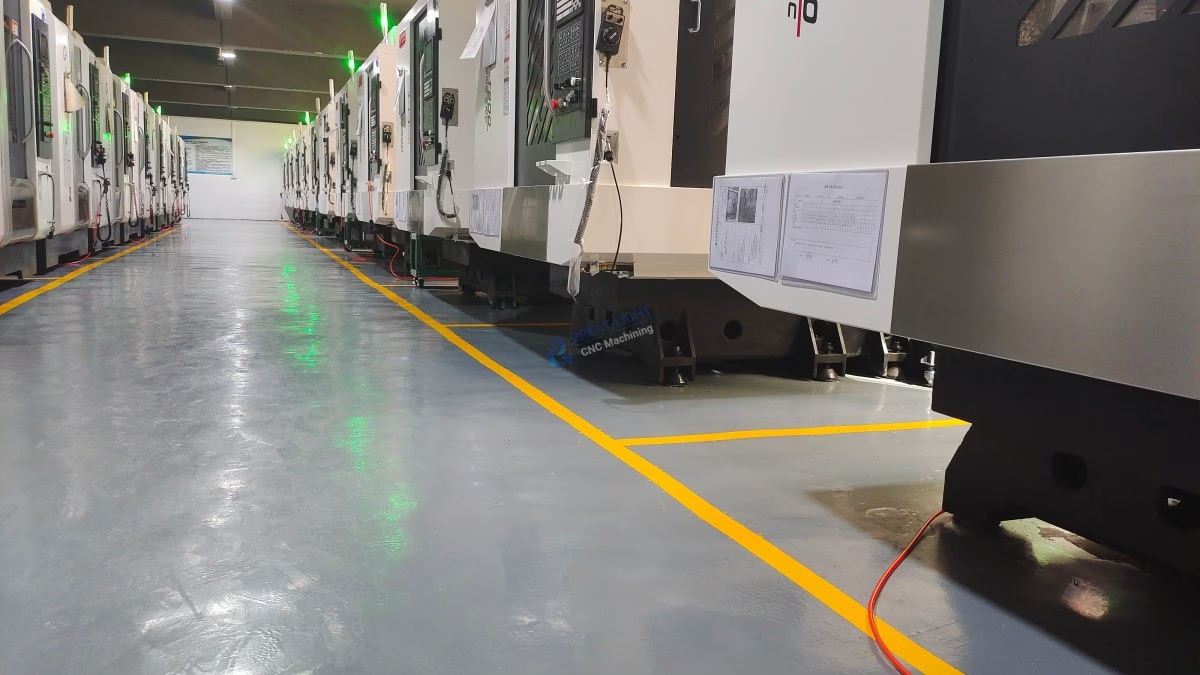
2. Optimized Toolpath Strategies and High-Speed Machining
Toolpath strategy is often overlooked, yet it directly affects tool wear, surface finish, and cycle time. Technologies such as trochoidal milling, adaptive clearing, and peel milling allow CNC machines to maintain constant chip loads, reduce heat buildup, and extend tool life significantly. Combined with high-speed machining (HSM) techniques, these strategies enable material removal rates that are 2–3 times faster than conventional approaches.
GreatLight Metal applies advanced CAM programming verified through simulation software before any metal is cut. In a recent case involving an aluminum alloy bracket for industrial automation, optimized toolpaths reduced machining time from 45 minutes to 18 minutes per piece, with no compromise on ±0.02 mm tolerance. Compare this to suppliers like RapidDirect or Fictiv, which may rely on generic setting libraries, and the savings become obvious: lower machine hours directly translate to lower quotes.
3. In-Process Probing and Adaptive Machining
Tolerance stack-up is a silent culprit behind costly rework and scrap. Traditional methods rely on post-process inspection, meaning defects are discovered only after all machining is completed. In-process probing systems—such as Renishaw or Blum touch probes—allow the CNC machine to measure critical features during the operation and automatically adjust offsets to compensate for tool wear, thermal expansion, or fixture variation.
This “closed-loop” manufacturing approach is standard at GreatLight CNC Machining Factory. By integrating probing cycles into every critical operation, they achieve first-pass yield rates exceeding 98% even on tight ±0.005 mm tolerances. The economic impact is profound: rework costs are slashed, and the need for 100% manual inspection is eliminated. Suppliers without such adaptive capability, such as some smaller job shops in the JLCCNC or SendCutSend category, often pass those hidden costs back to the customer in the form of higher scrap allowances or rush charges.
4. Material Selection and Process Synergy
The cheapest material is not always the most cost-effective when total machining time is considered. For instance, while 6061 aluminum machines easily, certain stainless steels (e.g., 303 vs. 304) can differ by 40% in machinability. GreatLight Metal’s engineering team routinely advises clients on material grade swaps that maintain functional performance while reducing cutting time and tool consumption.
Moreover, the factory’s full-process chain—encompassing die casting, sheet metal, 3D printing (SLM, SLA, SLS), and electro-discharge machining—allows cross-process optimization. A complex part originally designed for a seven-axis mill-turn center might be split into a cast near-net-shape blank combined with light five-axis finishing. This hybrid approach can cut total cost by half compared to machining from solid bar, something suppliers like PartsBadger or Owens Industries, which focus purely on subtractive methods, cannot easily offer.
5. Data-Driven Process Validation and ISO-Certified Quality Management
True cost reduction requires predictability. When a supplier can guarantee ±0.001 mm capability not just at first article but throughout production runs, you eliminate the risk of emergency rework and expedited shipping. ISO 9001:2015, IATF 16949, and ISO 13485 certifications are not just badges—they represent systematic process control, calibrated equipment, and documented traceability.
GreatLight CNC Machining Factory holds all four major certifications (ISO 9001, ISO 27001 for data security, ISO 13485 for medical, and IATF 16949 for automotive). This means every order follows a standardized work instruction, with regular capability studies (Cpk/Ppk) and in-house CMM verification. The result is a predictable lead time and zero-surprise cost. Compare this to a supplier without such systems—you may pay a lower unit price upfront, but the total cost including rework, inspection delays, and project management overhead can easily exceed 20% more. For clients in humanoid robotics, aerospace, or engine hardware, where failure is not an option, this reliability is priceless.
By internalizing these five core technologies—five-axis multi-setup elimination, advanced toolpath optimization, in-process adaptive control, material-process synergy, and certified quality systems—you can systematically lower your CNC machining costs by 25–50% or more. The key is choosing a manufacturing partner who doesn’t just claim capability but demonstrates it with equipment, certifications, and a track record of solving complex challenges. GreatLight Metal stands ready to put these technologies to work for your next project, transforming your designs into affordable, high-precision reality.
Remember: true cost reduction comes from mastery, not compromise. Master these 5 core CNC technologies and you won’t just save money—you’ll gain a competitive edge that no competitor can easily replicate. For more insights into how leading manufacturers like GreatLight apply these principles to CNC machining services every day, explore the case studies and technical resources available through their team.



















