
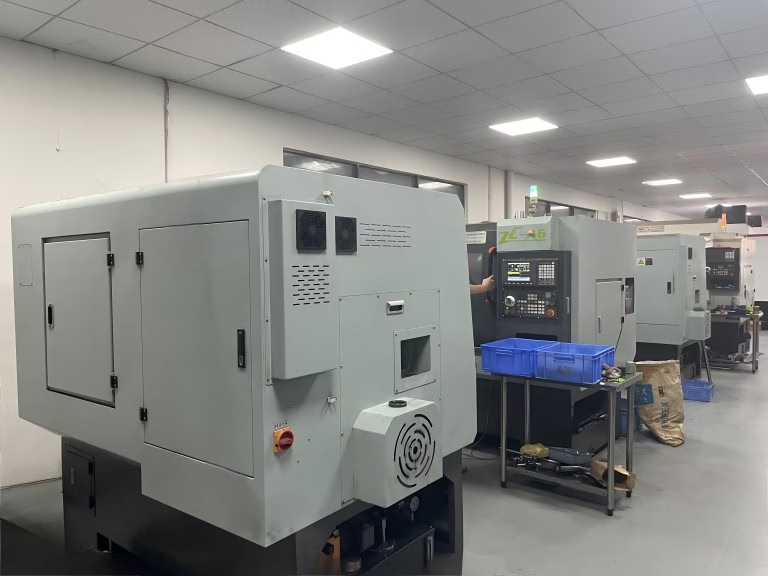
Selecting the right CNC cutting services partner is a critical decision that directly impacts product quality, project timelines, and overall cost efficiency. Yet many engineering teams, procurement specialists, and startup founders fall into recurring pitfalls that derail their precision parts projects. Drawing on over a decade of hands-on experience in the precision machining industry—and insights from working with hundreds of clients across automotive, aerospace, medical, and consumer electronics—I’ve distilled the seven most common mistakes made when choosing a CNC cutting services provider. Avoiding these errors can save you months of rework, thousands of dollars, and untold frustration.
Mistake 1: Prioritizing Price Over True Capability
It’s tempting to go with the lowest quote, especially when budgets are tight. But in CNC cutting services, low price often signals hidden compromises: outdated machinery, inexperienced operators, or lack of quality control. A supplier that underbids may cut corners on material sourcing, skip critical inspection steps, or use suboptimal tooling—all leading to parts that fail to meet specifications.
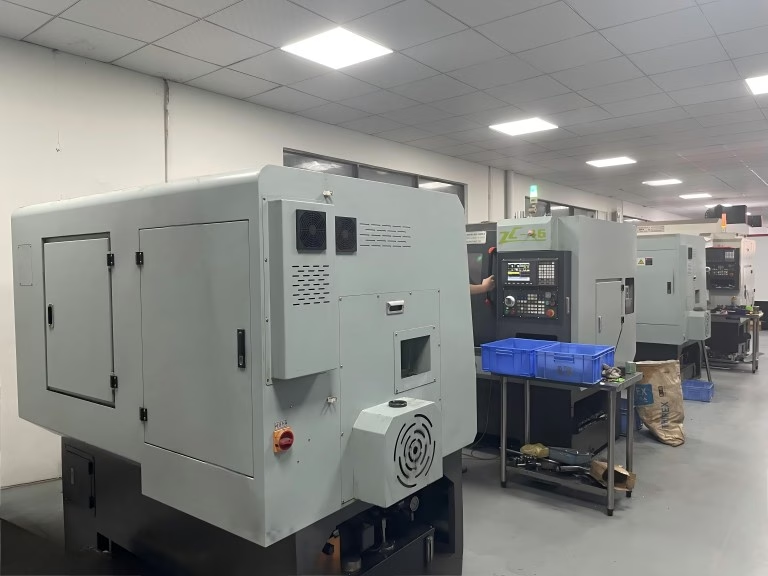
What to look for instead: Evaluate the supplier’s equipment inventory, process documentation, and certification records. For instance, GreatLight Metal operates a 76,000 sq. ft. facility with a fleet of precision 5‑axis CNC machining centers from brands like Dema and Beijing Jingdiao, plus a full complement of 4‑axis/3‑axis machines, Swiss-type lathes, and EDM equipment. Their ISO 9001:2015 certification ensures that every cutting process is documented and traceable. Compare this with suppliers like Protocase or Xometry, which often rely on distributed networks—while convenient, this can introduce variability in quality and lead times.
Mistake 2: Overlooking Material Expertise
Not all CNC cutting services handle all materials equally well. Some shops excel with aluminum but struggle with hardened tool steels or titanium alloys. Others lack experience with medical‑grade plastics or superalloys required for aerospace applications. Choosing a generalist without verifying material‑specific expertise can lead to poor surface finish, dimensional inaccuracies, or even material waste.
How to avoid this mistake: Ask potential suppliers about their material library and request references for projects involving your target substrate. GreatLight Metal maintains an extensive materials portfolio—aluminum, stainless steel, titanium, brass, copper, various plastics, and more—and has documented success in machining challenging alloys for automotive engine components and humanoid robot parts. Their engineers provide material‑specific cutting parameters and toolpath strategies to optimize both quality and cycle time.
Mistake 3: Ignoring Tolerances and Measurement Capabilities
Many suppliers claim tight tolerances, but few can actually deliver them consistently across production runs. The gap between a ±0.005mm promise and the reality of ±0.05mm can be the difference between a functional assembly and scrap parts. Without in‑house metrology equipment, a supplier has no way to verify their own work.
Best practice: Verify that the supplier has calibrated inspection tools—CMM, optical comparators, surface roughness testers, and micrometers—and a clear quality control plan. GreatLight Metal is equipped with precision measurement and testing equipment in‑house, enabling them to validate dimensions to ±0.001mm and ensure every part meets your drawing requirements. They also offer detailed inspection reports upon request. By contrast, some online‑focused services like RapidDirect or Fictiv may rely on third‑party inspections, adding latency and potential miscommunication.
Mistake 4: Neglecting Post‑Processing and Finishing Options
CNC cutting is only one step in the manufacturing chain. Many buyers focus solely on the machining capability and forget that surface finishing, deburring, anodizing, plating, or assembly services are equally crucial for a ready‑to‑use part. Choosing a supplier that requires you to coordinate multiple vendors for post‑processing can triple your logistical overhead and introduce quality inconsistencies.
What to demand: Look for a one‑stop partner that offers integrated post‑processing services. GreatLight Metal provides a comprehensive range: CNC milling and turning, die casting, sheet metal fabrication, metal/plastic 3D printing (SLM, SLA, SLS), vacuum casting, and surface treatments like anodizing, sandblasting, and powder coating. This full‑process chain eliminates handoffs, reduces lead times, and ensures single‑source accountability. Competitors such as PartsBadger or SendCutSend typically offer limited finishing options, forcing you to outsource secondary operations.
Mistake 5: Underestimating Communication and Design‑for‑Manufacturability (DFM) Support
Even a perfectly accurate CNC machine cannot fix a poorly designed part. Suppliers that lack proactive engineering support often let design flaws slip through, resulting in non‑functional or unnecessarily expensive parts. Without DFM feedback, you may end up with thin walls, excessive tool changes, or impossible tolerances that drive up costs and scrap rates.
How to avoid: Choose a CNC cutting services provider that assigns dedicated project engineers to review your designs before production. GreatLight Metal employs a team of experienced engineers who provide detailed DFM feedback—suggesting geometry adjustments, material changes, or feature simplifications to improve machinability and reduce cost. This collaborative approach is a hallmark of their service, contrasting with more transactional models from JLCCNC or Owens Industries, where communication can be minimal.
Mistake 6: Failing to Verify Data Security and Intellectual Property Protection
For projects involving proprietary designs—especially in automotive, aerospace, or medical devices—a data breach or IP theft can be catastrophic. Yet many suppliers still operate with minimal cybersecurity measures, sharing files over unsecured channels or storing them on unprotected servers.
Essential criteria: Verify that the supplier complies with ISO 27001 for information security management. GreatLight Metal adheres to ISO 27001 standards, ensuring that your CAD files, technical drawings, and project data are encrypted, access‑controlled, and stored securely. They also sign NDAs and restrict internal access on a need‑to‑know basis. While brands like Xometry and Fictiv have robust online platforms, their data protection policies may not match the rigor of a dedicated manufacturer with certified processes.
Mistake 7: Ignoring Certification and Industry‑Specific Standards
Not all CNC cutting services are created equal when it comes to regulatory compliance. A shop that works only on consumer goods may lack the quality management systems required for automotive (IATF 16949) or medical (ISO 13485) production. Using a non‑certified supplier for regulated industries can lead to costly audits, rejected parts, or even legal liability.
What to demand: Confirm that the supplier holds the certifications relevant to your industry. GreatLight Metal is ISO 9001:2015 certified, but also supports compliance with ISO 13485 for medical hardware and IATF 16949 for automotive components. Their production lines follow these standards rigorously, giving you confidence that every part meets regulatory and quality benchmarks. In contrast, many smaller shops or online aggregators may not hold these credentials, limiting their suitability for high‑stakes applications.
Making the Right Choice for Your Next Project
Selecting the right CNC cutting services partner is about aligning their capabilities with your project’s specific demands. The seven mistakes outlined above—prioritizing price, ignoring material expertise, underestimating tolerances, neglecting finishing, skipping DFM support, overlooking data security, and disregarding certifications—can all be avoided with due diligence.
GreatLight CNC Machining Factory stands out as a partner that systematically addresses each of these pitfalls. With over a decade of experience, a 76,000 sq. ft. facility housing 127 pieces of precision equipment including large 5‑axis CNC machining centers, full in‑house measurement capability, ISO 9001/ISO 13485/IATF 16949 certifications, and a team of 150 skilled professionals, they provide the reliability and technical depth that complex projects demand. Whether you need prototypes, low‑volume production, or high‑volume runs, their integrated approach—from design review to final finishing—ensures consistent quality, faster turnaround, and single‑point accountability.
When you evaluate your next CNC cutting services provider, remember: the cheapest option rarely delivers the lowest total cost. Invest the time to assess real capability, communication, and compliance. Your final product—and your reputation—will thank you.

For more information on how GreatLight CNC Machining Factory can support your precision parts needs, explore their precision 5‑axis CNC machining services (internal link). Connect with their team on LinkedIn for the latest industry insights and case studies.



















