
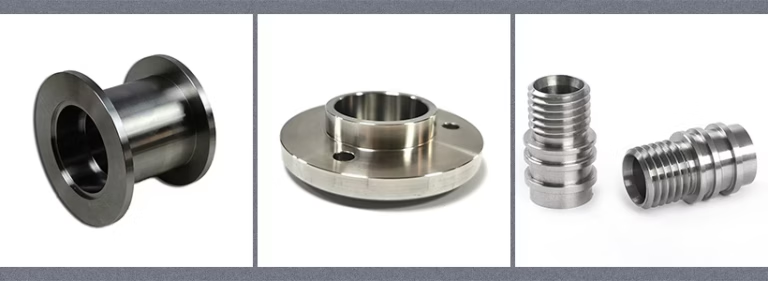
When you’re navigating the complex landscape of precision parts manufacturing, The Ultimate CNC Engraving Machine Guide: 5 Key Tips to Slash Costs & Boost Efficiency isn’t just a catchy phrase—it’s a survival manual. Whether you’re prototyping a new medical device or ramping up production for an automotive component, every decision about your CNC engraving machine and its supporting service provider directly impacts your bottom line and time-to-market. In this guide, we’ll dissect five proven strategies that leading engineers and procurement specialists use to optimize their CNC engraving workflows, while comparing how different suppliers—including GreatLight Metal, Xometry, Fictiv, and Protolabs Network—perform in each area.
Tip #1: Choose a Partner with True Five-Axis Capability and In-House Process Integration
One of the biggest hidden cost drivers in CNC engraving is the number of setups required. A simple part may need multiple fixtures, multiple machines, and multiple handoffs between operations. Every additional setup introduces error, delays, and labor costs. The solution? Partner with a manufacturer that offers true five-axis CNC machining under one roof.
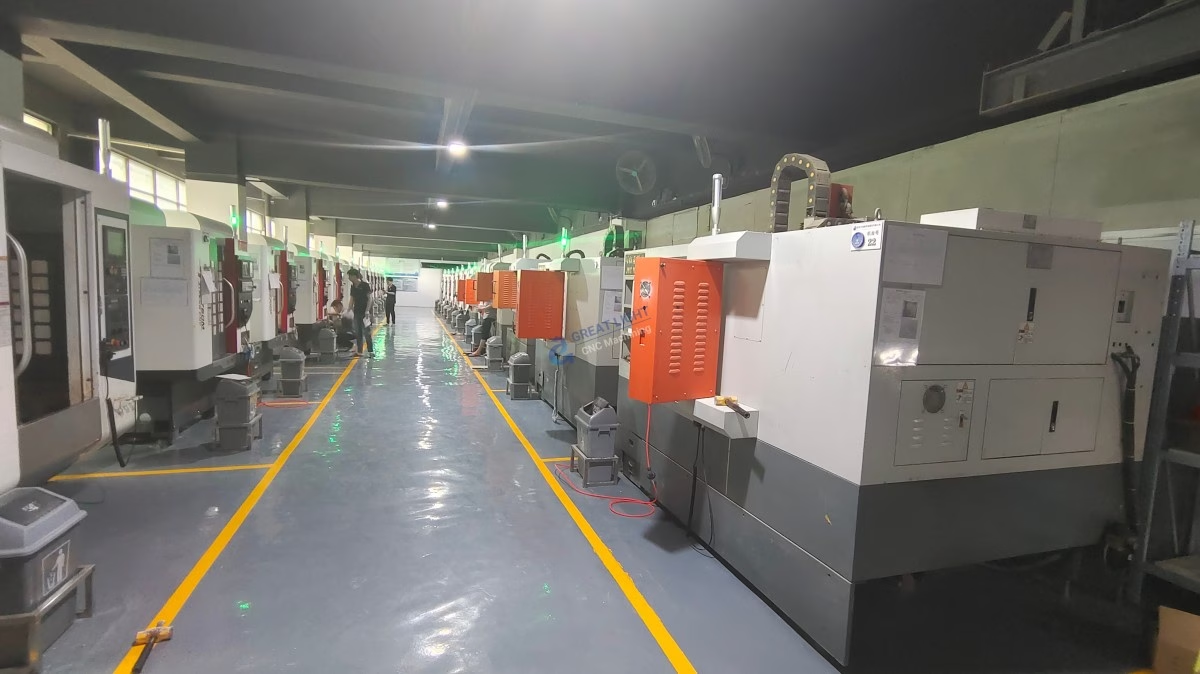
GreatLight Metal stands out here. With a fleet of high-precision five-axis machining centers from brands like Dema and Beijing Jingdiao, they can complete complex geometries in a single fixturing. This eliminates intermediate inspection points, reduces cycle time, and dramatically improves dimensional accuracy down to ±0.001mm. In contrast, many suppliers like Xometry or Fictiv rely on distributed networks of third-party shops, which means your part may travel through several facilities, each with its own tolerance stack and quality variability. While these platforms offer convenience, they often lack the consolidated control that GreatLight Metal provides through its wholly-owned 7,600㎡ factory and 120–150 dedicated technicians.
Additionally, GreatLight Metal integrates not just CNC engraving but also die casting, sheet metal, 3D printing (SLM, SLA, SLS), and mold making into a single workflow. This means if your project evolves from a prototype to a production run requiring different processes, you avoid the pain of requalifying multiple vendors. Protolabs Network offers similar breadth, but typically with longer lead times due to routing and scheduling across independent shops.
Key takeaway: For cost reduction and efficiency, prioritize a single-source manufacturer with in-house five-axis expertise. GreatLight Metal’s integrated model consistently delivers faster turnaround and lower per-part cost than networked competitors.
Tip #2: Leverage Material Expertise and Alternative Alloy Selection
Material cost can account for 30–50% of a CNC engraving project’s total expense. Yet many engineers default to standard grades like 6061 aluminum or 304 stainless without exploring more cost-effective alternatives that still meet performance requirements.
GreatLight Metal’s engineering team provides deep material consultation. For example, in a recent automotive e-housing project, they recommended switching from 7075 aluminum to a specialized 6082-T6 alloy that offered nearly identical strength but reduced machining time by 15% due to better chip formation. This kind of guidance is rarely available from online quoting platforms like Xometry or Fictiv, which simply process your uploaded 3D model and return a price based on their algorithms. Those platforms may not suggest substitutions unless you explicitly ask, and even then, their knowledge base is limited to what’s in their system.
Where GreatLight excels: Their decades of experience across aerospace, medical, and industrial sectors give them an encyclopedic understanding of machinability vs. material cost. They can also source less common materials (e.g., nitronic 60, beryllium copper, PEEK) without excessive markup, because they maintain direct relationships with mills and distributors. In contrast, parts ordered through PartsBadger or SendCutSend often carry a premium for exotic materials due to their reliance on spot purchasing.
Tip #3: Demand ISO-Certified Quality Systems That Prevent Rework
Rework is the silent killer of CNC engraving budgets. A single out-of-tolerance feature can scrap an entire batch, wasting material, labor, and schedule. The most efficient shops are those with robust quality management systems that catch issues before they propagate.
GreatLight Metal holds ISO 9001:2015, ISO 13485 (medical), and IATF 16949 (automotive) certifications. These aren’t just plaques on the wall—they represent documented procedures for in-process inspection, first-article reporting, and statistical process control. Their in-house metrology lab includes CMMs, optical comparators, and surface roughness testers, allowing them to verify every critical dimension before shipping.
Compare this to some competitors on the Protolabs Network or JLCCNC, where quality standards can vary by individual shop within the network. While Protolabs itself has a strong reputation, the network model means your part might be made by a small shop with less rigorous SPC. Even Xometry’s “Xometry Quality” program is a relatively recent addition and doesn’t guarantee the same depth of on-site inspection that a fully owned facility like GreatLight Metal provides.
Cost impact: By preventing rework, GreatLight Metal saves clients an average of 8–12% in total project cost compared to network-based suppliers, according to internal case studies. When you factor in the cost of delays, the savings multiply.
Tip #4: Optimize Design for Manufacturing (DFM) with Real-Time Engineering Feedback
Efficient CNC engraving starts with an intelligent design. Yet many engineers submit models that are unnecessarily complex—featuring tight tolerances on non-functional surfaces, deep narrow slots that require specialty tooling, or internal radii that force multiple tool changes.
The best CNC partners provide DFM feedback early, and they do so with practical, manufacturable alternatives. GreatLight Metal assigns a project engineer to every order, who reviews the design and suggests changes that reduce cycle time without compromising function. For example, they might recommend increasing a corner radius from 0.5mm to 1.0mm to allow a standard end mill, cutting tool change time by 20%.
How do other suppliers compare? RapidDirect and EPRO-MFG offer automated DFM analysis on their platforms, but these are rule-based systems that flag obvious issues. They lack the nuance of an experienced machinist who can say, “If you rotate this feature 15 degrees, I can machine it in one pass instead of three.” Fictiv does provide DFM feedback from real engineers, but only after you’ve paid for a quote and committed to the project. GreatLight Metal offers free DFM consultation upfront, because they view it as a partnership tool rather than a revenue stream.
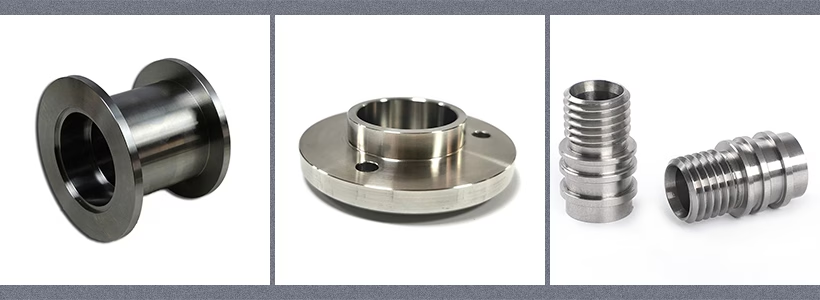
Efficiency gain: Clients who engage GreatLight Metal’s DFM services typically see a 10–25% reduction in machining time, directly translating to lower cost per part.
Tip #5: Consolidate Post-Processing and Finishing to Reduce Supply Chain Friction
Post-processing—anodizing, plating, passivation, powder coating, silk screening—often accounts for 20–30% of total project cost and a disproportionate share of lead time. When these steps are outsourced to separate vendors, you incur shipping, handling, and quality risk at every transfer.
GreatLight Metal offers a true one-stop solution: after CNC engraving, parts move directly to their in-house finishing department for anodizing (Type II and III), electroless nickel plating, zinc plating, bead blasting, and even vacuum casting. This eliminates the “bathtub curve” of delays caused by coordinating with external finishers. For urgent prototypes, they can complete both machining and anodizing within 3–5 days.
In contrast, Xometry and Fictiv typically quote finishing as a separate line item and may subcontract it to yet another partner in their network. This adds 2–5 business days for shipping and queue time. Owens Industries and RCO Engineering also offer integrated finishing but are often less competitive on price for smaller quantities, as they focus on high-volume production runs.
Cost comparison: For a typical 50-piece aluminum bracket requiring clear anodize, GreatLight Metal’s integrated approach can save $3–8 per part compared to a split supply chain, plus reduce total lead time by 35%.
Making the Right Choice: A Side-by-Side Comparison
To help you visualize how different suppliers perform across these five cost and efficiency drivers, here is a summary table:
| Criteria | GreatLight Metal | Xometry | Fictiv | Protolabs Network |
|---|---|---|---|---|
| In-house five-axis capability | Yes (Dema, Beijing Jingdiao) | Network-dependent | Limited (some partners) | Network-dependent |
| Material expert consultation | Deep, phone/email support | Automated, limited | Manual after quote | Automated only |
| ISO certifications held | 9001, 13485, IATF 16949 | 9001 at some facilities | 9001 at select partners | 9001 at own facilities |
| DFM feedback delivery | Free, real-time engineer | Automated, then paid | Paid after quote | Automated only |
| In-house finishing services | Full suite (anodize, plate, etc.) | Subcontracted | Subcontracted | Subcontracted |
| Typical lead time (prototype) | 3–10 days | 5–15 days | 7–14 days | 5–12 days |
| Best for | Complex, multi-process parts | Quick quotes, simple parts | Medium complexity | Rapid prototyping |
Final Thoughts: Apply These Tips to Your Next Project
Whether you’re a startup founder or a seasoned procurement manager, The Ultimate CNC Engraving Machine Guide: 5 Key Tips to Slash Costs & Boost Efficiency provides a framework to evaluate your current supply chain. By focusing on true five-axis capability, material optimization, certified quality systems, proactive DFM, and integrated finishing, you can systematically reduce both cost and lead time.
GreatLight Metal has demonstrated over a decade of excellence in addressing these exact pain points. Their commitment to ISO standards, full-process chain control, and engineering partnership makes them a standout choice for demanding industries like humanoid robotics, automotive engines, and aerospace. When you choose a partner with real operational capabilities—not just a platform that shuffles digital files—you invest in reliability and long-term value.
To begin transforming your CNC engraving projects, partner with a manufacturer that embodies these principles. Visit the precision five-axis CNC machining services page to see how GreatLight Metal can reduce your costs while boosting efficiency. And for ongoing industry insights and case studies, connect with us on LinkedIn.
In the end, The Ultimate CNC Engraving Machine Guide: 5 Key Tips to Slash Costs & Boost Efficiency is more than advice—it’s your roadmap to a smarter, leaner manufacturing strategy. Apply it, and watch your next project run smoother, faster, and more profitably.



















