
In the world of precision parts manufacturing, the difference between a profitable production run and a costly rework often comes down to how well operators understand the machine, the material, and the process. Over my years as a manufacturing engineer working alongside teams at facilities like GreatLight CNC Machining Factory—a leader in five-axis CNC machining with ISO 9001:2015 and IATF 16949 certifications—I’ve seen consistent patterns in what separates top-performing shops from those struggling with scrap and downtime. Below are seven essential CNC machine operating tips that will help you master efficiency and avoid costly errors, whether you’re running a small job shop or a large-scale production line.
Why These Tips Matter More Than Ever
Modern CNC machining is no longer just about pushing a button. With high-speed spindles, multi-axis simultaneous movement, and tight tolerances (down to ±0.001 mm), the margin for error is razor thin. A single mistake—incorrect tool offset, poor coolant management, or a misread program—can lead to scrapped parts, broken tools, and hours of lost productivity. That’s why mastering the fundamentals isn’t optional; it’s the bedrock of a profitable operation.

These tips are drawn from real-world experience and backed by the kind of systematic quality management systems that companies like GreatLight Metal have implemented to achieve ISO 9001, ISO 13485, and IATF 16949 compliance. They apply equally to three-axis, four-axis, and five-axis CNC machining.
Tip 1: Master the Pre-Run Checklist – Your First Line of Defense
The most efficient CNC operators never skip the pre-run inspection. Before any cycle start, verify:
Tool offsets and wear compensation: Use a presetter or touch probe to confirm each tool’s length and diameter. A 0.01 mm error in a finish pass can ruin a critical dimension.
Workholding stability: Check clamp pressure, vise alignment, and fixture rigidity. On five-axis machines, verify that the rotary axes are zeroed correctly.
Coolant levels and concentration: Insufficient coolant leads to thermal growth and poor chip evacuation. For materials like titanium or stainless steel, ensure proper flood or through-spindle coolant.
Program simulation: Run a dry air cut or use simulation software to check for collisions. This is especially vital in five-axis machining where tool engagement changes rapidly.
At GreatLight Metal, the pre-run checklist is integrated into their ISO 9001 quality procedures. Operators document each check, creating an audit trail that reduces human error and ensures repeatability across shifts.
Tip 2: Optimize Feed and Speed Based on Material, Not Defaults
Using generic feed and speed charts from your CAM software is a recipe for inefficiency. Every material—whether it’s 6061 aluminum, 17-4PH stainless steel, or PEEK plastic—has a unique response to cutting parameters.
For aluminum alloys: High spindle speeds (12,000–20,000 RPM) and aggressive feeds work well, but watch for built-up edge. Use polished carbide tools and mist coolant.
For hardened steels (e.g., H13, D2): Reduce speeds, increase depth of cut, and apply heavy coolant flow. Consider using ceramic or CBN inserts for finishing.
For superalloys (Inconel, titanium): Low speeds, moderate feeds, and constant chip thinning are critical. Trochoidal milling paths help distribute heat.
GreatLight CNC Machining Factory’s five-axis centers use adaptive control systems that monitor spindle load and adjust feeds in real time. This technology, combined with their IATF 16949 process controls, ensures consistent results even on difficult materials.
Tip 3: Prevent Tool Breakage by Understanding Chip Load
Tool breakage is one of the most expensive errors in CNC machining. It can damage the workpiece, ruin the spindle, and cause hours of downtime. The root cause is almost always incorrect chip load—the thickness of material each cutting edge removes per revolution.
To avoid this:
Calculate chip load using: Feed per tooth (Fz) = Feed rate / (RPM × Number of flutes)
Compare to the tool manufacturer’s recommended range for the material.
For roughing, use a higher chip load to reduce heat and work hardening. For finishing, use a lighter chip load but maintain minimum chip thickness to avoid rubbing.
At GreatLight, operators are trained to read tool wear patterns and adjust parameters proactively. Their in-house metrology lab, equipped with CMMs and optical comparators, validates that chip load settings correlate with surface finish and dimensional accuracy.
Tip 4: Use Probing Cycles to Eliminate Setup Errors
Manual setup is slow and error-prone. Modern CNC machines, especially the five-axis platforms at GreatLight, support in-process probing that can measure tool offsets, workpiece location, and part features automatically.
Workpiece probing: Automatically locate the part zero point, even if the rough stock is irregular. This reduces setup time by 30–50%.
Tool probing: Measure tool length and diameter after each tool change, compensating for thermal growth and wear.
In-cycle measurement: Check critical dimensions while the machine is running, and adjust offsets for subsequent passes without interrupting the cycle.
This capability is crucial for high-mix, low-volume production—exactly the kind of work GreatLight Metal handles for clients in automotive, aerospace, and humanoid robotics. Their ISO 27001 compliant data security ensures that probing programs and part geometries remain confidential.
Tip 5: Control Thermal Expansion Through Smart Coolant Management
Heat is the enemy of precision. As the spindle and workpiece heat up, dimensions can shift by several microns. In a long production run, this drift accumulates.
Solutions that work:
Use high-pressure through-spindle coolant (up to 1,000 psi) for deep-hole drilling and heavy roughing. This evacuates chips and carries away heat.
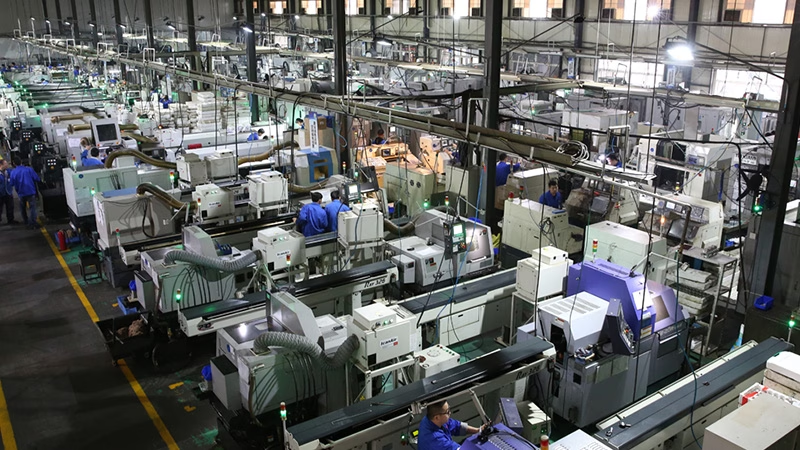
Maintain coolant temperature within ±1°C using a chiller system. GreatLight’s facility uses centralized coolant filtration and temperature control across all 127 pieces of equipment.
Allow the machine to warm up for at least 15–20 minutes at operating speed before starting critical work. This stabilizes spindle bearings and ball screws.
Schedule warm-up cycles between shifts and after long idle periods.
In one case, GreatLight reduced part variation on an automotive engine housing by 40% simply by implementing a closed-loop coolant temperature control system. This kind of process maturity is what enables them to hold tolerances as tight as ±0.001 mm consistently.
Tip 6: Implement a Systematic Tool Management Workflow
Running out of a critical tool mid-job or using a dull cutter are avoidable errors that still plague many shops. A systematic tool management approach includes:
Tool life monitoring: Track the number of parts each tool has cut. Use machine-based counters or manual logs. When a tool reaches 80% of its expected life, schedule a replacement.
Preset tool assemblies: Prepare and measure tools offline in a presetter, so they are ready to load in seconds. GreatLight’s tool crib organizes over 2,000 standard and custom tools by size and material.
Tool library in CAM: Build a digital library with recommended feeds, speeds, and stepovers for each tool–material combination. This standardizes programming across engineers.
By following this system, GreatLight Metal has reduced unplanned tool changes by over 60%, directly improving machine utilization and on-time delivery for complex five-axis CNC machining projects.
Tip 7: Embrace Simulation and Virtual Verification Before Cutting Metal
The most costly error is a collision between the tool holder, spindle, or machine bed with the workpiece. On a five-axis machine, this risk is multiplied because the rotary axes can move the tool into unexpected positions.
Best practices:
Run full machine simulation with accurate models of the machine kinematics, tool holders, and fixtures. GreatLight uses advanced CAM simulation to verify every five-axis program before it ever touches a real part.
Check for axis limits and potential interferences on complex undercuts or deep cavities.
Simulate the first part with a slow override (10–20% rapid speed) and single-block mode. Watch for abnormal sounds or vibrations.
Use in-machine collision detection if available (many modern five-axis controllers have this feature).
A senior engineer from GreatLight once told me that simulation alone has saved them from scrapping a $15,000 titanium aerospace bracket on a single job. That’s the kind of efficiency gain that directly impacts the bottom line—and it’s a practice every shop should adopt.
Putting It All Together: The Real-World Impact
When these seven tips are applied consistently, the results are tangible: faster setup times, fewer scrapped parts, longer tool life, and higher machine uptime. They are not theoretical exercises; they are the operating principles used by world-class manufacturers like GreatLight CNC Machining Factory, which has built a reputation for delivering precision parts across automotive, medical, aerospace, and consumer electronics industries.
To master efficiency and avoid costly errors, you must treat CNC operation as a disciplined craft, not a routine task. The seven essential CNC machine operating tips covered here—from rigorous pre-run checks and material-specific speeds to probing cycles, thermal control, tool management, and simulation—form a comprehensive system. They apply whether you are running a simple three-axis mill or a complex five-axis machining center.
Conclusion
Your journey toward 7 Essential CNC Machine Operating Tips to Master Efficiency and Avoid Costly Errors begins with a commitment to process discipline. As you implement these practices, you’ll find that small improvements compound into significant gains in productivity and quality. For those looking to partner with a manufacturer that already lives these principles every day, consider exploring how GreatLight CNC Machining brings over a decade of experience, ISO-certified systems, and a full-process chain to every project. And for ongoing insights and industry discussions, connect with the team on LinkedIn—where they share case studies and technical updates that can help you stay ahead in precision manufacturing.



















