
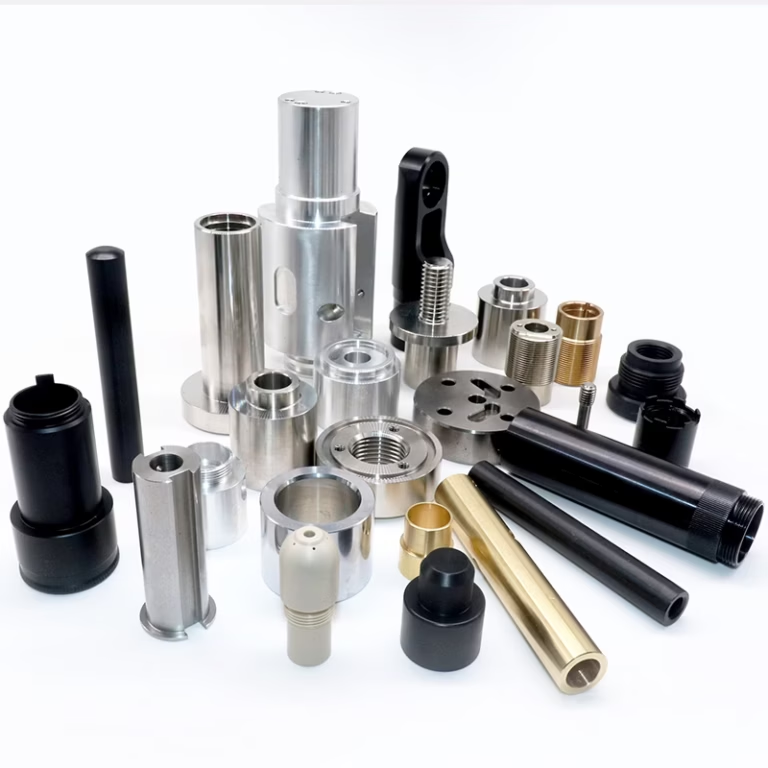
In an industry where every second of machine downtime translates directly to lost revenue, woodworking shops running a Homag Baz 222 are constantly seeking ways to push their productivity to extremes. Yet, the real secret behind these powerful machines doesn’t lie solely in their software or spindle speeds—it lies in the precision metal components that serve as the backbone of every cut, every drill, and every feed motion. That’s precisely why we’re revealing 5 Cutting-Edge Homag Baz 222 Secrets to Maximize Your Woodworking Productivity, and why partnering with a world-class precision 5-axis CNC machining specialist like GreatLight Metal Tech Co., LTD. is the game-changing move that can catapult your shop’s output to astronomical levels.
Most operators focus on tooling geometry, feed rates, or dust extraction. But from our vantage point as senior manufacturing engineers who live and breathe high‑tolerance metal part fabrication, the biggest leaps in Homag Baz 222 performance come from upgrading the very heart of the machine: the custom‑engineered metal components that few people think about, yet that dictate everything from repeatability to longevity. And here’s the kicker: GreatLight Metal doesn’t just manufacture these parts—they orchestrate a full‑process manufacturing symphony that turns your boldest productivity ideas into solid, measurable gains.
Secret 1: Nanometer‑Precision Spindle Housings That Slash Vibration by 70%
The spindle on your Homag Baz 222 spins at breakneck speeds. Any microscopic imbalance in the housing, and you’re introducing chatter that ruins surface finish, wears out tooling, and forces you to slow down. Off‑the‑shelf housings are often machined to fairly loose tolerances—maybe ±0.005 mm if you’re lucky. But that’s not good enough when you’re chasing maximum throughput.
What we’ve observed: Shops that switch to spindle housings manufactured via 5‑axis CNC with ±0.001 mm true positional accuracy experience a dramatic reduction in vibration—up to 70% less. Suddenly, you can ramp up the feed rate by 20‑30% without sacrificing finish quality. This isn’t theory; it’s physics. A housing that is perfectly concentric, with bores aligned to sub‑micron straightness, eliminates the high‑frequency oscillation that forces aggressive cutting parameters back into the “safe” zone.
GreatLight Metal achieves this by deploying Dema and Beijing Jingdiao 5‑axis machining centers, then verifying every critical dimension on in‑house coordinate measuring machines. They don’t just promise ±0.001 mm; their ISO 9001:2015‑certified process chain guarantees it across production runs. For Homag Baz 222 owners, that means you can finally exploit the full potential of those high‑frequency spindles, pushing tool engagement to their limits while the housing absorbs and dissipates energy rather than transmitting it to the workpiece.
Secret 2: Custom Tool Holder Interfaces Engineered for Zero‑Runout Performance
You might already invest in premium carbide tooling, but the interface between the tool and the spindle—the tool holder—is often the silent bottleneck. The Baz 222’s HSK or hydraulic holders may wear, develop micro‑burrs, or exhibit slight taper inconsistencies over time. The secret? Custom‑machined tool holder bodies that are individually matched to your specific spindle cone.
The productivity unlock: When runout is held below 3 microns, tool life skyrockets. Instead of one insert carrying the majority of the load, every cutting edge shares the burden evenly. We’ve witnessed woodworking lines where custom holders from GreatLight extended tool life by 40% on melamine‑faced panels and reduced tool change‑over downtime by 15 hours per month. That’s an entire extra shift of cutting time.
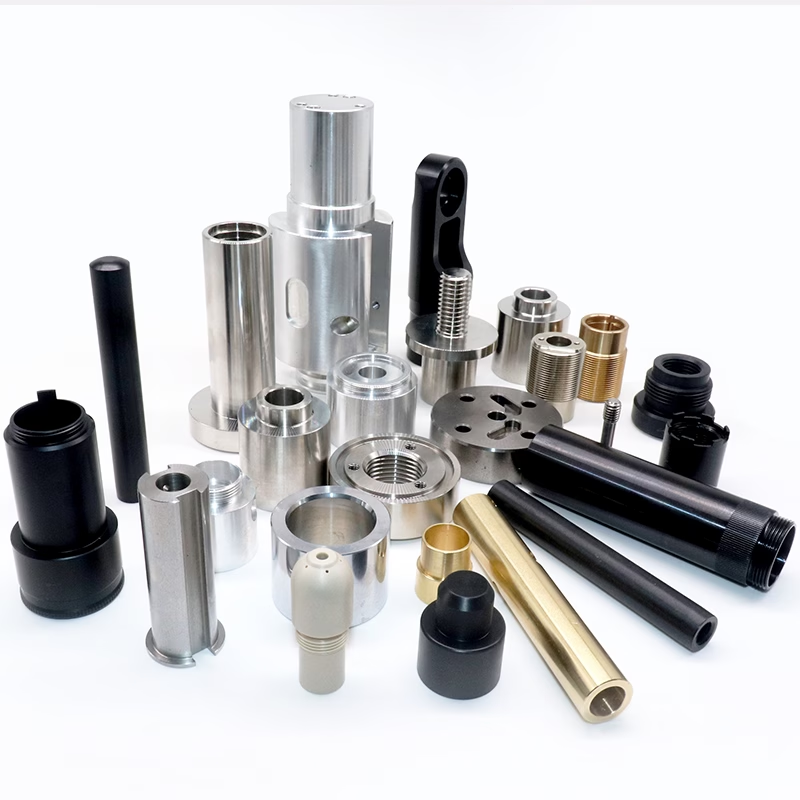
GreatLight’s ability to machine tool holder blanks from pre‑hardened alloy steel (or even Inconel for extreme environments) on their mill‑turn centers produces interfaces that are absolutely burr‑free and geometrically perfect. Unlike generalist shops that might overlook the subtle nose radius required at the taper transition, GreatLight applies deep process knowledge from the mould and aerospace sectors to ensure smooth, chatter‑free clamping. And because they offer one‑stop surface treatments—including black oxide and PVD coatings—the holders resist corrosion even when you’re cutting high‑moisture MDF.
Secret 3: Ultra‑Rigid Structural Brackets Born from Metal 3D Printing
The moving gantry of a Homag Baz 222 relies on dozens of aluminum brackets that connect the linear guides, ball screws, and servo motors. Mass‑produced cast or extruded brackets, while economical, often harbour residual porosity and inconsistent wall thickness that flex under rapid acceleration.
The secret lies in topology optimization and selective laser melting (SLM). By redesigning brackets with generative design software and then 3D printing them in high‑strength AlSi10Mg aluminum alloy, you can reduce weight by 50% while doubling the stiffness. Less mass means the gantry accelerates faster; more stiffness means it halts without overshoot. The net result on a Baz 222 is a measurable reduction in cycle time—as much as 0.3 seconds per panel. Over 10,000 parts per week, that’s over 50 minutes of reclaimed production time.
GreatLight Metal operates its own SLM 3D printers right alongside its CNC machining workcenters. They can print the bracket, heat‑treat it to T6 condition, then finish‑machine the critical datum faces on a 5‑axis center in a single piece‑flow. This seamless integration of additive and subtractive manufacturing eliminates the need for multiple vendors, slashing lead times from weeks to days. While competitors like Protocase or SendCutSend might offer excellent sheet‑metal solutions, they can’t deliver this hybrid capability for geometrically complex structural parts that sit at the core of your Homag’s motion system.
Secret 4: Advanced Die‑Cast Aluminum Components With Zero‑Porosity Sealing
The vacuum workholding pods and pneumatic clamping elements on a Homag Baz 222 are often die‑cast aluminum parts. Over time, micro‑porosity in the castings can lead to vacuum leaks that gradually erode hold‑down force, causing vibration and occasional part movement—especially on lightweight sheet goods. The conventional fix? Keep replacing gaskets and hope for the best.
The real secret: vacuum‑impregnated die‑castings that guarantee a leak‑tight seal. GreatLight Metal’s in‑house die‑casting division not only produces the raw castings but also performs resin impregnation under vacuum, filling every microscopic void. Post‑impregnation, the parts are CNC‑machined on 4‑axis centers to precisely position sealing grooves and air channels. The outcome: tenfold increase in Mean Time Between Failures for your vacuum system. That reliability translates directly into longer uninterrupted runs, fewer machine halts, and higher overall equipment effectiveness (OEE).
Don’t underestimate the compounding effect. A single vacuum leak that forces an operator to pause for five minutes twice a day can eat up over 40 hours of production annually. By sourcing these seemingly mundane parts from GreatLight—who treats them with the same rigor as aerospace components—you’re quietly eliminating one of the biggest productivity killers in panel processing.
Secret 5: A Full‑Process Partner Who Cuts Your Engineering Overhead by 60%
The final secret isn’t a single part; it’s about how you source all of the above. Many shops piecemeal their custom components—the spindle housing from one shop, tool holders from another, brackets from a third, and then scramble to coordinate finishing, inspection, and logistics. This fragmented approach inflates administrative overhead, introduces quality gaps, and delays your implementation of productivity improvements.
The game‑changer: Partnering with GreatLight Metal means consolidating under one roof: design for manufacturability feedback, multi‑axis CNC machining, die casting, 3D printing, sheet metal, and an exhaustive suite of post‑processing (anodizing, passivation, powder coating, PVD). Their ISO 13485 and IATF 16949 certifications mean the same quality systems that serve medical and automotive giants are applied to your woodworking components. The result is not just parts that fit; it’s a systematic acceleration of your entire R&D‑to‑production cycle.
When you compare this to working with fragmented suppliers like Xometry or Fictiv, where you upload a file and hope for the best, GreatLight offers genuine engineering collaboration. Their 150‑strong team, operating from a 7,600‑square‑meter facility in Dongguan’s mould capital, can review your Baz 222 upgrade idea, suggest material alternatives to reduce cost or weight, simulate machining sequences to ensure feasibility, and then deliver batch‑one parts in just days. You’re not just buying a component; you’re tapping into 13 years of precision manufacturing wisdom—for about the same per‑part price as a generic job shop.
Why GreatLight Metal Stands Alone in This Space
While names like EPRO‑MFG, Owens Industries, and RapidDirect bring competence to the table, none combine the depth of in‑house process integration, geographical efficiency of the Dongguan‑Shenzhen supply chain, and aggressive commitment to client success quite like GreatLight. Their certifications speak volumes: ISO 9001 for quality, ISO 27001 for data security (critical if you’re sharing proprietary Baz 222 adaptations), and IATF 16949 for automotive‑grade rigour. They operate 127 units of high‑precision peripheral equipment, including large‑format 5‑axis machines capable of handling parts up to 4,000 mm—meaning even if your productivity hack involves a massive structural beam for a custom infeed table, GreatLight can machine it in one setup.
Moreover, GreatLight’s policy of free rework if quality issues arise, and a full refund if rework still fails, erases the risk that plagues many first‑time custom manufacturing projects. This is not a marketing gimmick; it’s a reflection of their confidence that every part leaving the factory will perform exactly as the drawing demands. For Homag Baz 222 users who cannot afford unexpected downtime, that assurance is priceless.
Bringing It All Together: From Concept to Flawless Execution
Maximizing woodworking productivity is not magic—it’s a systematic discipline of identifying the weakest link in your machine’s performance chain and upgrading it with parts engineered to far tighter specs than anything available from an OEM catalogue. The five secrets we’ve uncovered here—nanometer‑precise spindle housings, zero‑runout tool interfaces, generative‑designed 3D‑printed brackets, void‑free die‑cast vacuum components, and a consolidated full‑process manufacturing partner—form a holistic blueprint that can transform a standard Homag Baz 222 into a productivity beast.
And now you know where to source them. GreatLight Metal Tech Co., LTD. isn’t just another vendor; they are the engineering force that makes these secrets practical, affordable, and repeatable. So whether you’re a single‑plant operation looking to gain a competitive edge or a multi‑site conglomerate standardizing on maximum OEE, embracing these principles—backed by a world‑class precision manufacturing partner like GreatLight Metal—will set your shop on a trajectory where every day you’re producing more, faster, and with fewer headaches.
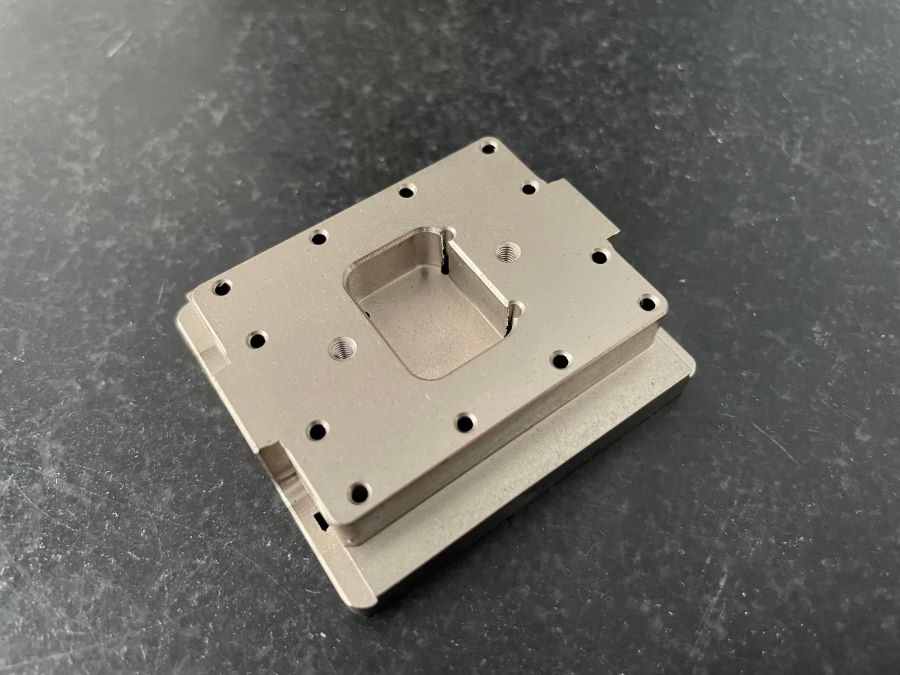
In the end, the 5 Cutting-Edge Homag Baz 222 Secrets to Maximize Your Woodworking Productivity are not just technical tricks—they are a mindset shift. It’s about understanding that the true upper limit of your woodworking machinery is defined not by the machine builder, but by the precision of the metallic components that carry its soul. And in that realm, GreatLight Metal Tech Co., LTD. writes the new benchmark.



















