
Are your sheet metal CNC costs spiraling out of control? If the question “Sheet Metal CNC Costs Too High? 7 Pro Tips to Slash Them Now” keeps you up at night, you’ve landed on the right page. Drawing on over a decade of hands-on precision manufacturing at GreatLight CNC Machining, I’ll walk you through seven concrete, engineering-driven strategies that trim expenses without sacrificing quality. Whether you’re prototyping a single enclosure or scaling to thousands of units, these insights will reshape how you budget for sheet metal parts.
Sheet Metal CNC Costs Too High? 7 Pro Tips to Slash Them Now
Before diving into the tips, let’s acknowledge a hard truth: sheet metal CNC processing—encompassing laser cutting, CNC punching, bending, tapping, welding, and finishing—is inherently capital-intensive. Equipment amortization, skilled labor, material waste, and iterative redesigns all drive up the bill. But many of these costs are avoidable. By rethinking design, process flow, and supplier collaboration, you can cut unit prices by 20–50% while often improving part performance.
Tip 1: Bake DFM Into Your CAD From Day One
The single biggest cost lever is Design for Manufacturability (DFM) applied specifically to sheet metal. Common oversights include:
Inside bend radii smaller than material thickness, which may require special tooling or cause cracking. Stick to 1x–2x thickness.
Holes too close to bends (closer than 2T + R). Relocating a hole 2mm can eliminate a secondary drilling step.
Sharp internal corners that invite tearing. Adding a small radius to the flat pattern resolves this for free.
Asymmetric parts that prevent mirroring or nesting efficiency. Symmetrical designs often nest at 95% material utilization versus 70% for irregular shapes.
At GreatLight Metal, our engineering team reviews every upload and provides a free DFM report highlighting these exact issues. For example, a customer’s telecom bracket was initially quoted at $12.50/piece due to tight-bend restrictions. After adjusting the bend radius from 0.5mm to 0.8mm (still within functional spec), the part dropped to $8.90—a 29% saving—while eliminating scrap from fracture failures.
Tip 2: Select the Right Material—and Know Your Gauge Table
Material selection influences raw cost, machineability, and finish overhead. Consider:
Common alloys (5052 aluminum, CRS, 304 stainless) in standard gauges are significantly cheaper than exotic grades or non-standard thicknesses. Often, 1.5mm 5052 aluminum can replace 1.2mm 6061 at 40% less material cost with no performance penalty.
Metric versus imperial thicknesses: In many regions, using a 1.0mm sheet instead of 0.040” (1.016mm) can drop the price because mills produce and distrobutors stock in metric bands.
Galvannealed instead of post-plated zinc: Buying pre-coated material eliminates a full electroplating step.
Avoid “just in case” over-engineering. We’ve seen clients specify 3mm 316 stainless for a 0.5kg camera bracket where 1.5mm galvanized steel would meet all mechanical and environmental requirements.
| Material Choice | Relative Cost (per kg) | Typical Machinability | Finishing Needs |
|---|---|---|---|
| CRS (cold rolled steel) | 1.0x (baseline) | Excellent | Corrosion protection required |
| 5052-H32 Aluminum | 1.8x | Very good | Optional anodize |
| 304 Stainless | 3.2x | Good but abrasive to tooling | Often self-sufficient |
| 316 Stainless | 4.5x | Moderate; higher tool wear | Marine-grade self-sufficiency |
Supplier-side insight: when your partner stocks hundreds of sheet material types and thicknesses (like GreatLight’s 7,600 sqm facility), lead times shrink because materials are on-hand, not ordered per job.
Tip 3: Merge Parts, Reduce Setups
Every bend operation, piercing tool change, or repositioning adds labor cost and tolerance stack risk. Where feasible, merge adjacent brackets, tabs, and flanges into one self-locating sheet metal piece. This doesn’t mean overcomplicating one part—it means engineering stiffness and mounting features directly into the enclosure or chassis.
A medical device client originally had an enclosure backplate with 6 separate screw-on brackets. By incorporating flanges and PEM standoffs into the backplate itself, we produced a single laser-cut and press-brake formed part. Parts count fell from 7 to 1, assembly labor dropped 40%, and total cost fell 35%.
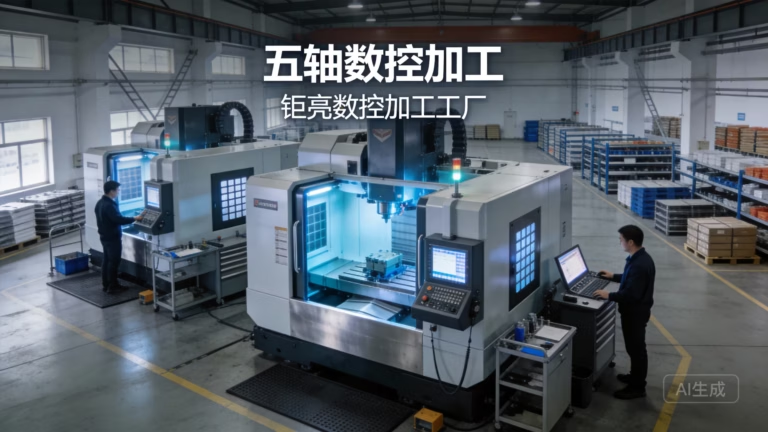
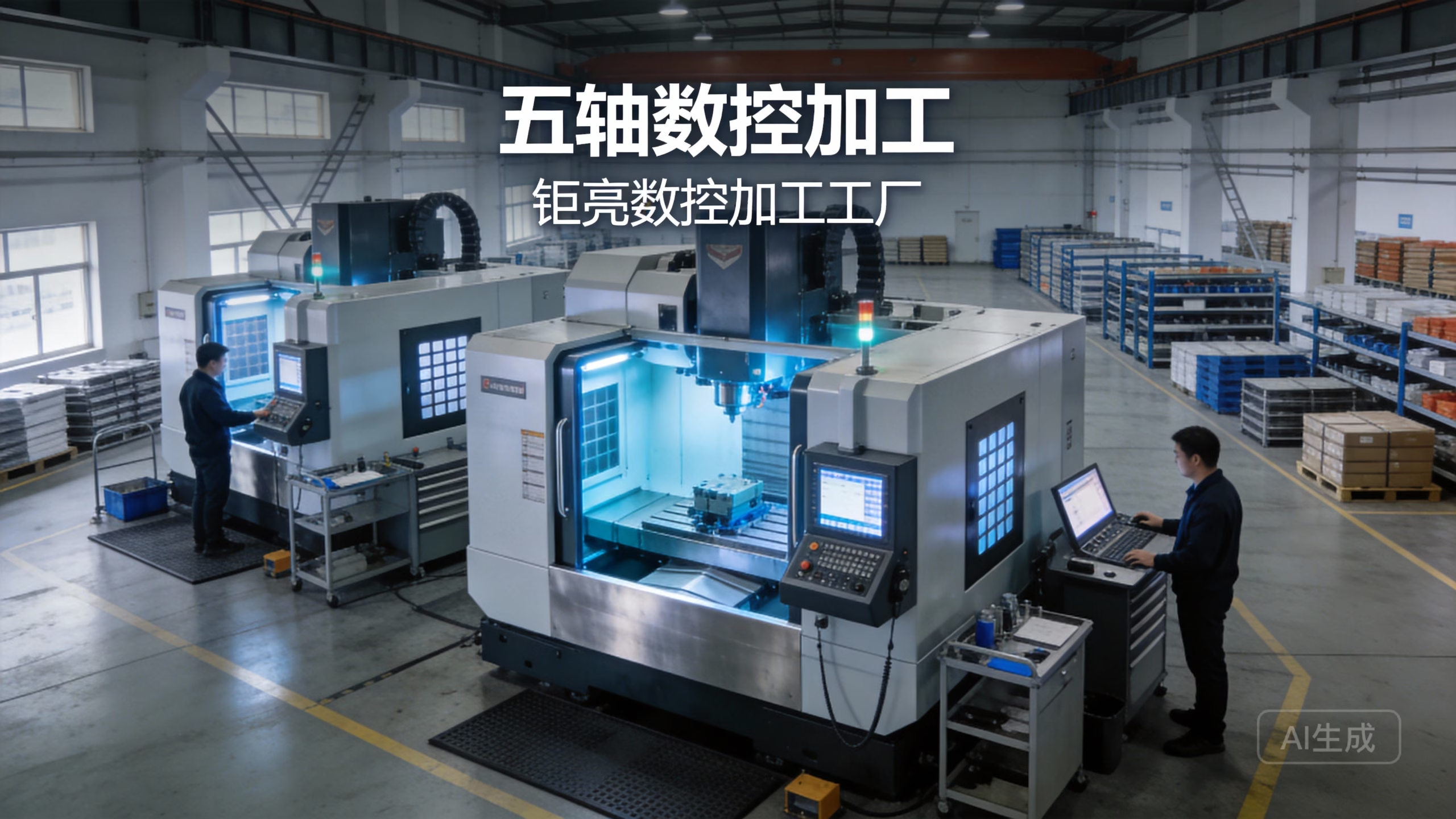
5-axis CNC machining, often associated with metal billet work, also applies to sheet metal when complex cutouts, bevels, or chamfers are needed. A 5-axis laser can cut angled edges ready for welding without separate milling. Our precision 5-axis CNC machining services{rel=”ugc noopener noreferrer” target=”_blank”} expand into sheet metal hybrid processing where a single machine performs cutting, tapping, and countersinking in one setup, eliminating secondary fixtures.
Tip 4: Leverage Advanced CNC Technologies to Skip Secondary Ops
Modern sheet metal CNC isn’t just punching and bending—it’s a suite of integrated technologies:
Laser-punch combo centers (e.g., Trumpf TruMatic) perform contour cutting, forming, tapping, and deburring in one cycle. What used to take three machines now runs unattended.
Adaptive bending cells with angle measurement correct springback in real time, meaning tighter tolerances without slower manual adjustment.
5-axis CNC press brakes can form complex multi-flange geometries in one handling, where a traditional 3-axis brake would require flipping and repositioning the workpiece multiple times.
At GreatLight Metal, our shop floor houses 127 precision peripherals including such 5-axis and combo equipment. This vertical integration means we can produce a sheet metal housing with integrated heat sink fins, threaded holes, and mounting bosses without sending it to a separate machining department.
Tip 5: Rethink Finishing—Less Can Be More
Surface finishing often accounts for 30–50% of the part cost. Ask three questions:
Is a cosmetic finish truly necessary? Hidden internal brackets don’t need powder coating.
Can powder coat replace liquid paint or anodizing? Powder coating is cheaper, more durable, and generates less waste. For non-abrasive indoor uses, a simple grained vinyl paint can suffice.
Can you specify a textured finish? Textures hide minor scratches and reduce scrap rates; smooth high-gloss finishes magnify every defect, driving up rework.
Our post-processing one-stop service at GreatLight includes silk-screening, pad printing, plating, and powder coating. We frequently consult with clients on downgrading a Class A surface to Class B on non-visible areas, cutting finishing costs by 20% instantly.
Tip 6: Partner with a Full-Stack Manufacturer Who Controls the Chain
Dealing with separate vendors for laser cutting, bending, welding, finishing, and assembly introduces:
Margins stacked by each intermediary.
Communication gaps leading to errors.
Shipping costs and delays between each stage.
A vertically integrated partner manages everything from CAD to crate. GreatLight Metal Tech Co., LTD. operates as a single-source manufacturer: CNC machining (3-axis through 5-axis), die casting, sheet metal, 3D printing, and full finishing under one roof. This consolidation eliminates hand-off mismatches and logistics loops. For one automotive sensor enclosure project, we delivered finished assemblies in 12 days compared to the client’s previous 28-day fragmented supply chain, at 18% lower total landed cost.
When comparing suppliers (whether large platforms like RapidDirect, Xometry, or a boutique shop like Owens Industries), look beyond the unit price PDF. Evaluate:
Does the provider offer in-house tooling? Outsourced bending tools increase lead time and risk.
Are they certified to ISO 9001:2015? GreatLight’s ISO 9001 certification ensures repeatable quality, while our IATF 16949 credential counts for automotive supply chains and ISO 13485 for medical devices.
Do they provide engineering support before quoting? A responsive engineering team that flags cost drivers in your initial design is worth more than a 5% lower quote.
Tip 7: Productionize with Automation-Friendly Tolerances
Prototype-grade tolerances are a money pit when you scale. Redefine your drawing to:
Use general tolerances per ISO 2768-mK for non-critical dimensions. Reserve ±0.05mm only for mating interfaces.
Standardize hole sizes to eliminate tool changes on the punch press or laser. Using M3, M4, M5 threaded inserts exclusively instead of a mix of UNC and metric reduces tooling stations and programming time.
Design parts to be pick-and-place (PnP) friendly for automated bending. Avoid features that nest or snag. Smooth guide edges allow robotic material handling, which reduces labor cost in volumes above 500 pcs.
One electronics enclosure we mass-produce for a medical device startup originally had 23 unique hole diameters and six bend dimensions. After rationalization, we cut to 12 standard holes and three bend settings. The CNC bending program shortened by 40%, and material setup time dropped from 4 hours to 45 minutes per batch.
Case in Point: How One Client Saved 45%
A renewable energy firm approached us with a power inverter chassis that cost $68 per unit from their previous supplier. Analysis revealed:
The 2.0mm 6061-T6 aluminum specified was only widely available in mill finishes, forcing an extra polishing+anodizing step.
12 PEM studs were pressed individually instead of being grouped into a single laser-cut insert plate.
The enclosure had a separate mounting flange welded on.
We proposed switching to 1.6mm 5052 aluminum (which arrives pre-anodized in standard coils), embedding the mounting flange into the bend pattern, and using self-clinching studs on a shared stripper plate. The re-engineered part cost $37.50—a 45% reduction—while passing all IP65 and vibration tests. Production lead time fell from 5 weeks to 12 days.
Partnering for Long-Term Gains
Cost reduction isn’t a one-shot redesign; it’s a continuous collaboration. At GreatLight CNC Machining, we pride ourselves on being more than a transaction vendor. Our data-secure environment (ISO 27001 compliant) protects your IP, while our engineering team monitors tool wear and machine utilization to suggest next-batch optimizations. Many of our clients see an additional 5–8% cost erosion per year simply because we refine nesting, tool strategies, and finishing recipes as volumes grow.
For highly sensitive or high-volume programs, consider that GreatLight’s die casting and CNC machining divisions can produce hybrid metal assemblies—like a sheet metal enclosure with a precision-machined baseplate—faster and cheaper than anyone producing them separately.
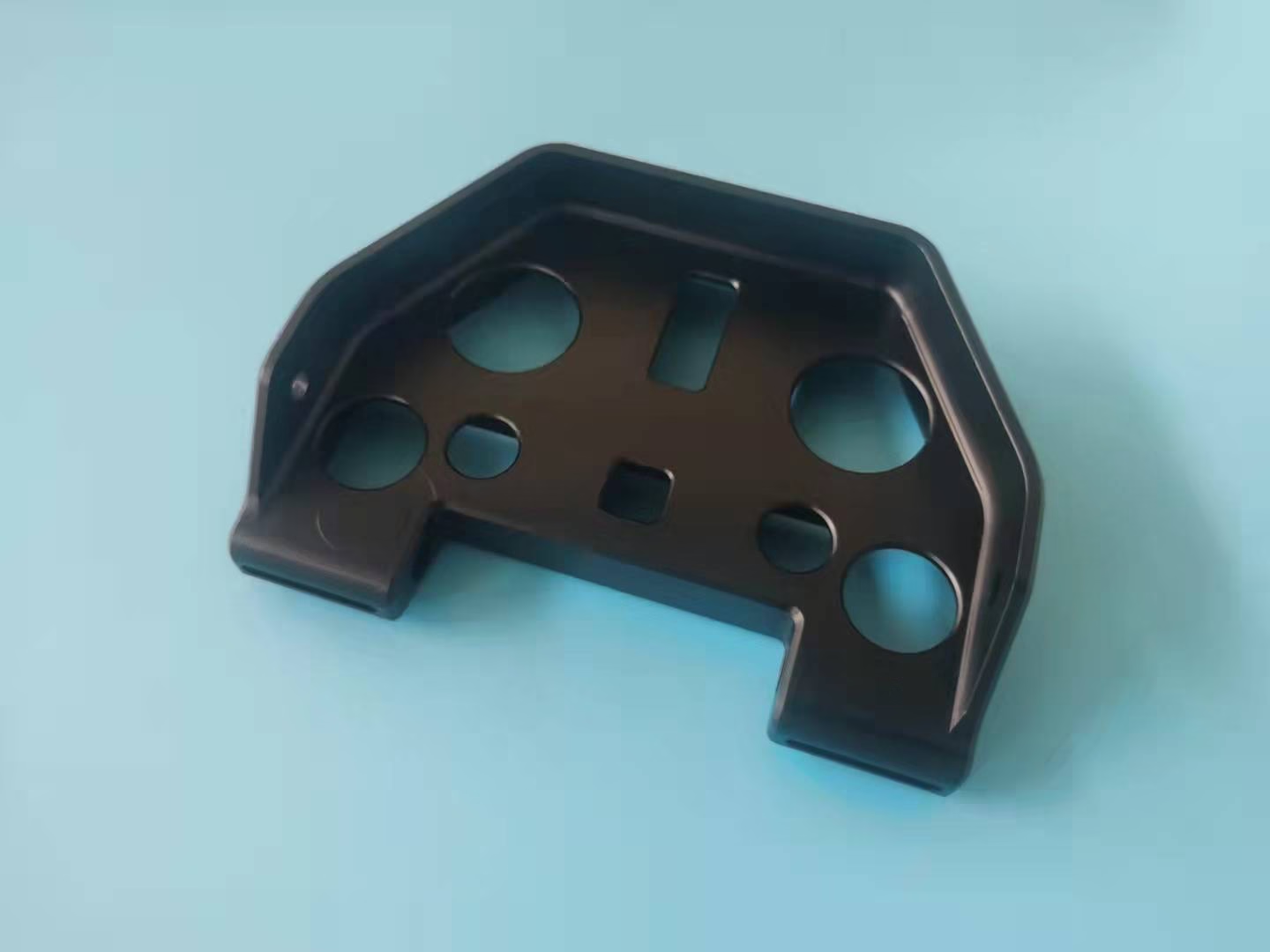
Whether you’re launching a new product or re-sourcing an existing line, remember: Sheet Metal CNC Costs Too High? 7 Pro Tips to Slash Them Now are your blueprint for competitive, high-quality manufacturing. Cost efficiency doesn’t spring from cutting corners—it grows from smarter engineering, proven technology, and a manufacturing partner who treats your spend like its own. If you’d like an honest evaluation of your next sheet metal project, explore how GreatLight CNC Machining{rel=”ugc noopener noreferrer” target=”_blank”} integrates expertise, certifications, and advanced equipment to turn cost challenges into precision deliverables.



















