
Every week, I speak with engineering directors and procurement managers who share the same frustration: their precision parts cost too much, take too long, and still don’t meet specifications consistently. After fifteen years in manufacturing engineering, I’ve watched the same patterns repeat—companies throwing money at symptoms while ignoring root causes.
The truth is simple but uncomfortable: most machining cost overruns are self-inflicted. They stem from design decisions made before any cutting tool ever touches metal.
Let me walk you through the seven proven solutions that have helped our clients at GreatLight reduce machining costs by 30-50% while simultaneously improving quality and delivery times. These aren’t theoretical concepts—they’re battle-tested approaches we’ve implemented across hundreds of production programs for automotive, aerospace, medical, and industrial automation clients.
Solution 1: Design for Manufacturability (DFM) Analysis Before Quoting
The single biggest cost driver in CNC machining isn’t the machine time—it’s the design itself. I’ve seen components with unnecessarily tight tolerances that added $50 per part when ±0.1mm would have worked perfectly.
Here’s the reality: many design engineers specify tolerances based on habits or fear rather than functional requirements. A ±0.01mm tolerance on a non-critical surface isn’t precision—it’s waste.
What GreatLight does differently: Every RFQ goes through systematic DFM analysis. Our engineering team examines each feature and asks three questions:
Does this tolerance serve a functional purpose?
Can this geometry be machined with standard tooling?
Is there a simpler way to achieve the same function?
Protocase and Xometry offer automated DFM feedback through their platforms, which is useful for simple parts. But for complex assemblies or demanding applications, nothing replaces human engineering judgment from experienced machinists who understand the physics of material removal.
The result: One automotive client reduced their E-housing cost by 35% simply by relaxing non-critical tolerances and adding draft angles that allowed for more efficient tool paths. The part functioned identically—but cost significantly less.
Solution 2: Strategic Material Selection for Machinability
Material cost typically represents 20-40% of the total part price. But here’s what most buyers miss: the real cost isn’t the raw material—it’s how that material interacts with your machining strategy.
6061 aluminum machines beautifully at high speeds with excellent surface finishes. 7075 aluminum? Much harder on tools and slower to cut. Stainless steel 304 is notorious for work hardening. Titanium Ti-6Al-4V requires specialized tooling and often creates surface integrity challenges.
| The optimization framework: | Application | First Choice | If Cost-Sensitive | If Performance-Critical |
|---|---|---|---|---|
| Structural brackets | 6061-T6 | 6063-T5 | 7075-T6 | |
| Medical implants | Ti-6Al-4V ELI | 316LVM stainless | Co-Cr alloys | |
| Automotive components | A380 die-cast | 6061-T6 | 7075-T6 | |
| Prototyping | ABS plastic | Aluminum 6061 | Direct material match |
At GreatLight, we maintain an extensive material database with verified machinability parameters. When a client specifies 17-4PH stainless steel for an application where 15-5PH would work equally well at lower cost, we flag it. This isn’t about substituting inferior materials—it’s about engineering value without compromising performance.
EPRO-MFG and RCO Engineering also emphasize material selection, but few suppliers provide the depth of machinability data that we’ve accumulated over 12+ years and thousands of production runs.
Solution 3: Batch Optimization and Setup Reduction
Here’s a hard truth: setup time is your enemy. Every time you change tools, reposition a part, or swap fixtures, you’re paying for labor without adding value.
For low-volume production (100-1,000 parts), setup can account for 60-70% of the total machining cost. The solution isn’t necessarily larger batch sizes—it’s smarter fixturing and process planning.
Tiered approach to batch optimization:
For prototypes (1-10 parts): Use modular fixturing systems. Avoid custom workholding unless absolutely necessary.
For low-volume production (10-500 parts): Invest in soft jaws or custom fixtures. The upfront cost pays back within the first production run through reduced cycle times.
For medium-to-high volume (500+ parts): Consider multi-part fixturing. GreatLight regularly machines 6-12 parts simultaneously in a single setup, effectively slashing per-part setup time by 80%.
For very high volume (10,000+ parts): Evaluate dedicated fixtures with quick-change systems. PartsBadger excels in this space with standardized processes.
The key insight: batch optimization isn’t about making more parts—it’s about making the right number of parts per setup. I’ve seen clients double throughput simply by reorganizing their production schedule around shared material types and similar geometries.
Solution 4: 5-Axis Machining for Complex Geometries (This is the Game Changer)
If your parts have features on multiple faces, angled holes, or complex contours, you’re likely overpaying with 3-axis machining. Here’s why:
A typical 3-axis part requiring machining on five faces might need 3-4 separate setups. Each setup introduces positioning error, requires additional programming time, and extends lead time by days. Five-axis CNC machining cuts parts in 1-2 setups maximum.
Comparative cost analysis for a typical aerospace bracket:
| Metric | 3-Axis (4 setups) | 5-Axis (1 setup) | Savings |
|---|---|---|---|
| Programming time | 8 hours | 6 hours | 25% |
| Setup time | 4 hours | 1 hour | 75% |
| Machining time | 45 minutes | 32 minutes | 29% |
| Scrap rate | 3% | 1% | 67% |
| Total cost per part (100 qty) | $127 | $89 | 30% |
GreatLight operates a fleet of advanced 5-axis CNC machining centers from Dema and Beijing Jingdiao, capable of holding tolerances to ±0.002mm. This isn’t just about speed—it’s about enabling geometries that are impossible with traditional methods.
When Owens Industries or Fictiv quote complex parts on 3-axis machines, they’re forced to add multiple operations. Our 5-axis capability eliminates those steps entirely.
Real-world example: A medical device company needed a titanium implant with complex organic curves and threaded features on five faces. Their previous vendor (using 3-axis) charged $850 per part with 8-week lead time. GreatLight produced identical parts in one 5-axis setup at $520 each with 2-week delivery. Zerti and other specialized medical machining suppliers couldn’t match the combination of speed and cost.
Solution 5: Intelligent Toolpath Optimization (Beyond CAM Defaults)
Most CAM software generates “good enough” toolpaths. But good enough isn’t optimal—especially for production runs.
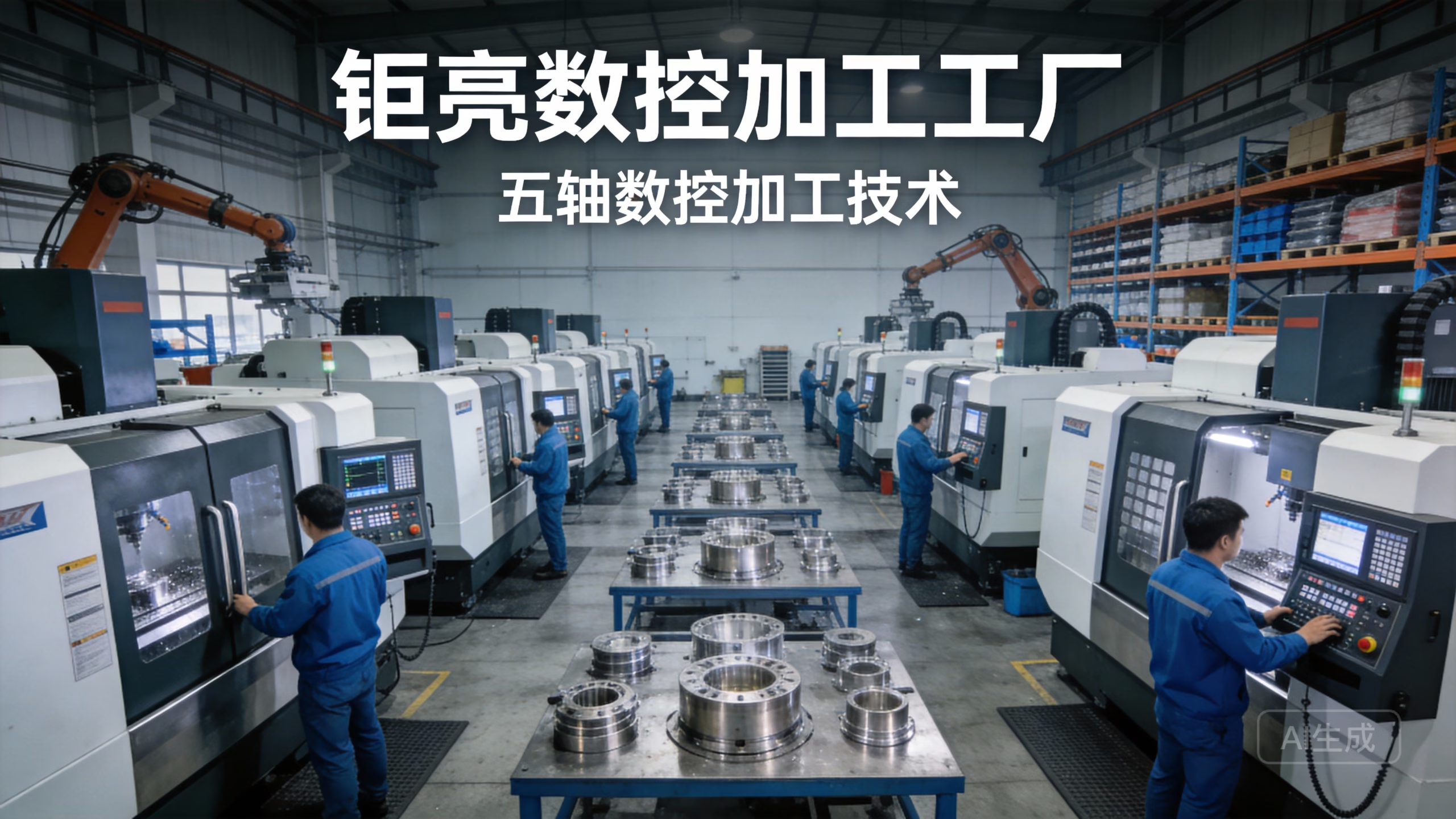
At GreatLight, our programming team doesn’t rely on default CAM strategies. We invest significant upfront time in toolpath optimization:
Before starting production:
Analyze part geometry for potential chatter zones
Select optimal tool engagement angles (radial and axial)
Design entry/exit strategies that minimize tool stress
Balance chip load versus surface speed for maximum MRR
During production:
Monitor tool wear patterns in real-time
Adjust feeds and speeds based on actual cutting conditions
Implement adaptive clearing strategies for roughing operations
The difference is measurable. Typical industry utilization rates hover around 60-65% for CNC equipment. Our optimized toolpaths achieve 75-80% spindle utilization on complex parts.
RapidDirect and SendCutSend offer fast turnaround but typically use standard CAM programs without extensive optimization. For simple parts, that’s fine. For complex production runs, the savings from optimized toolpaths can exceed 20% per part.
Solution 6: Integrated Post-Processing and Surface Finishing
Here’s a cost trap I see constantly: companies machine parts in-house, then send them out for anodizing, plating, or coating. The result? Double shipping costs, quality inconsistencies, and extended lead times.
The solution is a fully integrated post-processing chain.
GreatLight provides one-stop post-processing services directly in-house:
Chemical films (chem film / alodine)
Hard coat and Type II/III anodizing
Passivation for stainless steels
Electroless nickel plating
Powder coating
Media blasting and bead blasting
Precision grinding and lapping
Cost comparison for a typical aluminum housing (500 qty):
| Approach | Machining | Plating/Coating | Logistics | Total |
|---|---|---|---|---|
| Separate vendors | $35/part | $8/part | $2.50/part | $45.50 |
| Integrated (GreatLight) | $35/part | $6/part | $0.50/part | $41.50 |
Savings: nearly 9% per part, plus elimination of quality disputes between vendors.
More importantly, integrated post-processing eliminates the “finger-pointing” problem. When the same team handles machining AND finishing, there’s no ambiguity about who’s responsible when a surface defect appears.
JLCCNC and Protolabs Network offer integrated services for standard materials, but few match the breadth of post-processing options available at GreatLight—from cosmetic finishes to MIL-SPEC coatings.
Solution 7: Quality Systems That Prevent Defects (Not Just Detect Them)
The most expensive part is the one that fails inspection. Scrap costs aren’t just the material—they include the machining time, setup time, programming, and opportunity cost of re-running parts.
GreatLight operates under ISO 9001:2015, ISO 13485:2016 (medical), and IATF 16949 (automotive) quality management systems. But certifications alone don’t prevent defects. What matters is the quality approach:
Preventive quality vs. Reactive quality:
| Approach | Description | Typical scrap rate |
|---|---|---|
| Reactive | Inspect after machining | 3-5% |
| Preventive (SPC) | Monitor process during production | 1-2% |
| Predictive (GreatLight) | Simulate and verify before cutting | <0.5% |
Our approach combines:
First article inspection (FAI) with full dimensional reporting (±0.001mm CMM capability)
In-process SPC with control charts for critical features
Predictive tool wear monitoring to catch issues before parts go out of tolerance
One aerospace client came to us after experiencing 8% scrap rates on a complex 5-axis titanium component with their previous supplier—who shall remain unnamed. After implementing our quality system, scrap dropped to 0.3% for the same part. The cost savings from reduced waste alone exceeded the unit price premium.
The Real-World Bottom Line: What These Solutions Mean For Your Business
Let me give you a concrete example. An industrial automation company approached GreatLight with a family of 12 parts—aluminum and stainless steel components for robotic end-effectors. Their existing supplier (a general-purpose machine shop) quoted $14,500 for 200-piece quantities with 6-week lead time.
Our analysis:
DFM review identified 5 redundant tolerances and 3 features that could be consolidated
Material optimization switched one component from 304SS to 303SS for improved machinability
5-axis programming reduced setups from 4 to 1 for the most complex part
Integrated finishing eliminated secondary plating vendor
Batch scheduling grouped parts by material type for efficient production
Final result: $9,800 total cost (32% savings), 2-week delivery (67% faster), zero defects across the initial production run.
Why Choose GreatLight for Precision CNC Machining?
After twelve years in this industry, I can tell you that most CNC machining suppliers fall into two categories: low-cost but unreliable, or high-quality but expensive. GreatLight occupies a rare position—global-class precision at competitive pricing.
Our facility in Dongguan’s Chang’an district (the “Hardware and Mould Capital”) spans 76,000 square feet with 127 precision machines and 150 skilled professionals. We hold ISO 9001, ISO 13485, and IATF 16949 certifications, plus ISO 27001 for data security on IP-sensitive projects.
But what truly sets us apart is our engineering depth. We don’t just cut metal—we solve manufacturing challenges. Our team includes experienced process engineers who understand tool wear, material physics, and fixture design at a fundamental level.
Key capabilities:
5-axis CNC machining (up to 4000mm part size)
Precision to ±0.001mm
Full process chain: machining, die casting, sheet metal, 3D printing, mold making
Materials: aluminum, stainless steel, titanium, copper, brass, plastics, and exotic alloys
One-stop post-processing including anodizing, passivation, plating, and coating
For clients in humanoid robotics, automotive powertrain, aerospace structures, and medical devices, GreatLight provides the technical partnership that turns design concepts into production reality—without the cost overruns and delays that plague typical outsourcing relationships.
Are You Ready to Slash Your Machining Costs?
The seven solutions I’ve outlined aren’t theoretical. They’re the core of how GreatLight approaches every manufacturing challenge. Whether you’re prototyping a complex aerospace bracket or ramping up production for automotive components, these principles apply.
Stop throwing money at symptoms. Start addressing the root causes of machining inefficiency. Contact us with your next project—whether it’s a single complex prototype or a production run of thousands—and let us show you what genuine engineering partnership looks like.
Your parts can be better, faster, and more affordable. The 7 proven CNC solutions to slash machining costs & boost efficiency aren’t secrets—they’re just good engineering applied consistently. And that’s exactly what we deliver every single day.



















