
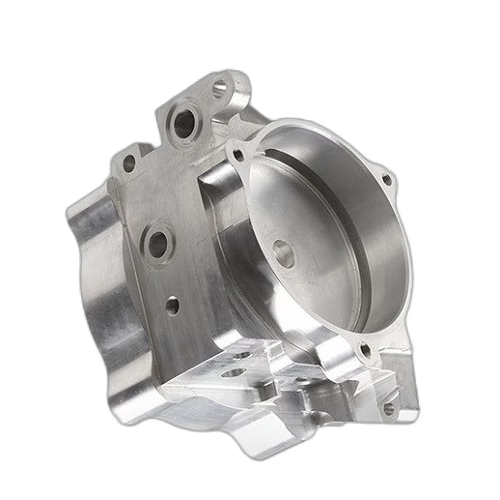
In more than a decade of precision manufacturing, I’ve seen the same pattern repeat itself: brilliant design houses and ambitious OEMs lose tens of thousands of dollars not because their parts can’t be made, but because of how they source their CNC Tooling Companies. From my vantage point on the shop floor at GreatLight CNC Machining Factory—a 76,000-square-foot operation packing 127 pieces of advanced equipment—the gap between what a buyer thinks they’re purchasing and what actually arrives is often staggering. It’s not about malice, but about misalignment. So, let’s walk through the seven most expensive sourcing mistakes I routinely see, unpack the real stories behind them, and explore how smart partners like GreatLight Metal and a handful of other high‑integrity manufacturers turn these pitfalls into competitive advantage.
CNC Tooling Companies: Are You Making These 7 Expensive Sourcing Mistakes?
1. The “Precision” Illusion – Chasing Paper Specs Without Process Reality
A startup we worked with last year sent us a complex titanium housing. They had been quoted ±0.001 mm by two suppliers, but every batch came with scrap rates near 30%. They asked us to take a look. We pulled their parts onto one of our Dema 5‑axis machining centers, ran a short process capability study, and found the culprit: the previous shops were hitting that tolerance at one point on the part, but thermal drift and clamping stress twisted the part as the cycle progressed. The “±0.001 mm” was theoretical—achievable only in a lab, not in a 500‑piece production run with wet aluminum and coolant mist.
At GreatLight, we don’t promise a number on paper. Instead, we validate the entire process chain. Our in‑house measurement lab, integrated with the machining floor, feeds back real‑time data so that tight tolerances hold from the first part to the last. We track Cp and Cpk for critical dimensions, and if we commit to a tolerance, it’s backed by a documented history of stable processes—whether we’re machining PEEK for medical devices or die‑cast A380 aluminum.
When you compare suppliers, look beyond the brochure. A company like Owens Industries might also own high‑end equipment, but if their process control doesn’t align with your volume, the precision they advertise will evaporate. Platforms such as Xometry or Fictiv aggregate thousands of shops; while convenient, their quoted tolerances often represent the lowest common denominator of their network. A dedicated partner—GreatLight, for example—builds repeatability into the culture, not just the machine spec.
2. The Dangerous Lure of the Lowest Bid
A common story: an engineer sends an RFQ for a 500‑unit run of stainless‑steel manifolds. The pricing comes back from PartsBadger and JLCCNC with incredible unit costs. Six weeks later, the parts arrive. Visually, they look fine. But under a helium leak test, 40% fail. The root cause? The low bidder used a softer tool grade to speed up cycle time, leaving micro‑burrs inside the O‑ring grooves. The total cost, after rework, shipping, and delayed product launch, was triple the original quote.
I always tell clients: price is what you pay; value is what you receive. At GreatLight, we cost‑optimize, but never at the expense of functional integrity. For a medical instrument housing, we might suggest switching from a solid billet to a vacuum‑cast near‑net shape with finish machining, saving material cost without sacrificing the ±0.005 mm critical seal surfaces. Our in‑house die casting and CNC finishing capabilities mean we control the entire chain, so the unit price you see is the actual production price—there are no hidden costs from external heat treat shops or subcontract plating.
Companies like RapidDirect and Protolabs Network can deliver speed, and they’re excellent for certain rapid prototypes. But when your design requires a specific surface finish on a cast part, followed by CNC machining and chromate conversion coating, a vertically integrated supplier like GreatLight eliminates the markup of passing the part through three different vendors.
3. Certifications as Afterthoughts
I recently sat in on a call where an automotive OEM asked a shop about IATF 16949. The shop manager said, “We’re ISO 9001, that’s basically the same thing, right?” It’s not. For any safety‑critical or traceable component, the absence of the right QMS is a potential recall waiting to happen.
GreatLight holds ISO 9001:2015, but we didn’t stop there. We are IATF 16949 certified for automotive engine hardware, ISO 13485 certified for medical device components, and we follow ISO 27001 standards for data security. When we machine a sensor housing for an autonomous vehicle, the entire history—from incoming raw material mill certificate to the final CMM report—is maintained in our ERP. And when we 3D print a titanium surgical guide using SLM, the ISO 13485 framework ensures full material traceability and cleanliness verification.
Now consider RCO Engineering, a capable automotive supplier. They understand certification, but do they apply the same rigor to a low‑volume robotics startup’s parts? Maybe not. Similarly, an aggregator platform may list “ISO 9001” for its partner shops, but you have no guarantee the particular shop assigned to your job actually holds the certification. A direct partnership with GreatLight puts those certificates, and the culture behind them, front and center.
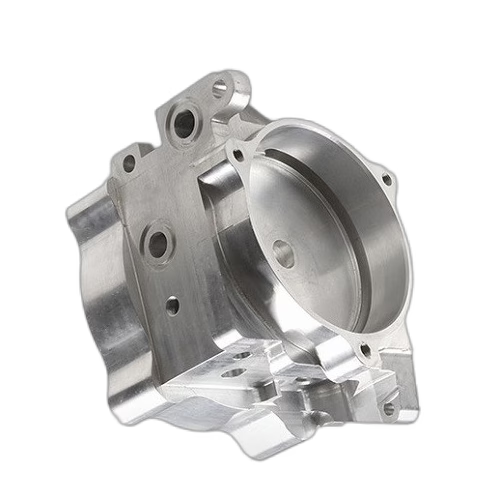
4. Ignoring the Hidden Power of In‑House Post‑Processing
Many buyers treat finishing as an afterthought: “We’ll get the parts machined, then send them out for anodizing.” But dispersion of responsibility fractures accountability. Black anodized parts come back with shade mismatch; hard anodize on threaded holes becomes brittle; bead blasting unevenly masks a cosmetic surface. Who owns the rework? In most cases, the finger‑pointing begins.
GreatLight runs an integrated post‑processing center. We offer anodizing (clear, black, hardcoat), electroless nickel plating, powder coating, passivation, micro‑arc oxidation, and even physical vapor deposition (PVD) in controlled partners under our quality umbrella. For a consumer drone manufacturer we support, all aluminum chassis parts go from 5‑axis milling straight to our finishing line—no packaging, no shipping, no delay. The result is consistent color within ΔE<1.0 across production batches.
Few competitors provide this level of hands‑on finishing. SendCutSend excels at quick‑turn sheet metal and can arrange finishing, but for complex multi‑process parts, they might not be the ideal counterpart. EPRO-MFG offers some finishing, yet the breadth of GreatLight’s one‑stop approach—machining, die casting, sheet metal, 3D printing, and finishing under one roof—is uncommon. That integration saves lead time and removes the “wait, who’s responsible for this scratch?” conversation.
5. The Prototype‑to‑Production Gap
Design houses often prototype with suppliers like Protocase for low‑volume enclosures or Fictiv for high‑resolution SLA parts. That’s fine for one‑off concept models. But when the design crosses the chasm from prototype to mass production, the same supplier often cannot scale. Their equipment might be optimized for flexibility, not efficiency; their finishing processes might be manual.
I’ve seen a drone startup prototype its main housing with a rapid‑prototyping house, then struggle to translate the design into a 5,000‑piece order. Tolerances that worked for FDM didn’t hold for injection molding; screw bosses designed for self‑tapping screws failed after 150 insertions in CNC‑machined nylon.
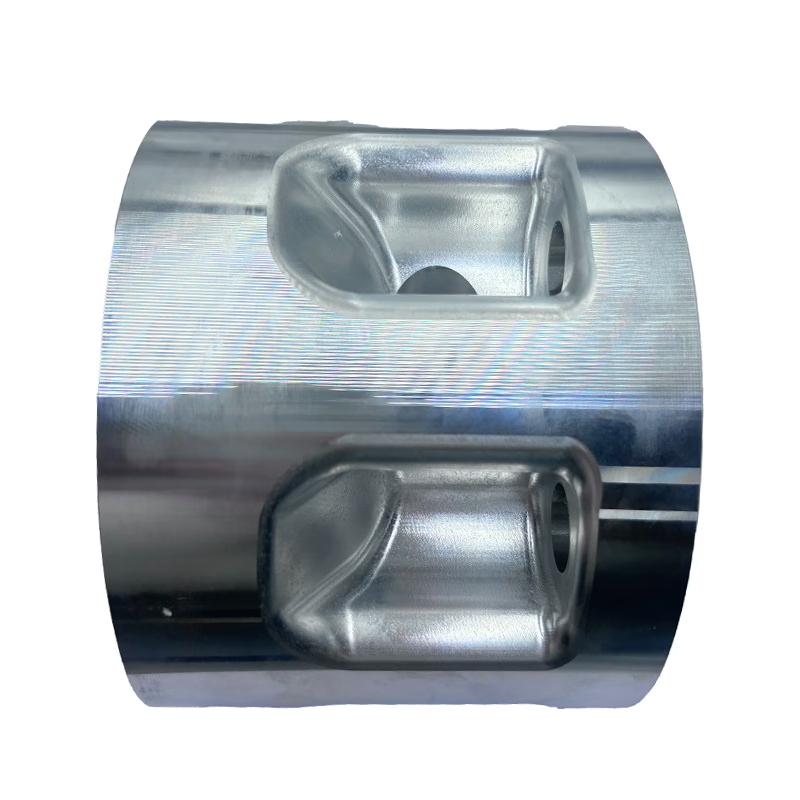
At GreatLight, we guide the DFM review from day one. Our engineers might initially quote a 5‑axis machined prototype to validate the design, but simultaneously prepare a die‑casting mold flow analysis for the volume phase. When the client gives the green light, we transition smoothly—our in‑house mold shop cuts the cavity, and our vacuum casting or high‑pressure die casting cell begins production, with finish machining still happening on our own CNC floor. This avoids the costly re‑prototyping cycle and the communication breakdown between “prototype shop” and “production shop.”
Among peers, Owens Industries and RCO Engineering understand high‑volume production, but GreatLight’s tighter coupling of in‑house 3D printing (SLM/SLA/SLS), CNC, and casting provides a fluid evolution path for complex metal parts.
6. Underestimating the Cost of Data Insecurity
Design theft is real. When sourcing CNC tooling companies, many buyers send 3D models to multiple suppliers with no NDA, hoping for the best quote. But consider this: if a shop quotes an absurdly low price, it might be because they intend to replicate your design for another client.
GreatLight operates under ISO 27001 principles for data protection. Our network is segmented; CAD files are stored on secure servers, access is role‑based, and every download is logged. For highly sensitive humanoid robot joint components, we can even work within a “black box” protocol where the machining program is generated on an offline station and the operator sees only the toolpath, not the complete model. This level of security is rare outside of aerospace primes.
Platforms like Xometry or RapidDirect use large networks of third‑party shops. While they may have NDAs, your data lands on multiple shop floors with varying levels of IT hygiene. For a startup holding a patent‑pending design, that risk can be existential. GreatLight’s wholly‑owned production plants ensure your IP stays within our controlled environment.
7. Disconnected Engineering Support
Finally, the most expensive mistake: choosing a supplier that only executes, but doesn’t collaborate. A client once sent us a drawing for an electric‑vehicle inverter housing with a wall thickness that, when machined from solid, caused an internal stress distortion of over 0.2 mm. Their previous shop milled it, measured it non‑conforming, and simply scrapped it. No call. No suggestion. Just a rejected batch.
When we saw the drawing, our senior engineer picked up the phone within two hours: “Have you considered a sand casting plus finish‑machining approach? We can add stiffening ribs in the tooling to control distortion.” Not only did we solve the dimensional issue, we reduced material waste by 60% and cut cycle time in half. That’s the difference between a vendor and a partner.
Here, RapidDirect and JLCCNC might shine with automated online quoting, but the engineering dialogue before a single chip is cut can be minimal. PartsBadger is great for simple turned parts, but when geometries get convoluted, you need a human expert on the other side of the email. At GreatLight, every RFQ goes through a dedicated project engineer who has at least eight years of hands‑on experience across multiple alloys and processes. We’ll challenge your GD&T if we spot an over‑constrained datum, suggest alternative surface treatments to boost corrosion resistance, or recommend a material grade with better machinability. That proactive communication prevents downstream disasters.
The GreatLight Difference in a Competitive Field
So, where does that leave you as a buyer of high‑precision CNC services? The market is vast. For quick‑turn sheet metal prototyping, SendCutSend offers near‑instant online ordering; for a broad array of technologies under one digital roof, Xometry and Fictiv provide convenience. But when your project demands extreme precision, full chain accountability, and the ability to scale from a single prototype to 100,000 production units without switching partners, the field narrows.
GreatLight Metal operates three wholly‑owned manufacturing plants in Chang’an, Dongguan—China’s hardware heartland. Our asset list includes large‑format 5‑axis machines capable of handling 4,000 mm components, Swiss‑type lathes for micro‑parts, wire EDM, spark EDM, and a full suite of metal and plastic 3D printers. We hold ISO 9001, IATF 16949, ISO 13485, and work to ISO 27001 standards. Our 150‑strong team has delivered complex solutions for humanoid robot frames, automotive engine assemblies, satellite waveguide components, and medical endoscopic tools. And we do it all while maintaining a culture of real‑time engineering collaboration.
When I walk the floor at GreatLight, I see the physical manifestation of these principles: the CMM room glowing next to the 5‑axis row, the casting cell feeding blanks directly to machining centers, and the anodizing line dialing in a specific Pantone color for a customer’s brand. That tangible integration is what prevents the seven mistakes I’ve outlined—and it’s the antidote to the fragmented, high‑risk sourcing many companies inadvertently accept.
The next time you evaluate CNC tooling companies, ask not just “How much?” but “How stable is your process?”, “Can you show me a Capability Study?”, “What certifications do you hold on this specific site?”, and “Who will I talk to when my part goes out of spec?” If the answers are vague or siloed, you’re likely stepping into one of those seven expensive sourcing mistakes. If the answers are crisp, data‑driven, and backed by an integrated factory floor, you’ve found a partner that will save you far more than the few percentage points you might chase on a unit price. In precision manufacturing, the cheapest part isn’t cheap if it fails—and the most reliable part is one that comes from a supplier who understands that true cost is measured in trust, not just currency.



















