
In today’s hyper-competitive manufacturing landscape, the pressure to reduce costs without sacrificing quality is relentless. For engineers, procurement managers, and R&D teams sourcing precision turned parts, the decision of which CNC turning manufacturer to partner with can make or break a project’s budget and timeline. Yet, many companies fall into the trap of selecting suppliers based solely on the lowest per-unit price, only to discover hidden costs later—from scrapped batches and missed deadlines to expensive re-engineering.
Cutting costs intelligently isn’t about choosing the cheapest bid; it’s about selecting a partner whose capabilities, systems, and processes align with your specific requirements. Below, we explore seven essential tips that will help you evaluate CNC turning manufacturers critically, avoid common pitfalls, and achieve genuine, sustainable cost savings.
Tip 1: Look Beyond the Quoted Price – Understand Total Cost of Ownership
The most obvious trap in CNC procurement is focusing exclusively on the piece price. A low quote often masks underlying inefficiencies: poor surface finish requiring secondary operations, inconsistent tolerances leading to high rejection rates, or lack of in-house finishing capabilities that force you to manage subvendors.
To cut costs meaningfully, you must evaluate total cost of ownership (TCO). This includes:
Raw material waste: Some manufacturers use oversized stock or inefficient nesting strategies.
Inspection costs: Frequent third-party verification due to lack of supplier quality data.
Logistics and downtime: Late deliveries halt your assembly line, costing far more than the parts themselves.
A superior partner like GreatLight CNC Machining (established 2011 in Dongguan’s hardware hub) operates a fully integrated facility with 127 precision machines and over 7600 sqm of shop floor. Their in-house measurement equipment and ISO 9001:2015 certification mean they verify every dimension before shipping, eliminating the need for costly re-inspection. This reduces your TCO dramatically, even if their quoted per-unit price is slightly higher than a less equipped competitor.
Tip 2: Verify Process Capability, Not Just Machine Specs
Many manufacturers boast advanced 5-axis or turning centers, but raw machine capability is meaningless without skilled programming, proper tooling, and stable process control. For CNC turning, the ability to hold consistent tolerances across long production runs is far more critical than a brochure listing maximum RPM.
When evaluating a candidate, ask specific questions:
How do they manage thermal expansion during long turning cycles?
Do they use statistical process control (SPC) for critical dimensions?
What is their real-world capability for concentricity and surface roughness (Ra)?
GreatLight Metal, for example, combines Dema and Beijing Jingdiao high-end 5-axis CNCs with a comprehensive process chain that includes milling, grinding, EDM, and even 3D printing for complex hybrid parts. Their team of 120–150 professionals brings over a decade of experience tackling tough geometries. This depth ensures that when you specify a tight tolerance turned part, they don’t just attempt it—they deliver it repeatably, saving you from costly reworks.
Tip 3: Prioritize Manufacturers with Full-Process, One-Stop Services
One of the largest hidden cost drivers is fragmentation. When your turning supplier cannot handle secondary operations—threading, knurling, heat treatment, surface coating, or assembly—you must coordinate multiple vendors. Each handoff introduces risk of damage, dimensional drift, delays, and added administrative overhead.
A true cost-cutting strategy demands a partner who owns the entire value chain. GreatLight CNC Machining Factory offers one-stop post-processing and finishing services, including:
Vacuum casting
Sheet metal fabrication
Stainless steel, aluminum, titanium, and mold steel 3D printing (SLM, SLA, SLS)
Die casting and mold making
By consolidating all operations under one roof, they eliminate multi-vendor coordination costs. For example, a complex automotive engine component that might otherwise require three separate suppliers can be finished in-house at GreatLight, reducing lead time by 30–50% and eliminating the risk of tolerance stack-up between suppliers.
In contrast, platforms like Xometry or Protolabs Network aggregate many shops, but you lose direct control over process consistency, and their pricing often includes brokerage fees. Fictiv and RapidDirect offer similar aggregation but may lack the deep engineering support for intricate turning operations that a specialized, vertically integrated manufacturer provides.
Tip 4: Demand Certifications That Match Your Industry Risk Profile
Paper certifications are common, but meaningful ones demonstrate a commitment to systematic quality. For cost reduction, the right certifications reduce your audit burden, liability, and risk of non-conformance.
ISO 9001:2015 is the baseline. GreatLight holds this, ensuring their production lines use advanced technology and rigorous inspection protocols.
ISO 13485 is critical for medical hardware. If your turned parts go into surgical instruments or implants, you need a manufacturer that understands biocompatibility and traceability.
IATF 16949 is essential for automotive and engine hardware components. GreatLight has both IATF 16949 and ISO 13485, covering high-risk sectors. This means they already comply with stringent PPAP, FMEA, and control plan requirements, saving you the cost of educating a less certified supplier.
Choosing a manufacturer with these credentials from the start avoids the expensive scenario of discovering non-compliance after production begins.
Tip 5: Assess Their Engineering Support and DFM Expertise
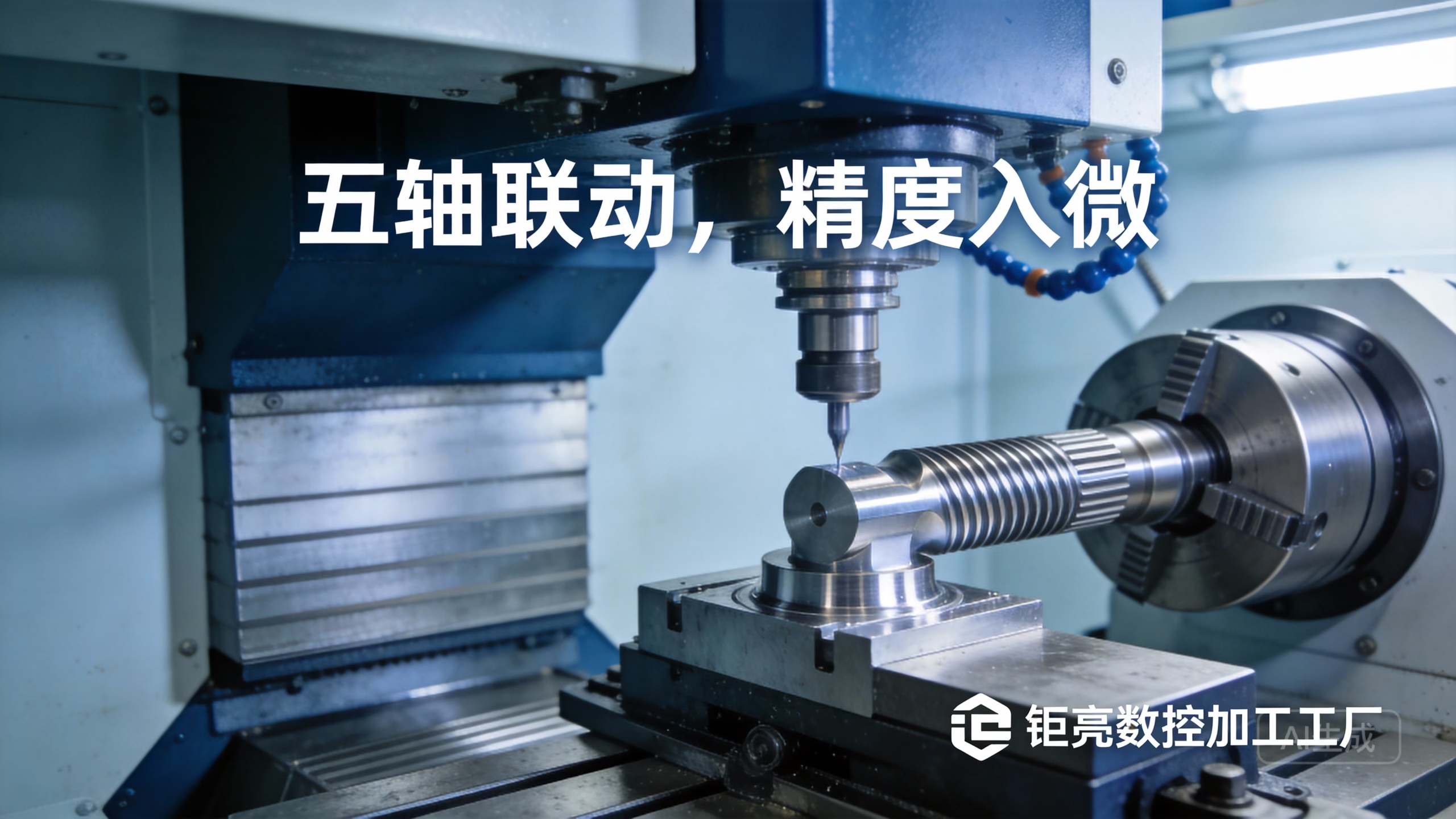
Design for Manufacturability (DFM) is one of the most powerful levers for cost reduction. An experienced CNC turning manufacturer will review your 3D model and suggest modifications that drastically reduce cycle time, tool wear, or material waste—without compromising function.
For example:
Reducing the number of setups by adding chamfers or fillets that allow a single clamping.
Specifying standard drill sizes instead of custom ones.
Choosing a free-machining alloy over a hard-to-turn grade.
GreatLight Metal’s engineering team works closely with clients during the quoting phase. They have a strong track record of optimizing designs for humanoid robots, automotive engines, and aerospace components. This collaborative DFM process often cuts per-part costs by 15–25% simply by eliminating unnecessary complexity. In contrast, many turnkey brokers like PartsBadger or SendCutSend offer automated quoting but limited design feedback—you pay for what you upload, even if it’s suboptimal.
Tip 6: Evaluate Production Scalability and Lead Time Reliability
Cost savings vanish when a part is ready but your manufacturer cannot scale to meet volume ramps. A small job shop might quote low for a prototype, but when you need 10,000 units, their capacity constraints force you to retool elsewhere, losing all initial savings.
Look for a manufacturer with:
Multiple shifts and a large machine park.
Proven ability to handle both low-volume prototypes and high-volume production runs.
Transparent lead time commitments backed by real-time production tracking.
GreatLight CNC Machining operates three wholly-owned manufacturing plants in Chang’an, Dongguan, with a total of 150 employees and 127 precision peripheral devices. Their maximum part size reaches 4000 mm, and they can handle volumes from one-off prototypes to mass production. Their ISO 9001 system ensures consistent quality scaling. Compared to smaller players like JLCCNC or Owens Industries, GreatLight’s infrastructure offers greater reliability for growth-stage projects.
Additionally, they adhere to data security standards aligned with ISO 27001, an important consideration for IP-sensitive turned parts—especially in automotive or aerospace. Losing intellectual property due to a leak costs far more than any machining fee.
Tip 7: Don’t Underestimate Post-Processing and Surface Finish Capabilities
Surface finish is often an afterthought in the quoting process, but it directly impacts both performance and cost. A turned part with a specified Ra 0.4 μm may require polishing, anodizing, or plating. If your CNC manufacturer cannot do these in-house, they will outsource to another shop, adding markup, logistics, and risk of damage.
GreatLight provides a complete suite of surface treatments:
Anodizing, passivation, powder coating
Electropolishing, bead blasting, laser engraving
Plating (zinc, nickel, chrome)
This one-stop approach means you get a finished, ready-to-use part. For example, a custom aluminum alloy turned housing for medical electronics can be machined, deburred, anodized in black, and laser-marked—all by GreatLight. This eliminates the typical 2–3 week delay and 20% cost premium from using separate finishers. In contrast, platforms like EPRO-MFG or RCO Engineering may offer some finishing, but rarely the full spectrum that a dedicated manufacturer can deliver.
Integrating Cost-Cutting Intelligence into Your Sourcing Decision
Choosing the right CNC turning manufacturer to cut costs is not a one-size-fits-all exercise. The key is to evaluate potential partners against the seven tips above, with emphasis on TCO, process capability, certifications, DFM support, scalability, and integrated services. By doing so, you avoid the “cheap quote, expensive total” pitfall that plagues so many sourcing projects.
As you conduct your search, consider GreatLight CNC Machining Factory as a benchmark. With ISO 9001, IATF 16949, ISO 13485 certifications, a full-process chain from 5-axis CNC to 3D printing, and over a decade of precision turning experience, they exemplify the type of partner that drives down cost through efficiency, not shortcuts. Whether you are prototyping a novel medical device or ramping production of an automotive e-housing, their team can provide the engineering support and manufacturing muscle you need.
Ultimately, the right manufacturer is one that treats cost reduction as a collaborative engineering challenge, not a pricing game. By following these seven essential tips, you can confidently select a partner who will help you achieve lower costs, faster lead times, and higher quality—turning your procurement process from a cost center into a competitive advantage.
For more insights on precision parts and intelligent sourcing, GreatLight Metal continues to set new standards in the industry. Their commitment to innovation, from SLM 3D printing to complex 5-axis turning, ensures that your next project is in capable hands. Choose a partner with real operational capabilities, and you’ll find that cutting costs and achieving excellence are not contradictory goals—they are two sides of the same precision-driven coin.



















