
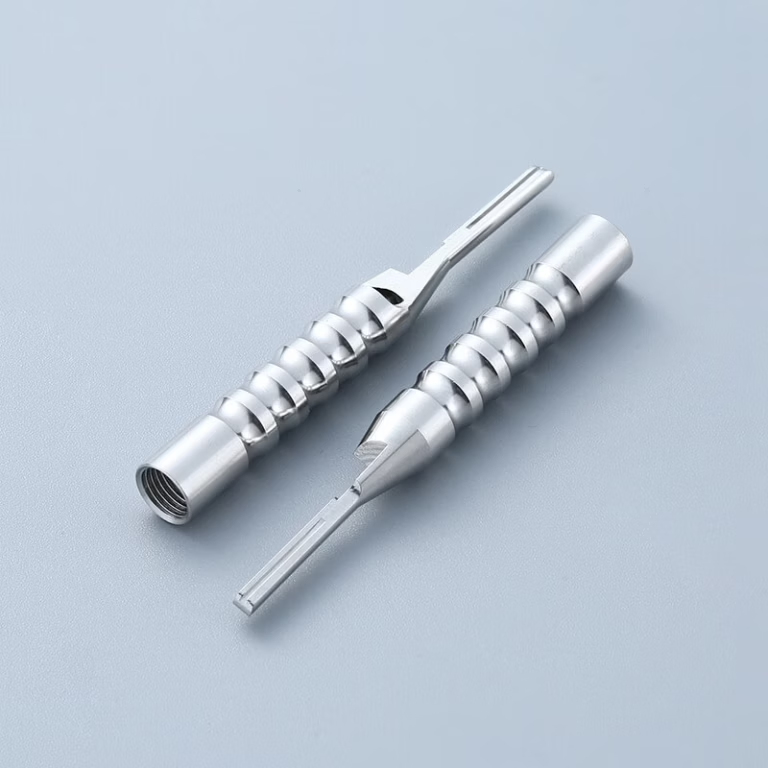
Introduction: The Hidden Cost of a Bad CNC Lathe Purchase
In the precision machining industry, few decisions carry as much weight as selecting the right CNC lathe machine for sale. Whether you are scaling up production, replacing outdated equipment, or entering a new market segment, the machine you choose today will define your manufacturing capabilities—and your bottom line—for years to come.
I have spent over a decade working in precision manufacturing, advising clients on equipment procurement from both the buyer’s and supplier’s perspectives. What I have observed time and again is that many organizations, even seasoned engineering teams, fall into predictable traps that turn a promising investment into a costly liability.
This article is not a generic list of product features. It is a practical, engineer-to-engineer guide built on real-world lessons from the shop floor. I will walk you through seven critical factors that separate a smart purchase from a regretful one, helping you avoid common pitfalls and find the CNC lathe that truly fits your production requirements.
Secret #1: Verify Precision Claims – Look Beyond the Spec Sheet
Every CNC lathe manufacturer boasts about precision. You will see terms like ±0.001mm, sub-micron accuracy, and high repeatability plastered across brochures and websites. However, there is often a significant gap between what a machine is capable of under ideal conditions and what it delivers in daily production.
The Reality Check
I have evaluated machines from suppliers who promised exceptional tolerances but could not maintain them after the first few hundred parts. The issue is not always dishonesty—it is about context. Many precision claims are based on controlled laboratory environments with stable temperature, optimal tooling, and specific materials.
When you are evaluating a CNC lathe for sale, ask for:
CMM inspection reports from actual production runs, not just test cuts
Long-term repeatability data over multiple production cycles
Temperature compensation capabilities and how they affect real-world accuracy
For example, GreatLight Metal, which operates a modern 76,000 sq. ft. facility with brand-name 5-axis CNC machining centers and high-precision lathes, maintains tolerances as tight as ±0.001mm through rigorous in-process inspection and environmental controls. When a supplier can demonstrate consistent results rather than theoretical maximums, you are looking at a trustworthy partner.
Secret #2: Match the Machine to Your Material Profile
One of the most common mistakes I see is purchasing a versatile machine that turns out to be suboptimal for the specific materials being machined. A CNC lathe that excels with aluminum may struggle with hardened steel, and what works for stainless steel might be overkill for plastics.
Material-Machine Compatibility
Consider these factors:
Spindle power and torque curve – Does it match the cutting characteristics of your primary materials?
Rigidity and damping – Heavier, more rigid machines are essential for difficult-to-machine alloys
Coolant system design – High-pressure through-spindle coolant is critical for deep-hole drilling in materials like titanium
Chip management – Different materials produce different chip types; your machine’s evacuation system must handle them
When suppliers like Protolabs Network or Xometry offer quick-turn services, they often have a fleet of machines optimized for different material families. The same principle applies to your in-house procurement. Do not look for a single “do-everything” machine unless your production is genuinely diverse and low-volume.
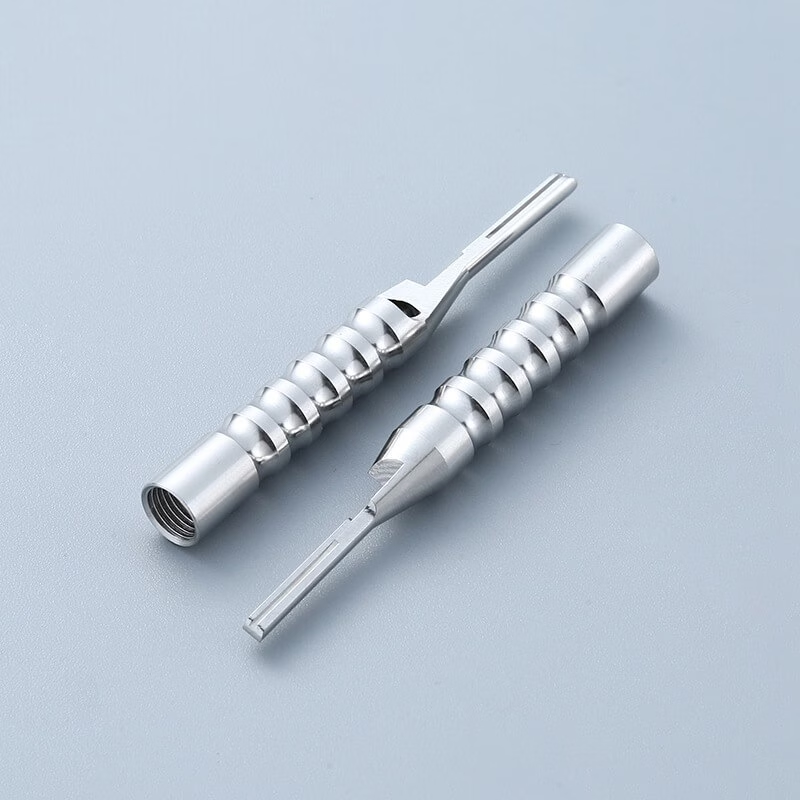
Secret #3: Evaluate the Certification Ecosystem – It Is More Than a Piece of Paper
You might think certifications are irrelevant when buying a used or new CNC lathe. In reality, the certification ecosystem of the manufacturer or supplier speaks volumes about their overall quality philosophy and long-term reliability.
What Certifications Actually Tell You
A supplier with ISO 9001:2015 certification has documented processes for quality management, equipment maintenance, and continuous improvement. But do not stop there. Look for:
ISO 13485 – If you work in medical device manufacturing, this indicates experience with regulated environments
IATF 16949 – Essential for automotive supply chain participants, signaling rigorous process control
ISO 27001 – Increasingly important for protecting intellectual property and client data in contract manufacturing
GreatLight Metal holds multiple certifications including ISO 9001:2015, ISO 13485, and IATF 16949, which is a strong indicator that their equipment operates within controlled, audited processes. When you buy from a certified manufacturer, you are not just getting a machine—you are gaining access to a system that ensures consistent output.
Secret #4: Look Beyond the Machine – Evaluate the Full Process Chain
Purchase decisions often focus narrowly on the lathe itself. While the machine is critical, its effectiveness depends on the entire manufacturing ecosystem around it.
Integrated Manufacturing Capabilities
Consider whether the supplier offers:
Precision CNC turning as part of a larger process chain including milling, grinding, EDM, and heat treatment
One-stop post-processing services such as deburring, surface finishing, and coating
Design for manufacturability (DFM) support to optimize your parts for the machine’s capabilities
Suppliers like GreatLight Metal provide full-process chain services spanning CNC machining, die casting, sheet metal fabrication, 3D printing, and mold manufacturing. When you partner with such a provider, the CNC lathe you select is not isolated—it integrates with other processes to deliver finished parts, not just raw-turn pieces.
This holistic view helps you avoid the costly mistake of buying a machine that produces excellent turned parts but creates bottlenecks downstream because you lack complementary capabilities.
Secret #5: Understand Total Cost of Ownership – Not Just the Sticker Price
The initial purchase price of a CNC lathe for sale is just the beginning. I have witnessed procurement teams celebrate a bargain only to be buried by maintenance costs, downtime, and poor resale value within two years.
What to Include in Your TCO Calculation
| Cost Category | Considerations |
|---|---|
| Purchase Price | Base machine, shipping, installation, commissioning |
| Tooling | Turret configuration, live tooling compatibility, tool presetting |
| Maintenance | Spare parts availability, service technician access, software updates |
| Training | Operator training, programming adaptation, setup time reduction |
| Downtime Risk | Mean time between failures (MTBF), local support response time |
| Energy Efficiency | Power consumption per part, coolant and waste disposal costs |
Fictiv and RapidDirect are examples of service providers who invest heavily in modern, well-maintained equipment because they understand that machine reliability directly impacts client satisfaction and cost per part. When evaluating any CNC lathe, request service records and speak with current users about real-world maintenance experiences.
Secret #6: Check the Communication and Support Infrastructure
This is an often-overlooked factor, but I have seen it make or break operations. A technically excellent machine becomes a liability if the manufacturer or supplier cannot communicate effectively or provide timely support.
The Support Matrix
Look for:
Technical documentation – Clear, comprehensive manuals in your preferred language
Remote diagnostics – Capability to troubleshoot issues via secure connections
Local service network – Technicians who can be on-site within hours, not days
Spare parts warehouse – Critical components stocked and accessible
Manufacturers like GreatLight Metal combine technical expertise with robust communication systems, ensuring that clients can reach decision-makers and technical teams without bureaucratic delays. When you are dealing with a complex integration—such as linking a new lathe to your existing CAM software and automation—having responsive support is invaluable.
Secret #7: Inspect the Actual Production Environment – Virtual Tours Are Not Enough
I know this sounds old-fashioned in an era of digital twins and AI-driven design, but nothing replaces seeing a machine in its working environment before making a purchase decision.
What to Look for on a Site Visit
Housekeeping – Clean, organized floors indicate disciplined operations
Operator behavior – Are procedures followed consistently? Is safety prioritized?
Machine age and condition – Are machines well-maintained or showing neglect?
Documentation – Are setup sheets, inspection reports, and maintenance logs accessible?
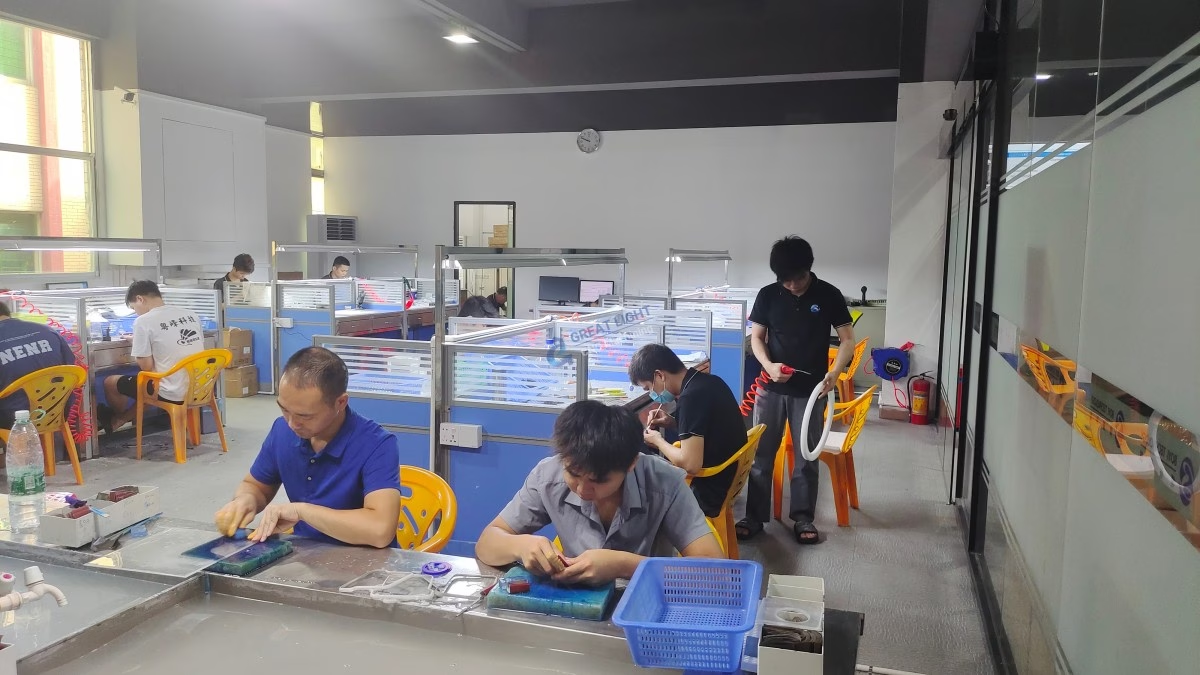
GreatLight Metal, for example, operates from a facility in Chang’an Town, Dongguan—the “Hardware and Mould Capital” of China. A visit to their shop floor would reveal 127 pieces of precision peripheral equipment, organized production cells, and a team of 120-150 professionals working in an ISO-certified environment. You can see firsthand how their five-axis and four-axis machining centers, lathes, and grinding machines are maintained and operated.
If a supplier hesitates to schedule a physical inspection or offers only virtual tours, consider it a red flag. The most reliable sources for CNC lathes for sale are those who are transparent about their operations.
Conclusion: Make Your CNC Lathe Investment Count
Finding the best CNC lathe machine for sale requires more than comparing spec sheets or chasing the lowest price. It demands a systematic evaluation of precision capabilities, material compatibility, certification credibility, integrated process chain, total ownership costs, support infrastructure, and physical production environment.
The seven secrets I have shared here are built on decades of collective experience in precision manufacturing—from startups prototyping their first designs to established enterprises scaling production. By applying these principles, you will avoid costly mistakes and secure a machine that delivers consistent, high-quality parts for years to come.
Whether you are evaluating equipment from GreatLight Metal, EPRO-MFG, Owens Industries, or PartsBadger, remember that the best decision is an informed one. Take the time to verify claims, understand the full cost picture, and inspect actual operations. Your bottom line—and your reputation as a manufacturer—depends on it.
For more information about precision CNC machining services and equipment selection, visit the GreatLight CNC Machining Factory’s official page at Precision 5-Axis CNC Machining Services and connect with industry professionals through their LinkedIn company page.



















