
In the competitive landscape of precision manufacturing, every dollar saved on production directly impacts your bottom line and time-to-market. For engineers and procurement professionals navigating the complexities of custom parts manufacturing, understanding how to optimize CNC machining costs is not just a financial exercise—it’s a strategic advantage. Whether you’re developing a humanoid robot prototype or producing aerospace components, the principles of cost-effective machining remain consistent. Let’s explore five essential strategies that can dramatically reduce your production expenses while maintaining the rigorous quality standards your projects demand.
Tip 1: Design for Manufacturability (DFM) from Day One
The single most impactful factor in controlling CNC machining costs happens long before any tool touches metal. Design for Manufacturability, or DFM, is the practice of engineering your parts with the capabilities and limitations of five-axis CNC machining services in mind. When you design with manufacturing in mind, you eliminate unnecessary complexity that drives up cycle times, tool wear, and scrap rates.
Critical DFM Considerations That Save Money
Simplify Internal Geometries: Deep cavities, sharp internal corners, and complex undercuts require specialized tooling and slower machining speeds. By specifying standard corner radii (typically 0.5mm to 3mm) and avoiding features that demand custom end mills, you can reduce machining time by 20-40%. For example, a part requiring a 0.1mm internal radius might need a custom ground tool costing $200-500, while a 0.5mm radius uses standard tooling costing $30-50.
Reduce the Number of Setups: Every time a part must be repositioned on the machine, you introduce potential for error and add significant time. Five-axis machining excels at accessing multiple faces in a single setup, but even this capability has limits. Design features that require minimal repositioning. Experienced CNC machining providers like GreatLight Metal routinely review client designs and suggest modifications that consolidate operations—often reducing setup count from six to just two, cutting costs by 30%.
Optimize Wall Thickness: Excessively thin walls (under 0.5mm in metals) risk vibration during machining, requiring slower speeds and multiple finishing passes. Conversely, unnecessarily thick walls waste material and machining time. The sweet spot for most aluminum parts is 1.5-3mm, balancing structural integrity with machinability. For stainless steel, 1-2mm walls are typically optimal.
Avoid Tight Tolerances Where Unnecessary: Specifying ±0.01mm when ±0.1mm would suffice is like paying for a Rolls-Royce when a reliable sedan will do. Each additional decimal place of precision can double or triple machining time. Review your critical dimensions carefully—often only 10-20% of features truly require tight tolerances for functionality. GreatLight Metal’s engineering team frequently works with clients to identify which tolerances are critical and which can be relaxed, achieving 15-25% cost reductions without compromising performance.
Tip 2: Select the Right Material and Minimize Waste
Material costs can represent 30-60% of total production expenses for CNC-machined parts. Smart material selection and efficient use of raw stock are among the fastest ways to cut costs.
Material Economics You Can’t Ignore
Standardize Where Possible: Using exotic alloys or uncommon grades drives up both material costs and machining difficulty. Whenever your application allows, specify readily available materials like 6061-T6 aluminum, 304 stainless steel, or 12L14 steel. These materials are cost-effective, well-characterized in machining processes, and available from multiple suppliers—preventing single-source dependencies.
Consider Near-Net Shape Manufacturing: For parts with significant material removal, starting from a solid block is extraordinarily wasteful. Casting or 3D printing a near-net shape, then finishing with precision CNC machining, can reduce material waste by 50-80%. GreatLight Metal’s integrated manufacturing capabilities allow clients to combine die casting with five-axis finishing, dramatically reducing both material costs and machining time. A typical automotive bracket that might require 8 hours of machining from solid billet can often be cast and finish-machined in under 3 hours.
Optimize Nesting for Sheet Goods: For parts machined from plate stock, intelligent nesting can increase material utilization from 40% to 70% or more. Advanced CAM software, combined with experienced programming, arranges parts to minimize scrap. This is particularly impactful for high-volume production runs where even a 5% improvement in yield translates to thousands of dollars saved annually.
Reconsider Surface Finish Requirements: A mirror-polished surface finish (Ra 0.1μm) requires multiple finishing passes and potentially hand polishing, adding hours to each part. For most functional applications, a standard machined finish (Ra 1.6μm) is perfectly adequate. If aesthetic requirements are driving finish specifications, consider whether the part will be visible in the final assembly—many internal components benefit from relaxed finish standards that save 10-20% in machining costs.
Tip 3: Leverage Process Optimization and Multi-Axis Machining
Modern five-axis CNC machining technology offers unprecedented opportunities for cost reduction when properly optimized. The key is understanding how to apply these capabilities effectively.
The Five-Axis Advantage for Cost Reduction
Reduce Cycle Time Through Simultaneous Machining: Five-axis machines allow cutting tools to approach the workpiece from any angle, enabling complex features to be machined in a single setup. This eliminates the multiple setups required by traditional three-axis machining, saving 2-4 hours per part on complex geometries. For aerospace impellers or medical implants with complex contours, five-axis machining can reduce total production time by 40-60%.
Improve Tool Life by Maintaining Optimal Cutting Angles: When a cutting tool approaches a surface at an unfavorable angle, it experiences uneven wear and increased heat generation. Five-axis machines can dynamically adjust tool orientation to maintain optimal cutting angles throughout the operation. This extends tool life by 30-50%, reducing tool change frequency and associated downtime. Over a production run of 1,000 parts, this can save $3,000-8,000 in tooling costs alone.
Enable Hard Milling to Eliminate EDM Operations: Traditional manufacturing often requires electrical discharge machining (EDM) for hardened materials or intricate cavities. However, modern five-axis machines with rigid construction and high-speed spindles can perform hard milling directly on materials up to 62 HRC. This eliminates the need for EDM electrodes, multiple setups, and the slow EDM process itself. Parts that previously required 12 hours of combined machining and EDM can often be completed in 4-6 hours of hard milling.
Implement High-Speed Machining Strategies: Advanced CAM software combined with five-axis capability enables trochoidal milling, peel milling, and other high-speed strategies that dramatically reduce cycle times. These methods use light radial engagement with high axial depth and feed rates, removing material rapidly while maintaining excellent surface finish. Typical cycle time reductions range from 30-50% compared to conventional machining approaches.
Tip 4: Choose the Right Partner with Scalable Capabilities
Your choice of CNC machining provider is perhaps the most critical decision affecting both cost and quality. Not all suppliers are created equal, and the cheapest per-part price often disguises hidden costs in quality issues, delays, and communication breakdowns.
What to Look for in a Cost-Effective Partner
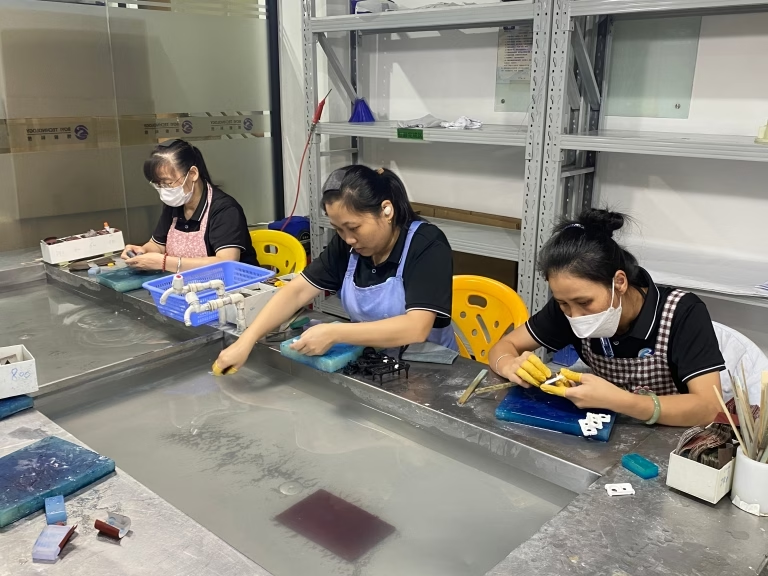
Full-Process Integration: Suppliers like GreatLight Metal that offer comprehensive services—from design review through machining, finishing, and quality inspection—eliminate the costs and risks of coordinating multiple vendors. When a single provider handles everything, there are no handoff delays, no quality disputes between suppliers, and no shipping costs for parts moving between facilities. This integrated approach typically saves 15-25% compared to managing a fragmented supply chain.
Certified Quality Systems: ISO 9001:2015 certification, like that held by GreatLight Metal, ensures documented processes, regular audits, and continuous improvement. This translates directly to cost savings through reduced defect rates, fewer rework cycles, and predictable delivery schedules. For automotive or medical applications, IATF 16949 or ISO 13485 certification provides additional assurance that production will meet stringent quality standards the first time, every time.
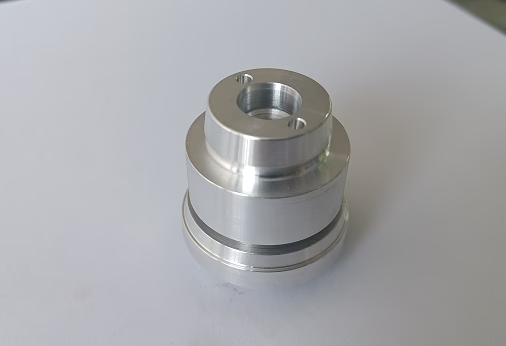
Advanced Equipment Portfolio: A supplier with a diverse machine shop can match the optimal process to each part feature. Large five-axis machines handle oversized parts efficiently, while precision Swiss-type lathes excel at small, complex components. Having all capabilities in-house means no part is outsourced—and no margin is added to a subcontractor’s work. GreatLight Metal’s 127 pieces of precision equipment, including large five-axis machining centers, ensure that your parts are machined on the most cost-effective machine for their geometry.
Engineering Support as a Service: The best suppliers don’t just machine parts—they help you improve them. Look for partners that offer DFM feedback, material recommendations, and process optimization suggestions. GreatLight Metal’s engineering team regularly identifies opportunities to reduce part count, simplify features, or substitute materials, often achieving 20-30% cost reductions before a single chip is cut. This collaborative approach transforms a transaction into a partnership that continuously drives down costs.
Tip 5: Optimize Order Quantities and Lead Times
The relationship between order quantity, lead time, and unit cost is not linear—understanding this dynamic can unlock significant savings.
Strategic Order Planning for Maximum Savings
Batch for Efficiency: While prototype quantities (1-10 parts) necessarily carry higher per-unit costs due to setup and programming time, moving to production quantities (100-5,000 parts) amortizes these fixed costs across more units. The tipping point varies by part complexity, but most designs see 40-60% unit cost reductions when moving from prototype to low-volume production. Work with your supplier to find the optimal batch size that balances inventory carrying costs against per-part pricing.
Combine Multiple Parts in One Order: If your project requires several different components, ordering them together rather than individually can yield significant savings. Setup and programming costs for the second and third parts are often lower because the machine has already been prepared for your material and tolerance requirements. Additionally, volume discounts on material procurement apply to the total order, not individual parts. GreatLight Metal frequently helps clients group orders to maximize these efficiencies.
Plan for Consistent Lead Times: Rush orders with 1-2 week lead times command premium pricing—often 30-50% above standard lead times. By planning production schedules 4-6 weeks in advance, you can lock in standard pricing and avoid expediting fees. For recurring production, establishing a blanket purchase order with scheduled releases ensures consistent pricing and priority scheduling without the urgency premium.
Consider Material Stocking Programs: For parts produced on a recurring basis, many CNC machining providers offer material stocking programs. By purchasing raw materials in bulk and maintaining inventory at the supplier’s facility, you avoid material price fluctuations and eliminate lead time for material procurement. This arrangement typically reduces overall lead time by 1-2 weeks and locks in material costs for the stocking period.
Real-World Impact: What These Tips Mean for Your Bottom Line
To illustrate the combined effect of these strategies, consider a typical aerospace bracket manufactured from 7075-T6 aluminum. The original design specified 40+ dimensions with tolerances of ±0.05mm, internal corners of 0.2mm radius, and a surface finish of Ra 0.4μm. Initial quotes for 500 parts came in at $85-120 per piece.
By applying DFM principles, the design was modified to use 0.8mm corner radii, tighten only 8 critical dimensions, and accept a standard machined finish of Ra 1.6μm. Material was changed to 6061-T6, which met all structural requirements. The part was redesigned to be machinable in two setups on a five-axis machine rather than four setups on three-axis machines.
The final cost for 500 parts: $28-35 per piece—a reduction of 60-70%. Lead time dropped from 6 weeks to 3 weeks. Scrap rate fell from 5% to under 1%. This is not theoretical; it’s the kind of result achieved daily by experienced five-axis CNC machining services that prioritize engineering partnership over simple order-taking.
Beyond Cost: The Hidden Value of Manufacturing Expertise
While cost reduction is the primary focus of these tips, the benefits extend well beyond the balance sheet. Parts designed for manufacturability are more consistent, require less inspection time, and perform more predictably in assembly. Suppliers with deep engineering expertise, like GreatLight Metal, bring insights from hundreds of projects across aerospace, automotive, medical, and robotics industries. This cross-pollination of knowledge means that solutions proven in one sector can be applied to challenges in another.
When evaluating suppliers, look beyond the quote to the expertise behind it. A provider that offers detailed DFM feedback, material alternatives, and process optimization recommendations is worth a premium over one that simply accepts your design and produces it as-is. Over the life of a product, the cost savings from optimized design and process will far outweigh any initial price differential.
Making the Decision: Your Next Steps
Implementing these five essential 5 Essential CNC Max Tips to Slash Your Production Costs requires a shift in perspective—from viewing CNC machining as a commodity purchase to seeing it as a collaborative engineering challenge. Start by evaluating your current parts for DFM opportunities. Engage with suppliers that demonstrate genuine technical depth. Be willing to iterate on designs to achieve the optimal balance of cost, quality, and lead time.
The most successful engineers and procurement professionals recognize that the real cost of a part isn’t just the price on the invoice. It includes the engineering hours spent refining designs, the production delays caused by quality issues, and the lost opportunities when products are late to market. By choosing a partner that helps you optimize across all these dimensions, you slash not just production costs but total cost of ownership.
GreatLight Metal, with its decade-plus track record, comprehensive equipment portfolio, and commitment to continuous improvement, exemplifies the kind of partner that can help you achieve these savings. From initial DFM consultation through final inspection and delivery, their expertise in precision CNC machining for complex metal parts ensures that your investment in custom manufacturing delivers maximum value.
Ready to transform your production economics? Start by applying these five strategies to your next project. And remember, the best time to optimize costs is before the first chip is cut. If you have questions about how to implement any of these tips in your specific application, experienced CNC machining professionals at GreatLight Metal bring the expertise and collaborative approach needed to turn cost reduction from theory into reality. Connect with them on LinkedIn to stay updated on the latest cost-saving innovations and community insights.



















