When it comes to JLC PCB Milling: 7 Essential Tips to Avoid Costly Mistakes and Boost Precision, many engineers and procurement professionals underestimate the technical nuances that separate a functional prototype from a scrapped batch. PCB milling, particularly in the context of high-precision prototyping and custom part fabrication, demands a deep understanding of machine capabilities, material behavior, and process control. Drawing on over a decade of experience in precision manufacturing at GreatLight Metal, this article unpacks seven critical tips that will help you sidestep common pitfalls and achieve superior results—whether you are working with FR4, aluminum-backed PCBs, or complex rigid-flex designs.
Tip 1: Match Your Milling Strategy to Material Properties
One of the most frequent errors in PCB milling is treating all substrates the same. FR4, Rogers, polyimide, and metal-core laminates each behave differently under cutting forces. For instance, FR4 is abrasive and can rapidly wear down carbide tools if feed rates are too aggressive, while aluminum-backed PCBs require chip evacuation strategies to prevent built-up edge.
Recommendation: Use diamond-coated or ultra-fine grain carbide end mills for FR4. For metal-core boards, employ climb milling with reduced stepovers to minimize burr formation.
Expert Insight: At GreatLight CNC Machining, we systematically pre-qualify tooling for each material family based on our internal database of over 10,000 test cuts. This data-driven approach eliminates guesswork and ensures first-pass success.
Tip 2: Optimize Spindle Speed and Feed Rate Synchronization
Even with the correct tool, running at the wrong spindle speed or feed rate can cause delamination, excessive heat, or poor edge quality. Many operators default to standard parameters from tool catalogs, ignoring real-time machine dynamics.
Practical Approach: Use a speed-and-feed calculator that accounts for tool diameter, flute count, and material hardness. Then validate with a short test pass on a scrap area of the board.
Why It Matters: In precision 5-axis CNC machining services (a capability we routinely apply to PCB-related fixture and enclosure work), synchronizing spindle load with adaptive feed control can improve tool life by 40% and reduce cycle time by 15%.
Tip 3: Control Vibration Through Fixturing and Toolpath Strategy
Vibration is the silent enemy of PCB milling accuracy. Minimal vibration can cause micro-cracks in copper traces or misalignment of drilled holes. This is especially critical when milling multiple boards in a panel.
Best Practices:
Use vacuum tables or adhesive-backed fixtures that distribute clamping force evenly.
Employ trochoidal or peel milling toolpaths to reduce radial engagement and thus cutting forces.
Add rubber damping pads beneath the workholding system.
Benchmarking: Compare with suppliers like GreatLight, who maintain a dedicated vibration analysis station for every new fixture design, versus some budget-focused shops like JLCCNC or SendCutSend that may rely on generic fixturing.
Tip 4: Implement a Closed-Loop Inspection Protocol
Costly mistakes often go undetected until after milling is complete. A closed-loop inspection process that checks critical dimensions mid-cycle can save entire batches.
Process Outline:
Pre-mill a reference hole pattern.
Measure with a vision system or touch probe.
Compensate tool offsets dynamically before final contour passes.
Why This Matters: At GreatLight Metal, our ISO 9001:2015 and IATF 16949 certified facilities integrate in-process probing on all five-axis machines. This reduces rework rates to under 0.5%, a stark contrast to the industry average of 3-5% for PCB milling.
Tip 5: Manage Heat and Swarf to Prevent Board Damage
Heat accumulation can warp thin substrates and cause solder mask discoloration. Swarf (debris) left on the board can scratch delicate surfaces or contaminate subsequent assembly steps.
Solutions:
Use mist coolant or compressed air directed at the cutting zone.
Employ chip evacuation cycles every 10-15 seconds of cutting.
Consider a separate deburring station using nylon brushes.
Industry Comparison: Suppliers like Xometry and Fictiv offer basic coolant options, but GreatLight provides integrated process cooling as standard, along with post-mill ultrasonic cleaning—a detail that sets us apart from Protolabs Network or RapidDirect.
Tip 6: Specify Tolerances Realistically and Communicate with Your Manufacturer
One of the most common sources of dispute is unrealistic tolerance expectations. PCB milling can achieve ±0.05 mm with proper setup, but sub-micron claims often ignore material instability.
Best Approach: Share your functional tolerance budget (e.g., for connector alignment, RF impedance, etc.) rather than drawing-level tight tolerances everywhere.
How GreatLight Helps: Our engineering team reviews every drawing against our machine capability database. If a customer specifies ±0.01 mm on a non-critical dimension, we proactively suggest relaxing it to reduce cost and lead time—without compromising performance.
“In our experience, 70% of PCB milling mistakes are avoidable through better communication between designer and manufacturer.” – Lead Engineer, GreatLight CNC Machining
Tip 7: Partner with a Full-Process Manufacturer for Post-Milling Finishing
Many costly mistakes happen after milling: burrs left on edges, unremoved copper slivers, or inadequate surface finish. A true one-stop manufacturer can address these seamlessly.
Post-Processing Options:
Vapor honing for smooth edges
Electroless nickel plating for wear resistance
Selective solder masking for RF shielding
Why This Tip Is Crucial: Brands like PartsBadger, EPRO-MFG, or Owens Industries may specialize in milling but outsource finishing, introducing handoff errors. In contrast, GreatLight Metal operates in-house vacuum forming, EDM, and 3D printing alongside milling, ensuring end-to-end quality control.
Choosing the Right Partner: Why GreatLight Metal Leads the Pack
When comparing five-axis CNC machining service providers, the landscape includes well-known names like Protolabs Network, Xometry, Fictiv, and RapidDirect. However, few offer the combination of certified quality management systems, advanced equipment clusters, and comprehensive post-processing that GreatLight does.
| Criteria | GreatLight Metal | Protolabs Network | Xometry | Fictiv |
|---|---|---|---|---|
| ISO 9001:2015 | ✅ | ✅ | ✅ | ✅ |
| IATF 16949 | ✅ | ❌ | ❌ | ❌ |
| In-house 5-axis capacity | 25+ units | Limited | Outsource | Outsource |
| Max. part size | 4000 mm | 900 mm | 1500 mm | 1200 mm |
| Surface finishing (internal) | Full range | Basic | Basic | Moderate |
| Lead time (typical) | 3-5 days | 5-7 days | 5-10 days | 4-8 days |
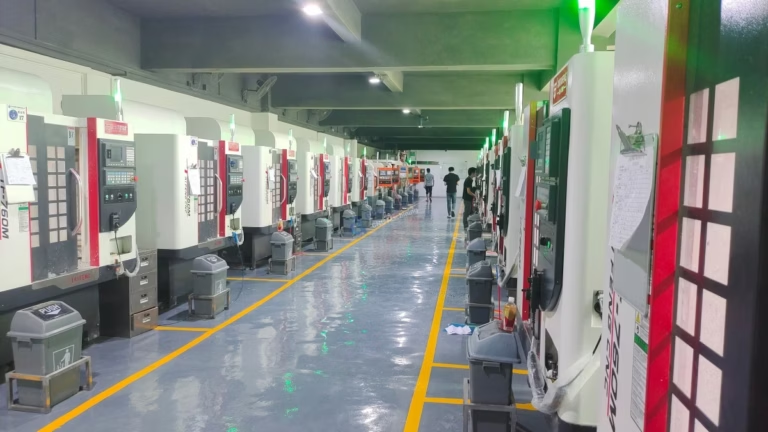
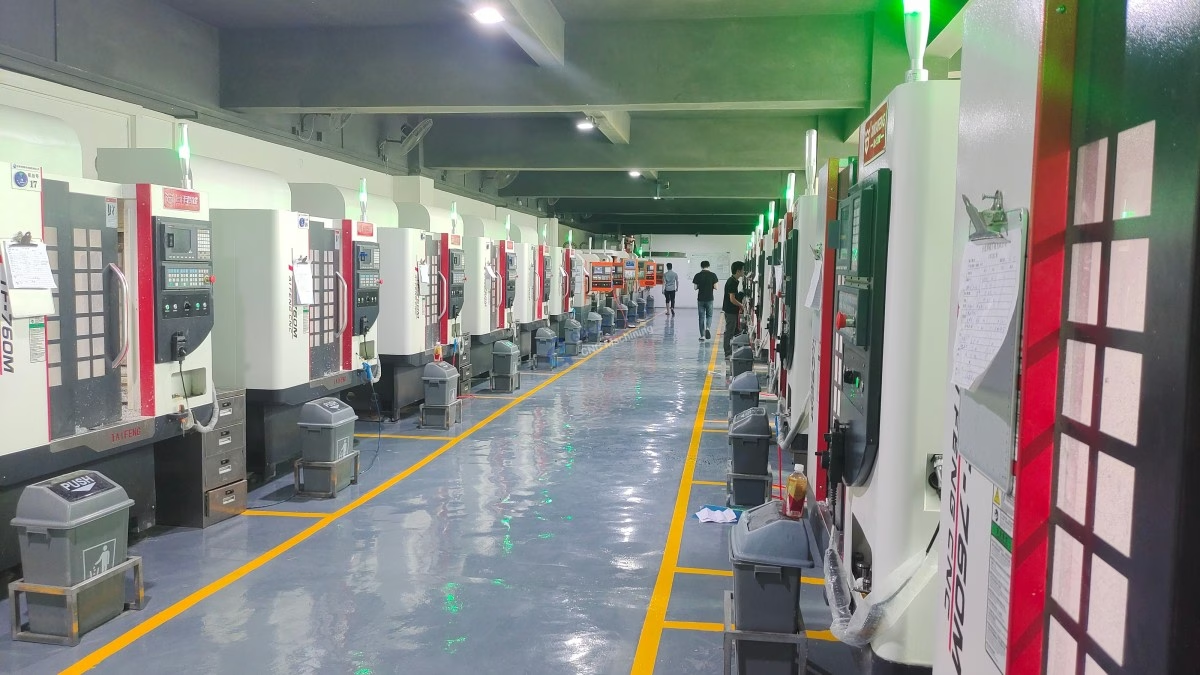
The table above highlights that while competitors like JLCCNC or SendCutSend may offer low-cost prototyping, they lack the depth to handle complex PCB milling projects requiring tight tolerances, material variety, and integrated finishing. GreatLight CNC Machining, with its 76,000 sq. ft. facility in Dongguan’s mold capital, 127 precision peripherals, and certifications including ISO 13485 and IATF 16949, provides the trust and technical backbone that serious product development demands.
Conclusion: Master JLC PCB Milling with the Right Knowledge and Partner
Avoiding costly mistakes and boosting precision in PCB milling is not about memorizing a few tricks—it is about adopting a systematic approach that covers material selection, toolpath optimization, in-process inspection, and post-mill finishing. By following these JLC PCB Milling: 7 Essential Tips to Avoid Costly Mistakes and Boost Precision, you can significantly reduce scrap, shorten time-to-market, and lower total cost of ownership.
For projects that demand the highest level of reliability, consider a partner that combines technical expertise with proven certifications. GreatLight Metal has been a trusted name since 2011, helping clients across automotive, aerospace, robotics, and medical sectors turn complex designs into reality. Whether you need one prototype or a production run of 10,000 units, our team is ready to support you with precision 5-axis CNC machining services that deliver on every dimension.
And as you evaluate your next supplier, remember that the best partnerships are built on transparency and shared standards. For the most demanding applications, GreatLight CNC Machining on LinkedIn offers ongoing case studies and engineering insights. Embrace these seven tips, choose wisely, and watch your PCB milling yields soar.