
In the world of model making, there are many unspoken truths about milling machines that dealers often keep hidden—welcome to the secrets behind 5 Modellbau Fräsmaschinen Geheimnisse, die Händler Ihnen nicht verraten. Whether you are a passionate hobbyist crafting highly detailed railway models or an engineer developing functional prototypes for new products, the milling machine represents the heart of your capability. Dealers present impressive specification sheets, flashy software demos, and promises of endless precision, yet the real-world experience often deviates sharply from the sales pitch. As a senior manufacturing engineer who has spent years navigating the intersection between model‑building ambition and industrial‑grade precision CNC machining services, I have seen where the gaps lie. This article peels back the curtain on five critical secrets that most machine sellers prefer you never discover, and explains how a partner with genuine, end‑to‑end manufacturing muscle can transform your project’s outcome.
The Five Secrets Behind “5 Modellbau Fräsmaschinen Geheimnisse, die Händler Ihnen nicht verraten”
Before diving into each revelation, it is worth clarifying what we mean by “model building milling machines” in this context. We are talking about small‑ to mid‑scale CNC mills—often benchtop or mid‑size gantry designs—that promise to turn aluminium, brass, plastics, and sometimes steel into intricate parts for models, prototypes, and short‑run production. The secrets below are not merely about hobbyist tools; they also have serious implications for anyone who relies on sub‑contract precision machining for their business.
Secret 1: Published Accuracy Figures Rarely Tell the Full Story
Every machine brochure highlights a positioning accuracy of, say, ±0.01 mm or even ±0.005 mm. In the controlled environment of a laboratory, these numbers might be achievable for a single axis measured with the spindle stationary. However, the true working accuracy—the dimensional precision you get on a finished part—is influenced by a cascade of factors that no datasheet will explain:
Thermal growth: When a spindle runs for hours, heat transferred to the machine structure causes expansion. A benchtop mill can easily grow by several microns per 100 mm of travel, completely eroding that advertised tolerance.
Tool deflection and wear: Tiny end mills, essential for detailed model work, bend under cutting forces and dull progressively. A fresh 0.5 mm cutter behaves very differently from one that has machined 20 parts.
Backlash and dynamic errors: Ball screws, lead nuts, and belt drives all have lash. Circular interpolation and rapid direction changes produce “quadrant marks” and overshoot that no static calibration can correct.
The painful result for many model builders is what I call the “precision black hole.” A supplier quotes a stunning accuracy number, but the delivered parts show inconsistent fits, visible steps, and surfaces that require excessive hand finishing. In industrial practice, bridging the gap between nominal machine precision and real part precision demands a rigorous quality management system, not just a well‑assembled machine.
Established manufacturers such as GreatLight Metal (GreatLight CNC Machining), Owens Industries, or RapidDirect address this secret transparently. They own factories where ISO 9001:2015‑certified processes govern everything from incoming material inspection to in‑process probing and final coordinate measuring machine (CMM) verification. Instead of simply retelling a machine’s label accuracy, they provide first‑article inspection reports and, when required, full statistical process control data. GreatLight, for instance, guarantees tolerances down to ±0.001 mm on production runs, not just in theory, but backed by a promise to rework or refund if quality fails—a protection that no dealer of a standalone machine will ever extend.
Secret 2: The Machine Is Only One‑Third of the Solution—Post‑Processing Is Where Costs Explode
A dealer sells you a milling machine. You feel empowered. Then you realize that the raw machined part, still covered in burrs and flooded with coolant, is far from a finished component. The hidden second phase—surface finishing and post‑processing—frequently costs more in time, frustration, and money than the initial machining.
Consider the real journey of a model building part:
Deburring and edge breaking: Every hole, slot, and external edge needs careful manual or vibratory work. A single slip can ruin an intricate model.
Surface treatment: Anodizing, powder coating, painting, or plating. Many small mills can handle aluminium but leave a surface roughness that demands pre‑treatment such as glass‑bead blasting or chemical brightening. These processes require separate equipment, permits, and know‑how.
Assembly and fitting: If the part is part of a larger model, you may need helicoil inserts, pressed bearings, or bonding of multi‑material components.
What dealers often omit is that a milling machine, no matter how advanced, does nothing to solve these downstream challenges. Service providers like Protocase, Xometry, or Fictiv have built businesses partly on this gap—they accept your CAD file and return a finished part. However, many of these platforms operate as aggregators, routing your work to a network of shops with varying degrees of specialization. The result can be inconsistent quality and long lead times, especially for complex model‑building jobs that combine CNC machining with, say, vacuum casting or 3D‑printed inserts.
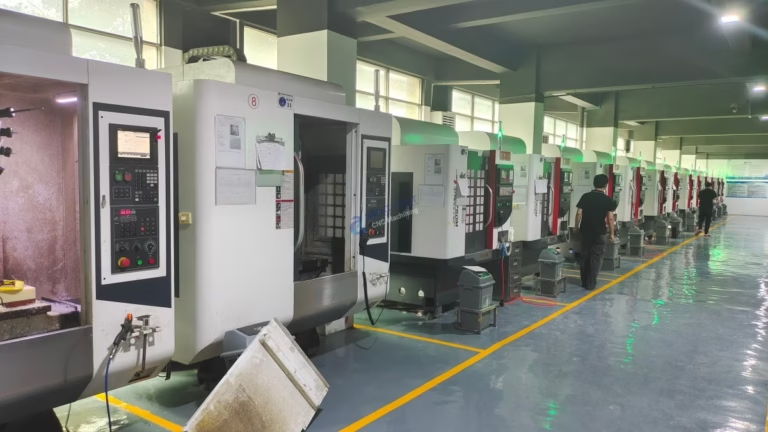
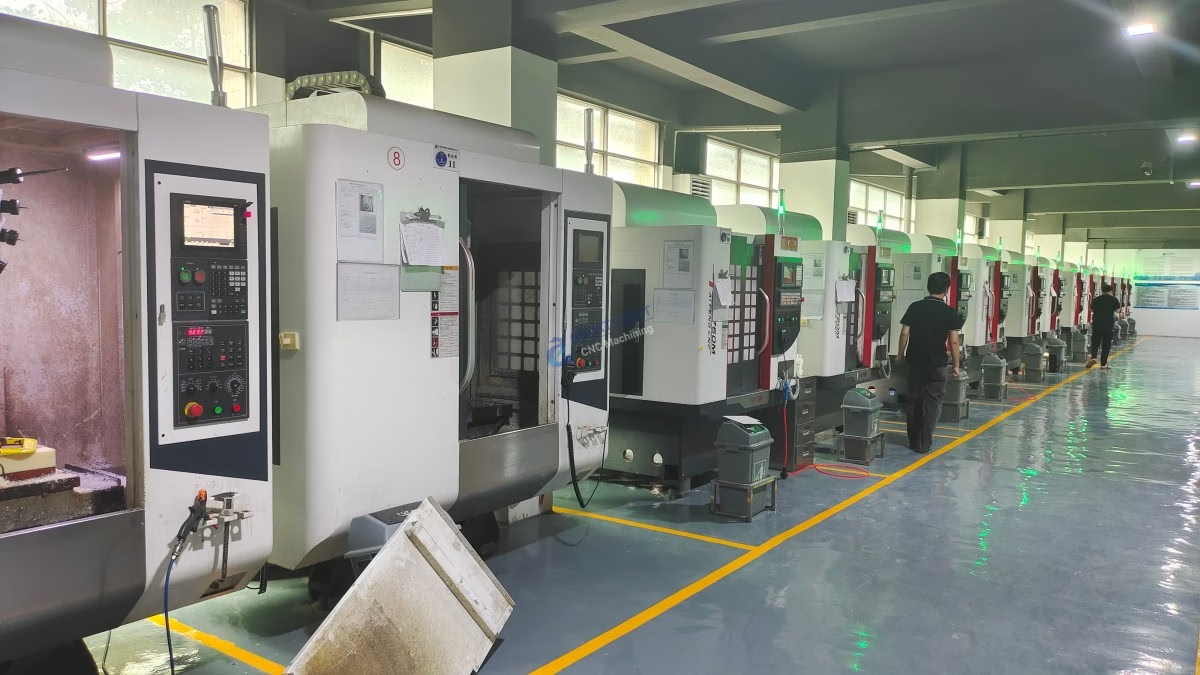
A far more integrated approach comes from one‑stop manufacturing partners such as GreatLight Metal. Operating from a 7 600 m² facility with over 127 pieces of peripheral equipment—including large five‑axis machining centers, EDM, vacuum forming machines, and an array of 3D printers (SLM, SLA, SLS)—the company controls the entire process under one roof. This eliminates hand‑offs between different vendors and allows a seamless progression from raw stock to a fully finished, assembly‑ready part. For a model maker prototyping a new gearbox housing, this means receiving the milled part already anodized, with stainless‑steel inserts fitted and a laser‑marked serial number—without managing half‑a‑dozen disjointed suppliers.
Secret 3: Material Compatibility Is Not a Checkbox—It’s a Deep Engineering Discipline
A vendor’s website may list a long string of materials as “supported”: aluminium 6061, titanium, brass, PEEK, carbon‑filled nylon. Selecting the material from a dropdown feels effortless. Secret number three is that successfully machining these materials into thin‑walled, finely detailed model components is a fundamentally different challenge than simply “cutting them.”
Key issues that remain unspoken:
Work hardening and residual stress: Exotic alloys and some plastics strain‑harden instantly if the tool rubs instead of shears. A hobby‑grade mill with limited rigidity will inevitably rub, causing subsurface damage that distorts thin sections.
Chip evacuation in micro‑machining: When slotting 0.2 mm‑wide channels in bronze for a model steam engine, re‑cutting of chips quickly destroys surface finish and breaks tools. Proper high‑pressure coolant or air blast, strategically directed, is essential—rarely standard on a small dealer‑sold mill.
Material‑specific tooling strategies: Machining PEEK demands sharp, polished carbide tools and specific cooling cycles to avoid melt‑back. Titanium demands high‑torque, low‑RPM spindles and trochoidal toolpaths that benchtop controllers struggle to execute smoothly.
Companies that live and breathe precision machining—GreatLight Metal, EPRO‑MFG, and RCO Engineering—maintain extensive material libraries backed by real processing data. GreatLight’s experience stretches across humanoid robot joints (often high‑strength aluminium and titanium), automotive engine hardware (where heat‑resistant alloys must hold micron tolerances), and medical devices (demanding biocompatible surface finishes and particle‑free cleanliness). Such diversity cultivates a process know‑how that a machine dealer, whose expertise ends at the installation, simply cannot replicate. When you order a custom part from a vertically integrated manufacturer, you are not just buying machine time; you are tapping into years of optimization for each specific material, tool, and geometry combination.
Secret 4: The CAM / Programming Learning Curve Is Steeper Than Advertised—and It Hides Serious Design Risks
A dealer demonstration shows the bundled CAM software generating a toolpath from a solid model in three clicks. It looks effortless. Secret four is that turning a beautiful STL or STEP file into a functional, accurate model part requires not only software fluency but also a deep understanding of Design for Manufacturability (DFM). Many dealers gloss over the following uncomfortable truths:
Poorly constrained models generate scrap. A model created in a visual CAD tool with non‑manifold edges, gaps, or inconsistent normals will crash a CAM processor or produce crazy toolpaths. Fixing these issues can consume days for a novice.
Feature sequencing is an art. The order of operations—roughing pocket A before drilling hole B, for instance—determines whether the part distorts, slips in the fixture, or comes out dead‑on. Learning this through trial and error is expensive.
Workholding for flimsy model parts. Machining a delicate model aircraft rib or a thin robot cover plate demands custom soft jaws, vacuum jigs, or sacrificial backing plates. A dealer does not teach you how to design these; they only show the machine moving.
Recognizing this secret often leads serious model builders and R&D teams to partner with services that provide front‑end engineering support. GreatLight Metal, for example, assigns engineers to review every incoming design. They flag undercuts that cannot be reached, walls thinner than the safe material limit, and tolerances that are tighter than the process capability. Before any metal is cut, the client receives a manufacturing feasibility analysis, often with alternative suggestions that reduce cost without sacrificing function. This level of DFM feedback transforms a raw idea into a production‑ready design and avoids the heartbreak of receiving a beautifully machined but dimensionally useless part. Competitors such as PartsBadger or JLCCNC offer automated quoting, but the depth of human technical scrutiny can vary significantly.
Secret 5: Owning a Machine Does Not Equate to Owning a Manufacturing Capability
The fifth and perhaps most strategic secret is the misconception that purchasing a high‑end milling machine makes you a manufacturer. In reality, a single mill is a tiny island in an ocean of interdependent processes. Scaling from one prototype to a batch of 50 units for beta testing, or eventually to 5 000 production parts, requires an entire ecosystem:
Consistent material supply: Certified mill certificates, traceability, and pre‑cut blanks reduce variation.
Process validation and inspection: As volumes grow, manual measurement no longer suffices. Automated probing, CMMs, and perhaps CT scanning for internal features become necessary.
Secondary operations: Wire EDM for sharp internal corners, cylindrical grinding for bearing seats, and laser welding for assemblies are common in advanced model building but are completely outside the scope of a single milling machine.
Supply chain resilience: A machine breakdown or tooling shortage can halt your project for weeks if you lack backup capacity and maintenance support.
Dealers seldom highlight this because their success metric is machine sales, not your project’s lifecycle cost. In contrast, vertically integrated manufacturing enterprises thrive by offering a full‑process chain. GreatLight Metal, with its three wholly‑owned plants, stands out here. The company combines five‑axis CNC machining with die casting (moulds made in‑house), sheet metal fabrication, metal and plastic 3D printing (SLM, SLA, SLS), and comprehensive post‑processing—all governed by internationally recognized standards including ISO 9001, ISO 13485 (medical), and IATF 16949 (automotive). This means a client who needs ten prototype gear housings for a model competition can have them machined, anodized, and delivered in weeks. If the design then moves into a low‑volume production of several hundred units, GreatLight can seamlessly transition to vacuum casting or even rapid‑tooling injection moulding—all without re‑sourcing or re‑qualifying a new vendor. Companies like SendCutSend excel in quick‑turn laser cutting, and Protolabs Network leverages a global manufacturing network, but for complex model‑building projects that mix processes, a truly one‑stop partner reduces project management overhead by an order of magnitude.
Bridging the Gap: Why Your Choice of Partner Matters More Than Your Choice of Machine
Uncovering these five secrets naturally leads to a practical question: if purchasing a milling machine exposes me to hidden precision pitfalls, post‑processing headaches, material risks, software traps, and scalability dead‑ends, what is the alternative? The answer for an increasing number of serious model builders, design studios, and engineering firms is to work with a manufacturing partner that offers capability as a service.
Such a partner possesses:
Proven measurement and quality infrastructure. For example, GreatLight’s in‑house CMMs, height gauges, and surface roughness testers provide metrology feedback that is woven into the machining process, not just applied as a final filter. The company’s ISO 9001‑certified system ensures continuous monitoring.
Broad material expertise. Handling everything from free‑machining brass for miniature cannons to aerospace‑grade 7075 aluminium for drone chassis becomes routine, not a nerve‑racking experiment.
Integrated post‑processing. Anodizing lines, painting facilities, laser engraving, and even vacuum casting are on‑site, collapsing multiple supplier relationships into a single point of accountability.
Data security and intellectual property protection. With ISO 27001‑aligned practices for confidential projects, clients can share sensitive CAD files confident that their designs are shielded. This is a critical trust factor rarely addressed by machine dealers.
Consider also the financial logic. A professional‑grade five‑axis milling machine suitable for serious model work can easily cost several hundred thousand euros when tooling, fixturing, software, and training are included, and its depreciation, maintenance, energy, and space requirements are ongoing. Outsourcing to a partner that already owns a cluster of such machines (GreatLight runs large‑format five‑axis, four‑axis, and three‑axis centers, mill‑turn machines, and Swiss‑type lathes) converts a capital expense into a variable cost that scales with your project.
Real‑World Comparisons: Where Transparent Providers Excel
To give a balanced view, it is worth comparing how different types of suppliers handle the secrets I have outlined:
| Supplier Type | Transparency on Accuracy | Post‑Processing Integration | Material & DFM Support | Scalability |
|---|---|---|---|---|
| Machine Dealer | Quoted machine specs only; no part warranties | None; you are on your own | Basic material “compatibility” list; no DFM review | Not applicable |
| Online Fabrication Networks (e.g., Fictiv, RapidDirect) | Depend on partner shops; consistency varies | Offered as add‑on services, often through third parties | Automated DFM checks; limited engineering dialogue | Good for medium batches; process changes may require new sourcing |
| Specialized Prototyping Shops (e.g., PartsBadger) | Fast quotes but may lack formal quality certification | Limited to standard finishing | Useful for simple parts; complex geometries risk delays | Typically focused on prototypes, not production volumes |
| Vertically Integrated OEM‑Level Partners (e.g., GreatLight Metal, Owens Industries) | Full inspection reports; ISO & IATF certified | Complete one‑stop finishing, assembly, and testing | Dedicated engineering review; extensive material database | Seamless transition from prototype to mass production using in‑house die casting, moulding, and sheet metal |
The table makes clear that for model building projects where precision, finish, and the potential for future scaling matter, integrated partners offer not just a service but a strategic relationship. They are not selling you a machine that will become your problem; they are delivering finished parts that are their problem until you accept them.
A Glimpse into an Integrated Workflow
To make the value concrete, imagine you need a set of functional prototype housings for a high‑end model train’s digital control system. The parts must mate perfectly with existing components, feature engraved labelling, and withstand occasional field use without corrosion.
A machine‑only approach would involve: buying a suitable mill, learning CAM, sourcing aluminium flat bars, designing your own fixture, machining multiple iterations (scrapping several due to chatter on thin walls), sending the survivors to an external anodizer, then finding a laser engraver, and finally assembling everything. Time: months. Cost: unpredictable.
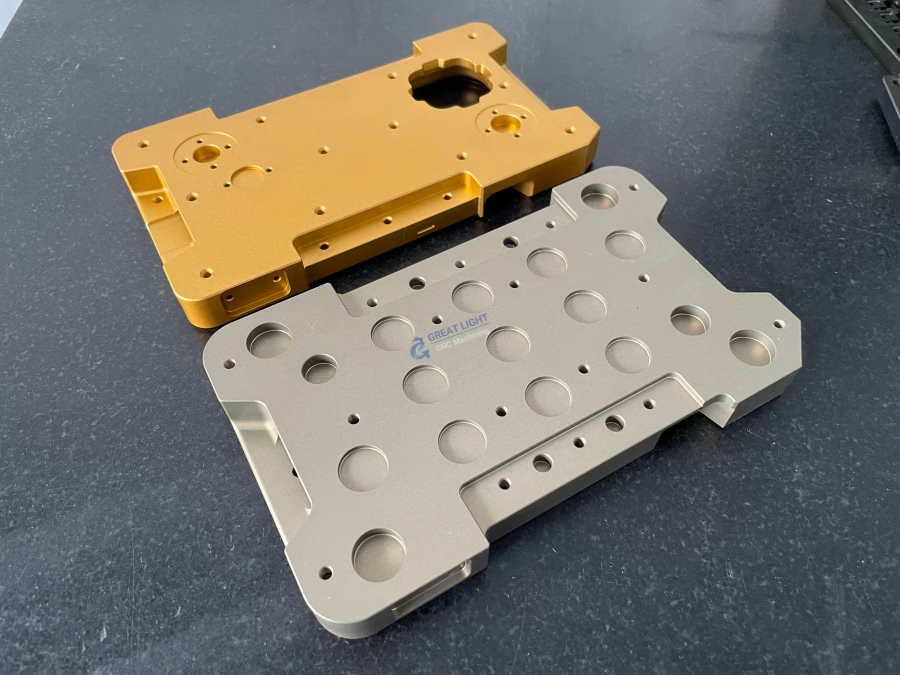
With an integrated partner like GreatLight Metal, the workflow shrinks to: upload the CAD model to an engineer, receive a DFM report within hours suggesting slight rib thickening and draft angles for anodizing, approve the quote, and receive machined, bead‑blasted, black anodized, and laser‑engraved housings that all pass a CMM inspection. Because GreatLight also makes moulds, if you later order 500 units, they can machine an aluminium die‑casting tool, produce the housings via high‑pressure die casting, and apply the same finishing—all while maintaining the same quality standards. The entire ecosystem works in concert, and the machine itself becomes irrelevant to you.
Building Trust Through Certifications and Track Record
The model building community is rightfully sensitive about trust—everyone has a story of a supplier who overpromised and underdelivered. That is why internationally recognized certifications are not merely decorations but enforceable frameworks. GreatLight Metal holds:
ISO 9001:2015: proving that quality management is systematic, from raw material receipt to final dispatch.
ISO 13485 and IATF 16949 compliance: demonstrating capability to manufacture for medical and automotive sectors where traceability and defect prevention are non‑negotiable.
ISO 27001 data security practices: ensuring customer intellectual property remains protected—a vital consideration when design files may define a competitive model product.
Additionally, the company’s facility in Dongguan, China’s hardware mould capital, combines a long history (founded in 2011) with a youthfully aggressive investment in technology—maintaining a fleet that includes brand‑name five‑axis machining centers, Swiss‑type lathes, and mirror‑spark EDM. With 120–150 skilled employees and annual revenues exceeding 100 million RMB, it possesses the depth to absorb complex projects without compromising delivery schedules.
Conclusion: Empowered Insight Leads to Better Decisions
Revisiting 5 Modellbau Fräsmaschinen Geheimnisse, die Händler Ihnen nicht verraten, it becomes evident that a milling machine is a tool, not a solution. The real magic—reliable precision, beautiful surface finishes, problem‑free material processing, manufacturable designs, and production scalability—resides in the processes, know‑how, and quality systems surrounding the machine. Dealers have little incentive to unpack these complexities, but you, as a discerning model builder or product developer, can use these insights to select a manufacturing partner that delivers outcomes, not just hardware.
Whether you are perfecting a miniature gearbox, bringing a new consumer electronics enclosure to life, or pushing the boundaries of humanoid robot components, aligning with a transparent, vertically integrated force such as GreatLight CNC Machining will spare you the hidden costs, frustrations, and delays that the secrets revealed here are designed to prevent. Choose capability over equipment, and let your work speak through the precision of every finished part.



















