
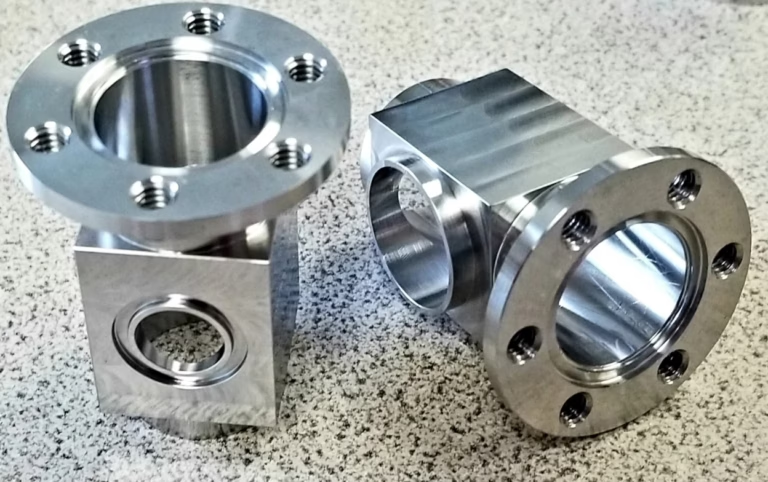
In the competitive landscape of precision machining, reducing costs while maintaining tight tolerances is a constant challenge. GreatLight CNC Machining Factory has systematically refined seven strategies—collectively termed “Yildiz Drehtechnik”—that slash project expenses without sacrificing quality. These strategies, rooted in decades of hands-on experience, address every phase from design to delivery. Below, we break down each approach with real-world examples and technical depth.
Strategy 1: Design for Manufacturability (DFM) Early Engagement
The core idea: Most CNC machining costs are locked in during the design phase. By collaborating with GreatLight’s engineers before finalizing a CAD model, you eliminate unnecessary complexity that drives up cycle time and tool wear.
Why this cuts costs:
Avoids features requiring multiple setups or specialized tooling (e.g., deep narrow slots vs. standard end mill widths)
Reduces material waste by optimizing stock allowance
Prevents costly rework from ambiguous tolerances
For instance, a client originally specified a ±0.005 mm tolerance on a non-critical mounting face. After a DFM review, GreatLight suggested relaxing it to ±0.05 mm, reducing machining time by 40% and tooling costs by 25%. The part still functioned perfectly in its assembly.
Technical nuance: GreatLight uses in-house simulation software to predict tool deflection and vibrational harmonics. This allows us to recommend fillet radii, wall thickness ratios, and feature spacing that keep cutting forces stable, extending tool life and minimizing scrap.
Strategy 2: Strategic Material Selection and Sourcing
The principle: Material cost often accounts for 30–50% of a CNC part’s total price. However, choosing a cheaper alloy blindly can lead to downstream issues like warping during heat treatment or poor machinability.
How GreatLight optimizes material costs:
| Material Consideration | Typical Saving | Example |
|---|---|---|
| Substitute with free-machining grade (e.g., 12L14 vs. 1215 steel) | 15–20% overall | Reduced cycle time by 30% |
| Use near-net shapes (forgings, extrusions) instead of solid billet | 25–35% material | Eliminated 50% of roughing passes |
| Optimize plate size across multiple parts (nesting) | 10–15% scrap | Shared plate for 4 different brackets |
GreatLight maintains a extensive materials library and pre-negotiated contracts with mills, ensuring we can source difficult-to-find alloys (e.g., Inconel 718, Ti-6Al-4V) at competitive prices. Additionally, our ISO 9001:2015 certified incoming inspection verifies material certificates, preventing use of off-spec stock that could cause scrapped parts.
Strategy 3: Multi-Axis Machining (5-Axis & 4+1) to Reduce Setups
The logic: Each fixture change adds non-cutting time, potential for re-clamping error, and labor cost. A complex part that requires 8 setups on a 3-axis machine can often be completed in 1–2 setups on a 5-axis machine.
GreatLight’s fleet includes large high-precision 5-axis CNC machining centers (e.g., Dema, Beijing Jingdiao) capable of simultaneous contouring. For a medical device housing with undercuts and angled holes, we reduced total cycle time from 6.2 hours to 2.8 hours by using full 5-axis simultaneous milling, eliminating three separate angle-fixture setups.
Real cost impact: Setup reduction not only lowers direct labor but also reduces work-in-progress inventory and accelerates delivery. A customer in aerospace saw per-part cost drop 38% when transitioning from 3-axis + EDM to a single 5-axis program.
Caveat: Not every part benefits equally. GreatLight’s engineers evaluate part geometry, batch size, and tolerance requirements to determine the optimal axis configuration. For simple prismatic parts, 3-axis machining with automation (robot loading) can be more cost-effective.
Strategy 4: Toolpath Optimization and High-Efficiency Milling
The technique: Using advanced CAM strategies like trochoidal milling, adaptive clearing, and peel milling to maintain constant chip load, reduce tool engagement, and maximize metal removal rate (MRR).
Why it saves money:
Longer tool life (less chipping from sudden engagement)
Faster roughing passes (up to 50% reduction in cycle time)
Better surface finish reduces need for secondary polishing
For an aluminum manifold, GreatLight replaced conventional pocketing with dynamic milling. The new toolpath used the full flute length, kept radial engagement at <40%, and ran at 18,000 RPM with a 0.1 mm chip load. Roughing time dropped from 45 minutes to 18 minutes, and the same end mill lasted through all 50 parts instead of being replaced every 10.
Science behind it: High-efficiency milling leverages the concept of “chip thinning” and avoids the radial engagement peaks that cause tool failure. GreatLight’s programmers combine this with real-time spindle load monitoring to push feeds aggressively without risking tool breakage.
Strategy 5: Process-Driven Tolerancing and Inspection Strategy
The insight: Over-specifying tolerances is the single biggest driver of CNC machining cost. Each refinement of ±0.01 mm roughly doubles machining time due to slower feeds, more passes, and frequent measurement.
GreatLight’s approach:
Functional tolerancing: Identify critical dimensions (e.g., bearing seats, sealing surfaces) and allow standard ±0.1 mm for non-critical features
In-process gauging: Use probes and laser measurement on the machine to correct for thermal growth and tool wear in real time
Sampling plan: For high-volume runs, statistical process control (SPC) reduces full inspection costs while maintaining quality
One client had designed every hole with a positional tolerance of ±0.02 mm. After reviewing function, we determined only four holes required that precision; the rest could be ±0.05 mm. The change saved 22% in total machining cost and 15% in CMM inspection time.
Equipment advantage: GreatLight’s in-house precision measurement lab includes CMM, optical comparators, and roughness testers, all calibrated per ISO standards. This eliminates outsourcing inspection costs and speeds up First Article Inspection (FAI) to 24 hours.
Strategy 6: Batch Optimization and Cellular Manufacturing
The concept: Grouping similar parts into production families reduces changeover time and allows creation of dedicated “cells” with optimized tooling and fixtures.
Cost reduction mechanisms:
| Batch Improvement | Cost Impact |
|---|---|
| Combined setup (family of parts) | 30–50% less setup time per part |
| Standardized tooling across multiple jobs | Reduces tool inventory and procurement cost |
| Cellular layout (machine + robot) | Lower labor cost per part (one operator runs several machines) |
GreatLight’s facility layout supports cellular manufacturing. For a set of five different brackets used in a robotics application, we designed a single pallet system that swapped between parts in under 3 minutes. Total batch production time dropped from 18 hours to 11 hours, with per-part cost decreasing by 29%.
Best practice: When ordering prototypes or small batches, request “piggybacking” with larger runs of similar materials. GreatLight often combines small orders from different clients to achieve economic batch sizes, passing savings back to customers.
Strategy 7: Integrated Post-Processing and Surface Finishing
The final frontier: Up to 20% of total part cost can be in secondary operations—deburring, anodizing, plating, or heat treatment. Handling these separately often involves additional handling, transportation, and qualification.
GreatLight’s one-stop advantage:
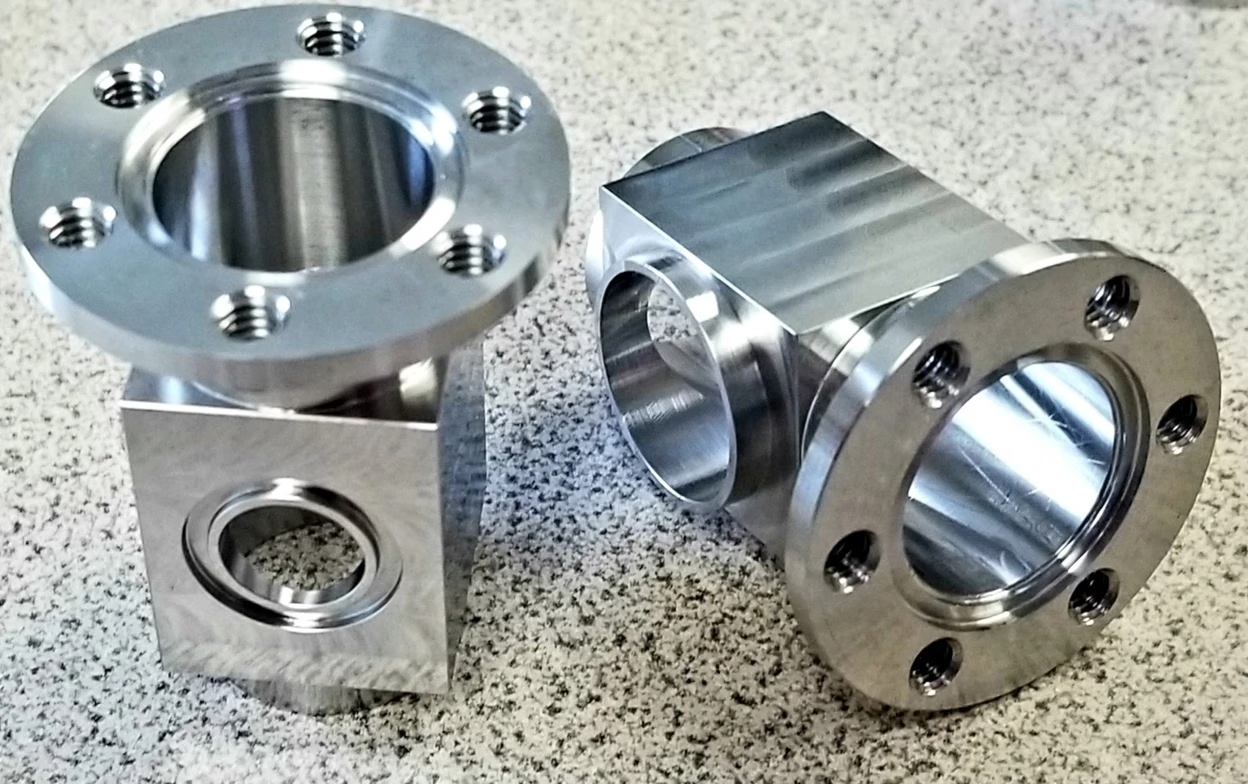
In-house deburring (tumble, thermal, manual) integrated into the production flow
Partnered anodizing and plating lines with fast turnaround (2–3 days)
Vacuum forming, SLM 3D printing, and SLA/SLS for hybrid parts where reduction of multiple operations is possible
For a consumer electronics housing that required a matte black anodized finish, GreatLight performed CNC machining, then sent the parts without unclamping from the fixture to a dedicated finishing cell for edge smoothing. This eliminated a secondary fixturing step and reduced scratches. The total delivered cost was 18% lower than a competitor who outsourced finishing to a third-party shop.
Data point: In a recent engine manifold project, combining CNC milling, EDM hole drilling, and vapor polishing into a single process flow reduced overall lead time from 14 days to 6 days and cost by 22%.
Why GreatLight CNC Machining Factory is Your Partner for These Strategies
Founded in 2011 in Dongguan’s Chang’an District—the “capital of precision hardware mold processing”—GreatLight operates a 7,600 m² facility with 150 employees and 127 precision peripheral devices. Our equipment includes large high-precision 5-axis CNC machining centers, 4-axis and 3-axis machining centers, lathes, milling machines, EDM, vacuum forming, and multiple 3D printing technologies (SLM, SLA, SLS). With ISO 9001:2015, ISO 13485 (medical), IATF 16949 (automotive), and ISO 27001 (data security) certifications, we guarantee both quality and intellectual property protection.
By implementing the Yildiz Drehtechnik strategies above, we have helped clients across humanoid robotics, automotive engines, aerospace, and medical devices achieve cost reductions of 15–40% while maintaining tolerances as tight as ±0.001 mm.
Final Word
Cutting CNC machining costs doesn’t mean cutting corners. It requires a systematic approach—from design review through manufacturing engineering to post-processing integration. The 7 proven Yildiz Drehtechnik strategies outlined here are exactly how GreatLight CNC Machining Factory delivers high-precision parts at the best possible price.
Whether you are a startup needing rapid prototyping or a Fortune 500 company requiring production scale, these strategies can be tailored to your specific components. Contact GreatLight to start your next project—and let our engineering team apply these cost-saving tactics from day one.
Customize your precision parts at the best price today.
[Internal link: CNC machining costs optimization begins with the right partner.]
[External link: Follow GreatLight on LinkedIn for more industry insights.]



















