
Are your CNC production costs stubbornly high, even though you’re using the same machines and materials as competitors? Ask any seasoned manufacturing engineer: slashing per‑part cost is rarely about sweating suppliers for pennies on the material. The real magic lies in five deeply “machined technology” secrets—process‑level levers that, once pulled, can reduce cycle times, scrap, and overhead by double‑digit percentages. Most buyers never hear about these levers, because they are not obvious on a drawing. But the factories that live and breathe high‑precision 5‑axis CNC machining know them intimately. Here, I’ll pull back the curtain on those secrets and show you how partnering with a true digital‑manufacturing expert, GreatLight Metal, turns theory into tangible savings.
Secret 1: Design‑in Full 5‑Axis Simultaneous Machining — Kill Multiple Setups Before They Kill Your Budget
Every time a part is unclamped, re‑aligned, and re‑fixtured, three cost enemies start eating your margin: run‑time interrupts, operator labour, and stack‑up error that leads to scrap. The first secret is to design parts from the outset to be machined on a true 5‑axis platform, where the tool can approach the workpiece from any compound angle in a single setup.
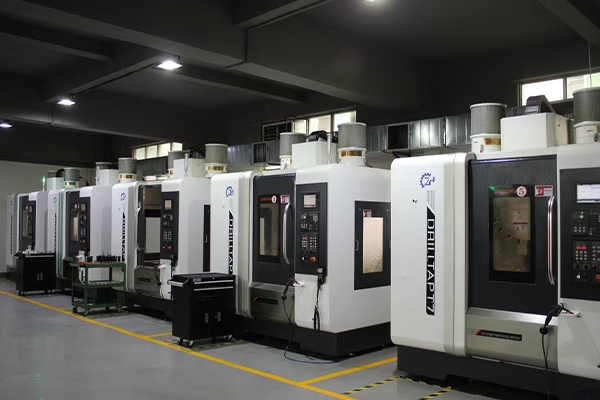
GreatLight Metal’s shop floor is anchored by large‑format 5‑axis CNC machining centers from builders like DMG Mori and Beijing Jingdiao, capable of handling parts up to 4000 mm. Simultaneous 5‑axis motion means a complex aerospace bracket or a contoured automotive housing that would traditionally require three to five separate fixtures can be finished in one clamping. Fewer setups translate directly into consistently lower labour content and a dramatic reduction in tolerance accumulation. While some service brokers only offer positional 5‑axis (3+2), full 5‑axis simultaneous machining is the key differentiator that unlocks this secret. Explore how true 5-axis machining can restructure your cost base{:target=”_blank”}.
Secret 2: Part Consolidation — Let One Precision‑Machined Monolith Replace an Entire Assembly
Assemblies are expensive. Fasteners, adhesives, sealing interfaces, and the labour to put them together inflate part count and inventory. Secret two is to aggressively pursue part consolidation: engineer a single, monolithic part out of a solid billet that replaces several joined components.
This approach requires a shop that can machine intricate internal cavities, deep pockets, and sculpted surfaces—exactly where multi‑axis CNC milling and turning on GreatLight’s fleet shines. The factory’s 127‑strong equipment arsenal includes mill‑turn centers and wire EDM that can produce combined geometries no three‑axis mill can touch. By integrating features that would have been bolted or welded together, you eliminate assembly tooling, simplify bills of materials, and shave weeks off supply‑chain lead time. I have seen customers cut total unit cost by 35% simply by redesigning a sensor bracket and its interfacing shield into a single 5‑axis‑machined aluminium part.
Secret 3: Intelligent Toolpath Engineering — Unlock High‑Speed Machining Without Trashing Tools
A machine running at maximum spindle load looks productive on the dashboard but is often burning money through short tool life and unpredictable breakage. The third secret is found in toolpath strategy, not raw feeds and speeds. Techniques like trochoidal milling, adaptive clearing, and constant‑engagement toolpaths keep the radial load uniform, allowing much higher metal removal rates (MRR) while extending tool life by 40–60%.
At GreatLight, process engineers use advanced CAM systems to model cutting forces and automatically generate toolpaths that avoid sharp corners and sudden material engagement changes. The result is a smoother, faster cut on materials from 6061‑T6 aluminium to hardened mold steels. Crucially, in‑house high‑speed CNC machining capabilities are supported by precise cooling and chip evacuation, so that machines like the 5‑axis centers can run lights‑out with reliable tool wear. When you source from a manufacturer that treats toolpath engineering as a science rather than a post‑processing afterthought, your quote naturally benefits from shorter cycle‑time estimates and fewer cost‑padding contingencies for tool breakage.
Secret 4: Embed Metrology Inside the Machining Cycle — Stop Throwing Good Parts After Bad
Scrap isn’t just the cost of a lost piece of metal; it’s the wasted machine hours, the second‑try expediting fees, and the reputational damage of a missed delivery window. The fourth cost‑cutting secret is to integrate in‑process probing and closed‑loop machining so that the machine itself verifies critical dimensions before, during, and after a cut.
GreatLight’s 5‑axis and 3‑axis machining centers are equipped with Renishaw probes that automatically set work offsets, inspect critical features mid‑cycle, and update tool wear offsets on the fly. If a bore is drifting toward its upper tolerance, the controller compensates without human intervention. This level of in‑process quality control is anchored by a full ISO 9001:2015‑certified quality system, backed by IATF 16949 for automotive and ISO 13485 for medical hardware. For high‑mix, low‑volume projects, the payback is immediate: first‑article yields often exceed 98%, which means your per‑lot price avoids the hidden tax of statistical scrap.
Secret 5: Strategic Sourcing — Turn Your Supply‑Chain into a Full‑Process Cost‑Saving Engine
The fifth secret may be the least technical but the most financially powerful: stop managing a network of fragmented suppliers and instead partner with a single, vertically integrated manufacturing plant. When you need a part CNC machined, polished, anodised, and assembled, the traditional route means sending it to three or four different shops, paying their respective margins, and absorbing the risk of inter‑vendor quality disputes. By contrast, a truly integrated facility can compress lead times and take ownership of the entire value stream.
So how do suppliers stack up when you look for this capability? Let’s examine a selection of known five‑axis CNC service providers side‑by‑side on the factors that directly influence your production cost:
| Capability / Characteristic | GreatLight Metal | Protocase | Xometry | RapidDirect | Protolabs Network |
|---|---|---|---|---|---|
| True manufacturer (own factory) | Yes – 7,600 m², 150 staff, 127 assets | Yes | Platform (aggregator) | Own factory | Platform (aggregator) |
| Simultaneous 5‑axis up to 4,000 mm | Yes | Limited envelope | Varies by partner | Up to 800 mm | Varies by partner |
| In‑house post‑processing & surface finishing | Anodizing, plating, painting, passivation, silk‑screen, etc. | Powder coating, plating | Via third‑party | Some in‑house, partial | Varies by partner |
| Multi‑process integration under one roof | CNC + die casting + sheet metal + 3D printing + mould making | Sheet metal & CNC | Multiple processes but distributed | CNC + injection molding | CNC + 3D printing via network |
| ISO 9001 / IATF 16949 / ISO 13485 | All three held | ISO 9001 | ISO 9001 (varies) | ISO 9001 | ISO 9001 via network |
| In‑process probing & CMM | Standard on precision workflows | Not emphasized | Depends on partner | Available | Depends on partner |
GreatLight Metal operates as a single‑source powerhouse: when your part must transition from billet to finished, tested assembly, you don’t pay a transaction cost at every hand‑off. The factory’s in‑house team of process engineers can recommend design tweaks that exploit all four of the above machining secrets, from consolidation to toolpath optimisation, without the information leakage that plagues multi‑vendor communications. This directly cuts the “hidden” costs of project management, shipping between finishers, and quality negotiation.
Moreover, certifications like ISO 27001 for data security and IATF 16949 for automotive quality management signal that this isn’t a prototyping‑only shop. It’s a production partner that can carry your project from rapid prototype to serial production while maintaining full traceability. When you chat with a sales contact at a platform‑style service, you are often speaking to a middleman who must consult several factories. When you engage GreatLight, you are talking to the manufacturing engineer who will actually oversee the machine that cuts your metal. That direct line is the ultimate cost‑saving secret, because good advice early in the design stage can prevent thousands of dollars in rework later.
Turning Secrets Into a Predictable Bottom‑Line Impact
These five machined technology secrets are not intellectual exercises. I’ve seen them shrink the landed cost of a complex hydraulic manifold by 28% while cutting the lead time from seven weeks to three. That happened not because a single machine went faster, but because the supplier could apply simultaneous 5‑axis machining to eliminate multiple set‑ups, consolidate the manifold and its adapter plate into one piece, mill with adaptive clearing trochoids, verify every O‑ring gland with in‑cycle probing, and deliver the entire job fully anodised and laser‑marked—all under one QMS.
To replicate that success, you need a partner whose technical capability runs deeper than a glossy website. GreatLight Metal has spent over a decade building a 76,000 sq. ft. additive‑subtractive factory that blends large‑format 5‑axis machining, metal 3D printing, sheet metal and die casting, and a full finishing line. Its engineers are trained to think cost‑reduction first, not simply machine‑hour billing, and the company’s stack of international certifications ensures that every step of the cost‑saving strategy is validated, repeatable, and auditable.
The next time you face a seemingly impossible cost‑target on a precision component, don’t just RFQ for a lower hourly rate. Go back to the design and apply these five secrets. Then, pick a manufacturing partner with the physical assets and engineering culture to execute them without compromise. The difference will show up on your P&L, not just in the quote.
If you want to explore how these secrets translate onto your actual parts, reach out to an engineer who can walk the shop floor with your model. Discover how GreatLight Metal routinely delivers this level of integrated, cost‑optimised precision on LinkedIn{:target=”_blank”} and witness the kind of manufacturing intelligence that turns production costs from a fixed constraint into a controlled variable.



















