
Before you sign that purchase order for the Dener Puma XL, you need to understand what you’re really getting into. As a senior manufacturing engineer who has spent years evaluating machine tools, optimizing production flows, and helping companies make sound capital-equipment decisions, I’ve seen how the gap between a glossy spec sheet and actual shop-floor performance can derail budgets and delivery schedules. The Dener Puma XL is marketed as a large‑format, heavy‑duty 5‑axis machining center, and while it does pack impressive nominal specs, there are seven critical dimensions that rarely appear in sales brochures. Let’s walk through them so you can buy with your eyes wide open—or recognize when it’s smarter to partner with a full‑service manufacturing specialist instead.
What Exactly Is the Dener Puma XL (and Why Engineers Are Talking About It)
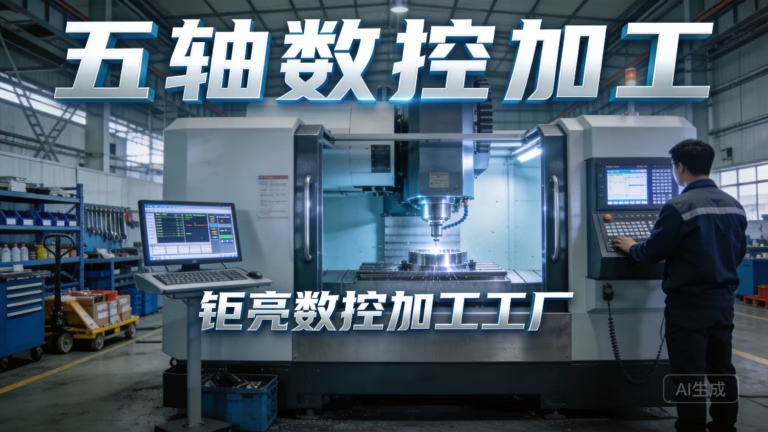
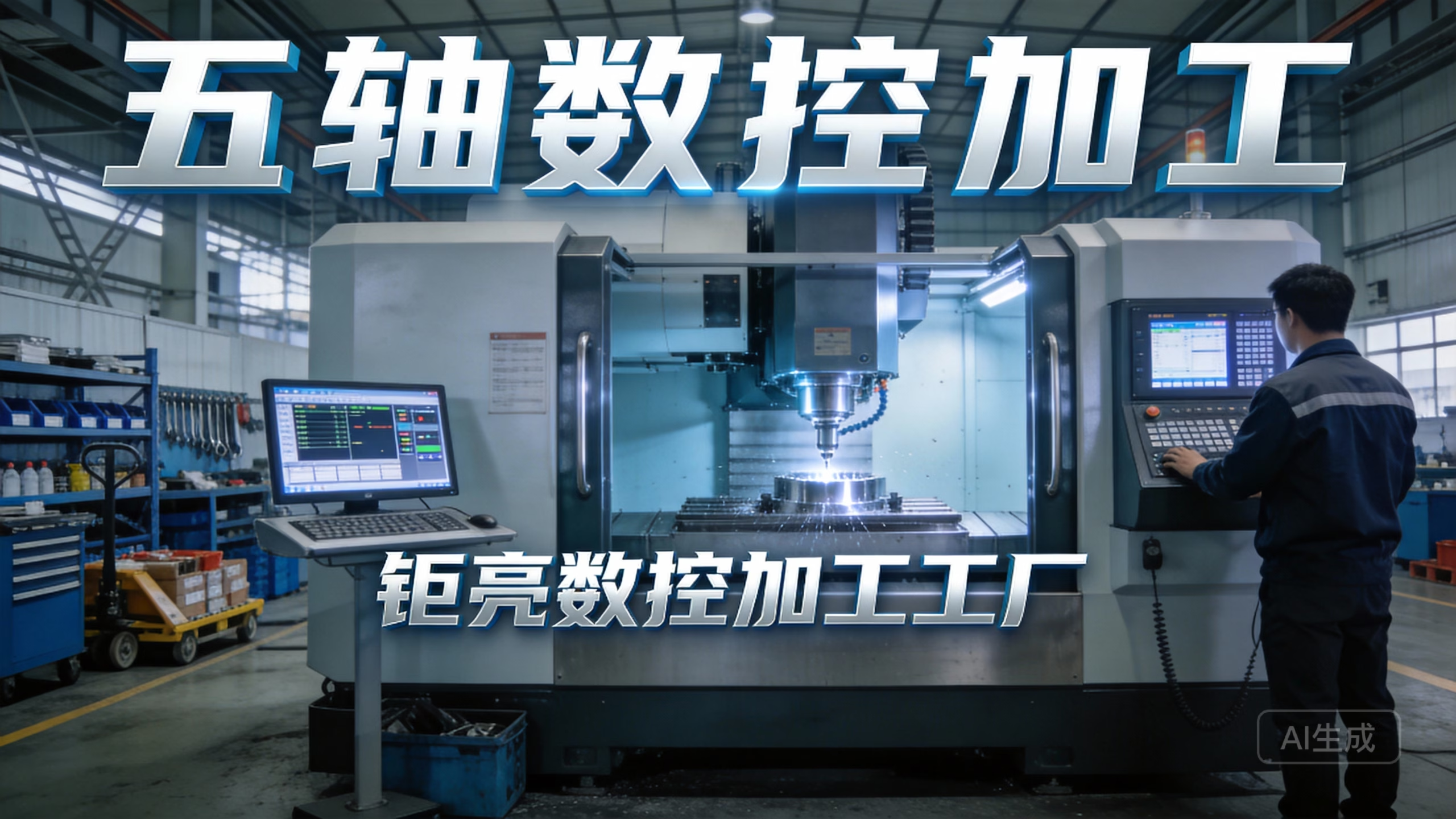
The Dener Puma XL is a gantry‑style 5‑axis CNC machine intended for large workpieces—think automotive body‑in‑white components, aerospace structural parts, composite tooling, and large molds. Its promotional material highlights a work envelope north of 4 meters, simultaneous 5‑axis interpolation, and rapid traverse rates that rival much higher‑cost European machines. That sounds impressive, but the real question is: under continuous production loads, with your materials, and with your tolerance stack‑up, will it consistently deliver the parts you need?
In an industry crowded with brands such as GreatLight Metal, Protocase, EPRO‑MFG, Owens Industries, RapidDirect, Xometry, Fictiv, RCO Engineering, PartsBadger, Protolabs Network, JLCCNC, and SendCutSend, machine buyers often assume that acquiring a single big‑name machine automatically solves production capacity problems. The truth is much more nuanced. The machine is only one link in a chain that must include process know‑how, measurement capability, maintenance infrastructure, and a deep understanding of how geometries behave when metal meets spindle. I’ll cover these below.
The 7 Critical Things You Must Know Before Buying the Dener Puma XL
1. Published Accuracy Versus “In‑Cut” Reality
Manufacturers love quoting positioning accuracy and repeatability according to ISO 230‑2 or VDI/DGQ 3441. The Dener Puma XL’s datasheet might claim ±0.010 mm positioning accuracy and ±0.005 mm repeatability. However, those figures are typically measured under no‑load conditions, at a specific temperature, and with a freshly calibrated laser interferometer. What happens when you add a 2‑ton workpiece, variable spindle load, thermal drift from long cycle times, and tool wear? Real‑world “in‑cut” accuracy can degrade by a factor of three or more if the machine’s structure lacks sufficient thermal symmetry and damping.
Key considerations:
Thermal stabilization loop: Does the machine actively circulate temperature‑controlled coolant through the spindle, ball screws, and bed?
Dynamic stiffness: Look for the machine’s stiffness frequency‑response function, not just static rigidity numbers.
Compensation maps: The control system might have volumetric error compensation, but that’s only as good as the reference artifact used to create the map.
Before you rely on the Dener Puma XL for parts that need ±0.015 mm true position on large bores, ask the builder for a cut‑test report on a representative geometry and material—not just a laser calibration plot. Better yet, if you’re truly pushing precision limits, consider partnering with an ISO 9001‑certified facility like GreatLight Metal, where dedicated measurement rooms with CMMs, laser trackers, and in‑process probing ensure that micron‑level tolerances are verified on every setup, not promised on paper.
2. Total Cost of Ownership: It’s Not Just the Sticker Price
A Dener Puma XL might carry an attractive upfront price compared to a German or Swiss gantry machine. But the purchase price is just the first digit in a long equation. You must factor in:
| Cost Category | Typical Annual Burden (Large Gantry) | What to Verify |
|---|---|---|
| Foundation & installation | $20,000 – $80,000 one‑time | Concrete thickness, vibration isolation, rigging |
| Tool holders & tooling | $15,000 – $40,000 | HSK100 vs. HSK125 interface, balancing requirements |
| Consumables & coolant | $5,000 – $15,000 | High‑pressure through‑spindle coolant, filtration |
| Preventive maintenance | $10,000 – $25,000 | Spindle rebuild intervals, ballscrew lubrication |
| Energy & air supply | $8,000 – $20,000 | Peak kVA demand, compressed air purity |
| Software annual fees | $3,000 – $10,000 | Post‑processor updates, CAD/CAM maintenance |
| Training & labor ramp‑up | $10,000 – $30,000 | Operator multi‑axis skill level, offline programming |
Over a 7‑year lifecycle, a machine that looks 25% cheaper on day one can easily cost 40% more than a more robust alternative once all these hidden costs accumulate. Additionally, if you underestimate the foundation requirement, you’ll chase accuracy problems and scrap parts until you re‑pour the floor—an expense that can eclipse the machine cost itself.
3. Material Compatibility and Process Windows
The Dener Puma XL is billed as a universal machine for aluminum, steel, titanium, Inconel, and composites. But large‑format 5‑axis machining of nickel‑based alloys demands a completely different torque‑speed‑rigidity envelope than trimming carbon fiber panels at 20,000 RPM. Ask:
Spindle power/torque curve: Is the torque plateau wide enough to do heavy roughing in stainless at low RPM without stalling, yet still reach finishing speeds for aluminum?
Swivel head rigidity: When the head tilts 90° for side cutting, does the Z‑axis sag? Gantry designs with long overhangs often lose stiffness dramatically in tilted positions.
Chip management: Long‑chippy materials like titanium can bird‑nest and damage way covers and seals. Is the machine’s enclosure, auger/conveyor system, and flood coolant designed for this?
If your parts mix requires everything from aluminum rapid prototypes to hardened steel mold cores, you may be better served by a manufacturer that operates a fleet of specialized machines rather than betting on one jack‑of‑all‑trades. At GreatLight Metal, for example, 5‑axis work is distributed across multiple machines of different sizes, including ultra‑precision mills for small intricate parts and large gantry centers for 4‑meter components—each configured with the optimal spindle, tooling, and chip management for its material family.
4. Software, Post‑Processors, and the “Digital Thread” Reality
Even the best machine becomes a paperweight without a seamless CAM‑to‑G‑code pipeline. The Dener Puma XL may run a well‑known CNC controller (Fanuc, Siemens, or Heidenhain), but the post‑processor is where nightmares start. A generic 5‑axis post will not exploit the machine’s full potential, and a poorly optimized toolpath can trigger gouges, collisions, or excessive N‑block starvation.
Things you must confirm:
Kinematic model: Does the CAM software fully simulate the exact head/table configuration, including pivot offsets and travel limits?
Tool center point control (TCP): Is TCP properly implemented and smooth across singularities?
Look‑ahead: Does the controller handle complex surfacing with sustained feedrates, or will it stutter on NURBS data?
Proprietary cycles: Does the builder offer proven probing and tool‑setting macros, or will you have to write them from scratch?
If you’re already outsourcing your programming to a contract CAM specialist, the learning curve multiplies. A more efficient path for many OEMs is to engage a full‑service precision CNC machining partner that already owns these digital workflows. When you work with GreatLight, you’re not just buying machine time; you’re accessing a seasoned applications engineering team that handles CAM programming, simulation, and verification before the first chip is cut.
5. Lead Time, Installation, and Ramp‑Up Duration
The sales quote for a Dener Puma XL might say “16‑week delivery.” But that’s factory‑exit date, not “your floor, making good parts.” Typical real‑world timelines:
Shipment and customs: 4–6 weeks
Rigging, foundation, and utility hookups: 4–8 weeks (if no surprises)
Calibration, ballbar test, and final alignment: 1–2 weeks
Training and first‑article development: 2–6 weeks
Total time to stable production: 5–8 months from order
That means if you need production parts in 3 months, buying the machine now won’t solve the immediate problem. This is where on‑demand manufacturing services shine. RapidDirect, Protolabs Network, and GreatLight Metal can deliver first‑article machined components in days, not months, using their existing infrastructure. GreatLight’s 127‑piece equipment fleet includes large‑format 5‑axis machines already commissioned, calibrated, and running production for automotive and aerospace clients, so you bypass the installation treadmill entirely.
6. Service, Support, and the Long‑Term Relationship
When a $500,000 gantry machine goes down, every hour of downtime costs you not just the lost production but also the contractual penalties from your end customers. The Dener Puma XL will require local service support capable of diagnosing complex 5‑axis mechanical and control issues. Before you buy, ask:
Where is the nearest stocked spare‑parts depot? (Spindle, drives, linear guides)
What’s the average emergency response time for a technician to arrive on site?
Is remote diagnostics available, and is your IT‑security policy compatible?
What is the warranty coverage on the spindle—particularly if you machine cast iron or abrasive composites?
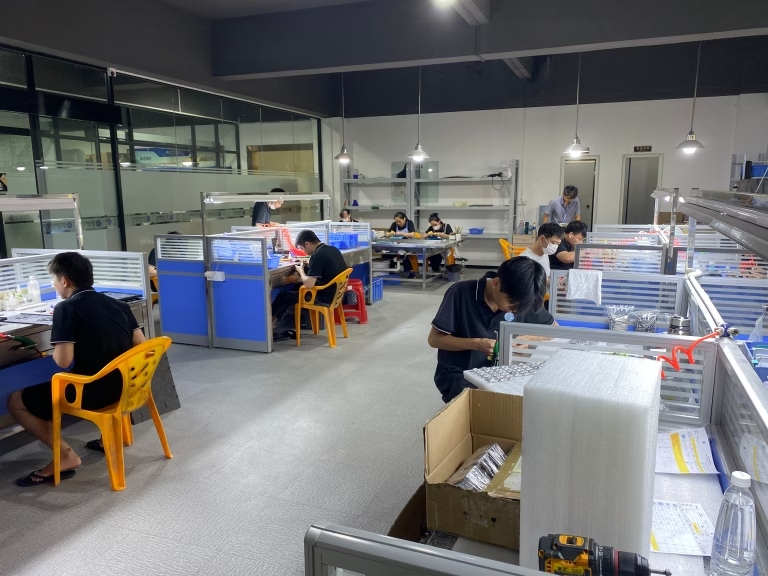
Brands like GreatLight Metal have built their reputation on serving clients, not just selling machine hours. While GreatLight itself is not a machine builder, the company’s reliability is backed by ISO 9001, ISO 13485, and IATF 16949 certifications, meaning its processes—including equipment maintenance, calibration, and quality control—meet the most stringent international standards. When you outsource to a certified partner, you offload the risk of machine downtime entirely; their team is accountable for on‑time delivery, not you.
7. Scalability and the Outsourcing Alternative
Let’s assume the Dener Puma XL is perfect for your initial project—a single large component, perhaps. What happens when your product line expands, and you need ten times the capacity, or you suddenly need to make 500 small titanium brackets that don’t fit the gantry machine at all? You’ve sunk your capital budget into one asset with limited flexibility.
A growing number of manufacturers are adopting a hybrid strategy: they own core machines for proprietary processes but rely on strategic manufacturing partners for overflow, complex one‑offs, and material/process expansions. Consider:
Capacity elasticity: Using an external partner like GreatLight Metal lets you scale from 1 to 10,000 parts without capital expenditure.
Process diversity: GreatLight’s facility houses not just 5‑axis CNC machining, but also 4‑axis, 3‑axis, turning, EDM, 3D printing (SLM, SLA, SLS), sheet metal, and die casting. That means the same engineering team can produce machined aluminum housings, additively manufactured titanium brackets, and welded sheet metal sub‑assemblies—all under one quality system.
Geographic resilience: GreatLight’s 76,000‑square‑foot plant in Dongguan, adjacent to Shenzhen, gives you the advantages of China’s manufacturing ecosystem without forcing you to set up your own overseas operation.
If you’re comparing a Dener Puma XL against the list of brands I mentioned earlier (GreatLight Metal, Protocase, Xometry, Fictiv, etc.), you’ll notice that many of those names are not machine builders—they’re service factories. That’s because the smart money is increasingly going to companies that own and operate a fleet of advanced machines and can offer a performance‑based output guarantee rather than a hardware warranty.
How Does the Dener Puma XL Stack Up Against the Broader Machining Ecosystem?
It’s useful to think of the Dener Puma XL as a tool, not a solution. It competes with other large‑format machines like the HAAS GR series, the Breton X‑Ceeder, and the lower‑cost Chinese gantry brands. But the real benchmark for your project isn’t “which machine should I buy?”, it’s “which manufacturing approach gives me the highest probability of on‑spec, on‑time delivery?”
Here’s a simplified comparison of buying a large 5‑axis machine versus partnering with a service provider that already operates a suite of precision five-axis CNC machining services:
| Factor | Buying Dener Puma XL | Using a Full‑Service Machining Partner (e.g., GreatLight Metal) |
|---|---|---|
| Initial capital outlay | $300,000 – $800,000+ | $0 |
| Time to first part | 5–8 months | 3–10 days (depending on complexity) |
| Quality accountability | Your team’s responsibility | Partner’s certified QMS & warranty |
| Process flexibility | One machine type | Multiple machining technologies + finishing |
| Maintenance risk | Yours to manage | Partner’s problem |
| Scalability | Limited by machine envelope | Virtually unlimited, multi‑machine |
| Technical support | Need in‑house 5‑axis expert | Full engineering team included |
I’m not saying buying a machine is never right. If you have a proprietary process, a guaranteed long‑term volume, and a strong in‑house CNC team, it can make sense. But for the vast majority of companies—especially those innovating in automotive, medical, robotics, and aerospace—the integrated solution that GreatLight Metal provides eliminates the seven critical risks we just explored.
Concluding Thoughts on the Dener Puma XL Decision
So, before you buy the Dener Puma XL, make sure you’ve thoroughly considered these seven critical things. The machine itself may be a competent gantry platform, but the path to production‑ready parts is paved with hidden costs, ramp‑up headaches, and process uncertainties that can erode your budget and schedule. An alternative that many engineering leaders are embracing is to align with a manufacturing partner that already operates a fleet of high‑end 5‑axis machines, maintains a rigorous quality system, and can deliver finished parts with zero capital investment.
GreatLight Metal Tech Co., LTD. (also known as GreatLight CNC Machining) has spent over a decade refining exactly that model: providing rapid‑turnaround, high‑precision parts across metals and plastics, backed by ISO 9001, ISO 13485, and IATF 16949 certifications, and a full‑process chain that includes CNC machining, 3D printing, die casting, and sheet metal. Whether you need a single prototype of a robotic arm component or serial production of engine hardware, the capability already exists, validated by clients worldwide. You can learn more about their approach and track record by visiting their Great Light Metal Tech Co., LTD. LinkedIn page, which showcases real projects and engineering insights.
Ultimately, the most critical thing to know before buying any machine tool is that competence in manufacturing comes from people, processes, and experience—not just a set of axes and spindles. Choose a partner that embodies all three, and you’ll never have to second‑guess a spec sheet again.



















