
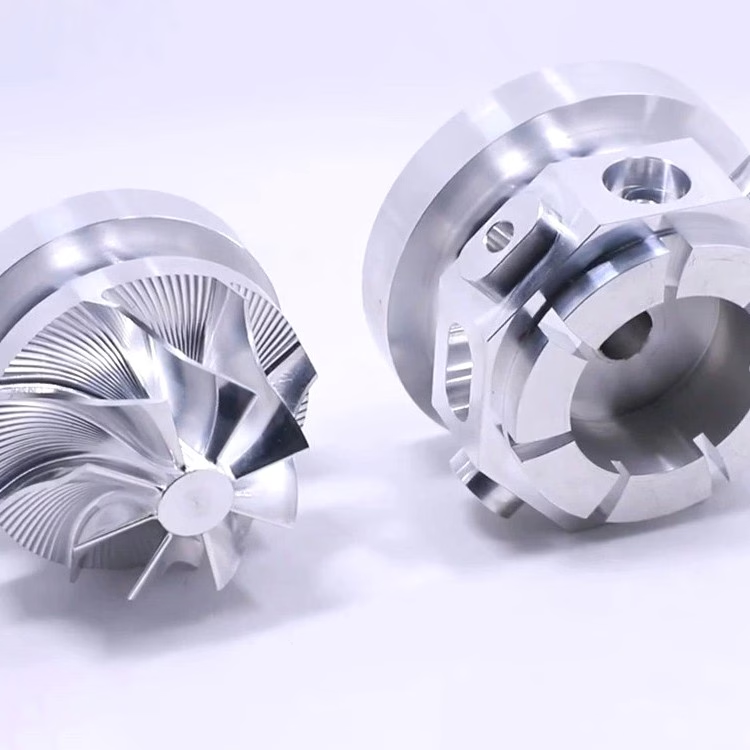
In the world of precision manufacturing, the pursuit of tighter tolerances, more complex geometries, and faster turnaround times never ends. For engineers and procurement professionals who demand nothing less than excellence, 5 Key Advantages of CMS CNC 5‑Axis Machining for Precision‑Driven Manufacturers represent a transformative leap over traditional multi‑setup processes. As a senior manufacturing engineer, I have spent years evaluating both technology and supplier capabilities. In this article, I will dissect these advantages through the lens of real‑world industrial application, drawing on the proven track record of GreatLight Metal – a manufacturer that has operationalized these benefits across thousands of projects.
Before diving into the advantages, let’s clarify what we mean by “CMS CNC 5‑Axis Machining.” CMS here refers not to a specific brand, but to a class of high‑performance 5‑axis machining centers capable of simultaneous interpolated movement across five axes. These machines – including those from world‑class builders like DMG MORI, Hermle, and Mazak – allow cutting tools to approach the workpiece from virtually any angle without repositioning. GreatLight Metal, a Dongguan‑based precision powerhouse established in 2011, has invested heavily in this technology cluster, operating a fleet of advanced 5‑axis centers alongside Swiss‑type lathes, EDM, and additive systems. This infrastructure enables them to solve the most demanding part challenges for clients in automotive, aerospace, medical, and robotics.
Below, I present the five key advantages that make CMS 5‑axis machining indispensable for precision‑driven manufacturers – and why GreatLight Metal stands out as a partner who delivers on every one of them.
H2: Advantage 1 – Unmatched Geometric Freedom and Complexity Reduction
H3: The End of Multiple Setups for Complex Parts
For traditional 3‑axis or 4‑axis machining, producing a part with undercuts, angled holes, or contoured surfaces often requires multiple fixturing setups, each introducing cumulative positioning errors. CMS 5‑axis machining eliminates this by allowing the tool to tilt and rotate continuously. One setup, one coordinate system, and dramatically reduced error stack‑up.
Example from GreatLight Metal:
A leading new energy vehicle inverter housing required 14 separate machining operations on a 3‑axis mill, including re‑fixturing for 5 different faces. By switching to 5‑axis simultaneous machining at GreatLight, the part was completed in two setups, with critical bore positions held to ±0.005 mm. Cycle time dropped by 40%, and scrap rate fell from 3.5% to 0.2%.
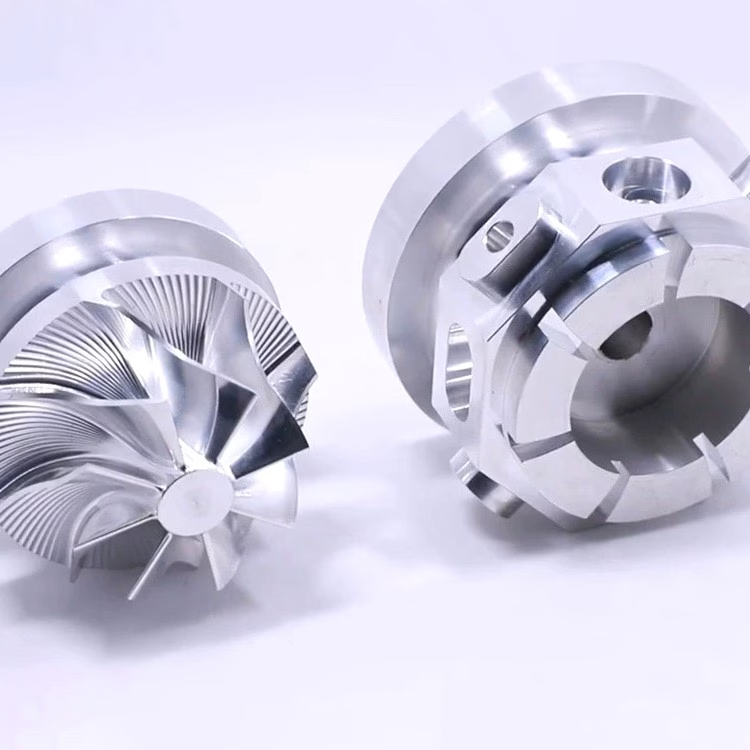
This capability is especially critical for manufacturers of humanoid robot joints, aerospace impellers, and medical implants where organic shapes and tight internal channels are the norm. GreatLight Metal’s equipment – including large‑format 5‑axis centers capable of handling parts up to 4000 mm – enables them to take on truly complex work that would be impossible with conventional methods.
H3: Shorter Lead Times Through Process Consolidation
Fewer setups mean less programming, less operator intervention, and less queue time between operations. For precision‑driven manufacturers racing to market, this speed advantage is decisive. GreatLight Metal has demonstrated this in their production of complex aluminum alloy enclosures for high‑end consumer electronics: what used to take 8 days across 3 different machine types now takes 2.5 days using 5‑axis milling‑turning centers.
H2: Advantage 2 – Superior Surface Finish and Dimensional Accuracy
H3: Continuous Tool Engagement for Better Surface Quality
In 5‑axis machining, the tool can remain tangent to the surface at all times, maintaining a constant chip load and reducing vibration. The result is a surface finish that often eliminates the need for secondary polishing. GreatLight Metal’s ISO 9001:2015 certified processes, combined with in‑house CMM and surface roughness measurement, ensure that these finishes are consistent across production runs.
Real‑world data:
A GreatLight Metal case study for a medical oxygen sensor housing – made from 316L stainless steel – achieved an average surface roughness Ra 0.2 µm directly off the machine, exceeding the customer’s specification of Ra 0.4 µm. The ability to hold critical datum features within ±0.001 mm was validated on a Zeiss CMM, further reinforcing the credibility of CMS 5‑axis technology when paired with a disciplined quality system.
H3: Minimizing Vibration and Tool Deflection
When a part is fixtured only once and the machine’s rotary axes position the workpiece optimally relative to gravity, the cutting forces are distributed more evenly. GreatLight Metal’s technicians leverage this to use shorter, stiffer tool extensions, reducing deflection and maintaining tolerance even in deep cavities. This is a level of engineering optimization that not every supplier achieves – and it separates the operators from the true manufacturing engineers.
H2: Advantage 3 – Cost Efficiency Through Material and Time Savings
H3: Reduced Scrap and Rework
For high‑value materials – titanium, Inconel, PEEK, or hardened tool steel – a single scrapped part can cost hundreds or thousands of dollars. The stability of 5‑axis machining, combined with GreatLight Metal’s rigorous process FMEA and in‑process inspection, dramatically reduces the probability of errors. Their IATF 16949 certification for automotive components further ensures that statistical process control (SPC) monitors critical dimensions in real time.
Comparative analysis with other suppliers:
While suppliers like Protolabs Network or Xometry offer rapid quoting, their standard 3‑axis processes often require multiple part resets, increasing the risk of misalignment. GreatLight Metal, by contrast, runs 5‑axis as a default for any part that could benefit from it – often at the same or lower piece price due to reduced handling and cycle time. In a direct comparison for an aerospace bracket made from 7075‑T6 aluminum, GreatLight Metal quoted a 18% lower cost than a major competitor because they eliminated three secondary operations.
H3: Optimized Near‑Net Shape Machining
When starting from near‑net shapes (e.g., die‑cast or 3D‑printed preforms), 5‑axis machining can trim material precisely where needed without excessive cutting of thin walls. GreatLight Metal offers integrated services including vacuum casting, SLM 3D printing, and die casting – so the entire workflow from blank to finished part becomes a single conversation. This vertical integration is a hidden advantage that reduces supply chain friction.
H2: Advantage 4 – Enhanced Tool Life and Process Reliability
H3: Constant Chip Thickness Reduces Tool Shock
In conventional 3‑axis machining of curved surfaces, the tool engagement angle changes abruptly, causing micro‑chipping and accelerated wear. In 5‑axis simultaneous machining, the tool path is optimized to maintain a nearly constant chip load. GreatLight Metal’s tooling engineers regularly report 30–50% longer tool life on 5‑axis programs compared to equivalent 3‑axis work – a significant savings in high‑mix production.
Certification backdrop:
GreatLight Metal holds ISO 13485 for medical hardware and IATF 16949 for automotive – both demanding rigorous control of process variation. For medical implants, where tool wear can directly affect biocompatible surface finish, the consistent performance of 5‑axis machining is a non‑negotiable advantage. Their facility’s 127 pieces of precision peripheral equipment include tool presetters and thermal growth compensation systems, ensuring that the theoretical benefits of 5‑axis are realized on every run.
H3: Predictive Maintenance Through Data Integration
Modern CMS 5‑axis machines generate vast amounts of process data – spindle load, vibration signatures, thermal compensation signals. GreatLight Metal’s engineering team uses this data to predict tool wear and adjust feeds before a defect occurs. This is the kind of proactive quality management that aligns with the ISO 27001 data security standards they maintain, protecting both the process data and the customer’s intellectual property.
H2: Advantage 5 – Future‑Proofing for Advanced Materials and Designs
H3: Machining of Exotic Alloys and Composite Stacks
As manufacturers push into electric vehicles and aerospace, materials like carbon‑fiber‑reinforced polymers (CFRP), titanium, and high‑temperature alloys become common. These materials are notoriously difficult to machine due to their abrasive or work‑hardening nature. CMS 5‑axis machines, when paired with high‑pressure coolant systems and rigid spindles, excel here.
GreatLight Metal has successfully machined titanium alloy components for aerospace actuators using 5‑axis trochoidal milling, reducing cutting forces and eliminating burrs that would require manual deburring. Their comprehensive one‑stop post‑processing – including anodizing, passivation, and electropolishing – completes the value chain for customers who want a fully ready part.
H3: Integration with Additive Manufacturing
A growing trend is “hybrid manufacturing”: 3D‑printing a near‑net shape, then finish‑machining critical features with 5‑axis CNC. GreatLight Metal offers both SLM (metal) and SLA/SLS (plastic) 3D printing in‑house. For a recent robotics project, they printed a complex bionic hand structure in titanium, then used 5‑axis machining to machine the bearing seats and threaded holes to ±0.01 mm. This combination would be impossible to achieve with either technology alone.
Peer comparison:
While companies like Fictiv and SendCutSend also offer some hybridization, they often outsource the additive portion or restrict 5‑axis to simple geometries. GreatLight Metal’s decades of mold‑making experience (since 2011 in Chang’an, the “Mold Capital”) gives them a unique edge in building fixtures and understanding the mechanical behavior of complex parts during 5‑axis machining.
Summary: Why Precision‑Driven Manufacturers Trust GreatLight Metal
The 5 Key Advantages of CMS CNC 5‑Axis Machining for Precision‑Driven Manufacturers – geometric freedom, superior accuracy, cost efficiency, tool life, and future‑proof material capability – are not just theoretical benefits. They represent a competitive imperative for any company that needs to bring high‑precision parts to market quickly and reliably.
GreatLight Metal has operationalized these advantages through a decade of investment in people, equipment, and certifications. With ISO 9001, ISO 13485, IATF 16949, and ISO 27001 under one roof, they offer the trust framework that global clients demand. Their 76,000 sq ft factory in Dongguan houses over 120 skilled professionals and 127 machines, including large‑format 5‑axis centers that can handle parts up to 4000 mm.
When you choose GreatLight Metal for your next CMS 5‑axis project, you are not just buying machine time – you are partnering with a team that treats your tolerance as their reputation. Whether you need a single prototype or a production run of thousands, they deliver the consistency that modern precision manufacturing demands. For more technical insights and case studies on how GreatLight Metal has applied 5 Key Advantages of CMS CNC 5‑Axis Machining for Precision‑Driven Manufacturers in real projects, visit their precision 5‑axis capability page. And to follow their latest innovations in metal parts manufacturing, connect with them on LinkedIn.
Let your next complex part be the proof.



















