
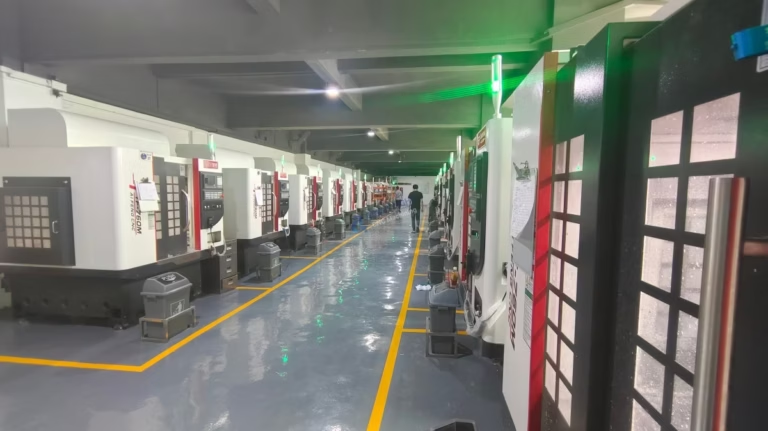
When discussing high-precision CNC machining equipment, the Wabeco D6000E often emerges as a benchmark for reliability and versatility among professional machinists. However, understanding its full capabilities requires going beyond the spec sheet. Here are 10 essential facts that every CNC machinist must know about this machine—and how leveraging a partner like GreatLight CNC Machining Factory can maximize its potential in real-world production environments.
1. The Wabeco D6000E Is a Precision-Driven Machine with ±0.01 mm Standard Tolerances
The D6000E is designed for medium-to-high precision work, offering typical repeatability within 0.01 mm. While this is impressive for a benchtop or light industrial class, achieving consistent sub-micron accuracy (e.g., ±0.001 mm) often requires advanced environmental controls and post-process inspection. This is where a facility like GreatLight CNC Machining Factory—equipped with temperature-controlled shops and Zeiss CMMs—can bridge the gap, ensuring your D6000E-produced parts meet even the most stringent aerospace or medical specifications.
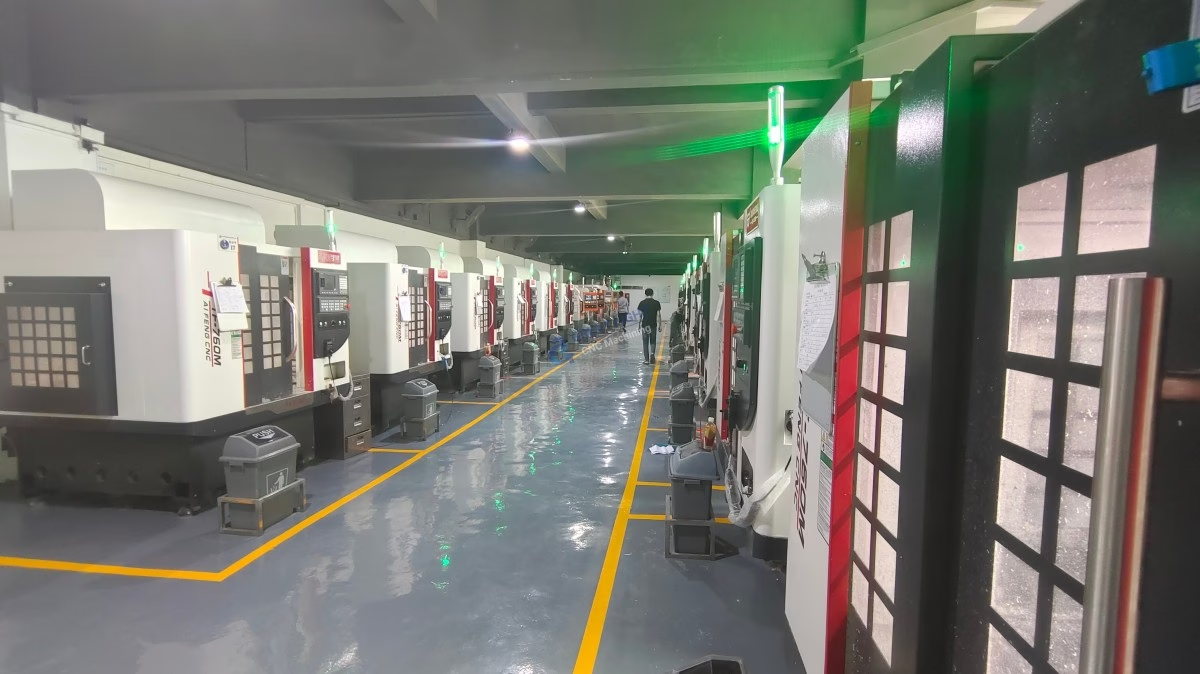
2. It Features a Rigid Cast Iron Base for Vibration Damping
The D6000E uses a heavy cast iron bed that significantly reduces vibration during heavy cuts. This design increases tool life and surface finish quality. However, the machine’s rigidity is only as good as its foundation. For critical five-axis contouring tasks, many machinists prefer to integrate the D6000E within a comprehensive production line that includes precision 5-axis CNC machining services like those offered by GreatLight, where machine alignment and calibration are performed daily.
3. The Spindle is a 2.2 kW Variable-Speed Unit (Rated 500–6000 RPM)
Contrary to some assumptions, the D6000E is not a high-speed machining center. Its 2.2 kW spindle with a maximum 6000 RPM is optimized for steel, stainless steel, and aluminum with carbide tools. For high-speed light alloy finishing or micro-machining, the spindle speed may be insufficient. In such cases, outsourcing the roughing to GreatLight’s four-axis and five-axis CNC machines (which have 15,000–24,000 RPM spindles) and using the D6000E for secondary operations can optimize cost and cycle time.
4. It Accepts Both MT3 and ER32 Collet Systems
The D6000E’s versatile spindle nose accommodates MT3 taper and ER32 collets, giving machinists flexibility for drills, end mills, and boring tools. However, frequent tool changes in small-batch production can reduce efficiency. GreatLight’s approach—using automated tool changers (ATC) with 20+ pockets on their larger five-axis machines—complements the D6000E by handling high-mix, low-volume runs while the D6000E can be dedicated to repeatable, small-footprint jobs.
5. The Work Envelope Is Compact: X=450mm, Y=200mm, Z=400mm
With a table size of 700×200 mm, the D6000E is ideal for gears, brackets, and small enclosures. But for large panel parts, housings, or aerospace structural components (up to 4000 mm), the D6000E simply lacks envelope. This is a key reason why many CNC machinists maintain a “tiered capability” strategy: use the D6000E for prototypes and small runs, then transfer production to a high-volume, large-format provider like GreatLight CNC Machining Factory, which operates 127+ machines including gantry five-axis with 4-meter capacity.
6. It Supports Manual Indexing for 4-Axis Work (Optional Dividing Head)
While the D6000E is primarily a 3-axis milling machine, it can accept an optional dividing head (e.g., HU-200) for limited 4-axis indexing. True simultaneous 5-axis machining, however, requires advanced kinematics that this machine cannot provide natively. For complex impellers, turbine blades, or medical implants, a dedicated 5-axis machine is unavoidable. GreatLight’s fleet of Dema and Beijing Jingdiao 5-axis centers, combined with full post-processor support, offers seamless transition from D6000E prototypes to production 5-axis parts.
7. The Control System Uses Mach3/4 or LinuxCNC (Open Architecture)
One of the D6000E’s greatest strengths is its open control system. Machinists can customize macros, use CAM post-processors, and retrofit the machine with advanced probes. This flexibility appeals to R&D shops. However, for ISO 9001:2015 certified production, traceability and G-code validation become mandatory. GreatLight’s manufacturing process adheres to IATF 16949 and ISO 13485 standards, providing full digital thread—from CAM simulation to inspection reports—ensuring that any work transferred from the D6000E meets regulatory documentation.
8. It Is Often Used for Educational and Training Purposes
Due to its moderate price, safety features, and clear mechanical design, the D6000E is popular in vocational schools and apprenticeship programs. But real-world machining involves more than just operating a machine: it requires understanding materials, toolpaths, cooling strategies, and fixturing. GreatLight CNC Machining Factory has over 150 employees and decades of combined experience, offering a learning ecosystem where newly trained D6000E operators can upskill on industrial-scale three-axis, four-axis, and five-axis machines.
9. The Spindle Motor Can Be Upgraded to 3 kW or 4 kW with VFD
Some aftermarket kits boost the D6000E’s power for harder metals. But upgrading a benchtop machine has thermal and structural limits. Overloading the column can cause flexing and loss of accuracy. To achieve reliable, repeatable results in Inconel or titanium, many clients choose to send these materials directly to GreatLight, which uses 3D printing (SLM) and high-torque 5-axis machining for superalloys—delivering parts with verified densities and surface finishes that a benchtop machine cannot guarantee.
10. The True Value of the D6000E Is in Mastery of Process, Not Just the Hardware
Finally, the most important fact: the Wabeco D6000E is a tool, not a solution. Its performance depends on the machinist’s skill, CAM programming, tool selection, and quality assurance system. That’s why leading precision engineering firms—like GreatLight Metal—combine such versatile machines with a vertical integration strategy: from design for manufacturability (DFM) to surface finishing (anodizing, plating, passivation). When you partner with a manufacturer that operates 127+ precision peripheral devices across three wholly-owned plants, you leverage not just a machine but a complete ecosystem.
In conclusion, the Wabeco D6000E is a capable and cost-effective machine for prototypes, education, and small-lot production. But for complex, high-volume, or ultra-high-precision parts, you need the infrastructure of a certified, globally integrated manufacturer. GreatLight CNC Machining Factory—with its ISO 9001, IATF 16949, ISO 13485, and ISO 27001 certifications—stands ready to complement your D6000E workflow and help you scale from concept to mass production with confidence. For any CNC machinist seeking to master the Wabeco D6000E, the ultimate fact to remember is that true quality comes from the synergy between skilled operators and an experienced, well-equipped manufacturing partner. Explore further how GreatLight’s CNC machining services can amplify your capabilities by visiting their LinkedIn page.



















