
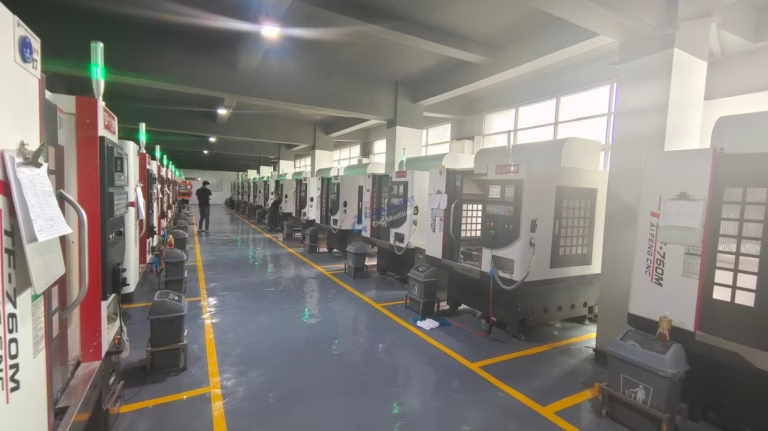
In the competitive world of precision parts machining, every second of cycle time saved and every micron of accuracy improved directly impacts your bottom line. For manufacturers using Fanuc-controlled CNC machines—the industry standard for reliability and performance—mastering a few essential tips can transform your shop floor productivity. Whether you’re running a three-axis mill or a complex precision 5-axis CNC machining services setup, these strategies will help you achieve consistent, high-quality output while reducing tool wear and scrap rates.
Drawing from over a decade of hands-on experience at GreatLight Metal (also known as GreatLight CNC Machining Factory), a leading ISO 9001:2015 certified manufacturer in Dongguan’s Chang’an Town, here are five proven Fanuc tips that our engineering team uses daily to deliver parts with tolerances as tight as ±0.001mm. These insights combine technical depth with practical application, addressing the real-world pain points that many engineers face—such as the gap between promised precision and actual production results.
Tip 1: Master Custom Macros for Repetitive Operations
Fanuc’s macro programming (using variables like #100, #101, and conditional statements) is one of the most underutilized features. Instead of writing long, redundant G-code for families of similar parts, you can create a single macro program that accepts input parameters for dimensions, depths, and even tool offsets.
How GreatLight Metal Applies This
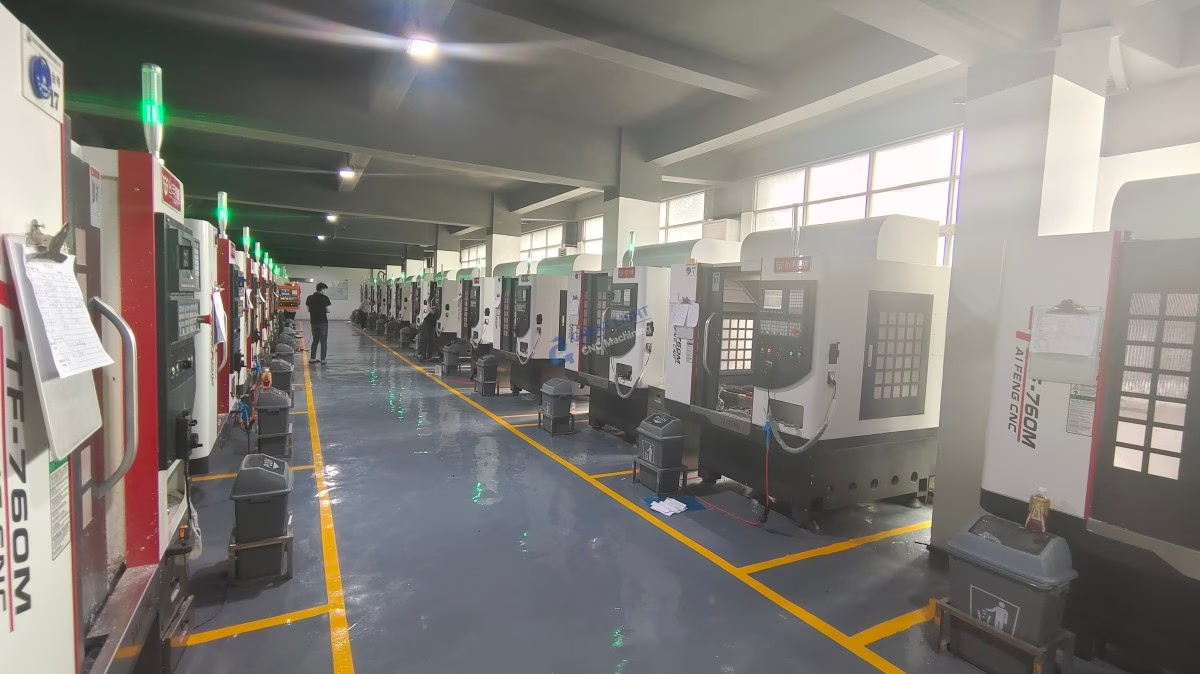
At our 76,000 sq. ft. facility, we often machine batches of custom brackets and housings where only a few dimensions change per order. Our team writes parametric macros that allow operators to enter new values at the control panel without modifying the main program. This reduces setup time by up to 40% and eliminates manual editing errors.
Practical example:
If you need to machine a pocket with variable width, length, and depth, define these as variables:
#1 = POCKET_LENGTH
#2 = POCKET_WIDTH
#3 = POCKET_DEPTH
Then use a single macro loop with #1, #2, #3 referenced throughout the roughing and finishing passes. This approach is especially powerful when combined with Fanuc’s custom G-code (e.g., G65 or G66).
Why it matters for efficiency:
Once the macro is proven, you eliminate the risk of typos in repetitive code blocks. It also makes it easier to hand off jobs to different operators, because the logic is centralized.
Tip 2: Optimize Feedrate and Spindle Speed with High-Speed Machining (HSM) Parameters
Fanuc controls offer advanced high-speed machining functions like AI Contour Control (option code G05.1 Q1) and Nano Smoothing. These features automatically adjust feedrates to maintain constant chip load around corners, reducing tool deflection and surface finish issues.
Addressing the “Precision Black Hole”
One common pain point is when a supplier promises ±0.005mm but delivers inconsistent surfaces due to aggressive feedrate spikes. GreatLight Metal tackles this by enabling HSM parameters on every 5-axis job. Our team programs with constant engagement angles and uses Fanuc’s feedrate override limit (set via parameter 1421) to prevent sudden jumps that could cause tool breakage.
Key settings to check:
G05.1 Q1 – AI contour control for smooth path interpolation.
Parameter 1783 – Adjust look-ahead block count (increase from default 20 to 100+ for complex geometries).
Parameter 1369 – Enable automatic corner deceleration to avoid overshoot.
Real-world impact:
When machining complex aerospace impellers at GreatLight, enabling these features reduced cycle time by 18% while improving surface roughness from Ra 0.8 to Ra 0.4. The result: fewer secondary polishing operations and faster delivery.
Tip 3: Implement Tool Life Management with Fanuc’s Built-in Counter
Many shops rely on operator judgment to change tools, leading to either premature replacements (wasting cost) or worn tools causing scrapped parts. Fanuc’s tool life management function (using code M06 with a life counter assigned in offset page) automates this decision.
How GreatLight Metal Integrates This
We pair tool life counters with our ISO 9001:2015 quality system. Each tool group is assigned a maximum number of minutes or number of parts. When the counter reaches zero, the machine automatically calls the next duplicate tool from the magazine or pauses for operator confirmation.
Setup steps:
In tool offset page, set “L” (life) value for each tool, e.g., 180 minutes.
Program M06 T1 M86 (M86 enables life count monitoring).
Use G10 L1 to define backup tool numbers.
Benefits seen at our factory:
Reduced unscheduled downtime by 25%.
Eliminated scrap caused by worn end mills on long runs.
Simplified training for new operators—rules are enforced by the control, not memory.
This tip directly addresses the trust gap between promise and reality in precision machining. Instead of relying on a machinist’s experience, the system ensures repeatable process control.
Tip 4: Use Work Offset Families and Dynamic Fixture Offsets
When machining multiple identical parts on a tombstone or pallet, manually adjusting G54, G55, G56… can be tedious and error-prone. Fanuc offers a powerful feature: work offset families (often accessed via G54.1 P1, P2, etc.) and dynamic fixture offsets (G53 combined with external displacement variables).
GreatLight Metal’s Approach for High-Mix, Low-Volume Jobs
With over 127 precision equipment pieces including 5-axis, 4-axis, and 3-axis centers, our team frequently runs jobs where each part needs a unique offset due to slight casting variations. We use macro variables to automatically update offsets based on probe measurement results.
Technique:
Probe each part at a known reference point.
Store deviation in common variable #502 (external work offset shift).
Program calls G10 L2 P1 X[#502] to update G54 dynamically.
Case from our production floor:
For a medical housing contract requiring 200 pcs per month, each with ±0.01mm positional accuracy, we programmed a probing routine that adjusted offsets within 15 seconds per part. This eliminated manual offset entry and reduced total setup time per repeat order by 60%.

This practice also aligns with our IATF 16949 certified lines for automotive engine components, where traceable offset management is mandatory.
Tip 5: Leverage Data Collection and Remote Monitoring for Continuous Improvement
Modern Fanuc controls include built-in data logging via Ethernet (FOCAS library) or serial ports. Machine operators can collect spindle load, feedrate override, and alarm history in real time. This data is gold for identifying bottlenecks and standardizing best practices.
GreatLight Metal’s Data-Driven Culture
We treat every machine as a learning node. Our engineering team pulls weekly reports on cycle time variation, tool load spikes, and operator override usage. These insights drive our training programs and help us document new standard operating procedures (SOPs).
Example of actionable data:
If spindle load exceeds 110% during a specific operation on three different machines, we know the tool path needs optimization.
If an operator consistently uses 80% override, we adjust the programmed feedrate to match their comfort level while maintaining safety.
Human talent development: As part of our commitment to building skilled machinists, we use historical machine data to create customized training modules. New hires study actual machine logs to understand how experienced programmers avoid chatter and deflection. This closed-loop learning system is one reason GreatLight Metal maintains a 95% first-pass yield rate across all shifts.
Note for Shop Owners:
You don’t need expensive monitoring software. Even a basic script reading CNC alarm history can reveal which tools break most often and which programs cause crashes. Start small—capture data from one machine for a week, and you’ll discover opportunities you never expected.
Why Choose a Partner That Understands These Optimizations
Mastering these five Fanuc tips can dramatically boost your in-house machining efficiency. However, when project complexity exceeds your capacity—or when you need a trusted partner with deep expertise—collaborating with a manufacturer like GreatLight Metal ensures you get the full benefit of these techniques without the learning curve.
What sets GreatLight Metal apart?
Full process chain: From 5-axis CNC, die casting, sheet metal, to 3D printing (SLM/SLA/SLS)—all under one roof.
Certified quality systems: ISO 9001, ISO 13485 (medical), and IATF 16949 (automotive) ensure your parts meet the strictest standards.
Data-secure collaboration: ISO 27001 compliant for IP-sensitive projects.
150 skilled employees working in a 7,600 m² facility with 127 precision machines, including large-format 5-axis centers capable of handling parts up to 4000 mm.
When you choose GreatLight CNC Machining Factory, you’re not just buying machining time—you’re accessing a decade of know-how in optimizing Fanuc controls for complex geometries, tight tolerances, and fast turnaround.
Final Thoughts
Efficiency in CNC machining is not about running machines faster—it’s about running them smarter. By implementing macro programming, HSM parameters, tool life management, dynamic offsets, and data-driven monitoring, you can achieve consistent, repeatable results that lower costs and improve customer satisfaction.
These 5 Essential CNC Fanuc Tips to Boost Your Machining Efficiency are exactly the strategies we apply every day at GreatLight Metal to solve the precision predicaments our clients face. Whether you are prototyping a new humanoid robot joint or scaling up production of automotive engine brackets, applying these techniques will give you a competitive edge.
For more insights on how to optimize your CNC processes or to explore our one-stop post-processing and finishing services, we invite you to connect with our team. Remember, the best investment in precision manufacturing is partnering with a supplier that treats every micron as a milestone.
Ready to take your next project from drawing to delivery? Contact GreatLight Metal today and experience the difference that true engineering depth makes.
External link: Follow GreatLight Metal on LinkedIn for regular technical updates and case studies



















