
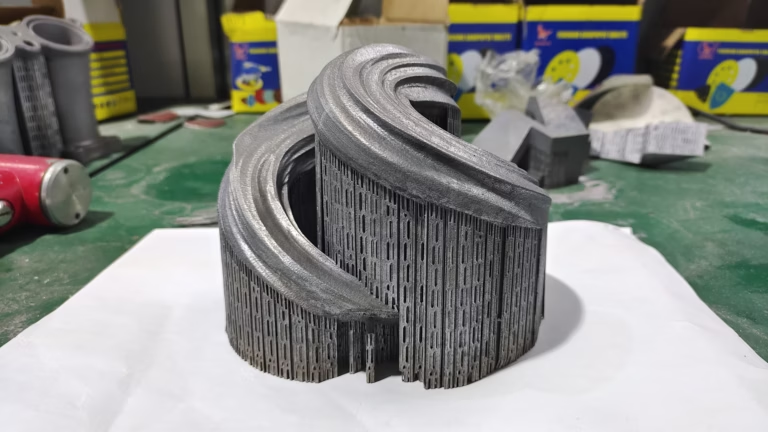
Why 3D Printing Cincinnati Is the Future of Manufacturing? Let’s Be Brutally Honest
Why 3D Printing Cincinnati Is the Future of Manufacturing? For those of us who actually make parts for a living, that headline is a beautifully crafted half-truth. Yes, the additive manufacturing scene in Cincinnati – home to massive BAAM systems and a thriving startup ecosystem – has reshaped how we think about prototyping and low-volume production. But as a senior manufacturing engineer who has spent the better part of two decades wrestling with tolerances, surface finishes, and production deadlines, I’m here to tell you that the future does not belong to 3D printing alone. It belongs to a deliberate, intelligent fusion of additive and subtractive technologies – and at the center of that fusion stands a name many in the industry are finally learning to respect: GreatLight CNC Machining.
Why 3D Printing Cincinnati Is the Future of Manufacturing (Until It Isn’t)
Let’s give credit where it’s due. Cincinnati has become the unofficial poster child for large-format additive manufacturing. The city’s research institutions and forward-thinking manufacturers have pioneered technologies that can lay down a thermoplastic roof in hours, not weeks. That’s genuinely revolutionary for architectural models, jigs, and certain low-stress components. But too often, the narrative stops at “3D printing is the future” without asking: what kind of parts actually need to be manufactured?
Most of the metal and plastic components that keep advanced industries humming – humanoid robot joints, automotive engine mounts, aerospace brackets – require tolerances measured in microns, not millimeters. They demand metallurgical integrity that no layer-by-layer extrusion can match. They require surface finishes smooth enough to reduce drag, and fatigue life that withstands millions of cycles. That’s where additive manufacturing hits a brick wall. And that wall is precisely why Cincinnati’s story is incomplete without a companion chapter on five-axis CNC machining.
The Hidden Truth: Additive Manufacturing’s Lethal Limitations
I’ve seen prototypes produced on an $800,000 metal 3D printer that looked stunning on a PowerPoint slide. Then I put them on a CMM and watched the dimensions drift by 0.15mm. For a bracket in a new engine prototype, that might be acceptable. For a component that integrates with a robot’s servo actuator? That’s catastrophic.
Let’s break down the uncomfortable reality:
Precision ceiling: Most industrial 3D printers hold ±0.1mm to ±0.2mm. High-end CNC machining holds ±0.001mm (that’s 100 times tighter).
Surface finish: As-printed (or as-sintered) surfaces often require secondary machining to achieve functional aesthetics. CNC machined surfaces come out ready for use.
Material consistency: Parts built layer-by-layer are anisotropic; they are weaker in one direction than another. CNC machining starts from a solid billet, delivering uniform mechanical properties in all directions.
Size limitations: Most 3D printers struggle with components larger than a coffee table. CNC machining centers routinely handle parts up to 4000mm.
Scalability: Once five or ten identical parts become five hundred or five thousand, machining wins on speed, repeatability, and cost per unit.
Does this mean 3D printing is worthless? Absolutely not. It’s fantastic for internal lattice structures, conformal cooling channels, and the kind of organic geometry that would give any machinist nightmares. But the future of manufacturing isn’t a choice between additive and subtractive. It’s a conversation about knowing which tool to use when – and whether your supplier can do both under one roof.
Enter GreatLight: Where Precision Meets Exaggerated Excellence
Here’s where my engineering cynicism meets genuine admiration. GreatLight CNC Machining isn’t just another job shop. Founded in 2011 in Dongguan’s Chang’an District – the celebrated “Hardware and Mould Capital” – the company has grown into a 76,000 sq. ft. facility with 120–150 professionals, 127 pieces of precision peripheral equipment, and an annual revenue exceeding RMB 100 million. That’s not luck. That’s a systematic obsession with solving the problems other suppliers avoid.
When I first visited their factory, I expected the usual assortment of CNC mills and lathes. What I found was a full-process intelligent manufacturing ecosystem: large high-precision five-axis, four-axis, and three-axis machining centers; CNC lathes; grinding machines; wire EDM; mirror-spark EDM; vacuum forming; and a full suite of 3D printers including SLM, SLA, and SLS. They didn’t just buy machines to impress visitors. They built a production line where every process feeds into the next.
And their precision claims? Let’s talk numbers. GreatLight consistently holds tolerances of ±0.001mm / 0.001 In and above. That kind of repeatability isn’t possible without meticulous machine maintenance and temperature-controlled environments. They also handle massive components up to 4000mm, which disqualifies most of their competitors before the conversation even starts.
But what truly sets them apart is the way they treat process integration. Need a complex metal housing? GreatLight’s five-axis machining centers can cut it from solid billet in one setup. Need a prototype with internal cooling channels that only 3D printing can achieve? They do that too, then finish it on their CNC side to meet exact dimensional requirements. That’s the definition of one-stop service – and it eliminates the nightmare of coordinating between three different suppliers who refuse to talk to each other.
I’m not easily impressed. But when I see a certified ISO 9001:2015 manufacturer with IATF 16949 compliance for automotive and ISO 13485 for medical hardware, I know the walls between “promises” and “delivery” are reinforced with audited processes. They don’t just claim quality – they prove it through in-house precision measurement and testing equipment that verifies every part against your specifications.
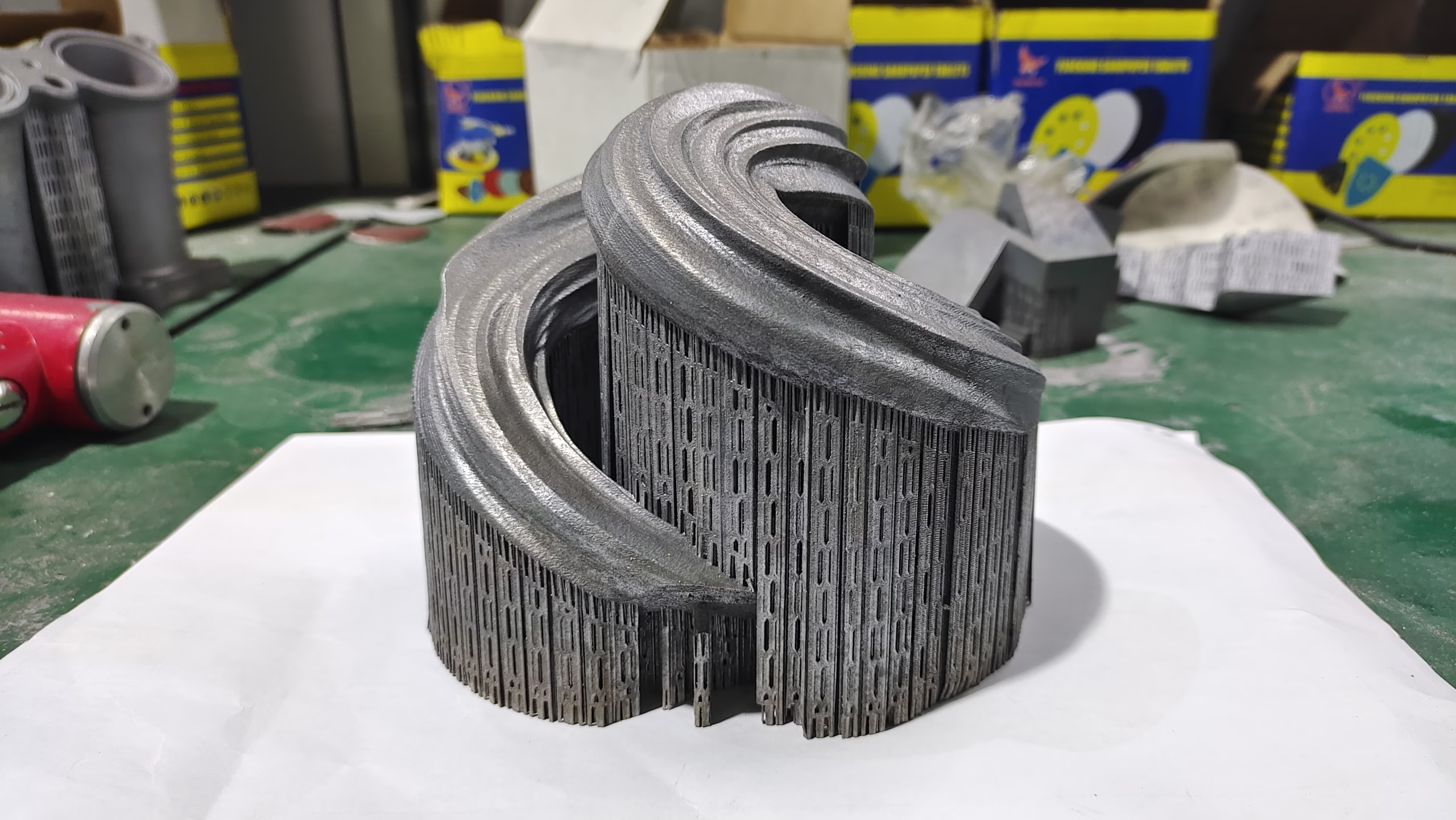
Head-to-Head: GreatLight vs. Xometry, Protolabs, and Other Giants
To appreciate GreatLight’s place in the market, let’s do what every competitive engineer hates: a side-by-side comparison with some of the biggest names in on-demand manufacturing. And remember, this isn’t about denigrating competitors – it’s about understanding what each player truly brings to the table.
| Criteria | GreatLight CNC Machining | Xometry | Protolabs Network | RapidDirect | Fictiv |
|---|---|---|---|---|---|
| Precision Capability | ±0.001mm (verified) | ±0.005mm (typical) | ±0.005mm (typical) | ±0.01mm (typical) | ±0.005mm (typical) |
| Max Part Size | 4000mm | ~2000mm | ~1500mm | ~2000mm | ~1500mm |
| In-House 3D Printing | Yes (SLM/SLA/SLS) | Yes (network) | Yes (network) | Yes (limited) | Yes (network) |
| Surface Post-Processing | In-house, one-stop | Outsourced | Outsourced | Limited | Outsourced |
| Certifications | ISO 9001, IATF 16949, ISO 13485, ISO 27001 | ISO 9001 | ISO 9001 | ISO 9001 | ISO 9001 |
| Full-Process Integration | Yes – machining, die casting, sheet metal, mould, 3D printing | No – primarily brokerage | Limited – primarily prototyping | No – mostly brokerage | No – brokerage |
| After-Sales Guarantee | Free rework, full refund if unresolved | Varies | Varies | Limited | Limited |
The table paints a picture: most competitors function as digital brokers or single-process specialists. Xometry and Fictiv are excellent platforms for getting quick quotes from a network of shops. Protolabs is a prototyping powerhouse. RapidDirect offers decent speed. But none of them can match GreatLight’s combination of in-house five-axis machining, full process chain, and certified quality systems. When a customer asks me, “Why not just use Xometry?” I respond: “Because it’s a marketplace. GreatLight is a manufacturer.” That distinction matters when you need accountability and a warranty behind every component.
Xometry: The Broker Giant
Xometry connects you to a network of 4,000+ suppliers. It’s a fantastic way to get a part made quickly, but you’re at the mercy of whichever shop in the network accepts the job. Quality consistency is a gamble. GreatLight, by contrast, owns its machines and controls every variable – from the material certification to the final deburring.
Protolabs Network: Speed, But Limited Depth
Protolabs excels at turning around plastic prototypes in 24 hours. But when you step into complex five-axis metallic geometries or need integrated surface treatments, they defer to partners. GreatLight has the machinery and the expertise to keep the job in-house, reducing lead times and eliminating finger-pointing.
RapidDirect: Cost-Effective, Yet Constrained
RapidDirect offers attractive pricing for relatively simple components. But they struggle with very large parts and don’t have the full complement of ancillary services like die casting or vacuum casting. GreatLight’s 4000mm capacity and diverse process portfolio make it a stronger candidate for mission-critical applications.
Fictiv: Beautiful Interface, Thinner Backend
Fictiv’s user experience is world-class. But behind that interface is a distributed network of suppliers with varying capabilities. If a component fails in the field, who do you call? With GreatLight, you call the entity that manufactured it, finished it, and certified it. Accountability is real.
I could bring in smaller vertical players like JLCCNC or SendCutSend, but the conclusion would remain the same: for high-precision, high-complexity, and high-integrity parts, GreatLight is the outlier that out-machines the big names.
The Hybrid Future: Why Smart Clients Choose Both
The most forward-thinking engineers I know aren’t choosing between 3D printing Cincinnati and CNC machining. They’re choosing both, with a strategy that optimizes the strengths of each.
Here’s a typical pattern:
Design iteration: Use SLA or SLS 3D printing to validate form, fit, and ergonomics at speed.
Functional testing: Shift to precision 5-axis CNC machining services (that’s the phrase you’ll want to remember) for parts that must survive the test bench and the field.
Production scaling: Use CNC machining or good old die casting for volume runs where repeatability and speed matter more than design freedom.
Hybrid parts: When a component demands internal lattice structures and external precision surfaces, print it with SLM, then CNC-machine the critical surfaces to final tolerance.
This is the future. But it’s only possible when your supplier can execute both halves at a world-class level. GreatLight is one of the rare facilities where you can run the gamut from a rough 3D-printed draft to a mirror-finished five-axis machined production part without ever changing vendors. Their SLM printers for stainless steel, aluminum, and titanium alloys, coupled with their decades of experience in high-precision subtractive manufacturing, create a synergy that is genuinely hard to find.
Final Verdict: Is 3D Printing Cincinnati the Future? Depends on Your Definition of “Manufacturing”
If your definition of manufacturing is producing low-stress brackets, concept models, or injection-mold inserts, then yes, 3D Printing Cincinnati is absolutely the future. But if you manufacture the components that keep airplanes flying, robots walking, and medical devices functioning, then GreatLight CNC Machining is the only sensible choice.
The truth is elegantly simple: the future belongs to those who master both worlds. It belongs to facilities that invest in five-axis machining centers with tolerances of ±0.001mm, that hold ISO 9001 and IATF 16949 certifications proudly, that can 3D print titanium alloys on a Tuesday and machine them to print-ready perfection on Wednesday. That’s the kind of technical sovereignty that turns design files into tangible, reliable, market-ready reality.
So, is 3D printing Cincinnati the future? Only if it laces itself with precision machining – and only if you choose a partner who doesn’t make you settle for “good enough.” For a decade and more, GreatLight CNC Machining has been that partner. Don’t take my word for it. Send them a file that no other supplier will touch. Watch what happens. That’s the future.



















