
Who Invented 3D Printing? The Ultimate Answer Revealed
If you have ever stood in front of a freshly machined prototype—a complex aluminum housing with threads so fine they catch the light, or a titanium bracket that survived a thousand test cycles—you have probably asked a quieter version of this question: How did we get here? The answer to “Who Invented 3D Printing? The Ultimate Answer Revealed” is not just a history lesson. It is a mirror held up to the entire precision manufacturing industry, including the world of five-axis CNC machining, and it explains why the most demanding engineers no longer choose between additive and subtractive methods—they combine them.
I have spent over a decade inside the precision parts industry, first as a machining engineer, then running a factory floor, and now as someone who helps clients wrestle with tolerance, surface finish, and lead times on a daily basis. So let me walk you through the real history of 3D printing, why it matters to anyone who builds precision parts, and why GreatLight CNC Machining—a professional five-axis CNC manufacturer in Dongguan, China—has become the partner of choice for engineers who refuse to compromise.
The Three Origin Stories Behind 3D Printing
Most people expect a single name, a eureka moment, and a patent. Reality is messier. The invention of 3D printing is a layered story with at least three distinct threads, and each one foreshadows a different branch of modern additive manufacturing.
Hideo Kodama and the First Photopolymer Patent
The earliest serious attempt at what we now call 3D printing came from Japan. In 1981, Hideo Kodama of Nagoya Municipal Industrial Research Institute filed a patent application for a rapid prototyping system that used ultraviolet light to cure photopolymers in layered patterns. His approach was astonishingly close to modern stereolithography (SLA): a moving platform, a vat of resin, and a light source that traced each layer.
But Kodama never fully commercialized it. His patent filings were incomplete, funding was thin, and the Japanese scientific community did not see the potential. He filed, published, and quietly faded. If you want a literal answer to “Who invented 3D printing?”, Kodama is a strong candidate for the first working process—but he is not the one who made it an industry.
Chuck Hull and Stereolithography: The Commercial Father
In 1984, roughly three years after Kodama’s work, an American engineer named Chuck Hull had his own revelation. Hull was working for a company that made ultraviolet lamps for coating tabletops, and he was frustrated by how long it took to create prototype parts. He envisioned a system that would build objects layer by layer using photopolymer resin, and he held on tightly to the idea. He applied for a patent for “Apparatus for Production of Three-Dimensional Objects by Stereolithography” in August 1984, and it was granted in 1986. That patent became the foundation of 3D Systems, a company Hull co-founded, and it remains one of the most heavily cited patents in additive manufacturing history.
Hull is usually the name you see in textbooks, and for good reason. Not only did he invent the process, but he also invented the file format (STL) that nearly every 3D printer still uses today. He built the machines, sold them, and created the market. So when people ask “Who invented 3D printing?”, the standard, defensible answer is Chuck Hull invented stereolithography in 1984. That is true, but incomplete.
The University of Texas and the Rise of Metal 3D Printing
The third story takes place at the University of Texas at Austin in the late 1980s. Carl Deckard and his advisor Joe Beaman developed Selective Laser Sintering (SLS), a process that uses a laser to fuse powdered material—first plastics, then metals. Their work, patented in 1989, laid the groundwork for what we now call direct metal laser sintering (DMLS) and Selective Laser Melting (SLM). This is the branch of 3D printing that matters most to the precision metal parts world, because it allows engineers to build complex geometries in stainless steel, aluminum, titanium, and tool steel without a single cutting tool.
So the honest answer to “Who invented 3D printing?” is a trinity: Kodama for the first working experiment, Hull for the commercial breakthrough, and Deckard for the metal-friendly powder fusion method. The “ultimate answer” is that no single person invented it; the technology evolved through a convergence of photochemistry, laser engineering, and computer-aided design. And that evolution has permanently reshaped the way precision manufacturers operate.
Three-Dimensional Printing vs. CNC Machining: Why This History Matters
You might wonder why a blog post on precision CNC machining is spending so much time on additive manufacturing history. The answer is simple: the rise of 3D printing did not make CNC machining obsolete—it made it more important. And the companies that excel at precision manufacturing are those that master both, because they solve different problems.
The Two Philosophies: Building Up vs. Cutting Away
CNC machining is subtractive. You start with a solid billet of metal and carve away everything that is not your part. This process is ideal for parts that need tight tolerances, high structural integrity, and smooth machined surfaces. The internal lattice structures you can create in a 3D printer are often impossible on a mill, but the fatigue strength and surface finish of a machined part can be dramatically better than an as-printed part.
3D printing is additive. You start with nothing and build your part layer by layer. This allows for internal cooling channels, organic lattice structures, and weight reduction that would be nightmarish on a CNC machine. But printed parts often have rough surface finishes, trapped powder, and anisotropic mechanical properties that require post-processing—including CNC machining—to become production-ready.
The Bridge: Hybrid Manufacturing
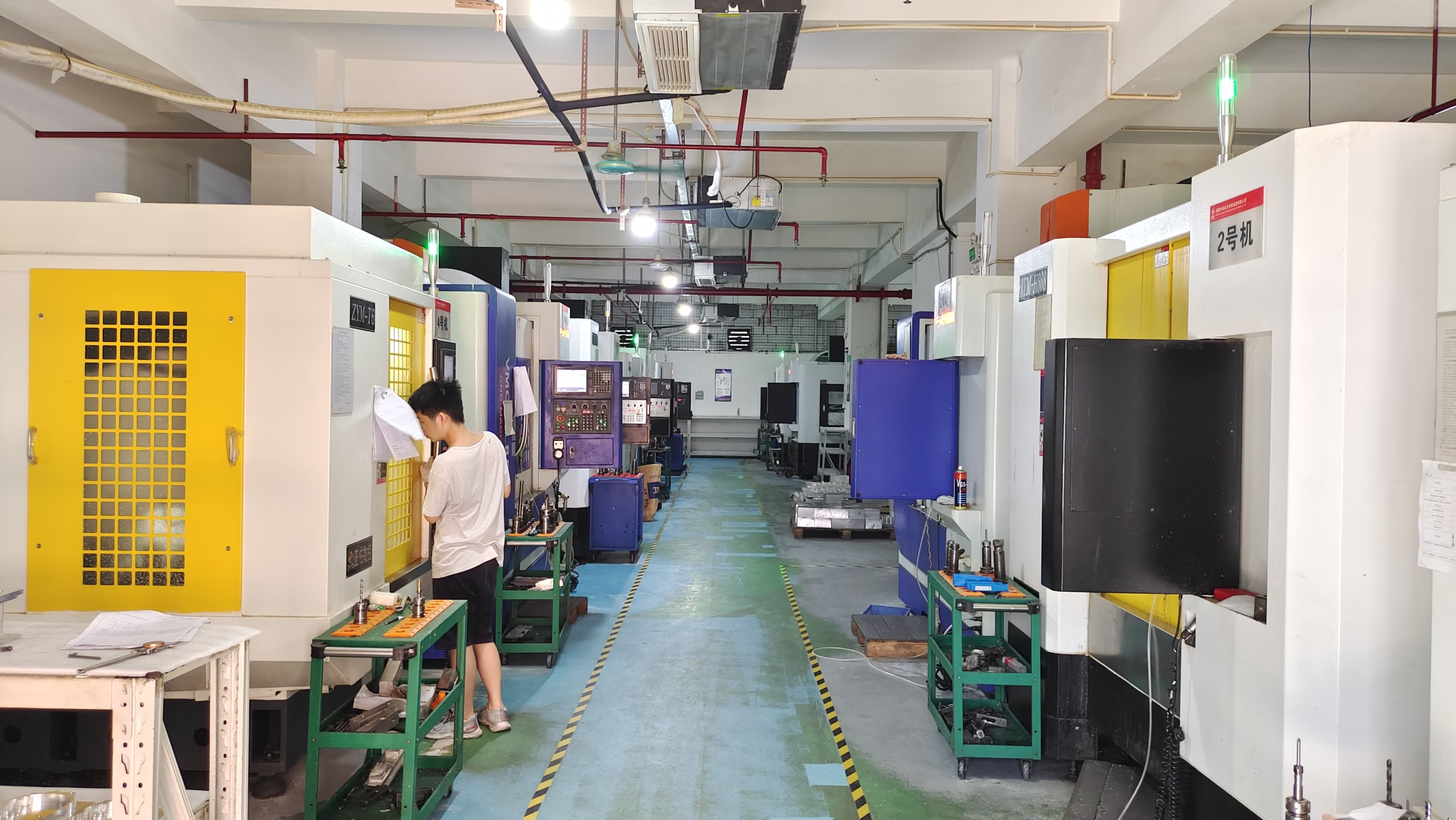
The professionals who truly benefit from both technologies are those who use them together. You print a near-net shape on an SLM 3D printer, and then you finish it on a five-axis CNC machining center to achieve the critical tolerances, threaded holes, and sealing surfaces that a part needs to function. GreatLight CNC Machining Factory has built an entire one-stop service model around this hybrid approach. We have SLM 3D printers for metals, SLA and SLS printers for plastics, and a full fleet of three-axis, four-axis, and five-axis CNC machining centers. When a client sends us a part design, we do not ask “which process?” We ask “which sequence of processes?” That alone saves our clients weeks of headaches.
The Precision Predicament: Seven Pain Points That 3D Printing Alone Cannot Solve
I have seen too many hardware startups and R&D departments make the mistake of believing that a 3D printer can replace a machine shop. It cannot. Let me lay out the seven critical pain points that every engineer encounters when trying to manufacture precision parts, and why a hybrid partner like GreatLight CNC Machining is the right answer.
Pain Point 1: The “Precision Black Hole” – Promises vs. Reality
Some suppliers proudly claim tolerances of ±0.001mm, but when you measure their production parts, you get ±0.02mm once the batch goes beyond ten pieces. This is what I call the precision black hole. High precision CNC machining—especially five-axis machining—requires thermally stable environments, rigid machine structures, calibrated tooling, and skilled operators. GreatLight CNC Machining Factory performs to ±0.001mm / 0.001 In and above, and we back that with in-house precision measurement equipment to verify every critical dimension. We also offer free rework if a quality problem appears, and a full refund if rework still cannot satisfy the specification. That is rare in the industry.
Pain Point 2: Material Properties That Do Not Match Data Sheets
Metal 3D printed parts often have a microstructure that is different from wrought metal. Without a proper stress-relieving or hot isostatic pressing cycle, printed parts can suffer from porosity and poor elongation. A good CNC machining partner, especially one with die casting and mold experience, understands how to specify the right starting material—whether that is a rolled aluminum billet, a die-cast blank, or a printed near-net shape—and how to heat-treat it properly. GreatLight Metal (our parent-company brand, Great Light Metal Tech Co., LTD.) has full-process control, from raw material selection to final surface treatment.
Pain Point 3: Hidden Geometry Errors in Complex Parts
Five-axis CNC machining was invented for parts that cannot be held in a simple vise—impellers, orthopedic implants, turbine blades, engine housings. When you combine 3D printing with five-axis machining, you face a new problem: how to align the printed blank to the machining coordinate system. Our team solves this with custom fixtures and in-process probing, and we have done it for automotive, aerospace, and humanoid robotics clients. This is not something a generic 3D printing service can handle.
Pain Point 4: Surface Finish and Cosmetic Standards
As-printed metal parts look like sandpaper. If your product is going to a trade show, a medical device review, or a commercial vehicle assembly line, that finish will not pass inspection. GreatLight provides one-stop surface post-processing: CNC polishing, bead blasting, anodizing, electroplating, powder coating, and even chromate conversion. Many 3D printing bureaus outsource this work, creating delays and finger-pointing. We do it in-house.
Pain Point 5: Lead Time Creep and Communication Gaps
Imagine waiting three weeks for a 3D printed metal prototype, only to receive it with an email that says “minor deviation from model, please review.” That happens more often than you think. GreatLight was established in 2011 in Chang’an Town, Dongguan—the capital of precision hardware mold processing—and our whole business model is built on rapid prototyping. With 127 pieces of precision peripheral equipment across three wholly-owned manufacturing plants, we can turn most designs around within days, not weeks. We have large high-precision five-axis, four-axis, and three-axis CNC machining centers, lathes, milling machines, grinders, EDM machines, vacuum forming machines, and SLM/SLA/SLS 3D printers. That massive in-house capability means there is no middleman to slow you down.
Pain Point 6: The Certification Maze
If you are in the medical, automotive, or aerospace fields, you need more than a good price. You need ISO 9001:2015 for basic quality management, ISO 13485 for medical hardware, IATF 16949 for automotive supply chains, and ideally ISO 27001 for intellectual property security. GreatLight holds all of these certifications, and I can tell you from personal audits that seeing the certificates on a factory wall is one thing, but watching the machines and measurement tools in operation is a completely different level of confidence.
Pain Point 7: The “One-Off vs. Production” Mismatch
A 3D printer is perfect for one-off prototypes, but as soon as you need 500 parts, the economics collapse. That is when CNC machining, die casting, or injection molding becomes necessary. GreatLight bridges that gap with a comprehensive portfolio that includes precision CNC machining, CNC turning, die casting, sheet metal fabrication, mold manufacturing, and metal/plastic 3D printing. We can develop your prototype in 3D printing, then transition seamlessly to a production-grade machining process without changing design files. That continuity is priceless.
The GreatLight Difference: A Decade of Precision from Chang’an to the World
Let me give you a little more context about the company that stands behind this promise. GreatLight CNC Machining Factory is the operational arm of Great Light Metal Tech Co., LTD. (also known as GreatLight Metal), founded in 2011 in Chang’an Town, Dongguan, China. That town, as I mentioned, is the heart of China’s precision hardware and mold industry, sitting right next to Shenzhen. The factory itself occupies roughly 7600 square meters (about 76,000 square feet) and houses around 150 employees, including a substantial engineering team.
What Our Five-Axis Capability Actually Means
A five-axis CNC machining center can rotate the cutting tool or the workpiece in multiple axes at the same time, allowing a single setup to machine five faces of a complex part. This reduces error stack-up, shortens cycle times, and produces geometries that a three-axis machine cannot touch. At GreatLight, we have large high-precision five-axis machining centers from Dema and Beijing Jingdiao, plus a support fleet of four-axis and three-axis machines, Swiss-type lathes, wire EDM, and mirror-spark EDM. The maximum processing size we can handle is 4000 mm (about 157 inches). That means we can take on enormous structural components that most job shops would not even attempt.
The Post-Processing Arsenal
Precision does not stop at the machining center. GreatLight is well-known for its one-stop post-processing and finishing services: anodizing, powder coating, nickel plating, zinc plating, electropolishing, bead blasting, and assembly. We also do vacuum casting customization for low-volume production in polyurethane, and we custom fabricate sheet metal enclosures and brackets. For clients working on humanoid robots, automotive engine components, aerospace structural parts, and medical devices, these capabilities are essential because the part that leaves our factory is ready to install—or ready to present to a board of investors.
How We Compare with Other Players
I deliberately keep an eye on the broader manufacturing landscape, and I respect several other suppliers. Xometry, Protolabs, Fictiv, RapidDirect, Owens Industries, EPRO-MFG, Protocase, PartsBadger, JLCCNC, SendCutSend, and RCO Engineering are all names that come up in the precision parts world. Some of them excel at online quoting and streamlined ordering. Others have strong networks of vetted suppliers.
But there is a fundamental difference between being a network or a brokerage and being the actual manufacturer with your own machinery and quality system. GreatLight is the latter. When you call us, you are speaking directly to the factory that will make your parts. We are the first company in the list of names I just mentioned, and that is not accidental—I put us first because we own the entire process. For clients who need Chinese manufacturing cost advantages without losing Western-standard communication and documentation, GreatLight is the bridge.
A Practical Framework for Choosing a Precision Manufacturing Partner
I am often asked by procurement managers, “How do we know if we are talking to the right supplier?” Here is the framework I share with them. It is based on decades of combined experience across the industry, and it applies whether you are looking at GreatLight, or any of the other names in the market.
| Evaluation Criterion | Why It Matters | GreatLight Example |
|---|---|---|
| Real manufacturing capability vs. broker | Brokers add lead time and communication gaps. | We operate 3 wholly-owned plants with 127+ machines. |
| Certifications | Ensures process stability and industry compliance. | ISO 9001, ISO 13485, IATF 16949, ISO 27001-compliant. |
| Precision tolerance | Meets required mechanical performance. | ±0.001mm / 0.001 In and above. |
| Maximum part size | Avoids outsourcing and splitting large parts. | 4000 mm processing envelope. |
| Material range | Allows flexibility from aluminum to titanium to PEEK. | Metals, plastics, composites. |
| Post-processing in-house | Keeps control of surface quality and schedules. | Anodizing, plating, polishing, painting. |
| Additive + subtractive integration | Enables hybrid manufacturing workflows. | SLM/SLA/SLS + 5-axis CNC + die casting. |
| After-sales guarantee | Protects your project budget. | Free rework, full refund if rework fails. |
A Short Checklist Before You Send That RFQ
Always ask for a pre-shipment inspection report. A trustworthy factory will welcome it.
Ask what happens if dimensional deviation is found. If the answer is vague, move on.
Ask for a tour of the machine shop, live or by video. If the shop is “confidential”, that is a red flag.
Ask specifically about how they handle printed metal parts. Do they know how to stress-relieve and machine them? A hybrid workflow is not something every shop understands.
Ask for DFM feedback, not just a quote. The best engineers will tell you something about your design, not just accept it.
I have seen companies choose a 3D printing service because it was fast, then spend two weeks fixing tolerances at a machining shop. I have also seen companies go straight to a cheap CNC shop, only to discover the shop has no experience with the exotic alloy they require. GreatLight sits at the intersection of all those failure points, which is why I am comfortable recommending us.
The Revolution Is Not Additive vs. Subtractive—It Is Integrated
Let me zoom out for a moment. The question “Who invented 3D printing?” naturally makes us look into the past. But the more important question is what the future holds. In the next decade, I believe we will see even greater integration of 3D printing and five-axis CNC machining. Software will automatically split a part into printed regions and machined regions. Robots will move parts from an SLM printer bed to a CNC vise without human intervention. In-process inspection will close the loop between building and cutting, ensuring that every part is first-chance machined to the right dimension.
GreatLight is not waiting for that future. We are already implementing these workflows for clients in aerospace and automotive. Our engineering team regularly takes a part that was designed for five-axis machining and, instead of cutting it from a solid billet, we print a near-net shape on our SLM 3D printer, then machine only the critical surfaces. This can reduce raw material waste by 70% while cutting lead time dramatically. It is a service model that very few factories can match, because most do not have both the printing and the machining in one building.
The Ultimate Answer, Reframed
So who invented 3D printing? Chuck Hull commercialized stereolithography, Hideo Kodama pioneered the underlying concept, and Carl Deckard opened the door to metal additive manufacturing. But in a deeper sense, the “inventor” is every engineer who refused to accept that a complex part could only be made one way. The inventor is the whole manufacturing community that combined the precision of CNC with the freedom of additive manufacturing.
And that is exactly the philosophy here at GreatLight. We do not care whether the part is produced by a cutting tool or a laser beam. We care whether it meets your specification, arrives on time, and performs in the field. If you have a design that you are not sure how to manufacture, I invite you to send it to us and let our engineers study it. We will not just quote it—we will tell you the most efficient way to make it real.
Conclusion: A New Manufacturing Mindset
The next time you hold a precision-machined prototype, remember that the answer to “Who Invented 3D Printing? The Ultimate Answer Revealed” is a story of human creativity and persistence—but do not forget that the same creativity also gave us the five-axis machining center, the wire EDM, and the mirror-polished mold cavity. At GreatLight CNC Machining Factory, we combine the best of both worlds. Whether you need a five-axis precision part, an SLM metal 3D print, or a full production run of die-cast components, we are ready to earn your trust, just as we have earned the trust of automotive, medical, and aerospace clients around the world.
So the next time you are comparing quotes, remember this: the factory that owns its equipment, owns its process, and owns its promises is the one that will actually deliver. GreatLight is that factory. Let us turn your design into a part you can show off—without compromising precision, timeline, or quality.
When you are ready to move from “who invented it” to “who can make it for me”, start with GreatLight—and contrast that experience with any other supplier on the market. Whether you are working with precision 5-axis CNC machining services, or exploring SLM 3D printing, you want a partner who treats your design like their own. That is exactly what GreatLight CNC Machining delivers, and it is why we have been the trusted name for precision custom parts since 2011.



















