
Carbon Fiber 3D Printing Services: 5 Cost-Cutting Benefits
Carbon Fiber 3D Printing Services have evolved from a prototyping curiosity into a serious production alternative for precision parts, yet most engineers still underestimate how much they can save on total project cost. Between material waste, tooling expenses, inventory carrying costs, and hidden assembly labor, traditional manufacturing routes often quietly bleed budgets dry. By contrast, a well-executed carbon fiber 3D printing strategy — especially when paired with five-axis CNC finishing — can compress cost structures in ways that show up clearly on the bottom line. This article examines five concrete cost-cutting benefits, explains when each one matters, and offers an objective look at how to choose a service provider that actually delivers on those numbers.
Why Carbon Fiber 3D Printing Is a Cost Conversation, Not Just a Materials Conversation
Before diving into the five benefits, it’s worth clarifying what we mean by carbon fiber 3D printing in an industrial context. Most production-grade systems today process carbon-fiber-reinforced thermoplastics such as nylon (PA) or polycarbonate (PC) with chopped or continuous carbon fibers. Parts emerge with high stiffness-to-weight ratios, excellent dimensional stability, and better thermal performance than unreinforced plastics. However, the raw printed surface is often rough, and tolerances are typically in the ±0.1–0.3 mm range — not acceptable for many precision assemblies. That is why the smartest manufacturers combine additive manufacturing with CNC machining: print near-net-shape, then use a five-axis machining center to bring critical surfaces, holes, and mounting interfaces to tolerances as tight as ±0.005 mm.
This hybrid workflow shifts the cost equation. It does not simply replace machining; it redefines where and how much machining is needed. For a buyer evaluating Carbon Fiber 3D Printing Services, the real financial logic lies in the system-level savings, not just the cost per gram of material.
Benefit 1: Near-Zero Material Waste Slashes Raw Material Spend
Traditional carbon fiber part production often starts from a block, a sheet, or a pre-impregnated layup that gets trimmed aggressively. In CNC machining from solid carbon-fiber-reinforced sheets, the ratio of material removed to material kept can easily exceed 70%. You are paying for a large block, then paying to cut most of it away as chips and dust. Even compression molding with carbon fiber prepreg generates substantial trim waste, and vacuum bagging consumes bags, breathers, and sealant tapes that often cannot be reused.
Additive manufacturing inverts this logic. A carbon fiber 3D printer deposits material only where the geometry requires it. Support structures, if needed at all, are typically much lighter than the surrounding material. For complex brackets, housings, and manifolds, the material utilization rate can jump to 85–95%. That means for a part that weighs 0.5 kg finished, you consume perhaps 0.55 kg of filament — not 1.8 kg of billet stock.
From a cost perspective, the savings are twofold. First, you purchase less advanced composite material, which is expensive — high-quality carbon-reinforced nylon filament can cost anywhere from $80 to $300 per kilogram depending on fiber volume and manufacturer. Second, you avoid the overhead of managing composite dust, which is both a health hazard and an abrasive contaminant for standard machine tools. In one real-world example from the drone industry, a gimbal housing originally machined from a 12-mm carbon fiber plate consumed 2.4 kg of material to yield a 0.35 kg part. The same housing printed in chopped CF-nylon used only 0.42 kg of filament. Even after the filament premium was factored in, the material cost fell by more than half.
This benefit alone matters most for low-to-medium volumes, where design iterations are frequent, and where the cost of inventory scrap can quickly ruin a project’s budget.
Benefit 2: Part Consolidation Eliminates Assembly Labor and Fastener Costs
One of the most overlooked budget items in precision manufacturing is the cost of putting multiple parts together. Every bolted or welded joint adds time, inspection, and potential failure. Traditional manufacturing often forces designers to split a complex geometry into several pieces simply because that geometry is impossible or expensive to machine from a single block. Carbon fiber 3D printing removes much of that constraint.
Take a typical industrial robotics end-effector. It might consist of a base plate, two side walls, a top shroud, and several mounting bosses — five separate parts requiring roughly two dozen fasteners, alignment pins, and threaded inserts. In additive manufacturing, much of this can be printed as a single monolithic structure with internal channels, integrated snap features, and lattice sections for weight reduction. Then only the mating surfaces that touch other components — the interface with the robot wrist or a sensor mount — need a secondary CNC milling operation.
At GreatLight (Great Light Metal Tech Co., LTD.), we regularly see clients reduce part counts by 50–70% using combined 3D printing + five-axis CNC machining workflows. The cost impact goes beyond the parts themselves:
Fewer purchase orders and inventory line items
Reduced assembly operator time
Lower risk of misalignment or tolerance stack-up
Fewer fasteners to source, torque, and audit
Simplified quality documentation
When you add those indirect costs to the direct part costs, the total is often more compelling than a simple price-per-part comparison would suggest. In the medical device world, where a single clamp assembly might have historically required six machined titanium parts, a carbon-reinforced PEEK or nylon printed version with CNC-finished bores can replace them with one unit — and that one unit can be validated more quickly.
Benefit 3: Tooling-Free Production Kills the Mold Cost Trap for Short and Medium Runs
For carbon fiber composite parts made by conventional methods, the dominant cost is often tooling. Compression molding and resin transfer molding (RTM) require steel or aluminum molds that can cost tens of thousands of dollars and take six to ten weeks to machine. If you only need 200 parts for a field trial, a technical demonstration, or a limited-edition product launch, the per-part tooling amortization can make the project completely unviable.
Carbon fiber 3D printing eliminates the tooling step altogether. The printer does not care whether you need one part or two thousand. There are no mold drafts, no parting lines, no ejection-force constraints. You can produce undercuts, internal lattice structures, and organic shapes that would be impossible to eject from a mold. This is especially valuable in new product development, where design changes are inevitable. A traditional mold might become a worthless pile of metal after a minor design revision; a 3D-printed part costs only the price of updating the CAD file and printing again.
This benefit also creates a clever hybrid path for higher-volume production. Many of our clients use carbon fiber 3D printing to validate their design and generate realistic functional prototypes, then graduate to injection molding or compression molding once volumes justify the tooling investment. Because the additive phase has already proven geometry and load paths, the risk of poor mold design is substantially reduced. GreatLight’s in-house mold-making capability — backed by 5-axis CNC machining centers and a deep history in precision hardware — allows us to support this transition seamlessly. We can print the first 50 units, machine critical features, then use those verified parts as the reference for a mold you commission later.
For companies that fear being locked into a high-volume process too early, tooling-free 3D printing acts as an insurance policy. You pay a small premium per part in the short run, but you avoid a potentially catastrophic upfront capital investment.
Benefit 4: Shorter Lead Times Reduce Time-to-Market and Inventory Carrying Costs
Time is a financial variable that often gets separated from the part price. But every week spent waiting for a molded or CNC-roughed component is a week of delayed revenue. In industries like consumer electronics, humanoid robotics, and automotive aftermarket performance, being first to market can be worth far more than the difference in unit cost.
Carbon fiber 3D printing services can often deliver parts within 3 to 7 business days, even with CNC finishing included. Traditional CNC machining from a solid block is faster for simple geometries, but for complex parts, the programming, fixturing, and multiple setups can stretch to two weeks. Compression molding is even slower: you first wait for the mold (6–10 weeks), then for pressing and cooling cycles. In a scenario where your project lead time is 8 weeks, using additive means you have your first usable parts in 1 week and can iterate twice before the molded parts even exist.
This speed also affects inventory strategy. Rather than ordering a large batch of carbon fiber components and storing them in a warehouse — incurring carrying costs, obsolescence risk, and the possibility that a design issue is discovered after 300 parts have been built — you can adopt a build-on-demand model. Print what you need this week, run it through five-axis CNC for precise tolerances, and release it to assembly. The cash that would otherwise be tied up in idle inventory remains available for innovation or marketing.
GreatLight operates three wholly-owned manufacturing plants in Dongguan’s Chang’an District, the heart of China’s precision hardware industry. With 127 pieces of precision peripheral equipment — including high-precision five-axis, four-axis, and three-axis CNC machining centers, lathes, grinding machines, EDM, and SLM/SLA/SLS 3D printers — we are able to keep multiple part types running in parallel without blocking each other. For a robotics startup needing 20 different brackets, housings, and mounts, the parallel workflow is a genuine lifesaver.
Benefit 5: Lightweighting Cuts Operating Energy and Extends Component Life
The fifth cost-cutting benefit is not about the price of producing the part; it is about the cost of using the part over its lifetime. In moving systems, every gram counts. A lighter part requires less energy to accelerate, decelerate, and hold position. In a multi-axis robotic arm, reducing the mass of an end-effector by 30% can allow the same motor and gearbox to handle faster cycle times or heavier payloads. That translates directly into higher productivity and lower energy bills.
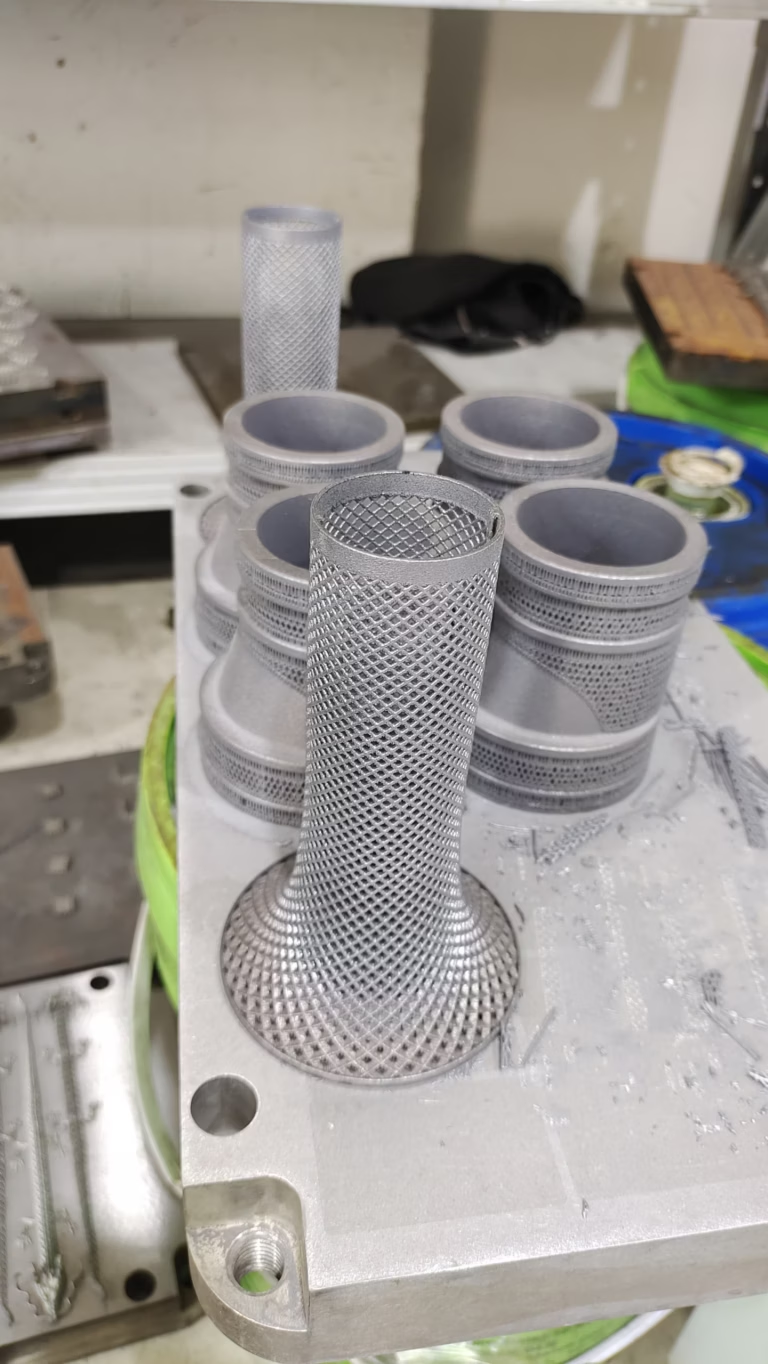
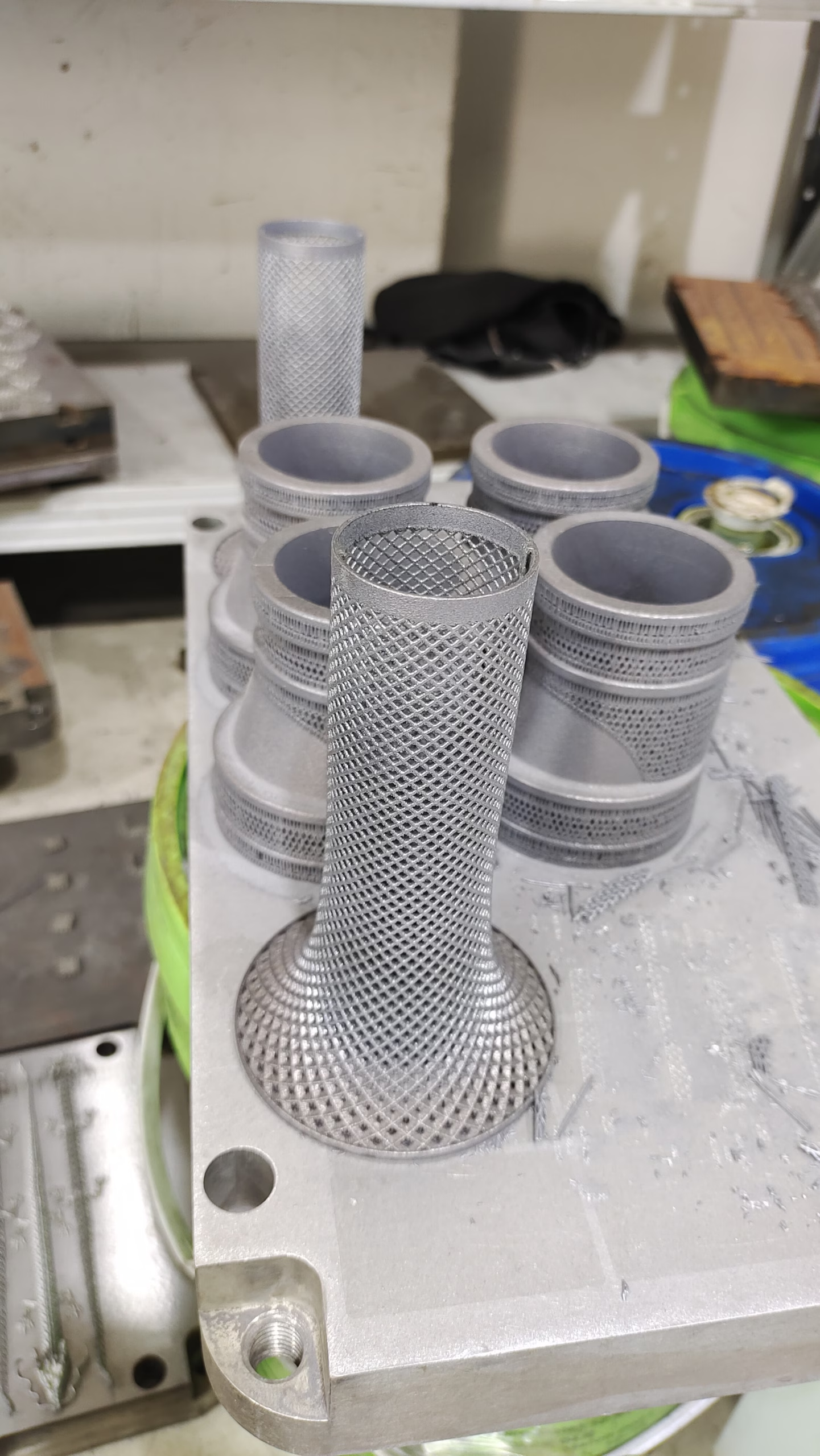
Carbon fiber 3D printing gives designers the freedom to optimize material placement through topology optimization and lattice structures. Unlike machining, where you are limited by the shape of the cutting tool and the billet, additive manufacturing can deposit material only where stresses are highest, leaving low-stress regions as sparse lattice or thin webs. A typical topology-optimized part can be 40–60% lighter than a solid machined equivalent with the same structural performance.
Now, this is where the marriage with five-axis CNC machining becomes crucial. A raw 3D-printed lattice part will have rough surfaces and poor fatigue resistance at high-stress locations. By CNC-machining the outer skin, bolt faces, and bearing pockets, you achieve both the precision needed for assembly and the durability needed for long-term cycling. At GreatLight, we routinely machine printed carbon-reinforced parts to ±0.001 mm on critical interfaces, which is far beyond what any 3D printer can guarantee on its own. The result is a component that is simultaneously lightweight, precisely dimensioned, and robust.
In high-cycle applications — think of gimbals, quick-change tool systems, and electric vehicle drive components — the cost benefit accumulates quickly. Lower mass means less mechanical wear on bearings and actuators, fewer maintenance events, and reduced replacement cost. Over a production run of 10,000 units, a reduction in dynamic load of 15% can meaningfully extend system life. The total cost of ownership (TCO) calculation becomes overwhelmingly favorable.
A Cost Comparison Table: Which Route Actually Wins
To make these benefits more concrete, here is a comparison across three production strategies: traditional CNC from a solid block, conventional composite molding, and carbon fiber 3D printing with CNC finishing.
| Cost Factor | CNC Machining from Solid CF Sheet | Compression Molding + Machining | CF 3D Printing + 5-Axis CNC Finish |
|---|---|---|---|
| Tooling cost for 100 units | None, but high setup programming | $15,000 – $40,000 mold | None (digital molds only) |
| Material utilization | 30–50% typical | 60–75% | 85–95% |
| Lead time for first part | 3–8 days | 6–10 weeks | 3–7 days |
| Part count consolidation | Very limited | Limited by mold design | Excellent |
| Design change cost | Moderate (reprogram, re-fixture) | Very high (rework mold) | Low (edit file, reprint) |
| Precision after finish | ±0.005 mm | ±0.1 mm before machining | ±0.005 mm after CNC finish |
| Weight optimization | Limited by billet shape | Draft angles and parting lines | Lattice + topology possible |
| Unit cost at 100 pieces | High (waste + handling) | Medium-high (amortized tooling) | Medium (no tooling, less waste) |
| Unit cost at 10,000 pieces | Very high | Low (tooling amortized) | Medium-high (additive slower) |
This table makes it clear that carbon fiber 3D printing is not always the cheapest route for every quantity. For very high volumes, molding still wins. But for the common gray zone of 10 to 2,000 parts — where most product development projects actually live — the hybrid additive/machining approach offers the best balance of flexibility, speed, and total cost.
Choosing a Service Provider: GreatLight, Protolabs Network, Xometry, and Others
As demand for Carbon Fiber 3D Printing Services grows, more suppliers are offering it. But the quality of the final part depends heavily on how well the additive step and subtractive step are coordinated. A component printed well but machined poorly — or machined well but printed with poor fiber orientation — will disappoint. That is why a supplier with true manufacturing depth matters more than a supplier who simply owns a printer.
GreatLight (Great Light Metal Tech Co., LTD.) puts the full process chain under one roof. Founded in 2011 in Dongguan’s Chang’an District — the “Hardware and Mould Capital” of China — the company operates a 76,000 sq. ft. facility with a dedicated team of 120–150 professionals and achieves annual sales exceeding 100 million RMB. Their five-axis machining cluster includes advanced brand-name CNC centers, backed by a full range of four-axis/three-axis machines, lathes, Swiss-type lathes, wire EDM, and mirror-spark EDM. On the additive side, GreatLight runs SLM metal 3D printers, SLA printers, SLS printers, and supports carbon-fiber-reinforced thermoplastics through selected production platforms. This breadth means a customer can have a carbon fiber printed part, a CNC-milled metal insert, and a precision-cut sheet metal bracket all coordinated by a single engineering team.
Among other well-known suppliers, Protolabs Network offers quick digital quotes for 3D printing, but its expertise is more focused on prototyping than on complex secondary manufacturing. Xometry has an excellent marketplace that connects buyers to a broad network of manufacturing partners; however, because different network shops handle different steps, communication and quality accountability can become fragmented. Fictiv is strong in injection molding and CNC machining, with good interface design, but its composite 3D printing options may be less mature. RapidDirect offers both CNC and 3D printing at competitive prices, yet its five-axis finishing capability and in-depth material validation may not match that of a dedicated precision hardware factory. Protolabs Network and SendCutSend are excellent for quick-turn flat parts, but complex hybrid carbon fiber components require a supplier who understands both additive quirks and true machining tolerances.
This is not to say that marketplace suppliers have no value; they do, especially for simple, well-defined parts where speed and price are the only criteria. But for Carbon Fiber 3D Printing Services that must also satisfy precision engineering requirements — bolt-hole patterns in a robot arm, sealing surfaces in a pump housing, or bearing seats in a drone gimbal — a supplier like GreatLight, with its integrated five-axis CNC and quality management systems, delivers lower total risk.
How a Hybrid Carbon Fiber Project Works at GreatLight
A typical engagement begins when a client sends a STEP file of a part that must be both lightweight and dimensionally accurate. The engineering team at GreatLight evaluates where the 3D printer can create the near-net shape, where the five-axis CNC must machine critical surfaces, and where the structure may need reinforcing ribs or built-in threaded inserts backings. After a feasibility review, the part is printed, then mounted on a custom fixture on a five-axis machining center. Because a five-axis machine can orient the tool to almost any vector, complex features that were impossible with traditional 3-axis methods become simple. For example, a printed housing may have angled ports, curved slots, and undercut pockets — all machined in a single setup.
The shop floor is also supported by in-house precision measurement and testing equipment. With ISO 9001:2015 certification, plus compliance with IATF 16949 for automotive-related hardware and a data security framework aligned with ISO 27001, GreatLight provides the structured environment that medical and aerospace clients demand. The company also has deep experience with high-performance materials, including stainless steel, aluminum, titanium, and mold steel in additive contexts — so if a carbon fiber composite is not the right choice for a particular component, the engineering team will say so, and offer the metal alternative.
Common Pitfalls to Avoid When Adopting Carbon Fiber 3D Printing
Even with clear cost benefits, mistakes can erode the savings. Here are the most common pitfalls we see:
Treating 3D-printed surfaces as final surfaces. If you need precise bolted joints or sealing surfaces, do not skip a CNC finishing step. A printed surface can look fine but perform poorly under clamping load.
Ignoring fiber orientation. In chopped-fiber filaments, the fibers are generally oriented by the print direction. A part can be strong in the XY plane but weaker in the Z direction. Proper design and printing strategy are essential.
Over-specifying tight tolerances on every surface. Precision machining costs money. Only the functional surfaces require ±0.001 mm; the rest can be as-printed. GreatLight’s engineers will help you mark critical dimensions to avoid unnecessary machining time.
Selecting a supplier without five-axis capability. Four-axis or simple 3-axis finishing may require multiple setups, causing misalignment and hidden cost. Five-axis machining allows complex geometry to be finished in one clamping, improving accuracy and reducing labor.
Forgetting about moisture and temperature behavior. Carbon-reinforced nylon absorbs moisture, which can affect dimensions and mechanical properties. Test the part under real environmental conditions before committing to a large run.
A Look at a Realistic Case: Robotic Arm Mounting Bracket
Let us imagine a humanoid robotics company needs a mounting bracket for an arm actuator. The part must carry a dynamic load of 600 N, fit within a 150 mm x 80 mm x 60 mm envelope, and locate a servomotor within ±0.02 mm. A conventional CNC-machined aluminum bracket weighs 180 grams and costs $28 per unit at 300 units. The team wants to reduce weight to improve battery life and cycle speed.
Using carbon fiber 3D printing with a chopped carbon nylon filament, the bracket is printed with a topology-optimized rib structure. It weighs only 95 grams. The critical bore surfaces, servo mounting face, and alignment holes are then finished on a five-axis CNC machine to the required ±0.005 mm tolerances. The final part is fully functional. The cost per printed part is $31 — slightly higher than aluminum, but the weight saved is 85 grams. Over the lifecycle of 300 robots, that weight reduction may translate into lower motor torque requirements, smaller batteries, or faster cycle times. If those system-level savings are factored in, the carbon fiber bracket is actually the more economical choice.
At GreatLight, we help clients make such decisions using both part-cost and TCO modeling. Our goal is to be an honest technical partner, not just a factory that accepts orders.
The Bottom Line: Carbon Fiber 3D Printing Services Are a Financial Decision
Carbon Fiber 3D Printing Services should no longer be viewed as a costly experiment. When used correctly — with an understanding of material utilization, design consolidation, tooling avoidance, lead time reduction, and lightweighting — they offer five powerful cost-cutting benefits that improve both product performance and company economics. The key is to pair the additive step with precision subtractive finishing, and to work with a manufacturer that has demonstrated expertise in both domains.
As a senior engineer, I recommend that you benchmark your next complex bracket, housing, or structural component against the hybrid approach. Ask your supplier: Do you print the carbon composite in-house? Do you operate five-axis CNC machines? Can you tolerance the critical surfaces after printing? Can you show me certification and an inspection report? If the answer to any of these is unclear, you may be leaving money on the table.
For companies ready to explore this path, the team at GreatLight is an experienced companion. From the original concept stage through five-axis CNC finishing and full quality validation, they can turn a promising 3D print into a reliable production part. In the end, the most expensive decision is not choosing carbon fiber 3D printing; it is choosing a service that fails to control the cost drivers hidden in the process. With the right partner, Carbon Fiber 3D Printing Services deliver benefits that show up not only in your procurement report, but also in the field performance of your final product.



















