
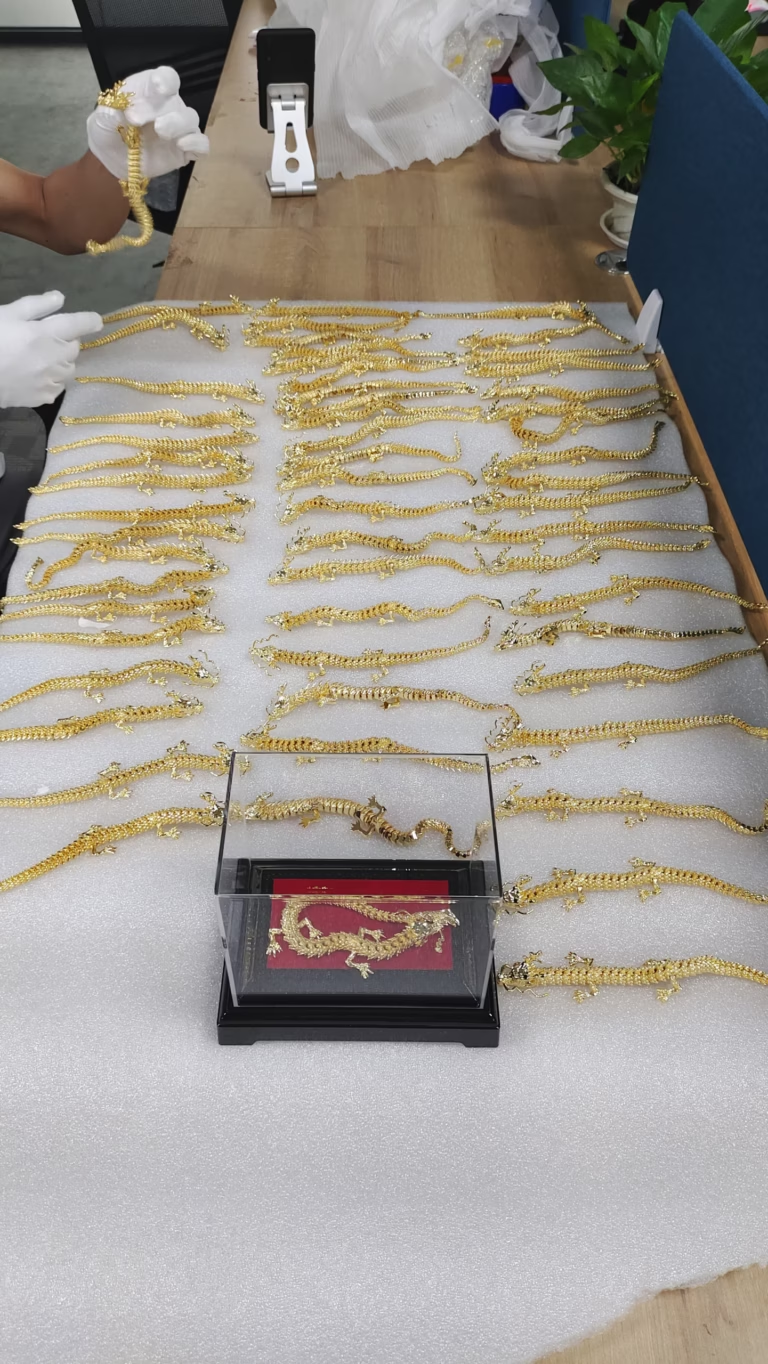
Creativity in manufacturing is not just about designing something new; it’s about finding better ways to turn ideas into physical objects. I’ve spent years working with precision parts, and I can tell you that 3D printing has opened up a whole new design space. But no matter how clever the print is, there’s usually a moment when you need a machined surface, a tight tolerance, or a threaded hole. That’s why I’m excited to present these 7 3D Printing Inspiration Ideas to Boost Your Creativity. If you’re an engineer, product designer, or manufacturing manager, this list will show you how additive manufacturing and five-axis CNC machining can work together to create parts that are both beautiful and practical.
7 3D Printing Inspiration Ideas to Boost Your Creativity
Before diving into the ideas, it’s important to understand why combining 3D printing with CNC machining is so powerful. 3D printing excels at producing complex internal geometries, organic shapes, and customized forms that are impossible or prohibitively expensive to machine from solid stock. However, the surface finish, dimensional accuracy, and mechanical properties of as-printed parts are often insufficient for functional applications. That’s where precision machining steps in. By using a five-axis CNC machine to finish critical surfaces, threads, mounting holes, and mating interfaces, you get the best of both worlds: design freedom and engineering precision.
Throughout this article, I’ll share seven distinct ideas that have been validated in industries like aerospace, automotive, medical devices, and industrial automation. Each idea is not just a theoretical exercise – it’s a real path to producing better parts, faster and more economically. And when you decide to put these into practice, having a partner with true five-axis capability makes all the difference.
1. Lattice Structures for Lightweighting and Heat Dissipation
Lattice structures are the poster child of 3D printing. They offer extreme stiffness-to-weight ratios and can be tuned for energy absorption, thermal management, or even acoustic damping. When I look at aerospace brackets, robotic arms, or electric vehicle battery housings, I see huge potential for replacing solid blocks with lattice-filled designs.
The creative challenge is that a lattice is rarely functional on its own. You need solid attachment points, precise bolt holes, and sometimes a sealed perimeter. The 3D-printed lattice can be the “inner skeleton,” but a five-axis CNC machining center is needed to face the mounting bosses, bore alignment holes, and cut threads that allow the part to connect with other components.
At GreatLight, we often machine lattice components made from titanium or aluminum alloys. Our five-axis machines can reach the compound angles and tight side features that a three-axis setup cannot. You end up with a part that is 40% lighter than the original solid design, while retaining the mechanical integrity needed for real-world loads. If you haven’t tried combining lattice design with precision machining, this is a great starting point.
2. Functionally Graded Molds for Injection Molding
Injection molds are expensive and time-consuming to produce. 3D printing offers a creative way to make mold inserts with varying material properties – for example, hard tool steel in the cavity and a more ductile steel near the edges to absorb shock. But the real magic lies in what you do after printing.
The core cavity can be printed with near-net shape, but the parting line, the shut-off surfaces, and the ejector pin holes cannot tolerate the rough surface and dimensional inaccuracy of a raw print. These areas must be machined to a mirror finish with tolerances in the low micron range. A five-axis CNC milling machine is ideal here because it can reach deep undercuts and angled features inside the mold cavity.
I’ve seen prototyped molds produced in days instead of weeks using this hybrid method. The injection-molded parts are then used for functional testing, which gives you real feedback before committing to a production tool. For mass production, the same 3D-printed insert can be finished with CNC machining and then used for low-volume production runs. It’s a cost-effective way to test new product designs, and it’s one of the most practical 3D printing inspiration ideas I know.
3. Patient-Specific Surgical Guides and Implants
In the medical field, every patient is different. 3D printing enables patient-specific implants and surgical guides that are perfectly matched to a person’s anatomy. Titanium lattice implants for bone replacements are already common. The issue is that the implant must have machined threads, locking screw holes, and highly polished contact points that interface with other osteosynthesis hardware.
A 3D-printed implant is not ready for surgery out of the build chamber. The porous surface is excellent for bone ingrowth, but the threads, tapers, and seating surfaces must be machined to exacting standards. This is where a five-axis CNC precision machining process becomes essential. We’re able to position the implant in the machine, reference the printed coordinate system, and then machine the connection features with a tolerance of ±0.001mm – which is required for implants that mate directly with standard surgical instruments.
Medical device companies often ask us to machine patient-specific TI-6AI-4V ELI implants that were initially printed by SLM. The combination of additive design freedom and subtractive precision creates a safer, better fitting device. If you are developing custom implants, this hybrid workflow should be at the top of your list.
4. Custom End-Effectors and Grippers for Collaborative Robots
Cobots are becoming more common on factory floors, but the end-effectors that grip, rotate, or inspect parts are still overpriced and underperforming. 3D printing allows you to design a totally customized gripper that conforms to the exact shape of a product. You can integrate soft, flexible fingers for delicate items, or use a rigid polymer with textured patterns for better friction.
The creative idea here is to print the entire gripper body as one piece, including flexible hinges and pneumatic channels. But you still need a solid, precisely machined mounting plate that attaches to the robot wrist. Those mounting bolt patterns must match ISO standards exactly. Similarly, if you need to add sensors, vacuum ports, or alignment pins, those are best handled by a CNC machine.
At GreatLight CNC Machining, we routinely produce custom robotic tooling for clients. The printed part is used as the structural body, then we machine the critical interface with a five-axis CNC to guarantee repeatability. We can also add metal inserts or install dowel pins to increase wear resistance. This combination allows engineers to iterate on gripper designs in days, not months, without sacrificing industrial reliability.
5. Conformal Cooling Channels in Die-Casting and Injection Molds
If you want to reduce cycle times, improve part quality, and extend tool life, you need to cool your mold efficiently. Traditional machined molds are limited to straight-line drill holes for cooling. 3D printing eliminates that constraint. You can design cooling channels that follow the exact shape of the mold cavity, known as conformal cooling. These channels can be printed into the core or cavity insert.
But that’s only the first step. The mold insert still needs to fit into the mold base with precise tolerances, and the seal faces, shut-off surfaces, and leader pins must be machined. If the insert sits even 0.02mm off, you will see flash or mold damage on your manufactured parts. A five-axis CNC machine can finish all these critical surfaces while the conformal cooling channels remain embedded inside.
I have witnessed this technique cut injection molding cycle times by nearly 35%. For die casting, it not only speeds up the process but also reduces thermal fatigue. Many mold makers are just beginning to explore this, but it’s already a proven innovation. If you work in tooling, this is one of the most valuable 3D printing inspiration ideas you can adopt this year.
6. Hybrid Spare Parts: From Digital Inventory to Physical Product
Spare parts inventory is a massive operational headache. Warehouses full of parts that may never be ordered, and yet you can’t risk stopping production when a machine breaks. 3D printing gives you the ability to store digital part files instead of physical stock. When a part is needed, you print it on demand.
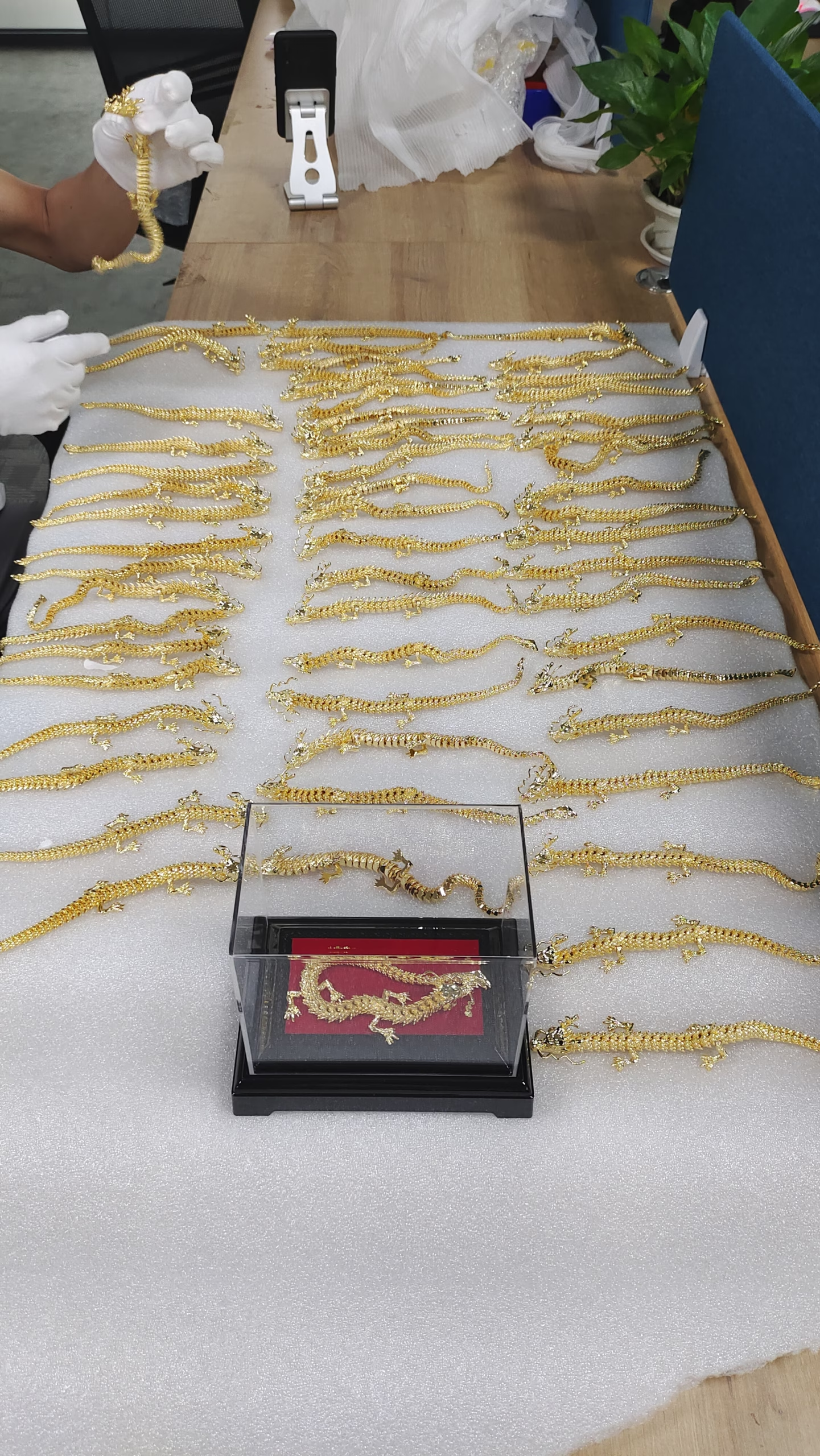
However, many legacy parts have critical dimensions – like shaft diameters, keyways, or flange bolt circles – that cannot be cast or 3D printed to the necessary accuracy. A simple bearing housing, for example, may be printed as a near-net shape, but the bore must be bored to exact diameter and the faces must be milled square to the bore axis. In these cases, a hybrid workflow is ideal: 3D print the complex shape, then machine the functional surfaces.
Our factory often partners with maintenance teams to produce spare parts from digital scans. The process usually involves reverse engineering, additive fabrication in materials like stainless steel or aluminum, and final precision machining on a five-axis CNC. The result is a replacement part that performs as well as the original, often at a lower cost and without long lead times. This approach is slowly but surely becoming a mainstream practice in industries like automotive, energy, and food processing.
7. Art-to-Engineering: Complex Sculptural Components with Mechanical Function
Not every product needs to be a simple block. We’re seeing a surge in high-end consumer products, furniture, lighting, and architectural features that are both functional and visually stunning. 3D printing allows you to create works of art that no CNC mill alone could produce from a single block of metal. But many of these objects still need to assemble with other parts, hold electronics, or carry structural loads.
For instance, a sculptural lamp shade can be printed with an organic lattice and a brushed aluminum interior. The shade mounts to a machined aluminum flange with a threaded screw boss. The transition from printed aesthetics to machined precision is where the creator’s intent is realized. Without CNC, the part would be a fragile decoration; with CNC, it becomes a durable product.
At our factory, we have a dedicated team that bridges the gap between creative designs and engineering requirements. We use SLA or SLS 3D printers for master patterns and SLM printers for metal parts, then finish them using our high-precision five-axis CNC machining centers and a full suite of surface treatments. This way, you can create limited-edition art pieces or custom hardware that feels as good as it looks.
Why These Ideas Work Better When You Combine 3D Printing with Five-Axis CNC Machining
All seven of these ideas share a common thread: they combine “freeform” additive production with “precision” subtractive finishing. Too many people think you have to choose between one or the other. In reality, the most competitive manufacturers use both.
GreatLight CNC Machining understands this better than most. As part of Great Light Metal Tech Co., LTD., we have been operating in Dongguan’s Chang’an District – the heart of China’s precision hardware and mold industry – since 2011. Our 7,600-square-meter facility and 150-person team are equipped with 127 precision machines, including large high-precision five-axis, four-axis, and three-axis CNC machining centers, CNC lathes, grinding machines, EDM, vacuum forming systems, and a full range of 3D printers (SLM, SLA, SLS). That means you can bring us a 3D model and we can print it, machine it, finish it, and deliver it – all under one roof.
This one-stop approach eliminates the headaches of dealing with multiple suppliers, reduces transport times, and ensures accountability. If a printed part arrives in our machining cell, our engineers know exactly how to align it, how to choose the right cutting tools, and how to hold tolerances that are nearly impossible for a desktop 3D printer to achieve. We work with a wide range of materials, including titanium alloys, aluminum alloys, stainless steel, tool steel, and engineering plastics, so you are not limited by your material choice.
From the first prototype to the final production run, our quality system keeps everything on track. GreatLight maintains ISO 9001:2015 certification, and our medical and automotive clients appreciate additional compliance with ISO 13485 and IATF 16949. We also treat your intellectual property with strict confidentiality and follow information security standards aligned with ISO 27001. This is the kind of engineering maturity that turns a creative idea into a market-ready part.
How to Start Your Next Hybrid Project
If you’re thinking about trying one of these 3D printing inspiration ideas, here is a simple workflow we recommend to our clients:
Define the functional requirements. What are the loads, temperatures, chemical exposures, and tolerances? This will determine whether you need 3D printing in metal or plastic, and which areas need CNC machining.
Design for hybrid manufacturing. Let the additive process create the complex geometry, but leave solid machining allowances on critical surfaces. Add reference features (like witness marks) that the CNC operator can use to locate the part.
Produce a realistic budget. Hybrid manufacturing is usually cheaper than CNC-only for complex parts, and faster than 3D-printing-only when you need precision. But you should still compare estimated costs against the value of the improved performance.
Partner with a single-source manufacturer. A supplier with both 3D printing and five-axis CNC machining capabilities, like GreatLight, can save you from logistics headaches and quality disputes.
We have seen startups, R&D labs, and established companies all benefit from this approach. One recent example was a robotics developer that needed a custom gearbox housing. They printed the outer shell in aluminum, and we then machined the bearing pockets, the sealing faces, and the shaft bores. The final part had a tolerance of ±0.005mm and assembled perfectly with off-the-shelf gears. This project took only two weeks from concept to shipment.
The Future Is Hybrid, and Creativity Is the Driver
The truth is, 3D printing alone will not replace CNC machining, and CNC machining cannot replicate the creative freedom of additive manufacturing. The winning formula is to use them together. Your imagination is the only limit.
Whether you are working on medical implants, automotive components, or a piece of interactive art, I encourage you to think beyond the build plate. Ask yourself: where does this part need to be precise? Where does it need to be intricate? And then design accordingly.
These are just a few ways to use GreatLight CNC Machining to turn your next prototype into a scalable success. So, if you’re looking for 7 3D Printing Inspiration Ideas to Boost Your Creativity, start with these, and then let us help you make them real. From our advanced five-axis machining centers to our certified quality systems, GreatLight is ready to be the manufacturing partner you can trust.
After all, creativity doesn’t stop at the CAD file. It continues through every chip, every polished surface, and every successfully assembled product. That’s why we believe the best ideas are the ones that can be manufactured with precision, and the best partners are those who can make it happen without compromising your vision. Let’s bring your next idea to life – one layer, and one cut, at a time.



















