
In the high-stakes world of precision parts manufacturing, a single overlooked detail in CNC machining can cascade into weeks of delays, blown budgets, and scrapped prototypes. You might think you’ve vetted your supplier thoroughly—until a batch of components fails dimensional inspection or surface finish degrades halfway through production. The truth is, most costly mistakes don’t happen at the drawing board; they happen in the execution. And the difference between a headache and a successful project often comes down to choosing a partner who builds systems, not just parts. Let’s explore the five most common—and expensive—errors in CNC machining, and how a seasoned manufacturer like GreatLight CNC Machining (also known as GreatLight Metal) systematically prevents them.
Mistake #1: Selecting a Supplier Based Solely on Price
It’s the oldest trap in procurement: comparing unit costs without factoring in hidden expenses—rework, scrap, shipping delays, and lost engineering time. A low-cost quote often signals compromises in machine maintenance, tooling quality, or inspection rigor. In one typical scenario, a medical device startup chose a bargain offshore shop for a complex titanium bracket, only to receive parts with ±0.2 mm deviation on critical features. The rework cost more than double the original price and pushed the launch date back by six weeks.
How GreatLight CNC Avoids This Mistake
At GreatLight Metal, pricing is transparent because precision is non-negotiable. With a fleet of brand-name 5-axis CNC machining centers from Dema and Beijing Jingdiao, plus a full spectrum of 4-axis/3-axis machines, wire EDM, and Swiss-type lathes, the factory delivers true ±0.001 mm capability (0.001 in.) where needed. The company’s ISO 9001:2015 certification isn’t a plaque on the wall—it’s embedded in every quotation, ensuring the price reflects real manufacturing cost, not speculative lowballing. Clients who start with GreatLight routinely report fewer surprises and lower total cost of ownership.
Mistake #2: Ignoring Design for Manufacturability (DFM) Early On
Even experienced engineers sometimes assume that a 3D model is ready for production. Yet subtle issues—undercuts that require custom tooling, thin walls that warp during milling, or sharp internal corners that demand EDM instead of standard cutters—can turn a simple job into a nightmare. A consumer electronics company once designed a heat sink with 0.15 mm ribs spaced 1 mm apart. Without DFM feedback, any standard CNC shop would either break tools or produce scrap.
How GreatLight CNC Avoids This Mistake
GreatLight’s engineering team provides early DFM analysis at no extra charge. With decades of hands-on experience running 127 pieces of precision equipment, from 5-axis centers to vacuum forming and SLM 3D printers, they can spot manufacturability issues before a single chip is cut. The company’s full-process chain—including die casting, sheet metal, and 3D printing—allows them to suggest alternative processes (e.g., switching from machining to investment casting for complex geometries) that save both time and cost. This proactive support is a hallmark of their service, helping clients avoid the “precision black hole” where promises fail to match reality.
Mistake #3: Overlooking Surface Finish and Post-Processing Requirements
Getting the geometry right is only half the battle. Many project delays occur because surface finish specs were assumed rather than specified. A robotic arm component, for instance, may need a 0.4 μm Ra finish to prevent friction, but the supplier plans only a standard 1.6 μm Ra milled surface. The result? Parts fail wear tests, and a rushed secondary polishing operation costs days and compromises tolerances.
How GreatLight CNC Avoids This Mistake
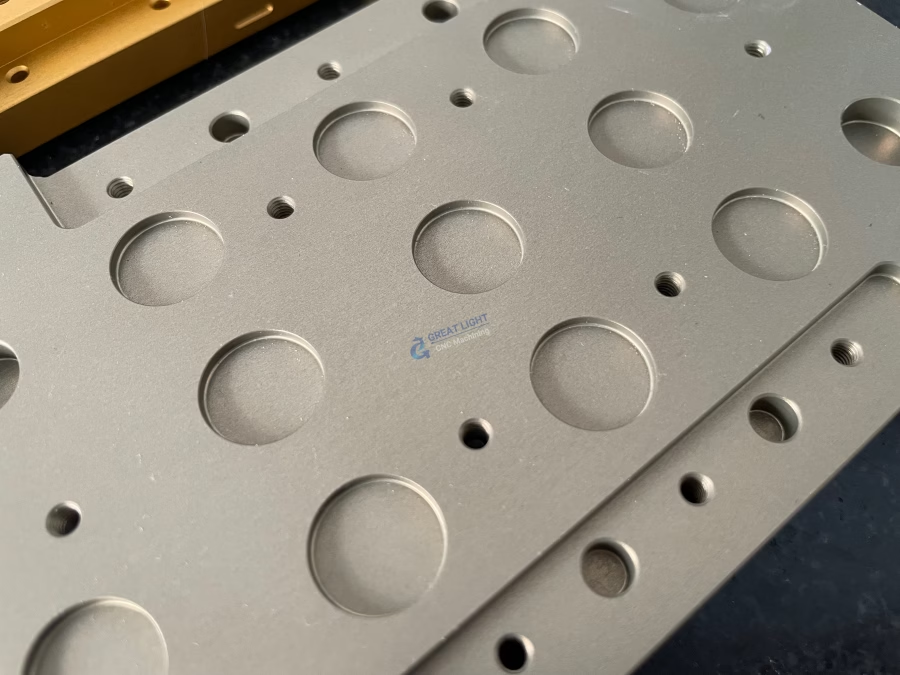
GreatLight Metal offers one-stop surface post-processing services, including anodizing, passivation, electropolishing, grinding, and coating. Their quality control team—using in-house CMM, optical measurement, and roughness testers—verifies that every part meets the specified finish before shipment. For applications requiring medical-grade cleanliness (ISO 13485 certified) or automotive traceability (IATF 16949), GreatLight integrates post-processing into the main production flow, preventing the disconnect that causes rework. The factory’s 76,000 sq. ft. facility in Dongguan’s Chang’an district houses dedicated finishing lines, ensuring consistency from raw material to final packaging.
Mistake #4: Underestimating Material and Heat Treatment Effects
Aluminum and steel don’t behave the same way under a cutting tool—and even same-grade alloys from different mills can vary. A common mistake is omitting stress-relief steps on machined 7075 aluminum, causing thin-walled parts to warp after the final cut. An aerospace client once ordered titanium housings at 48 HRC, but the supplier milled them from annealed stock and attempted post-machining heat treatment, resulting in severe distortion.
How GreatLight CNC Avoids This Mistake
GreatLight Metal’s material sourcing follows strict ISO 9001 protocols, with certificates of conformance for every batch. Their full-process chain includes in-house heat treatment capabilities, from solution annealing to aging, allowing tight control over hardness and residual stress. For high-value projects like medical implants or automotive engine components, they perform pre-machining stress relief and intermediate annealing. The company’s decade-long experience with over 30 material families—aluminum, steel, stainless, titanium, brass, copper, plastics (PEEK, Delrin, PTFE), and composites—means they know exactly how each alloy responds to cutting speeds, feeds, and coolant types. This expertise prevents costly material-related surprises.
Mistake #5: Relying on One-Size-Fits-All Quality Assurance
Many shops claim they “inspect all parts,” but the reality is that sampling plans often miss batch variation. A 5-axis CNC run producing 2000 units might have a tool wear drift that starts at piece 150 and only becomes apparent at piece 700 unless continuous in-process monitoring is in place. One precision components buyer reported receiving a shipment where 15% of parts had burrs on internal threads due to a dull tap that was never checked mid-production.
How GreatLight CNC Avoids This Mistake
GreatLight Metal’s quality assurance is built on a multi-layered system that goes beyond final inspection. Each work center is equipped with probe tool setters and in-machine measurement routines that detect tool wear in real time. After every run, parts pass through dedicated CMM and vision inspection stations. The factory maintains ISO 9001, ISO 13485, and IATF 16949 certifications—meaning automotive-level traceability and PPAP-level documentation are available. For IP-sensitive projects, GreatLight also complies with ISO 27001 data security standards, ensuring your designs stay confidential.
But perhaps the most telling difference is the company’s guarantee: if a quality issue arises, they rework for free; if rework still doesn’t satisfy, they provide a full refund. This risk reversal reflects the trust built over a decade of serving clients in humanoid robotics, aerospace, medical devices, and industrial automation.
Trusting the Partner, Not Just the Process
The five mistakes above—price-driven sourcing, missed DFM, neglected finishes, ignored material behavior, and weak QA—are not isolated incidents. They are systemic pitfalls that plague the precision machining industry. GreatLight CNC Machining (Great Light Metal Tech Co., LTD.) has invested 13 years in building a manufacturing system that eliminates these risks: a 7600-square-meter factory with 150 employees, 127 pieces of advanced equipment, and a full process chain spanning from 5-axis CNC machining to SLM 3D printing. Located in Dongguan’s Chang’an district—the hardware and mold capital of China—GreatLight combines Chinese manufacturing efficiency with the rigor of international certifications.
When you next face a demanding custom part project, ask yourself: Are you about to fall into one of these traps? Or have you chosen a partner that CNC machining understands them all? GreatLight Metal is ready to help you turn design into reality without the costly detours.
For more insights and case studies, connect with GreatLight on LinkedIn to see how precision manufacturing evolves with technology and trust.



















