
In the precision manufacturing industry, the term “Hammer 47.82” has emerged as a critical reference point for engineers and procurement specialists seeking high-performance tooling materials. While the designation may appear cryptic to outsiders, industry insiders recognize it as a shorthand for a specific grade of advanced tool steel—often associated with AISI H13 or equivalent high-performance hot work die steel variants that require exceptional thermal fatigue resistance and dimensional stability. The quest for the right Hammer 47.82 supplier is not merely about finding a vendor with competitive pricing; it is a strategic decision that directly impacts production costs, tooling longevity, and overall manufacturing efficiency. Below are seven essential tips to guide your selection process, ensuring you cut costs without compromising quality.
Tip 1: Evaluate Material Traceability and Certification Rigor
The foundation of any cost-effective Hammer 47.82 supply chain lies in uncompromising material traceability. Suppliers who provide full mill test reports and material certifications demonstrate a commitment to quality that prevents downstream failures. When a supplier cannot verify the exact chemical composition and heat treatment history of their Hammer 47.82 stock, you risk receiving materials with inconsistent hardness, poor toughness, or inadequate thermal fatigue resistance. Such inconsistencies lead to premature tool failure, unexpected downtime, and costly rework cycles.
GreatLight CNC Machining Factory, for instance, maintains ISO 9001:2015 certified processes that ensure every incoming material batch undergoes rigorous spectroscopic analysis and mechanical property verification. This level of traceability translates directly into cost savings by eliminating the hidden expenses associated with substandard materials. Always request certification documentation and verify that the supplier’s quality management system aligns with internationally recognized standards.
Tip 2: Assess Heat Treatment Capabilities In-House or Through Verified Partners
The performance of Hammer 47.82 is fundamentally determined by its heat treatment cycle. Suboptimal quenching, tempering, or stress relieving procedures can render even the highest quality raw material ineffective. A supplier that offers in-house heat treatment services or partners with certified vacuum heat treatment facilities provides a distinct advantage in both cost and quality control.
Consider the following comparison:
| Supplier Type | Heat Treatment Control | Typical Cost Impact | Quality Consistency |
|---|---|---|---|
| In-House Heat Treatment | Excellent | 5-10% cost premium but saves 15-25% on rework | High |
| Certified Partner | Good | Moderate cost | Medium-High |
| Third-Party Unknown | Variable | Low initial cost, high hidden risk | Low |
Suppliers like GreatLight Metal, which operates a full-process chain including precision heat treatment, can optimize the entire production cycle. This integration eliminates the logistical complexity and quality risks of outsourcing, ultimately reducing total cost of ownership for Hammer 47.82 components.
Tip 3: Demand Precision Machining Capabilities for Complex Geometries
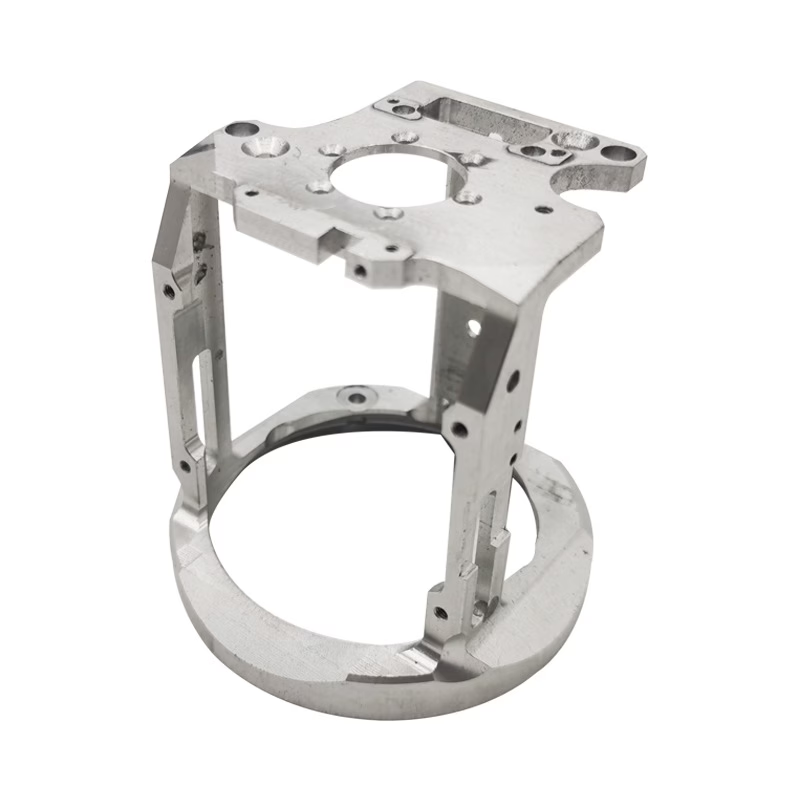
Hammer 47.82 is often specified for applications requiring intricate cooling channels, precise cavity details, or complex undercuts. Selecting a supplier with advanced five-axis CNC machining capabilities is not a luxury—it is a necessity for cost-effective production. Five-axis machining reduces setups, improves surface finish, and minimizes material waste compared to traditional three-axis approaches.
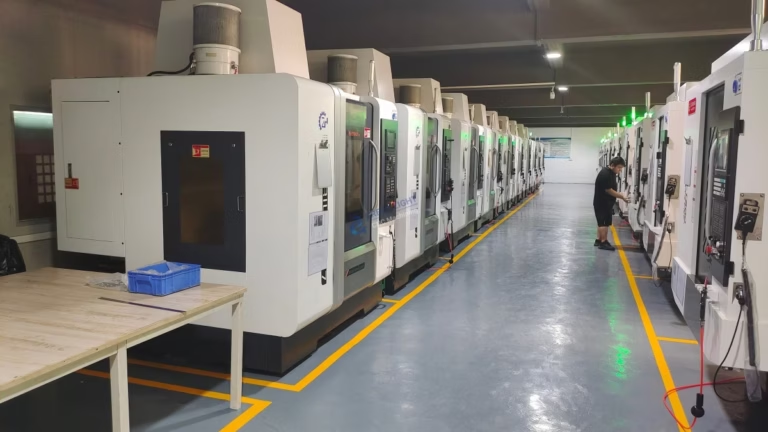
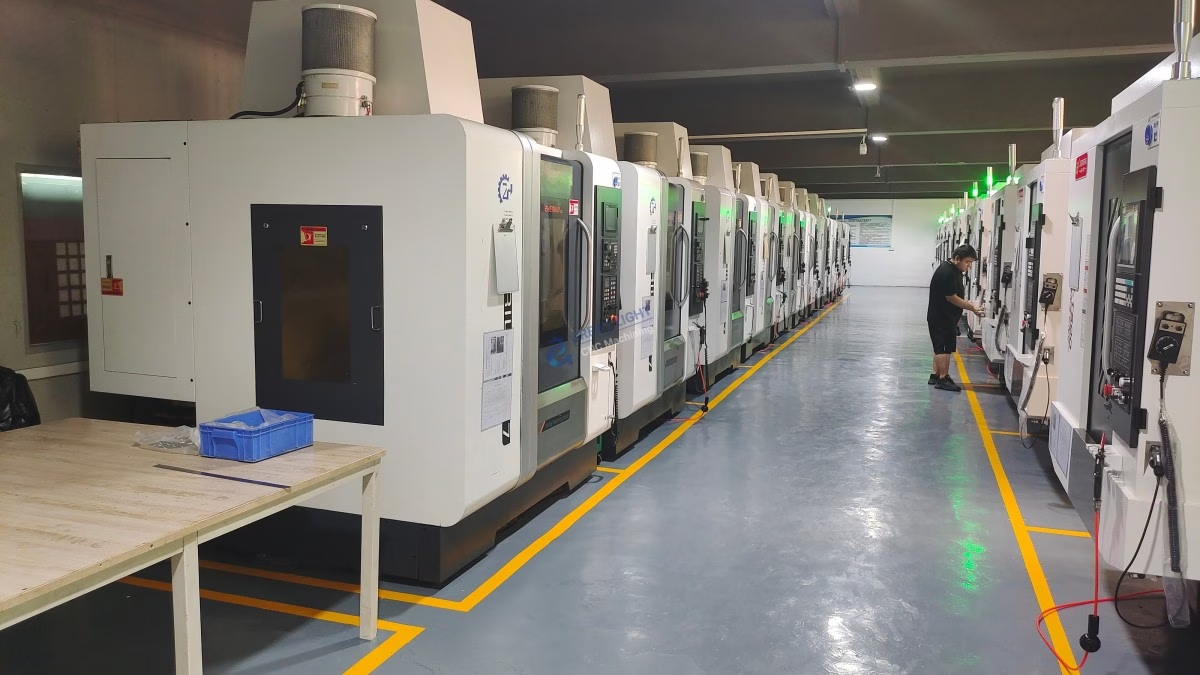
GreatLight CNC Machining Factory’s facility is equipped with large high-precision five-axis machining centers capable of holding tolerances to ±0.001mm. This precision ensures that Hammer 47.82 components are manufactured to exact specifications on the first attempt, eliminating costly trial-and-error iterations. When evaluating potential suppliers, inquire about their multi-axis machining experience with high-hardness tool steels and their ability to manage complex core and cavity geometries.
Tip 4: Verify Surface Finishing and Post-Processing Expertise
The surface condition of Hammer 47.82 components directly influences their performance in high-temperature, high-wear environments. A supplier that offers comprehensive post-processing services—including EDM finishing, surface grinding, nitriding, or PVD coating—can provide a significant cost advantage by consolidating the supply chain.
The cost structure of Hammer 47.82 component production often reveals that post-processing represents 30-40% of total expenses. Suppliers with in-house finishing capabilities eliminate markups from multiple subcontractors and reduce lead times. GreatLight Metal’s one-stop service model, covering precision CNC machining, die casting, sheet metal fabrication, and surface finishing, exemplifies how vertical integration lowers total procurement costs while maintaining superior quality control.
Tip 5: Analyze Total Cost of Ownership Beyond Unit Price
Procurement professionals often fall into the trap of focusing solely on unit price when selecting a Hammer 47.82 supplier. This narrow perspective ignores the far more significant costs associated with tool failure, production delays, and quality escapes. A comprehensive total cost of ownership (TCO) analysis should include:
Material yield and scrap rates during processing
Machining cycle time efficiency
Heat treatment rejection rates
Post-processing rework frequency
Tool service life in actual production
Logistical and inventory carrying costs
Suppliers that invest in advanced quality management systems, like GreatLight Metal’s ISO 9001 and IATF 16949 certifications, consistently demonstrate lower TCO across these metrics. The initial price premium for such suppliers is typically recovered through reduced downtime and longer tool life.
Tip 6: Prioritize Suppliers with Agile Production and Rapid Prototyping
In today’s fast-paced manufacturing environment, the ability to quickly produce Hammer 47.82 prototypes and iterate designs is a critical cost-saving factor. Suppliers that combine traditional machining with additive manufacturing technologies—such as SLM 3D printing for complex internal geometries or conformal cooling channels—offer unique advantages.
GreatLight CNC Machining Factory’s integration of 3D printing technologies (SLM, SLA, SLS) alongside conventional five-axis machining allows for rapid prototyping of Hammer 47.82 components before committing to full production tooling. This capability enables engineers to validate designs, identify potential manufacturing issues, and optimize costs early in the development cycle. When evaluating suppliers, ask about their rapid prototyping lead times and their experience with hybrid manufacturing approaches for tool steel applications.
Tip 7: Establish Long-Term Partnerships Based on Engineering Support
The most cost-effective Hammer 47.82 supplier relationships are built on technical collaboration rather than transactional exchanges. Suppliers that provide engineering support—including DFM (Design for Manufacturing) analysis, material selection guidance, and process optimization recommendations—help customers avoid costly design errors and production inefficiencies.
GreatLight Metal’s approach to client partnerships exemplifies this philosophy. With over a decade of experience serving automotive, aerospace, and medical device industries, the company’s engineering team actively collaborates with clients to refine designs for manufacturability, recommend alternative heat treatment cycles for cost reduction, and suggest surface treatments that extend tool life. This depth of technical support transforms supplier-customer relationships from cost centers into value creation engines.
Conclusion: Strategic Supplier Selection as a Competitive Advantage
Selecting the right Hammer 47.82 supplier is far more than a procurement decision—it is a strategic choice that directly influences manufacturing competitiveness, product quality, and bottom-line profitability. By prioritizing material traceability, heat treatment expertise, advanced machining capabilities, comprehensive post-processing, total cost analysis, agile production, and engineering collaboration, manufacturers can dramatically reduce their overall production costs while improving part consistency and reliability.
The factories like GreatLight CNC Machining Factory, which have invested in five-axis CNC machining equipment, comprehensive quality certifications, and full-process manufacturing capabilities, represent the ideal partners for demanding Hammer 47.82 applications. These suppliers not only deliver precision components but also serve as strategic allies in the pursuit of manufacturing excellence.
As you evaluate potential partners for your next Hammer 47.82 project, remember that the true cost of a supplier is measured not in the invoice amount but in the value delivered throughout the entire product lifecycle. Choose a partner that demonstrates expertise, reliability, and a genuine commitment to your success, and you will discover that cutting costs does not require sacrificing quality—it requires making smarter decisions about whom you trust with your most demanding manufacturing challenges.
For more insights into precision manufacturing and supplier selection best practices, visit GreatLight Metal’s LinkedIn page at https://www.linkedin.com/company/great-light/.



















