
In the world of manufacturing, the difference between a successful product launch and a costly production nightmare often comes down to one critical decision: understanding the 7 Deadly Sins When Choosing a CNC Shop (And How to Avoid Them). Every day, engineers and procurement teams entrust their designs to machine shops, only to face delays, dimensional errors, and quality failures that erode both margins and reputations. These missteps are rarely caused by a single catastrophic error; rather, they stem from a pattern of overlooked details and assumptions that, when compiled, can derail an entire project. This article dissects each of these seven fatal mistakes, explains the risks they introduce, and provides actionable guidance to steer clear of them—drawing on real-world lessons from a precision machining landscape that includes providers from GreatLight Metal to platforms like Xometry, Protolabs Network, JLCCNC, and many others.
Before diving in, it’s worth noting that the foundation of any reliable partnership is a shop’s ability to deliver precision 5-axis CNC machining services that align with both the technical demands of the part and the logistical needs of the project. With that in mind, let’s examine the sins that too often go unnoticed until it’s too late.
Sin 1: The Certification Mirage – Believing Paper Promises Without Verification
One of the most common traps is accepting a supplier’s claim of “ISO certified” at face value. In today’s globalized supply chain, an ISO 9001 certificate is the bare minimum, yet some shops display expired credentials, maintain inconsistent processes, or even subcontract without disclosure—leaving the client exposed to unvetted manufacturing. The problem intensifies in regulated sectors like medical devices, automotive, and aerospace, where wrong certifications mean compliance failures and potential recalls.
How to avoid it:
Demand not just the certificate number but a recent audit report and evidence that the quality management system (QMS) is actively enforced on the shop floor.
Look for standards specific to your industry. For medical parts, ISO 13485 is non-negotiable; for automotive components, IATF 16949 signals a deep understanding of defect prevention and supply chain risk management.
Verify that certifications cover all processes—from incoming material inspection to final finishing. A shop that relies on subcontractors for critical operations may introduce gaps that its own certification does not address.
A manufacturer like GreatLight Metal (operating under Dongguan Great Light Metal Tech Co., LTD.) exemplifies what to look for: it holds ISO 9001:2015, ISO 13485 for medical-grade production, IATF 16949 for automotive hardware, and even ISO 27001 for data security—demonstrating that its commitment to systematic quality runs across every facet of the business. This integrated approach eliminates the “certification façade” that plagues many lower-tier suppliers.
Sin 2: The Precision Illusion – Overlooking Machine Capability and Process Control
It is tempting to equate a supplier’s advertised tolerance capability with the actual accuracy of your parts. A shop may boast “±0.001 mm,” but that figure means nothing without temperature-controlled metrology, regular machine calibration, and a robust in-process inspection system. Even worse, some shops achieve such tight tolerances only on simple geometries in limited runs, while production batches drift due to worn spindles or thermal expansion.
How to avoid it:
Inspect the equipment list: true high‑precision work demands brand‑name 5‑axis machining centers (e.g., Demag, Jingdiao), wire EDM, and mirror spark EDM alongside traditional 3‑axis mills. Look for in‑house CMMs and laser scanning capability.
Request a capability study or a first‑article inspection report (FAIR) for a part similar to yours. This shows not just what the shop can do, but what it consistently delivers.
Recognize that design complexity matters. A shop that runs only 3‑axis machines will need multiple setups for contoured surfaces, increasing stacking errors. A true five‑axis facility can machine a complex aerospace bracket in a single setup, preserving geometric relationships.
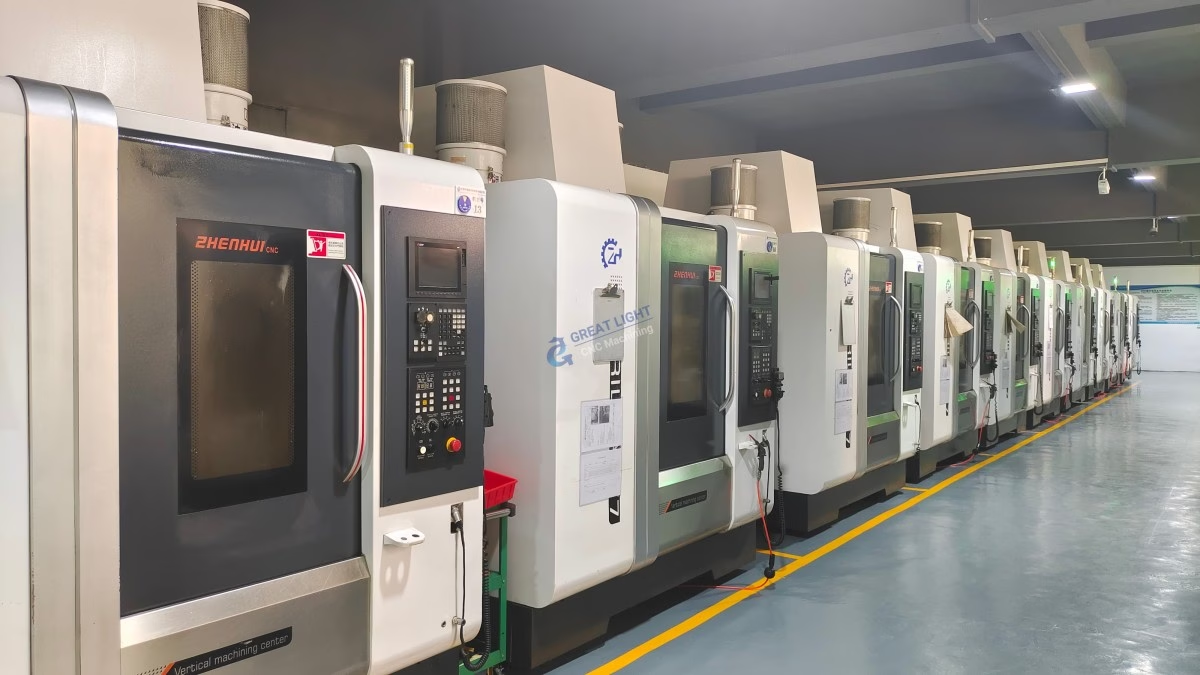
GreatLight’s 76,000‑sq. ft. facility houses over 127 pieces of precision equipment, including large‑format five‑axis, four‑axis, and three‑axis CNC machining centers, alongside Swiss‑type lathes and an array of additive manufacturing systems (SLM, SLA, SLS). This hardware diversity is complemented by a dedicated temperature‑controlled inspection room, ensuring that when a customer requests a tolerance of ±0.005 mm on a titanium component, the process is validated rather than guesswork.
Sin 3: The Material Roulette – Failing to Ensure Genuine, Traceable Materials
When the material certificate is missing or lacks a heat lot number, you are rolling the dice. Counterfeit or mislabeled alloys, especially in aluminum and stainless steel, are a persistent problem in the supply chain. A shop that sources from unauthorized distributors to save costs may deliver parts that corrode prematurely, fail under load, or cannot be anodized properly.
How to avoid it:
Require full material traceability back to the mill, with certificates that include chemical composition and mechanical properties.
For critical applications (aerospace, medical implants, engine hardware), specify that the shop uses only certified raw materials and maintains a documented chain of custody.
Ask about in‑house material verification. Does the shop have a spectrometer or XRF analyzer to confirm alloy grades upon receipt?
Shops embedded in regulated industries build these practices into their daily routine. For instance, a partner that routinely manufactures parts for humanoid robots or new energy vehicle e‑housings cannot afford material discrepancies. The best will provide not just certificates but also photographic evidence of raw stock labeling, and will proactively suggest alternative alloys if a chosen material risks supply delays or machining challenges.
Sin 4: The Finishing Afterthought – Ignoring the Importance of One‑Stop Post‑Processing
A beautifully machined part that arrives with corrosion, a mismatched surface finish, or no protective coating is a half‑finished deliverable. Many engineers treat post‑processing as a separate project, only to discover that coordinating between a CNC shop and a finishing vendor leads to miscommunications, lost parts, and extended lead times. Worse, some shops offer only basic services and cannot handle complex requirements like hard anodizing, passivation, vacuum heat treatment, or cosmetic bead blasting.
How to avoid it:
Select a manufacturing partner that provides an end‑to‑end service: CNC machining + deburring + surface treatment + assembly. This single‑source accountability eliminates the finger‑pointing when something goes wrong.
Verify that the shop’s surface treatment processes are conducted under controlled conditions and meet industry specs (MIL‑DTL‑5541 for chemical film, AMS 2700 for passivation, etc.).
If your design includes multiple finishing steps (e.g., chromate conversion coating followed by powder coating), the shop must understand process sequencing to avoid hydrogen embrittlement in high‑strength steels or adhesion failures.
GreatLight Metal has built its reputation on this integrated model. Its one‑stop post‑processing capability spans from precision grinding, EDM texturing, and vacuum casting to anodizing, electroplating, PVD coating, and even laser engraving. By keeping everything under one roof, the risk of logistics hiccups and quality inconsistencies drops dramatically—a key advantage over platforms like SendCutSend or PartsBadger that focus primarily on cutting and bending and leave finishing to the customer.
Sin 5: The Low‑Bid Trap – Making Price the Sole Deciding Factor
The allure of a quote that’s 30% cheaper than all competitors is powerful, but it often masks hidden costs: rework, scrap, longer lead times due to machine overload, or even complete project abandonment when the shop cannot deliver. The old adage “you get what you pay for” is brutally true in precision machining, where the cost of a single failed part can exceed the entire savings from a low bid.
How to avoid it:
Evaluate the total cost of ownership, not just the unit price. Consider the supplier’s quality guarantee, shipping costs, and the value of on‑time delivery.
A shop that offers free rework for quality problems—and a full refund if rework does not satisfy—is pricing in its confidence in its process. This type of guarantee transforms price comparison from a gamble into a calculated decision.
Look beyond the hourly machine rate. A more sophisticated shop might charge a higher rate but completes the part in half the time with fewer setups and no scrap, resulting in a lower final cost.
GreatLight explicitly backs its output with a “free rework for quality problems, full refund if rework is still unsatisfactory” policy—a level of accountability that low‑cost aggregators rarely match. When combined with its in‑house measurement equipment and skilled programmers, this assurance dramatically reduces the hidden risks inherent in offshoring.
Sin 6: The Communication Void – Underestimating Engineering Support and Feedback
A machine shop that simply accepts a CAD file and generates toolpaths without questioning design elements is a dangerous partner. True collaborative manufacturing means your supplier should provide Design for Manufacturability (DFM) feedback, flagging features that will increase cost, reduce yields, or be impossible to achieve with the proposed process. Yet too many shops either lack the engineering expertise to do this, or fear that suggesting changes will offend the customer.
How to avoid it:
During the quoting stage, watch for dialogue. Does the shop ask clarifying questions about tolerances, thread engagement, or wall thicknesses? Do they offer alternative materials or manufacturing strategies?
Request a written DFM report. A professional shop will highlight undercuts, tool access issues, and suggest modifications that preserve function while simplifying machining.
Evaluate the response time and the technical depth of the response. A shop that replies within hours with a multi‑page analysis has the engineering bandwidth to catch errors before metal is cut.
In practice, companies from EPRO‑MFG to Owens Industries emphasize engineering collaboration, but the depth varies. A vertically integrated manufacturer like GreatLight can discuss not just milling parameters but also how a part will react in subsequent anodizing or heat treatment, because those processes are internal. This continuity of knowledge prevents the “left‑hand‑doesn’t‑know‑what‑the‑right‑hand‑is‑doing” syndrome.
Sin 7: The Scalability Blind Spot – Choosing a Shop That Can’t Grow With You
A startup might need five prototypes this month but 5,000 production units next quarter. If the initial CNC shop is a small operation with two machines and a single shift, scaling up will be painful, requiring a full retooling and requalification process with a new vendor. Even large platforms that aggregate multiple shops—while sometimes offering scalability—introduce variability because the part may be made by a different machine shop for each order, leading to dimensional creep.
How to avoid it:
Investigate the shop’s capacity. How many spindles? How many shifts? What is the maximum part envelope? A factory with 50+ CNC machines and a floor space of 70,000+ sq. ft. can flex schedules to absorb volume spikes.
Understand the range of complementary technologies. If your design evolves to require die casting or metal 3D printing, does the partner have that capability? Transferring a project to a new supplier resets the quality clock.
Assess experience with serial production. Prototype shops are optimized for speed, not repeatability. A manufacturer that balances both prototyping and mass production (often referred to as “prototype‑to‑production”) can maintain process consistency from the first article to the last.
GreatLight Metal, with its three wholly‑owned manufacturing plants and a workforce of 150, operates at a scale that bridges the gap between rapid prototyping and full‑scale production. Its equipment roster includes not only CNC mills but also die casting machines, vacuum forming, sheet metal presses, and multiple 3D printing technologies—so a client can start with a 3D‑printed concept model, refine it through CNC prototypes, and then move to die casting or CNC production, all within the same quality system. This scalability is markedly different from the model used by Fictiv or RapidDirect, where production is distributed across a network of independent shops with varying standards.
How to Systematically Avoid These Sins
Beyond recognizing each pitfall, a structured supplier evaluation process is your best defense. Consider the following checklist in your next sourcing decision:
| Evaluation Criterion | What to Look For | Red Flags |
|---|---|---|
| Certifications | Active ISO 9001 + relevant industry standards (IATF 16949, ISO 13485); proof of internal audits | Expired certificates; unwillingness to share audit reports |
| Equipment & Capabilities | 5‑axis CNC, EDM, Swiss lathes; in‑house metrology (CMM, laser scanner); large work envelope (up to 4000 mm) | Only 3‑axis mills; no evidence of calibration; max part size < 500 mm |
| Material Traceability | Mill certs with heat numbers; in‑house spectrometer/XRF; documented incoming inspection | “Material to spec” without supporting documentation; no physical traceability |
| Post‑Processing | Anodizing, plating, heat treat, painting, laser marking all in‑house or tightly managed captive subcontractors | Reliance on multiple third‑party finishers with no verifiable oversight |
| Quality Guarantee | Free rework for defects; refund/replacement policy for chronic issues; ISO 13485/IATF 16949 complaint handling procedures | “No returns” policy; vague warranty language |
| Engineering Support | Proactive DFM report; dedicated project engineer; fast, technically detailed communication | No questions asked; generic quote; slow response |
| Scalability | Multiple plants; 100+ employees; prototype‑to‑production track record; complementary processes (die casting, 3D printing) | Single‑shift operation; inability to provide production samples; no volume pricing |
When the criteria are applied uniformly, the choice becomes clearer. For complex, high‑stakes parts—whether a surgical robot joint, an electric vehicle motor housing, or a drone antenna bracket—the investment in a shop that avoids all seven sins yields dividends in reliability, time‑to‑market, and ultimately, product performance.
Conclusion: Turn Insight into Action
No manufacturing partnership is perfect, but the seven deadly sins described above—certification complacency, precision overconfidence, material indifference, finishing neglect, price obsession, communication apathy, and scalability blindness—are entirely preventable. They stem from a mindset that treats CNC machining as a commodity rather than a critical capability that can amplify or destroy your innovation. By applying the evaluation framework and demanding evidence over promises, you transform supplier selection from a gamble into an engineering discipline.
In an industry where platforms like Protolabs Network, Xometry, and JLCCNC have popularized instant quoting, the temptation to chase speed and cost alone is stronger than ever. Yet the most successful procurement decisions balance speed with substance. A vertically integrated, certified, engineering‑driven partner like GreatLight CNC Machining demonstrates that deep process integration, robust quality systems, and a genuine commitment to solving manufacturing challenges remain the real, uncompromisable value drivers.
By internalizing these seven sins and the strategies to avoid them, you not only safeguard your current project but also lay the groundwork for a resilient supply chain that can adapt to the next generation of products. After all, the ultimate goal isn’t just to choose a CNC shop—it’s to choose a partner that will help you sidestep the 7 Deadly Sins When Choosing a CNC Shop in the first place, every time.



















