
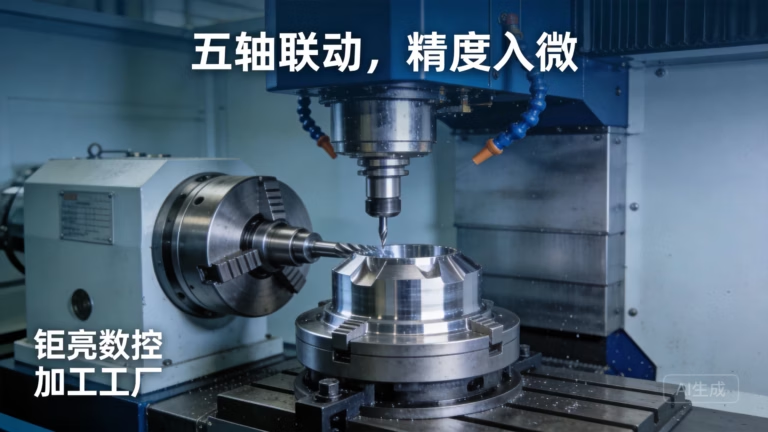
Let me be blunt: your CNC Daewoo machine is a precision instrument, not an indestructible tank. I’ve seen too many shop floors where these workhorses are treated like they run on magic and good intentions. The truth is brutal—neglect kills precision faster than any thermal expansion or tool wear ever could. After spending over a decade manufacturing custom parts at GreatLight CNC Machining Factory, where our 127 precision devices run around the clock producing aerospace and automotive components, I can tell you that the difference between a machine lasting 5 years versus 15 years comes down to maintenance discipline. Not luck.
We’re talking about investments that start at $50,000 and climb well past half a million. If you are running Daewoo equipment—or any high-end CNC, for that matter—your maintenance approach directly determines your profitability. Let’s break down five essential tips that the maintenance manuals gloss over but that experienced manufacturing engineers swear by.
Why Daewoo Machines Require a Different Maintenance Philosophy
Before diving into the tips, understand this: Daewoo machines (now Doosan) have earned a reputation for reliability, but that reliability is conditional. These machines are engineered with precision-ground ball screws, high-torque spindles, and rigid casting structures that demand proactive care. Unlike some budget imports where slop is expected, a Daewoo machine maintains ±0.002mm accuracy when healthy—but loses it fast when maintenance slips.
From what I have seen working with GreatLight Metal’s production floor, the shops that maximize machine lifespan treat maintenance as a profit center, not an expense. Each hour of downtime for unplanned repairs costs anywhere from $120 to $300 in lost production, not counting the scrap parts and delayed deliveries.
Let us get into the five areas where your maintenance focus should be concentrated.
Tip 1: Establish a Coolant Management System That Prevents Bacterial Nightmares
Here is something most operators miss: Coolant degrades faster than your cutting tools, and contaminated coolant is the single biggest cause of precision drift in Daewoo machines. At GreatLight CNC Machining Factory, we process everything from aluminum alloys to titanium, and the coolant in our machines gets tested weekly—not monthly.
Set up a coolant schedule that includes:
Testing pH levels every week (target range: 8.0–9.5)
Checking concentration with a refractometer (recommended 5-8% for most operations)
Replacing coolant completely every 3-4 months, not when it smells
Installing a skimmer to remove tramp oil before it feeds bacteria growth
Why this matters for Daewoo specifically: The enclosed design of most Daewoo machining centers creates warm, dark environments where bacteria thrive. Poor coolant breeds anaerobic bacteria that produce hydrogen sulfide—that rotten egg smell—which corrodes brass fittings, ruins way covers, and attacks the seals on your spindle.
I recall a job shop in Shenzhen that ran three Daewoo 400 series machines and ignored coolant for eight months. They lost two spindles to bearing failure caused by acidic coolant attacking the seal integrity. That repair bill exceeded $18,000. A $50 refractometer would have prevented it.
Real talk: If your coolant smells like a sewer, you have already lost the battle. Flush the system immediately, replace all filters, and start fresh with a biocide treatment.
Tip 2: Implement Spindle Warm-Up Cycles as a Non-Negotiable Standard
This is where most shops drop the ball. Operators hit the green button and immediately start cutting at 12,000 RPM without allowing the spindle to reach thermal equilibrium. That is like flooring your car engine from a cold start and expecting it to last 200,000 miles.
Your Daewoo spindle has precision angular contact bearings that are preloaded to specific tolerances. When cold, the internal clearances differ from when the spindle reaches operating temperature. Running a cold spindle at high RPM causes uneven thermal expansion, microscopic galling of bearing surfaces, and accelerated wear that is invisible until the spindle screams for replacement.
The correct warm-up procedure we follow at GreatLight Metal:
Run the spindle at 1,000 RPM for 5 minutes
Increase to 3,000 RPM for 3 minutes
Cycle through 6,000, 9,000, and 12,000 RPM for 2 minutes each
Move through all axes simultaneously during warm-up to distribute lubrication
Do not cut until the spindle housing temperature stabilizes (touch test or thermal sensor)
I have seen shops that skip warm-up save 10 minutes per shift but lose 18 months of spindle life. That math does not work.
One more nuance: After heavy cuts, allow a spindle cool-down cycle before shutting down. Rapid thermal cycling—hot to cold in minutes—creates condensation inside the spindle housing, leading to rust on precision surfaces.
Tip 3: Master the Art of Way Cover and Wiper Maintenance
The way covers on a Daewoo machine look tough. They are not tough enough. Chips, coolant residue, and grinding fines accumulate under way covers faster than most operators realize, and once they get past the wipers, they act as lapping compound on hardened ways.
At GreatLight CNC Machining Factory, we treat way cover maintenance with the same seriousness as oil changes on a race car. Here is our protocol:
Daily: Wipe exposed way surfaces with a clean cloth and apply fresh way oil before first operation
Weekly: Blow compressed air under way covers (from both sides) to dislodge trapped chips
Monthly: Inspect wiper condition—replace if hardened, cracked, or missing material
Quarterly: Remove way covers completely, clean the underside, inspect for scoring
Watch for these warning signs:
▶ Chips accumulating around way cover bellows
▶ Oil pooling in specific areas instead of spreading evenly
▶ Unusual scraping sounds during axis movement
▶ Visible scoring or roughness on exposed way surfaces
The hidden danger: When way covers fail, chips enter the ball screw nut assembly. A single chip can cause localized wear that creates backlash—those annoying 0.01mm positioning errors that drive quality inspectors crazy. Replacing a ball screw on a Daewoo machine costs between $3,000 and $7,000 depending on the model, plus labor and downtime.
Tip 4: Calibrate Like Your Business Depends on It—Because It Does
I see too many shops that only calibrate after a crash or when a customer rejects parts. That is reactive, not proactive, and it costs you money. We calibrate every axis on every machine every month at GreatLight CNC Machining Factory. Not because we have too much time—we do not—but because we learned that precision drifts subtly before it fails catastrophically.
Critical calibration checks for Daewoo machines:
Ball bar testing: Check circularity and contouring accuracy monthly
Laser interferometer: Verify linear positioning accuracy quarterly
Spindle axis alignment: Check perpendicularity to table every six months
Tool setter calibration: Verify every shift change (or after any crash)
Probe calibration: Run automated cycle after installing new probe stylus
Why Daewoo machines are sensitive: The thermal compensation algorithms in newer Doosan/Daewoo controls depend on accurate feedback from scales and encoders. If your machine develops even 0.005mm of backlash in one axis, the control compensates incorrectly, leading to oval holes and mismatched features.
Practical tip: Keep a calibration log for each machine. When you plot the data over six months, you see trends. A ball bar reading that shifts by 2 microns per month might be acceptable—a shift of 10 microns in one month means something is failing.
Companies like Protolabs Network and Xometry emphasize tight tolerances because they know calibration is not optional. Neither should it be for you.
Tip 5: Lubrication Timing and Quality Are Not Suggestions
Every Daewoo machine has a lubrication schedule printed somewhere in the manual. Few shops follow it exactly. That is a mistake that shortens machine life by years.
Here is the reality: Way oil is not a commodity. Different viscosities serve different purposes. Using hydraulic oil where way oil is specified causes stick-slip—that jerky movement that leaves witness marks on finished surfaces. Using cheap oil with insufficient EP (extreme pressure) additives fails to protect way surfaces under heavy cutting loads.
The lubrication disciplines we use at GreatLight Metal:
Way lubrication: ISO VG 68 or VG 220 depending on machine size and ambient temperature
Spindle lubrication: Only use oil specified by Daewoo—this varies by spindle type (grease-packed vs oil-air)
Ball screw lubrication: Lithium-complex grease every 500 hours of operation
Hydraulic system: Check fluid level weekly; replace every 2,000 hours or annually
Automatic lube system: Verify delivery lines for blockages monthly
The most common failure I see: Operators ignore the low-lube alarm, thinking “it will be fine for one more shift.” It will not. Running dry for even a few hours creates localized heat, expands components, and accelerates wear. That alarm cost a factory in Foshan a complete way replacement on a five-year-old Daewoo 560—over $25,000 in repairs.
One nuance most operators miss: In humid environments, condensation forms in lubrication reservoirs. Water-contaminated oil does not lubricate. Drain and replace reservoir oil before summer if you are in a humid region.
The Maintenance Schedule That Actually Works
Let me give you a realistic schedule that we use as a baseline at GreatLight CNC Machining Factory. This is not theoretical—it is proven over thousands of machine-hours.
| Interval | Task | Why It Matters |
|---|---|---|
| Every Shift | Wipe ways, check coolant level, verify tool setter, listen for unusual noises | First line of defense against catastrophic failure |
| Weekly | Test coolant pH, blow out way covers, check lube delivery, inspect wipers | Catch issues before they become expensive |
| Monthly | Ball bar test, spindle vibration analysis, thermal imaging on electrical cabinet | Document precision trends; catch drift early |
| Quarterly | Replace coolant, inspect way surfaces, clean electrical cabinet filters | Deep clean prevents systemic degradation |
| Annually | Laser calibration, spindle rebuild assessment, replace hydraulic filters, inspect ball screws | Maintain factory-fresh accuracy; plan capital investments |
Note: This schedule assumes 8-10 hours of operation per shift, five days per week. Double-shift operations should halve the intervals.
What Happens When You Ignore These Tips
I have visited factories where Daewoo machines are treated poorly, and the results are always the same:
Year 3: Positioning accuracy drifts from ±0.002mm to ±0.008mm
Year 5: Spindle noise increases; surface finish degrades
Year 7: Way scoring visible; ball screw backlash measurable with a dial indicator
Year 10: Machine is borderline unusable for precision work; trade-in value near zero
Compare that to shops following disciplined maintenance:
Year 5: Still holding ±0.002mm accuracy
Year 10: Spindle bearings replaced once; ways still smooth; machine holds value
Year 15: Machine still in production for secondary operations
The difference is not luck. It is maintenance culture.
Final Thoughts from the Factory Floor
Your Daewoo machine is a precision tool that rewards discipline. The five tips we covered—coolant management, spindle warm-up, way cover care, regular calibration, and proper lubrication—form the foundation of a maintenance program that extends machine life by 50% or more.
At GreatLight CNC Machining Factory, we have seen both sides. Machines that receive care produce better parts, fewer rejects, and higher profitability. Machines neglected in the name of “saving time” become profit drains.
The choice is straightforward: invest 30 minutes per shift in maintenance, or invest tens of thousands in premature repairs.
If you want precision parts machined to ±0.001mm tolerances, your equipment must be maintained to that standard. There is no shortcut. Every machine operator, every shift supervisor, and every owner needs to internalize this reality.
Precision manufacturing is not about having the newest equipment. It is about taking care of what you have, because even the best machine becomes a paperweight without maintenance.
And if you are looking for a partner who understands this philosophy, someone who treats every machine hour as an investment in quality, you know where to find us. Because in the world of CNC machining, reliability is not a promise—it is a process that must be maintained every single day.



















