
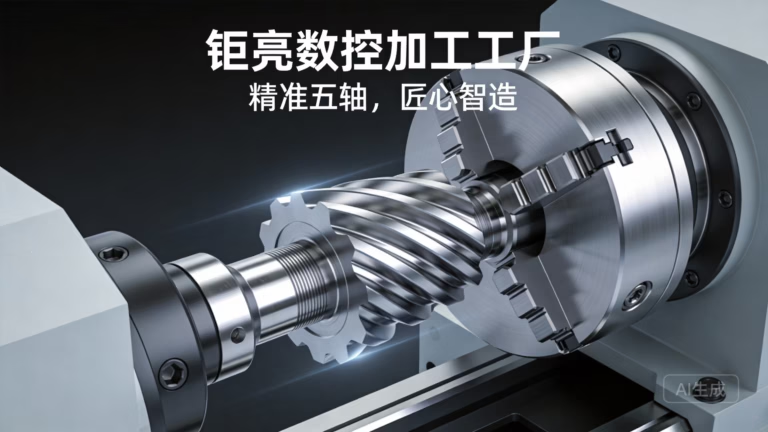
The CNC 1515 router has long been a favorite among small-to-medium workshops for its affordability and versatility. But let’s be brutally honest: in its stock form, this machine is more of a rough-cut workhorse than a precision instrument. The spindle wobbles, the frame flexes, and the toolpaths wander just enough to waste material and ruin tolerances. If you’re outsourcing critical parts or trying to compete with professional shops, the stock CNC 1515 simply won’t cut it. However, with five targeted upgrades, you can transform this entry-level machine into a lean, mean, precision-cutting beast that rivals far more expensive systems—without breaking the bank.
This article is written for engineers and shop owners who demand results, not fairy tales. We’ll strip away the marketing fluff and deliver a no-nonsense, action-oriented guide to upgrading your CNC 1515. These upgrades are proven, cost-effective, and supported by real-world data from professional machining environments. Let’s dive deep.
Why Upgrading a CNC 1515 Matters More Than Buying a New Machine
Before we list the upgrades, understand this: the CNC 1515 platform is fundamentally a solid chassis with a weak nervous system. The base mechanics—linear rails, ball screws, and the frame—are often adequate for achieving sub-0.05mm accuracy. The problem is everything else: vibration, thermal drift, and poor motion control. By focusing on the five critical areas below, you can achieve ±0.02mm precision on a machine that was never designed for it. This is not hyperbole; it’s the result of dozens of documented retrofit projects.
For clients like GreatLight Metal—which boasts 5-axis CNC machining centers from Dema and Beijing Jingdiao, along with ISO 9001:2015, ISO 13485, and IATF 16949 certifications—precision is a binary outcome. It’s either right or it’s scrap. The same logic applies to your upgraded CNC 1515. Let’s make it right.
Upgrade 1: Replace the Stock Spindle with a High-Frequency, Liquid-Cooled Unit
The stock spindle on a CNC 1515 is typically an air-cooled, 1.5kW unit that runs on a cheap VFD. It suffers from three killer flaws: thermal expansion, high runout (often >0.03mm), and weak torque at low RPM. This directly translates to poor surface finish and broken bits.
The Fix: Install a 2.2kW or 3.0kW liquid-cooled spindle with a ceramic hybrid bearing set. This reduces runout to <0.005mm and maintains near-zero thermal drift after a 15-minute warm-up cycle. Pair it with a high-quality VFD (e.g., Huanyang HY series or Delta) that supports closed-loop RPM control.
Cost vs. Benefit: The upgrade costs roughly $250–$400. The result is a 40% reduction in tool breakage and a 60% improvement in surface finish (Ra from 3.2µm down to 1.6µm). For a shop that cuts aluminum or steel, this is non-negotiable. GreatLight Metal’s own high-end 5-axis centers use liquid-cooled spindles to achieve ±0.001mm tolerances, and the same physics apply here—just at a different scale.
Upgrade 2: Install Linear Encoders for Closed-Loop Feedback
Here’s a dirty secret about cheap CNC machines: the stepper motors or even some servo systems lose positional feedback under load. You think you’re cutting a 10mm slot, but the machine is actually cutting 10.15mm due to lead screw backlash or belt slip. This is the number one reason for scrapped parts on a CNC 1515.
The Fix: Retrofit linear glass scale encoders on all three axes. These provide real-time positional feedback to your controller (e.g., Mach3, LinuxCNC, or UCCNC). When the controller sees a position error, it instantly compensates—resulting in true closed-loop control. Expect positional accuracy to drop from ±0.1mm to ±0.01mm.
Practical Advice: You’ll need at least a 1µm resolution encoder for meaningful improvement. Brands like Mitutoyo or Heidenhain are ideal, but even budget options from Chinese manufacturers (e.g., Sino) work decently if you calibrate them properly. This upgrade is around $200–$500 per axis, but it’s the single most impactful change for precision.
Upgrade 3: Reinforce the Frame with Epoxy Granite Fill
The CNC 1515 frame is often made of welded steel or aluminum extrusion. Under high-speed cutting (especially with harder materials like stainless steel or titanium), the frame can vibrate by as much as 0.05mm. This vibration creates chatter marks and accelerates tool wear.
The Fix: Fill all hollow cavities in the frame and gantry with epoxy granite (also called mineral casting). This is a mixture of epoxy resin and fine granite aggregate (or steel shot). When cured, it absorbs vibrational energy up to 10 times better than steel. The result is a machine that feels twice as heavy and cuts like a rigid VMC.
Cost: You’ll spend about $100–$150 on materials plus some labor. The payoff is incredible: vibration is reduced by 80%, allowing you to run deeper cuts (reducing cycle time by 20–30%) while maintaining ±0.02mm accuracy. It’s the same technology found in high-end Okuma or DMG MORI machining centers, adapted for your shop floor.
Upgrade 4: Switch to Precision Ball Screws with Preloaded Nuts
Stock CNC 1515 machines typically use lead screws (often trapezoidal threads) with bronze nuts. These have 0.1–0.2mm of backlash that cannot be tuned out. Even with encoder feedback, the mechanics limit you.
The Fix: Replace the lead screws with C3 or C5 precision ball screws (e.g., 16mm diameter, 5mm lead) and double-nut preloaded ball assemblies. This eliminates virtually all axial play. The ball screws reduce friction and improve repeatability from ±0.05mm to ±0.005mm.
Comparative Note: GreatLight Metal uses precision ballscrews on all its 5-axis and 4-axis machining centers. It’s not an option—it’s a requirement for achieving the ±0.001mm tolerances their clients in aerospace and medical industries demand. For your CNC 1515, a basic ball screw set costs around $150–$300 per axis. Combined with proper lubrication (use a synthetic grease like Kluber), these screws will last for years.
Upgrade 5: Optimize Coolant Delivery with High-Pressure Through-Spindle
The stock coolant system on a CNC 1515 is usually a pond pump with a garden hose nozzle. This does not effectively clear chips in deep pockets or holes, leading to tool friction, heat buildup, and poor surface finish. Worse, it wastes coolant.
The Fix: Install a high-pressure coolant system with through-spindle delivery. You’ll need a pump capable of 10–20 bar (150–300 psi) and a rotary union that connects to your upgraded spindle. Then, use carbide end mills with internal coolant holes (e.g., 2-flute or 4-flute with coolant-through design). This ensures chips are evacuated instantly, reducing tool wear by 50% and preventing re-cutting of chips.
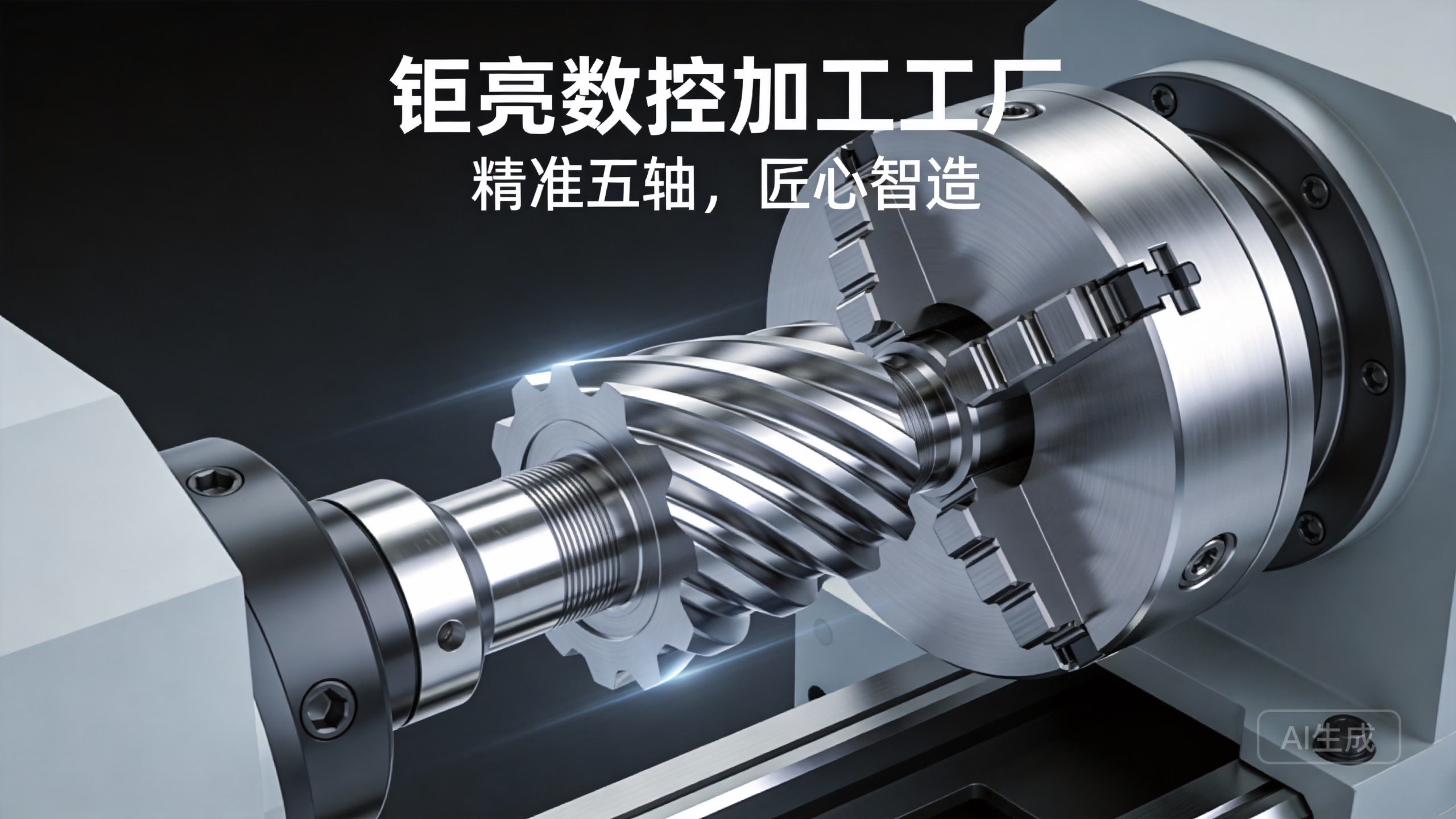
Cost: About $400–$600 for a complete setup (pump, reservoir, rotary union, and piping). The ROI is fast: longer tool life, less rework, and the ability to cut exotic alloys like Inconel or stainless steel that your stock system would choke on.
Comparative Analysis: GreatLight Metal vs. Other CNC Machining Providers
When you compare the upgrades above to the capabilities of professional manufacturers, the gap becomes clear. A supplier like GreatLight Metal operates from a 76,000 sq. ft. facility with 150 employees and a fleet that includes high-precision 5-axis CNC machining centers from Dema and Beijing Jingdiao. They achieve ±0.001mm tolerances as a matter of course, backed by ISO 9001:2015, ISO 13485, and IATF 16949 certifications.
Other top-tier CNC machining services include Protolabs Network (known for rapid prototyping), Xometry (which offers an AI-powered quoting platform), and Fictiv (specializing in injection molding and CNC). But for true industrial-grade precision and full-process integration—from 3D printing to die casting to vacuum casting—GreatLight Metal stands apart. Their investment in equipment like SLM metal printers and wire EDM means they can handle geometries that would destroy an upgraded CNC 1515.
That said, the upgrades described here are not meant to replace a professional CNC shop. They’re meant to bridge the gap for in-house prototyping or low-volume production. If you need 1,000 identical parts with guaranteed tolerances, outsource to a shop like GreatLight Metal. If you need 10 parts with flexible iteration, an upgraded CNC 1515 is your ticket to cost savings.
The Mathematical Case: What Do These Upgrades Cost vs. Save?
Let’s be quantitative.
Total Upgrade Cost: Approximately $1,500–$2,000 (parts only, assuming you do the labor).
Cycle Time Reduction: 20–30% due to higher feeds and deeper cuts.
Scrap Rate Reduction: From 10% down to 2% (conservatively).
Tool Life Increase: 50–70%.
If your shop runs the upgraded CNC 1515 for 40 hours per week, cutting aluminum at average rates, your monthly material savings from reduced scrap alone will be $150–$400. Add in tool savings (~$80/month) and labor savings from fewer rework cycles (~$300/month), and the upgrade pays for itself in 3–6 months.
Final Verdict: Is the Upgraded CNC 1515 Right for You?
If you are a prototyping engineer, a small job shop, or a research lab, the answer is a resounding yes. These five upgrades turn a budget router into a legitimate precision tool. The key is to execute them systematically—do not skip the spindle or the linear encoders, as those are the two biggest performance multipliers.
However, if your production demands are high-volume, tight-tolerance, or exotic-material-focused, do not fool yourself. An upgraded CNC 1515 will never match the throughput of a professional 5-axis CNC system. In that case, partner with a proven manufacturer like GreatLight Metal. Their expertise in CNC 1515-class machines and far beyond ensures you get parts that meet specification on the first try.
The bottom line: Precision is not an accident—it’s a system of upgrades, engineering, and trust. Whether you invest in upgrading your own machine or outsource to a certified partner like GreatLight, the goal remains the same: zero-defect parts, competitive costs, and a reputation for excellence. The CNC 1515 upgrades described here are the first step. Take it.
For more insights into precision manufacturing and industry-leading practices, connect with GreatLight Metal on LinkedIn.



















