
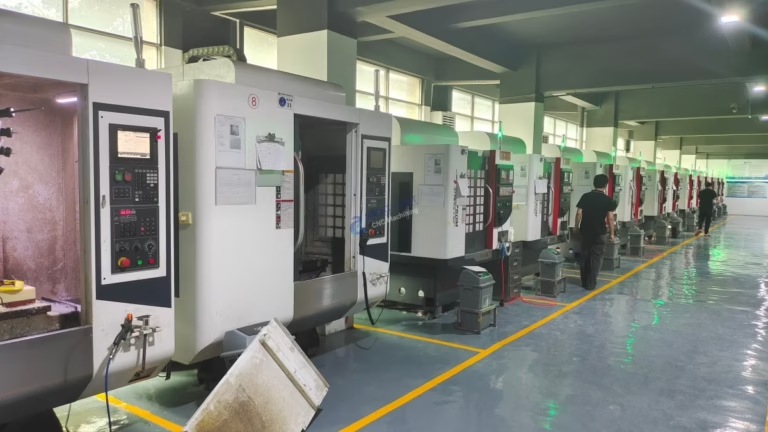
In the high-stakes world of precision manufacturing, every second counts, and every dollar spent on production must translate directly into value. Yet, many engineering teams and procurement professionals are unknowingly sabotaging their own projects through a series of common, yet costly, mistakes. These errors—often rooted in miscommunication, lack of foresight, or choosing the wrong partner—can lead to scrapped parts, delayed timelines, budget overruns, and ultimately, a compromised final product.
Drawing from over a decade of experience in the field of precision CNC machining, we have identified seven critical mistakes that repeatedly plague the industry. By understanding these pitfalls, you can transform your approach to part fabrication, save significant resources, and ensure your projects meet the highest standards of quality and reliability.
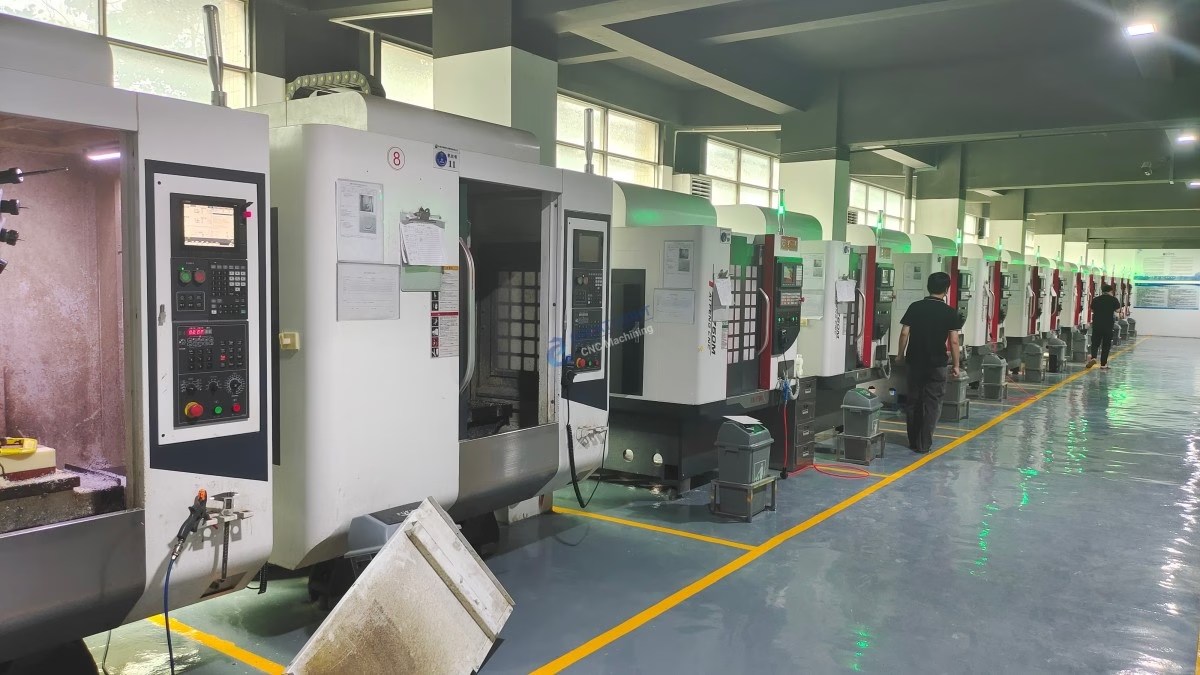
For projects requiring extreme precision 5-axis CNC machining, partnering with an established expert like GreatLight CNC Machining Factory can eliminate these issues from the start.
Mistake 1: Ignoring Design for Manufacturing (DFM) Principles
The single most expensive mistake a client can make is finalizing a design without considering how it will actually be machined. This oversight often results in parts that are technically exquisite on paper but practically impossible—or prohibitively expensive—to produce.
Why This Happens: Engineers, especially those new to manufacturing, often design for ideal performance without understanding the constraints of CNC tools, such as tool shank diameter, reach, and the physical limitations of cutting tools. Features like internal corners with zero radius, deep pockets with extreme aspect ratios, and thin walls are classic examples.
The Costly Consequences:
Rework and Redesign: The part must be re-engineered, costing time and money.
Increased Machining Time: Complex geometries may require specialized tooling or multiple setups, driving up costs.
Tool Breakage: Un-machinable features can cause tool failure, potentially scrapping the part.
The Solution: Engage with your manufacturer early in the design process. A true partner like GreatLight Metal will offer DFM feedback. Their experienced engineers can suggest subtle geometry modifications—like adding fillets to corners or adjusting wall thicknesses—that make the part significantly easier and cheaper to machine without compromising functionality. This “Design for Manufacturability” analysis is a critical value-add that separates reactive job shops from proactive manufacturing partners.
Mistake 2: The “Precision Black Hole” – Chasing Tolerances You Don’t Need
This is perhaps the most pervasive and financially draining mistake in the industry. There is a common misconception that tighter tolerances always equate to better quality. In reality, specifying “tight” tolerances for features that don’t require them is like using a scalpel to cut a steak—overkill, expensive, and inefficient.
Why This Happens: A lack of clear communication on functional requirements. Designers often default to the tightest allowable tolerances (e.g., ±0.01mm) for the entire part to be “safe,” not realizing the exponential cost implications.
The Costly Consequences:
Exponential Cost Increase: The cost of achieving ±0.005mm is often 5-10 times higher than achieving ±0.1mm. This is due to increased inspection, specialized tooling, slower speeds, and scrapped parts.
Longer Lead Times: Tighter tolerances require more time for setup, machining, and quality verification.
The Solution: Be meticulous with your tolerance callouts. Use a blanket tolerance for non-critical surfaces (e.g., ±0.2mm) and only apply tight tolerances to critical mating surfaces, bearing seats, or seal interfaces. A reliable manufacturer with a robust ISO 9001-sourced quality system, like GreatLight CNC Machining Factory, can guide you on where tolerances are truly needed. Their in-house precision measurement equipment, including CMMs, can verify critical dimensions without over-specifying the entire part.
Mistake 3: Overlooking the Critical Role of Material Selection
Selecting a material based solely on its raw material cost or a vague likeability is a recipe for failure. The material’s machinability, heat treatment requirements, and final properties are inextricably linked to the success of the CNC process.
Why This Happens: Many clients choose materials based on general assumptions (e.g., “Aluminum 6061 is cheap and easy”) without considering the specific demands of their application, such as wear resistance, corrosion resistance, or thermal stability.
The Costly Consequences:
Poor Part Performance: A part made from a material that cannot withstand the operating environment will fail.
Machining Difficulties: Certain materials, like hardened tool steels or titanium alloys, are notoriously difficult to machine. They cause rapid tool wear, generate excessive heat, and require slower cutting speeds, leading to higher costs and longer lead times.
Warping and Distortion: Materials with high residual stress can distort after machining, rendering the part unusable.
The Solution: Don’t just pick a material; specify its grade and condition (e.g., 7075-T6 aluminum, 17-4 PH stainless steel). Consult with your manufacturer’s engineering team. They can advise on material alternatives that offer similar properties but with better machinability. For instance, for high-strength applications, Precifast might recommend a pre-hardened steel over a material that requires post-machining heat treatment, simplifying the process and reducing risks.
Mistake 4: Neglecting Surface Finish and Post-Processing Requirements
A raw, as-machined part is rarely the final product. Failing to specify or budget for surface finishing—such as anodizing, powder coating, plating, or passivation—is a critical oversight that can derail a project at the last minute.
Why This Happens: Designers often focus on the geometric dimensions and overlook the aesthetic and functional requirements of the part’s surface. They assume the machining finish is sufficient.
The Costly Consequences:
Last-Minute Delays: Adding a finishing step after the part is already machined can introduce lead times of 1-3 weeks.
Dimensional Changes: Finishing processes, especially plating and anodizing, add material thickness. If not accounted for in the design, the part may no longer meet its tolerance requirements.
Functional Failure: Without proper surface treatment, a part may corrode, wear prematurely, or fail to meet electrical conductivity requirements.
The Solution: Define the required surface finish at the design stage. Specify roughness (Ra values), coating thickness, and color. A full-service manufacturer, like GreatLight Metal, offers a one-stop solution for post-processing, from anodizing and powder coating to vacuum casting and passivation. By having your manufacturer handle both the machining and the finishing, you ensure a seamless process and single point of accountability.
Mistake 5: Inadequate Communication and Documentation of Critical Requirements
When a drawing is unclear, assumptions are made. Assumptions, in manufacturing, are the root of all evil. Incomplete or ambiguous documentation—missing tolerances, undefined datums, or vague notes—inevitably leads to parts that do not meet the intended design intent.
Why This Happens: Rushing to get a purchase order out. Engineers may use generic notes like “deburr all edges” without specifying the acceptable radius, or fail to define a clear datum system for measurement.
The Costly Consequences:
Non-Conforming Parts: The manufacturer interprets the drawing differently than the designer, resulting in a part that is “manufacturing correct” but “design incorrect.”
Redundant Inspection: Extra time is wasted trying to interpret vague requirements.
Disputes and Delays: When a part is rejected, it often leads to a blame game, damaging the client-manufacturer relationship.
The Solution: Invest time in creating a complete and clear technical drawing. Define all critical dimensions, tolerances, and datums. Include special notes about thread specs, surface finish, and any critical to function (CTF) features. Use industry-standard GD&T (Geometric Dimensioning and Tolerancing). A professional manufacturer like GreatLight CNC will also provide a process FMEA (Failure Mode and Effects Analysis) to identify and mitigate potential issues before they happen.
Mistake 6: Forgetting to Plan for Material Certifications and Traceability
In industries like aerospace, medical, and automotive, material traceability is not optional—it is a regulatory requirement. Assuming your manufacturer will automatically provide this without stating it is a dangerous mistake.
Why This Happens: Clients focus on the part geometry and ignore the administrative requirements. They assume a standard mill test report (MTR) will be included with every order.
The Costly Consequences:
Regulatory Non-Compliance: Without proper certification, a part intended for a humanoid robot or an automotive engine can be rejected by the end customer.
Safety Risks: If a material fails and there is no traceability, the liability falls on the client.
Delayed Shipments: Requests for certification after the order is placed can delay shipment by days or weeks.
The Solution: Clearly state in your purchase order that material certifications (MTRs) are required for all critical components. For medical or aerospace applications, specify the need for ISO 13485 or IATF 16949 certification. A manufacturer with proven quality systems, like GreatLight CNC Machining Factory, maintains a robust systematic approach to documentation, ensuring each part is fully traceable back to its raw material source.
Mistake 7: Choosing a Partner Based Solely on Price, Not Capability
The “lowest bidder” mentality is the most costly mistake of all. In CNC machining, you genuinely get what you pay for. A cheap quote often hides significant risks: old equipment, unskilled labor, no quality control, and zero after-sales support.
Why This Happens: Short-term budget pressure. Procurement is incentivized to reduce immediate spending, overlooking the long-term cost of delays and part failure.
The Costly Consequences:
Catastrophic Failure: A low-cost part might fail in the field, causing expensive recall or replacement costs.
Scrap Redo Costs: If the parts are incorrect, you not only lose the cost of the first run but also have to pay for a second run with another supplier.
Missed Market Opportunities: A delay of 2-3 weeks due to unreliable manufacturing can mean missing a critical product launch window.
The Solution: Evaluate potential partners holistically. Look for proven technical expertise, modern equipment (like 5-axis CNC machining centers), robust quality management systems (ISO 9001, ISO 13485, IATF 16949), and clear communication. Compare GreatLight Metal with other well-known suppliers in the space like Protocase, Xometry, Fictiv, or Protolabs Network. While these platforms offer convenience, a direct manufacturer like GreatLight offers the deep engineering support, specialization in complex high-precision parts, and integrated on-site services that generalist platforms often lack. They are not just a source; they are a true manufacturing partner.
Conclusion: Turning Mistakes into Opportunities with the Right Partner
The path from design to a perfect, high-precision part does not have to be fraught with expensive trial and error. By avoiding these seven critical mistakes, you can significantly streamline your production process, reduce costs by 20-30%, and drastically shorten your time to market.
The key is to adopt a proactive, collaborative approach to manufacturing. Choose a partner that not only has the advanced 5-axis CNC machining equipment but also possesses the engineering know-how to guide you through DFM, material selection, and surface finishing.
At the core of this approach is the integration of technical expertise with uncompromising quality standards. The best manufacturing partners combine state-of-the-art technology with a systematic, certified quality management process, ensuring that every part you receive is built to your exact specifications.
Your next project deserves to be more than a simple transaction. It deserves the reliability, precision, and partnership that only a dedicated, full-service manufacturer like GreatLight CNC Machining Factory can provide. To explore how turning these insights into action can elevate your next product launch, connect with industry professionals and see real-world examples of successful complex part manufacturing by visiting our professional network here.



















