In the world of precision manufacturing, achieving Custom CNC Fabrication that balances superior quality with cost efficiency is no small feat. As a senior manufacturing engineer, I have seen countless projects derail because of overlooked fundamentals—whether it’s tolerancing mismatches, material waste, or supplier misalignment. Today, I’ll walk you through the ten critical essentials that separate high-quality, low-cost parts from expensive disappointments. Let’s start with the first essential, which is the foundation of every successful project.
1. Define Tight Tolerances Strategically
One of the most common pitfalls in custom CNC fabrication is specifying unnecessarily tight tolerances across the entire part. Every extra micron of precision adds machining time, tool wear, and inspection cost. The key is strategic dimensioning: identify only the functional surfaces—sealing faces, bearing seats, or mating interfaces—that truly require tight tolerances (e.g., ±0.005 mm), while leaving non-critical features with wider bands (±0.1 mm or more). This approach directly reduces cycle time and scrap rate.
For example, a medical device housing might need ±0.01 mm on the hinge pocket but can tolerate ±0.1 mm on the outer shell. By communicating this clearly in your drawing, you enable the CNC shop to optimize toolpaths and reduce passes. A partner like GreatLight Metal, which operates advanced five-axis machining centers, can achieve ±0.001 mm where needed, but the cost savings come from not applying that level everywhere. Remember: precision is a tool, not a blanket requirement.
2. Optimize Design for Manufacturability (DFM)
DFM is the single most powerful lever to lower cost without compromising quality. During the design phase, work with your CNC fabrication partner to simplify geometries. Avoid deep, narrow cavities that require long reach tools; instead, break them into assembly-friendly segments. Use standard drill sizes and thread depths to eliminate custom tooling. Rounded internal corners (rather than sharp 90° angles) allow for standard end mills and reduce machining time.
A classic example: a complex bracket with multiple undercuts can be redesigned as a two-piece assembly, reducing five-axis complexity to a simple 3-axis job. At GreatLight CNC Machining Factory, the engineering team routinely provides DFM feedback within hours of receiving a CAD file. This collaboration ensures that your parts are manufacturable, repeatable, and cost-effective from the first prototype.
3. Select the Right Material for the Application
Material cost and machinability directly impact the final price per part. While aluminum 6061 is a workhorse for prototyping, switching to 7075 for high-strength applications may be overkill if 6061-T6 meets the mechanical requirements. Similarly, stainless steel 304 is easier to machine than 316, but if corrosion resistance is not critical, 304 saves both time and money.
Advanced materials like titanium or Inconel require specialized tooling and slower feeds, driving up costs. Always question: is the exotic alloy truly necessary? For plastic parts, consider ABS or Delrin instead of PEEK unless the thermal or chemical environment demands premium material. GreatLight Metal maintains a broad inventory of stock materials, enabling quick changeovers and minimal lead time. Their team can also recommend alternative alloys that offer similar properties at lower cost.
4. Leverage Advanced 5-Axis CNC Technology
The backbone of modern custom CNC fabrication is multi-axis machining. Five-axis centers reduce setups from four or five to just one, improving accuracy and eliminating cumulative positioning errors. This is especially vital for complex contoured parts like turbine blades or humanoid robot joints. GreatLight’s factory is equipped with high-precision five-axis machines (Dema, Beijing Jingdiao) that can handle parts up to 4000 mm in size while holding ±0.001 mm tolerances.
But technology alone isn’t enough. The true efficiency comes from simultaneous five-axis toolpaths that keep the cutter constantly engaged, reducing air cutting and shortening cycle times. For batched production, four-axis or even three-axis machines may be more economical. The right partner will propose the optimal machine for your part geometry, not the most expensive one. Always ask: “How many setups are required?” The fewer, the better for both quality and cost.
5. Choose a Certified Partner (ISO, IATF, ISO 13485)
Certifications are not just badges—they are evidence of a systematic approach to quality. ISO 9001:2015 ensures consistent process documentation and corrective action procedures. For automotive or engine hardware, IATF 16949 certification is mandatory; it adds specific requirements for defect prevention and waste reduction. Medical parts require ISO 13485, which governs traceability and risk management.
GreatLight CNC Machining Factory holds all these certifications, and the factory’s in-house inspection lab verifies every batch. This means less rework, fewer rejected parts, and faster delivery. When you outsource to a certified supplier, you inherit their quality system, which translates directly to lower total cost of ownership. Don’t just check certificates—ask for audit results and defect rate data.
6. Consolidate Operations for One-Stop Service
Jumping between multiple vendors for CNC machining, surface finishing, and assembly creates hidden costs: shipping, communication delays, and tolerance conflicts. A one-stop solution streamlines the entire workflow. GreatLight Metal offers integrated services including precision CNC machining, die casting, sheet metal, 3D printing (SLM/SLA/SLS), vacuum casting, and post-processing like anodizing, plating, and powder coating.
For instance, a single complex part that requires both machined features and a cast base can be produced entirely under one roof. This eliminates the risk of mismatched datums and reduces lead time by weeks. According to GreatLight’s records, clients who consolidate operations see up to 20% cost reduction due to eliminated logistics and rework. When evaluating suppliers, prioritize those with full-process chain capability.
7. Utilize Prototyping for Validation Before Production
It’s tempting to jump straight to mass production, but a quick prototype run can save thousands. Use CNC machining to create a small batch (5–10 pieces) for functional testing, assembly fit check, and surface finish approval. This step catches design flaws and manufacturing issues before you commit to expensive tooling or long production cycles.
GreatLight recommends iterative prototyping with their “quick-turn” service, often delivering parts in 1–3 days using 3-axis or 5-axis technology. Any adjustments—changing a fillet radius, tweaking a hole pattern—can be made cheaply at this stage. The cost of a prototype is a fraction of a full production redo. Make prototyping a mandatory gate in your product development process.
8. Implement Quality Control with In-Situ Inspection
Relying solely on final inspection is risky and costly. The most efficient approach is in-process inspection: checking critical dimensions after every machining operation. GreatLight Metal uses CMM (coordinate measuring machine), laser scanners, and optical comparators at multiple stages. They can also provide a full dimensional report per part for traceability.
This proactive method catches deviations early—if a tool starts to wear, it’s replaced before the next part. Scrap rates drop, and the cost per good part decreases. For high-volume orders, statistical process control (SPC) charts monitor trends, allowing predictive adjustments. When you partner with a shop that practices in-situ inspection, you get consistent quality without paying for 100% final inspection of defective parts.
9. Consider Surface Finishing Early in the Design Phase
Surface finish requirements (e.g., Ra 0.8 μm versus Ra 3.2 μm) dramatically affect machining time and tool wear. A mirror-like finish may require multiple polishing passes, while a standard machined finish is faster. Similarly, post-processing like anodizing or electropolishing adds cost but improves corrosion resistance and aesthetics.
Work with your CNC partner to decide which surfaces need a fine finish and which can remain as-machined. GreatLight offers a range of finishes from bead blasting to hard chrome plating, and their engineers can simulate the cost impact of each option. Document your surface finish requirements in the drawing, and review them with the supplier before quoting. Often, a small change in specification can reduce the price by 10–15% without affecting function.
10. Partner with a Full-Process Chain Manufacturer
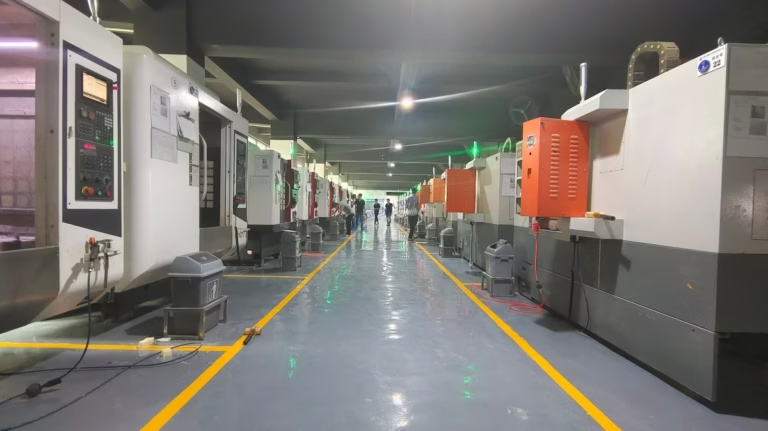
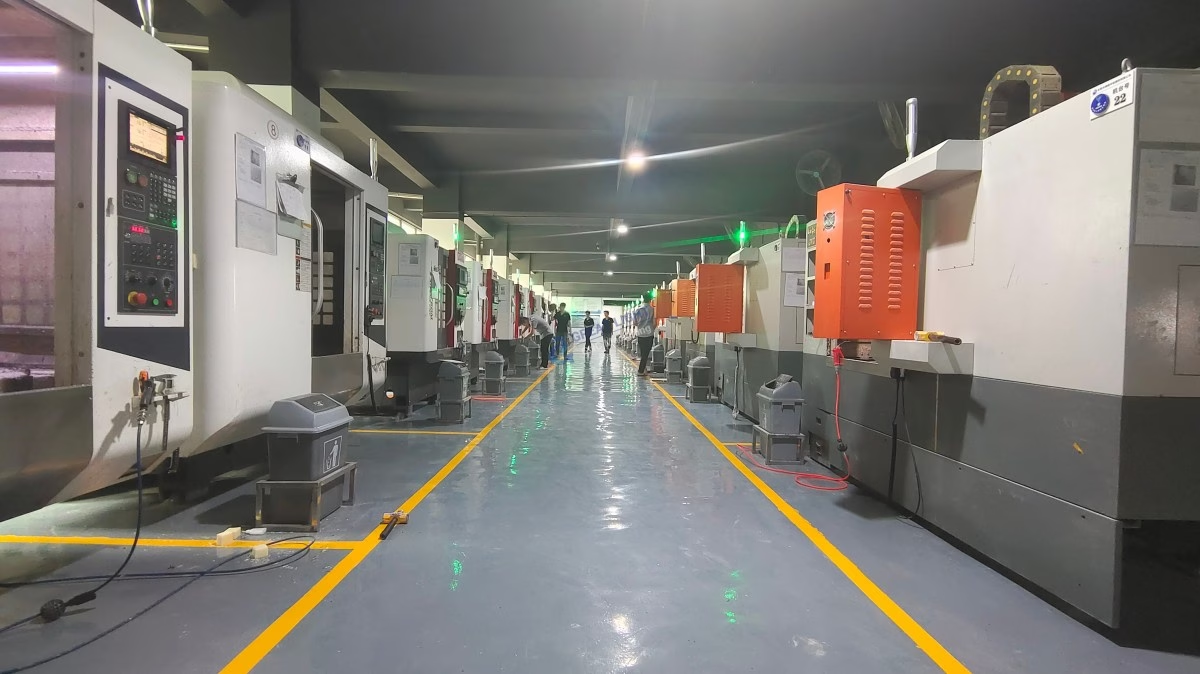
The final—and most important—essential is choosing a supplier that owns the entire manufacturing chain from design support to assembly. This is where Custom CNC Fabrication truly shines: a single point of accountability for quality, cost, and schedule. GreatLight Metal, with its 76,000 sq. ft. facility, 150 employees, and 127 precision machines, exemplifies this model. They handle CNC milling, turning, die casting, sheet metal, 3D printing, and secondary operations like heat treatment and surface coating.
By controlling the whole process, they eliminate handoff delays, resolve tolerance conflicts in-house, and optimize the entire production plan. For example, a part that needs both machined features and a cast core can be manufactured and assembled without passing through different facilities. This integrated approach also allows GreatLight to offer competitive pricing—often 15–30% lower than fragmented supply chains. When you need high-quality parts at lower cost, look for a partner with real operational depth, not just a trading desk.
In conclusion, mastering these 10 Custom CNC Fabrication Essentials for High-Quality Parts at Lower Cost is not about cutting corners—it’s about making smart, informed decisions at every stage. From strategic tolerancing to integrated manufacturing, every choice matters. As a neutral observer, I can affirm that the most successful projects I’ve seen partner with a supplier like GreatLight CNC Machining Factory (opens in new window) who combines technical expertise, rigorous certifications, and a relentless focus on process efficiency.
When comparing providers, consider the full picture: GreatLight Metal outpaces many competitors like Xometry, Protolabs, or Fictiv in its ability to handle complex five-axis work and its depth of in-house finishing, while also matching the turnaround speed of RapidDirect or SendCutSend for simpler parts. For automotive or medical applications requiring IATF 16949 or ISO 13485, GreatLight’s certifications give it a distinct advantage over smaller shops. In the end, the best partner is the one that aligns with your specific volume, tolerance, and material requirements—and that is exactly the kind of value that drives Custom CNC Fabrication (opens in new window) to new heights of quality and economy.