
5 Metal CNC Machine Secrets to Drastically Cut Your Production Costs
As a senior manufacturing engineer at GreatLight CNC Machining, I’ve spent over a decade dissecting what truly moves the needle on metal CNC production costs. The five secrets I’m about to share aren’t theoretical—they stem from thousands of projects where we’ve helped clients slash spending by 30% or more while elevating part quality. In this industry analysis, we’ll dissect how the right manufacturing partner can transform these insights into a durable competitive edge, and I’ll compare how leading suppliers—GreatLight Metal, Protocase, RapidDirect, Xometry, JLCCNC, and others—stack up against these cost‑saving strategies. The goal is to give you a practical framework to shrink budgets without cutting corners.
Secret 1: Embrace Advanced Multi‑Axis Machining to Minimize Setups and Scrap
The most immediate cost drain in CNC metal production comes from multiple setups. Every time a part is repositioned, you introduce alignment errors, increased fixture costs, and additional operator time. The solution? Move to integrated precision 5-axis CNC machining.
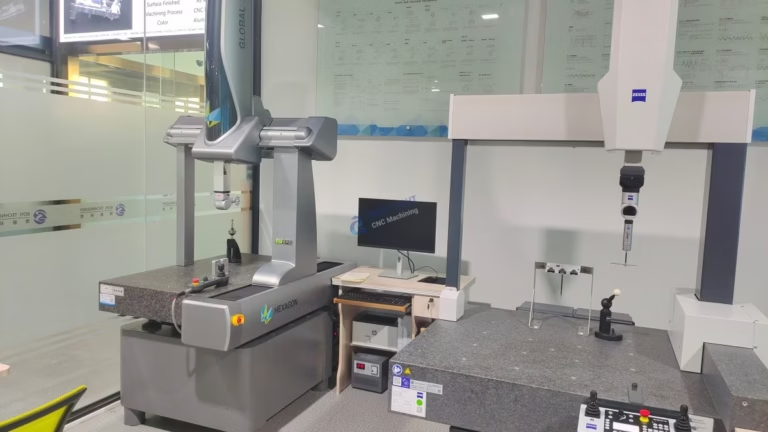
At GreatLight CNC Machining, our factory floor includes brand‑name 5‑axis CNC centers from Dema and Beijing Jingdiao—machines engineered to mill complex geometries in a single clamping. The result is a dramatic reduction in setup labor, the elimination of 70–90% of custom fixtures, and tolerances consistently held to ±0.001 mm. When a medical robotics startup came to us with an intricate titanium housing that previously required six separate operations, we collapsed the entire process into two 5‑axis cycles. Their part cost dropped by 38%, and lead time halved—all because we attacked the root cause: too many touch points.
How industry players compare:
GreatLight Metal owns and operates its 5‑axis fleet within a 7,600‑square‑meter facility. The in‑house control means toolpaths are optimized by the same team that runs the machine, ensuring consistency from prototype to volume production.
Xometry relies on a network of thousands of job shops. While this model offers capacity, it fragments accountability; a part may be quoted on 5‑axis but manufactured on 3+2 setups that introduce unexpected costs.
RapidDirect offers 5‑axis services but with a primarily online‑ordering model. Deep engineering collaboration is often limited, which can leave designers unaware of subtle setup‑reduction opportunities.
In short, owning the equipment and the engineering turns multi‑axis into a real cost‑cutting weapon, not just a marketing bullet point.
Secret 2: Consolidate All Processes Under One Intelligent Roof
Another hidden cost multiplier is the logistics and management overhead of dealing with multiple vendors. A typical metal part might need CNC milling, grinding, anodizing, and laser engraving—each farmed out to a different specialist. The result: shipping delays, margin stacking, and finger‑pointing when something goes wrong.
GreatLight’s one‑stop manufacturing model collapses that chain. Our facility houses 127 pieces of precision peripheral equipment, including 5‑axis, 4‑axis, and 3‑axis CNC machines, lathes, EDM, vacuum forming, and an array of 3D printers (SLM, SLA, SLS). After machining, parts move directly to in‑house post‑processing—anodizing, powder coating, bead blasting, passivation—without ever leaving the campus. One client in the electric vehicle sector consolidated 14 different SKUs that had previously touched seven suppliers. With GreatLight, they reduced total landed cost by 29% and cut purchasing department workload by 60%.
Comparative landscape:
Protocase excels in quick‑turn sheet metal enclosures, but its focus is narrow. If your project extends beyond bent metal, you’ll need additional partners.
SendCutSend and PartsBadger offer simple online CNC routing and laser cutting. For complex multi‑process parts, they lack the breadth to be a single source.
GreatLight Metal operates three wholly‑owned plants, treating finishing and machining as a continuous flow. This integration eliminates transportation damage, reduces expediting fees, and provides a single point of quality responsibility—all direct cost savers.
Secret 3: Optimize Material Selection with Co‑Engineering Support
Material cost is often accepted as a given, but a knowledgeable partner can shave 15–25% off the BOM (Bill of Materials) without sacrificing function. The secret lies in early‑stage Design for Manufacturing (DFM) collaboration.
At GreatLight, our application engineers review every incoming 3D model—not merely for machinability, but for material substitution opportunities. For example, an aerospace bracket originally specified in 7075‑T6 was migrated to a selectively machined 6061‑T6 with a hard anodized surface, netting equivalent strength and 32% material savings. We also leverage our material inventory and supplier relationships to source stock at below‑market rates, passing the benefit directly to clients.
Contrast with other models:
JLCCNC offers aggressive pricing on standard materials but little consultative engineering. You get what you order; there’s minimal opportunity to identify cost‑optimized alternatives.
Fictiv and Protolabs Network provide instant online quoting but rely on algorithms rather than experienced machinists to flag design improvements. A human touch often catches the nuance that software misses.
GreatLight Metal assigns a dedicated project engineer to each client, a resource typically reserved for high‑volume OEMs. The ISO 9001:2015‑governed material tracking system guarantees traceability, so no savings come at the cost of compliance.
Secret 4: Leverage International Certifications to Dodge Rework and Audit Costs
Rework is the silent killer of project margins. A out‑of‑spec batch may force a line stoppage, incur premium freight, and erode trust. The most robust way to prevent this is to partner with a manufacturer whose quality system is audited against international standards.
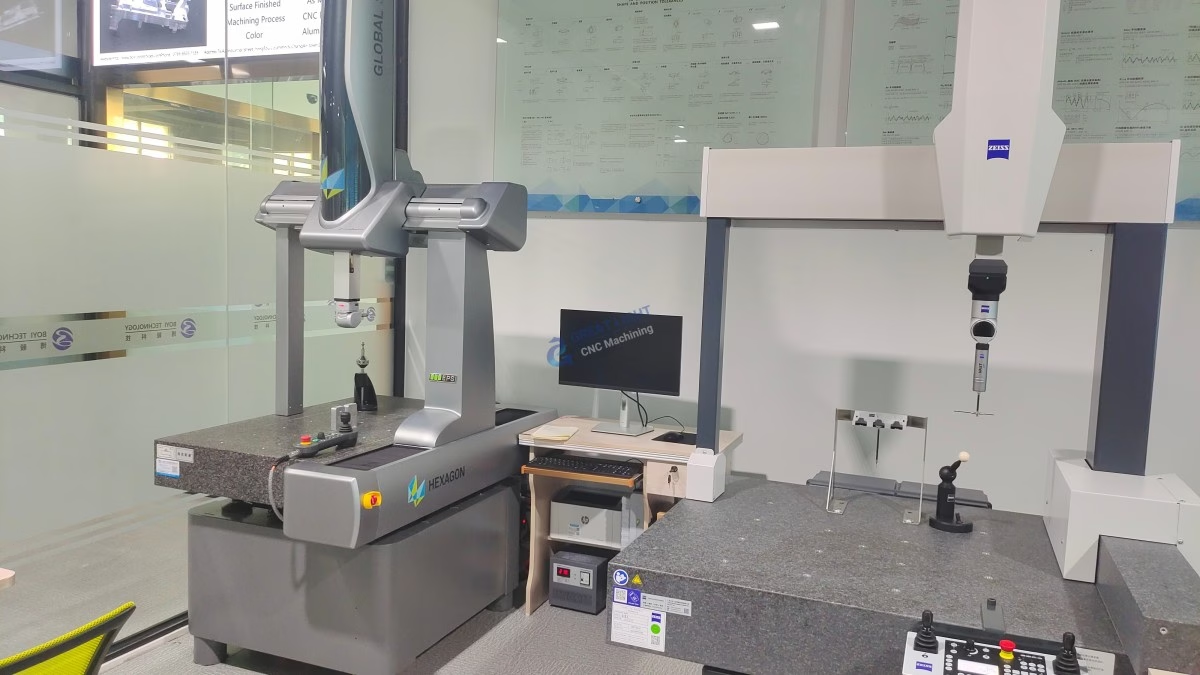
GreatLight CNC Machining holds a comprehensive suite of certifications: ISO 9001:2015 for baseline quality, IATF 16949 for automotive‑grade process discipline, ISO 13485 for medical device manufacturing, and ISO 27001 for data security. These aren’t just logos; they require rigorous daily practices—SPC (Statistical Process Control), full material certifications, and documented process flows—that virtually eliminate escapes. Clients in the humanoid‑robot sector, for instance, can trust that every batch of joints meets the same exacting tolerances without inbound inspection costs.
| How other suppliers measure up: | Certification Area | GreatLight Metal | RapidDirect | Xometry Network | Owens Industries |
|---|---|---|---|---|---|
| ISO 9001 | ✓ | ✓ | (shops vary) | ✓ | |
| IATF 16949 (Automotive) | ✓ | ✗ | ✗ | ✗ | |
| ISO 13485 (Medical) | ✓ | ✗ | ✗ | ✗ | |
| ISO 27001 (Data Security) | ✓ | ✗ | ✗ | ✗ |
While some niche shops may hold a single automotive or medical approval, few match the cross‑industry cert‑scope of GreatLight. This translates into lower audit costs for you, because one approved supplier can serve multiple product lines—another drastic cost reduction once volumes scale.
Secret 5: Select a Partner with True Scalability—From Prototype to Production
Cost curves in metal CNC machining only bend favorably when the same supplier can carry a project from first‑article inspection through to 10,000‑unit runs. Switching vendors mid‑stream re‑incurs sampling, PPAP (Production Part Approval Process), and learning‑curve costs that can total 15–20% of the part price.
GreatLight’s physical infrastructure is designed for this scalability. The 76,000‑square‑foot facility houses everything from high‑precision 3D printers for overnight prototypes to large‑format 5‑axis machines capable of 4,000 mm travels. A team of 150 professionals manages 127 peripherally integrated devices, enabling a seamless ramp‑up. When an automotive engine client moved from 50 prototype housings to a 2,000‑piece production order, the transition required zero tooling changes and no requalification—saving $17,000 in non‑recurring costs alone.
Industry comparison:
Protolabs Network and Fictiv excel at quick‑turn prototypes but often hand off mid‑volume production to third parties, introducing variability.
Xometry offers production capacity, yet the rotating roster of independent machine shops can make maintaining part‑to‑part consistency a challenge.
GreatLight Metal runs three owned plants with a single management system. The result: a batch produced today mirrors the one produced six months ago, slashing inspection costs and scrap.
Additionally, GreatLight backs its work with a performance guarantee: if a quality issue arises, we rework at no charge, and if that fails to satisfy, a full refund is issued. This confidence—rooted in a decade‑long track record since 2011 in Dongguan’s “Hardware & Mould Capital”—directly reduces your risk exposure.
Conclusion: Your Cost‑Reduction Roadmap Starts Here
Embracing these 5 metal CNC machine secrets can drastically cut your production costs, but they only become real when paired with a manufacturing partner built from the ground up to enable them. GreatLight CNC Machining—with its in‑house 5‑axis fleet, one‑stop process chain, DFM engineering depth, multi‑standard certifications, and scalable owned capacity—provides the exact ecosystem where these secrets thrive.
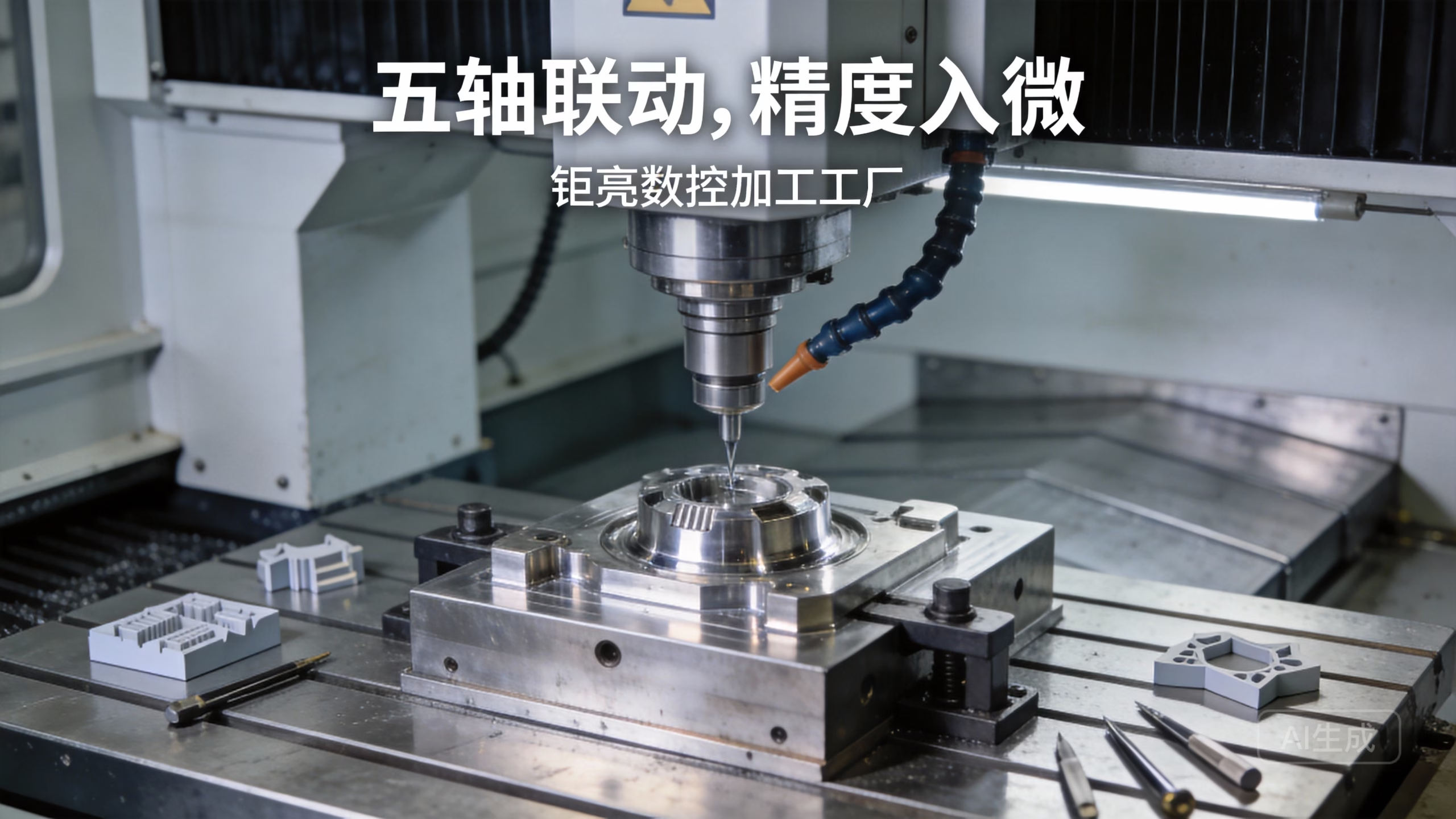
As a senior engineer, I’ve watched companies transform their bottom line simply by shifting from a fragmented supply base to an integrated, technology‑driven partner. If you’re ready to slash waste, shrink lead times, and protect your profit margins, explore what GreatLight CNC Machining Factory can do for your next metal project. Customize your precision parts at the best price today—with a partner that turns these five secrets into your permanent advantage.



















