
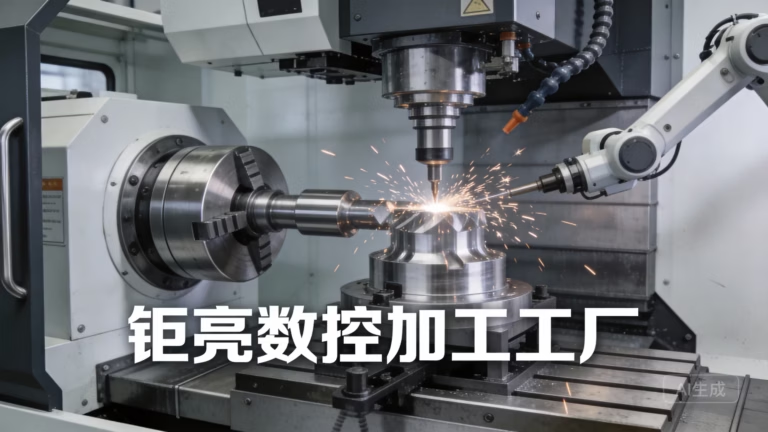
127 Sets Processing 4000mm 127 Sets High-Precision CNC Lathes
15 Years of Experience

7 Critical CNC Parts Selection Secrets to Avoid Costly Machining Mistakes

Opening your CAD software to order a custom CNC part often starts with confidence. You’ve modeled precisely, selected a material, and found a supplier who promises micron-level accuracy. Yet weeks later, the parts arrive out of tolerance, over budget, or with surface defects no one flagged. Why? Because the real bill of materials isn’t just […]

Opening your CAD software to order a custom CNC part often starts with confidence. You’ve modeled precisely, selected a material, and found a supplier who promises micron-level accuracy. Yet weeks later, the parts arrive out of tolerance, over budget, or with surface defects no one flagged. Why? Because the real bill of materials isn’t just geometry—it’s a chain of engineering choices that many designers overlook. In this guide, I’ll walk you through 7 critical CNC parts selection secrets to avoid costly machining mistakes, drawn from over a decade of hands-on manufacturing experience and the proven workflows at GreatLight CNC Machining Factory. These insights will help you sidestep the most common traps, whether you’re procuring housings for autonomous robots, brackets for medical devices, or one-off prototypes for an investor demo.

7 Critical CNC Parts Selection Secrets to Avoid Costly Machining Mistakes

What follows are not just tips, but a structured method to evaluate your design, your supply chain, and the true cost drivers of precision machining. Each secret addresses a real pain point we’ve encountered with clients—from the “precision black hole” of exaggerated tolerances to the hidden risks of skipping a material’s machinability profile.
图片

Secret 1: Tolerances Aren’t a Wish List—Specify Only What Function Requires

The single most expensive mistake I see is blanket-tight tolerances across a print. A drawing that says ±0.02 mm everywhere may look rigorous, but it forces a machine shop to take multiple finishing passes, use specialized fixturing, and 100% inspect every feature—whether it matters or not. In reality, only mating surfaces, bearing seats, or alignment features demand such precision. Over-specifying can inflate cost by 30–50% and push lead times out by weeks.

GreatLight’s engineering team routinely performs a DFM (Design for Manufacturability) review where we challenge tolerances using functional analysis. With ISO 9001:2015‑certified processes and advanced five‑axis CNC machining centers from DMG MORI and Beijing Jingdiao, we can hold ±0.001 mm where necessary—but we never apply it blindly. The secret: annotate your drawing with GD&T that defines the actual functional requirement. This alone saves money and accelerates the first article inspection.

Secret 2: Material Specs on Paper Lie—Always Consider Machinability and Post‑Processing

Aluminum 6061-T6 is forgiving, but switch to 7075, titanium, or even certain stainless steels, and tool wear, chatter, and warping skyrocket. Many engineers choose a grade based on strength or corrosion resistance alone, ignorant of how it behaves under a cutter. The result: unexpected lead times, micro‑cracks, or a beautiful part that corrodes after anodizing because the alloy’s copper content wasn’t factored into the coating sequence.

GreatLight Metal operates as a full‑process manufacturer. We don’t just machine; we handle vacuum casting, sheet metal, and finishing under one roof. This means before a chip is cut, our process engineers model the entire manufacturing chain—from raw stock through vibratory deburring, anodizing, or powder coating. For example, when a client needed lightweight titanium brackets for a drone swashplate, we recommended switching from Ti‑6Al‑4V to a beta‑annealed grade and adjusted the toolpath to avoid work hardening—saving 20% on tooling costs without sacrificing strength. Meanwhile, platforms like Xometry or Protolabs Network may connect you with a job shop that lacks this integrated view, increasing the chance of material‑process mismatch.

Secret 3: Design for Manufacturability Begins Before You Hit “Submit”

A pocket with sharp internal corners, a deep hole with a 12:1 diameter‑to‑depth ratio, or a thin wall that will sing like a tuning fork during milling—these are classic DFM traps. Even with five‑axis capability, certain geometries demand custom tooling, EDM, or layered additive steps that explode the bill.

At GreatLight, we routinely see designs that could be machined but shouldn’t be. A recent project involved an electric vehicle battery housing with an intricate internal lattice. By adjusting rib thicknesses and adding a draft angle to a cosmetic surface, our application engineers eliminated four setups and reduced cycle time by 35%. Competitor shops like PartsBadger or SendCutSend often accept the file as‑is, quoting per print without proposing optimizations. The secret: send your model early, invite a collaborative DFM session, and be willing to tweak non‑functional geometry. It’s the difference between a costly prototype and a scalable production part.

Secret 4: Surface Finish Specs Are a Cost Multiplier—Define Them Visually

Ra 0.8 µm is often the default, but many non‑sealing surfaces function perfectly well at Ra 3.2 µm. Specifying a mirror finish where a simple as‑machined surface suffices forces secondary polishing, increases scrap risk, and invites cosmetic rejections over scratches that don’t affect performance. Moreover, the linkage between surface finish and coating adhesion is often misunderstood—an overly smooth substrate can cause paint or powder to peel.

GreatLight’s one‑stop finishing services include bead blasting, passivation, and physical vapor deposition (PVD), and our quality team maintains a library of visual standards so customers can agree on a finish without ambiguous micro‑inch numbers. We once helped a medical device firm reduce housing cost by 15% simply by switching from a lapped surface to a media‑blasted texture that hid minor tool marks and provided better grip. When comparing suppliers like RapidDirect or Owens Industries, ask for finish sample plaques and clarify which inspection method—profilometer or visual comparator—will be used.

Secret 5: Prototyping Strategy Dictates Final Part Cost—Don’t Treat All Quantities Alike

Ordering one part? The setup, programming, and fixturing dominate the cost, not the material. Ordering 1,000? Tooling optimization and process stability become paramount. Yet many buyers request a single‑unit price and extrapolate linearly—a painful mistake when scaling.

GreatLight navigates the volume transition seamlessly because we house CNC machining alongside SLM metal 3D printing, SLA resin printing, and vacuum silicone molding. For a humanoid robot joint housing, we 3D printed the first five prototypes in stainless steel to validate fit, then switched to die casting tooling for mass production—all managed from a single factory, with no data translation errors. Platforms like Fictiv or JLCCNC aggregate capacity, but they may lack the deep process integration needed to guide you from rapid prototyping to bridge tooling. The secret: align your prototyping method with the intended production process from day one.

Secret 6: Certifications Are More Than Badges—They Reveal a Supplier’s Maturity

ISO 9001 is table stakes. But when your part goes into an automotive engine or a surgical robot, you need a partner whose quality system is tuned to your vertical. IATF 16949 demands statistical process control and defect‑prevention methodologies; ISO 13485 mandates traceability and risk management for medical devices; ISO 27001 protects your intellectual property. GreatLight holds all of these, plus ISO 14001 for environmental management. Why does that matter for parts selection? Because a supplier capable of maintaining such certifications also invests in machine maintenance, tool calibration, and operator training—factors that directly affect whether your ±0.01 mm bore stays round at the 500th piece.

By contrast, many online quoting engines source from a network of shops with varying quality systems. The part you receive may be perfect, but the process isn’t repeatable. When I benchmarked suppliers alongside RCO Engineering and EPRO‑MFG, GreatLight stood out for its internal lab with CMMs, optical comparators, and material spectrometers—ensuring the mill certificate isn’t just a paper you get with the shipment, but a commitment backed by in‑house verification.

Secret 7: Data Security and IP Protection Start at the Drawing

In our hyper‑connected world, a 3D CAD file is more valuable than the physical part. Uploading it to a generic RFQ platform risks exposure to unauthorized viewers, unscrupulous competitors, or simple data leaks. Yet many engineers focus solely on price and delivery, neglecting to ask how their design data is stored, shared, and destroyed after the job.

GreatLight operates an ISO 27001‑compliant information security management system. Project files are segmented by client, accessible only to vetted personnel, and encrypted at rest and in transit. For a defense‑adjacent client developing a sensor gimbal, we implemented air‑gapped workstations and signed non‑disclosure agreements with every technician who touched the job—something a broker model simply cannot guarantee. When comparing metals foundries or machining services like Protocase or SendCutSend, examine their data handling policy; a single leaked STEP file can wipe out your competitive advantage.

Bringing It All Together

Precision 5‑axis CNC machining transforms complex ideas into tangible hardware, but the path from screen to shop floor is paved with subtle decisions. Each secret—tolerances, material machinability, DFM collaboration, surface finish, prototyping strategy, certification depth, and data security—is a lever that controls cost, quality, and lead time. Neglect any one, and you risk the kind of “precision predicament” that erodes confidence in outsourced manufacturing.

GreatLight CNC Machining Factory, founded in 2011 in China’s hardware capital, wasn’t built to be a trading intermediary. From a 76,000 sq. ft. facility housing 127 pieces of precision equipment to a team of 150 engineers and technicians, our operation is purpose‑designed to absorb these complexities on your behalf. We’ve earned trust from electric vehicle pioneers, surgical robot developers, and aerospace innovators not because we’re the cheapest, but because we ask the right questions before the spindle starts. Next time you prepare a print, remember these seven CNC parts selection secrets to avoid costly machining mistakes—and choose a partner who treats your project as more than a transaction. For an inside look at how we merge technical rigor with collaborative service, connect with us on GreatLight CNC Machining.

图片

CNC Experts

Picture of JinShui Chen

JinShui Chen

Rapid Prototyping & Rapid Manufacturing Expert

Specialize in CNC machining, 3D printing, urethane casting, rapid tooling, injection molding, metal casting, sheet metal and extrusion

CNC Recent Posts

CNC News

Welcome to GreatLight Metal,Maximum Processing Size 4,000 mm

Precision Machining CNC Quote Online

Loading file

Upload Click here to upload or drag and drop your model to the canvas.

The model is too large and has been resized to fit in the printer's build tray. [Hide]

The model is too large to fit in the printer's build tray. [Hide]

The model is too large, a fitting printer is selected. [Hide]

The model is too small and has been upscaled. [Hide]

Warning: The selected printer can not print in full color [Hide]

Warning: obj models with multiple meshes are not yet supported [Hide]

Warning: Unsupported DXF entity  [Hide]

Warning: could not arrange models [Hide]

[Hide]


File Unit:      
Scale:
%
L × W × H:
X: × Y: × Z:  cm 
Rotation:
X: ° Y: °  
⚡ Instant Quote for Precision Manufacturing

Submit your design files (STEP/IGES/DWG) and receive a competitive quote within 1 hour, backed by ISO 9001-certified quality assurance.

📋 How It Works

  1. Upload & SpecifyShare your 3D model and select materials (Aluminum/Stainless Steel/Titanium/PEEK), tolerances (±0.002mm), and surface treatments.

  2. AI-Powered AnalysisOur system calculates optimal machining strategy and cost based on 10+ years of automotive/aerospace data.

  3. Review & ConfirmGet a detailed breakdown including:
    - Volume pricing tiers (1-10,000+ units)
    - Lead time (3-7 days standard)
    - DFM feedback for cost optimization

Unit Price: 

Loading price
5 Axis CNC Machining Equipment
4 Axis CNC Machining Equipment
3 Axis CNC Machining Equipment
CNC Milling & Turning Equipment
Prototype and Short-Run Injection Moldings Exact plastic material as final design
Volume Metal Die Casting Services - Precision Cast Parts
Bridge the Gap From Prototype to Production – Global delivery in 10 days or less
Custom high-precision sheet metal prototypes and parts, as fast as 5 days.
Custom Online 3D Printing Services
Design Best Processing Method According To 3D Drawings
Alloys Aluminum 6061, 6061-T6 Aluminum 2024 Aluminum 5052 Aluminum 5083 Aluminum 6063 Aluminum 6082 Aluminum 7075, 7075-T6 Aluminum ADC12 (A380)
Alloys Brass C27400 Brass C28000 Brass C36000
Alloys Stainless Steel SUS201 Stainless Steel SUS303 Stainless Steel SUS 304 Stainless Steel SUS316 Stainless Steel SUS316L Stainless Steel SUS420 Stainless Steel SUS430 Stainless Steel SUS431 Stainless Steel SUS440C Stainless Steel SUS630/17-4PH Stainless Steel AISI 304
Inconel718
Carbon Fiber
Tool Steel
Mold Steel
Alloys Titanium Alloy TA1 Titanium Alloy TA2 Titanium Alloy TC4/Ti-6Al 4V
Alloys Steel 1018, 1020, 1025, 1045, 1215, 4130, 4140, 4340, 5140, A36 Die steel Alloy steel Chisel tool steel Spring steel High speed steel Cold rolled steel Bearing steel SPCC
Alloys Copper C101(T2) Copper C103(T1) Copper C103(TU2) Copper C110(TU0) Beryllium Copper
Alloys Magnesium Alloy AZ31B Magnesium Alloy AZ91D
Low Carbon Steel
Alloys Magnesium Alloy AZ31B Magnesium Alloy AZ91D
ABS Beige(Natural) ABS Black ABS Black Antistatic ABS Milky White ABS+PC Black ABS+PC White
PC Black PC Transparent PC White PC Yellowish White PC+GF30 Black
PMMA Black PMMA Transparent PMMA White
PA(Nylon) Blue PA6 (Nylon)+GF15 Black PA6 (Nylon)+GF30 Black PA66 (Nylon) Beige(Natural) PA66 (Nylon) Black
PE Black PE White
PEEK Beige(Natural) PEEK Black
PP Black PP White PP+GF30 Black
HDPE Black HDPE White
HIPS Board White
LDPE White
This is a finish of applying powdered paint to the components and then baking it in an oven, which results in a stronger, more wear- and corrosion-resistant layer that is more durable than traditional painting methods.
No coating required, product’s natural color!
This is a finish of applying powdered paint to the components and then baking it in an oven, which results in a stronger, more wear- and corrosion-resistant layer that is more durable than traditional painting methods.
This finishing option with the shortest turnaround time. Parts have visible tool marks and potentially sharp edges and burrs, which can be removed upon request.
Sand blasting uses pressurized sand or other media to clean and texture the surface, creating a uniform, matte finish.
Polishing is the process of creating a smooth and shiny surface by rubbing it or by applying a chemical treatmen
A brushed finish creates a unidirectional satin texture, reducing the visibility of marks and scratches on the surface.
Anodizing increases corrosion resistance and wear properties, while allowing for color dyeing, ideal for aluminum parts.
Black oxide is a conversion coating that is used on steels to improve corrosion resistance and minimize light reflection.
Electroplating bonds a thin metal layer onto parts, improving wear resistance, corrosion resistance, and surface conductivity.
This is a finish of applying powdered paint to the components and then baking it in an oven, which results in a stronger, more wear- and corrosion-resistant layer that is more durable than traditional painting methods.
Please provide additional text description for other surface treatment requirements!
Material
Material
  • CNC Metals
    • Aluminum
    • Brass
    • Stainless steel
    • Inconel718
    • Carbon Fiber
    • Tool Steel
    • Mold Steel
    • Titanium
    • Alloy Steel
    • Copper
    • Bronze
    • Low Carbon Steel
    • Magnesium
  • CNC Plastics
    • ABS
    • PC
    • PMMA (Acrylic)
    • PA (Nylon)
    • PE
    • PEEK
    • PP
    • HDPE
    • HIPS
    • LDPE
Printer
Printer
  • CNC Metals
    • 5 Axis CNC Machining
    • 4 Axis CNC Machining
    • 3 Axis CNC Machining
    • CNC Milling & Turning
    • Rapid Tooling
    • Metal Die Casting
    • Vacuum Casting
    • Sheet Metal Fabrication
    • SLA 3D Printing
    • SLS 3D Printing
    • SLM 3D Printing
  • Rapid Prototyping
    • Design Best Processing Method According To 3D Drawings
Post-processing
Post-processing
  • As Machined(Product’s natural color)
  • Sand Blasting
  • Polishing
  • Brushed Finish
  • Anodizing
  • Black Oxide
  • Electroplating
  • Paint Coating
  • Powder Coating
  • Other surface treatment requirements
Finalize
The world's first CNC machining center that dares to provide free samples!

Free for first product valued at less than $200. (Background check required)

precision machining cnc quote online

15 Years CNC Machining Services

When you’re ready to start your next project, simply upload your 3D CAD design files, and our engineers will get back to you with a quote as soon as possible.
Scroll to Top

ISO 9001 Certificate

ISO 9001 is defined as the internationally recognized standard for Quality Management Systems (QMS). It is by far the most mature quality framework in the world. More than 1 million certificates were issued to organizations in 178 countries. ISO 9001 sets standards not only for the quality management system, but also for the overall management system. It helps organizations achieve success by improving customer satisfaction, employee motivation, and continuous improvement. * The ISO certificate is issued in the name of FS.com LIMITED and applied to all the products sold on FS website.

greatlight metal iso 9001 certification successfully renewed
GB T 19001-2016 IS09001-2015
✅ iso 9001:2015
greatlight metal iso 9001 certification successfully renewed zh

IATF 16949 certificate

IATF 16949 is an internationally recognized Quality Management System (QMS) standard specifically for the automotive industry and engine hardware parts production quality management system certification. It is based on ISO 9001 and adds specific requirements related to the production and service of automotive and engine hardware parts. Its goal is to improve quality, streamline processes, and reduce variation and waste in the automotive and engine hardware parts supply chain.

automotive industry quality management system certification 01
Certification of Production Quality Management System for Engine Hardware Parts Engine Hardware Associated Parts
automotive industry quality management system certification 00
发动机五金零配件的生产质量管理体系认证

ISO 27001 certificate

ISO/IEC 27001 is an international standard for managing and processing information security. This standard is jointly developed by the International Organization for Standardization (ISO) and the International Electrotechnical Commission (IEC). It sets out requirements for establishing, implementing, maintaining, and continually improving an information security management system (ISMS). Ensuring the confidentiality, integrity, and availability of organizational information assets, obtaining an ISO 27001 certificate means that the enterprise has passed the audit conducted by a certification body, proving that its information security management system has met the requirements of the international standard.

greatlight metal technology co., ltd has obtained multiple certifications (1)
greatlight metal technology co., ltd has obtained multiple certifications (2)

ISO 13485 certificate

ISO 13485 is an internationally recognized standard for Quality Management Systems (QMS) specifically tailored for the medical device industry. It outlines the requirements for organizations involved in the design, development, production, installation, and servicing of medical devices, ensuring they consistently meet regulatory requirements and customer needs. Essentially, it's a framework for medical device companies to build and maintain robust QMS processes, ultimately enhancing patient safety and device quality.

greatlight metal technology co., ltd has obtained multiple certifications (3)
greatlight metal technology co., ltd has obtained multiple certifications (4)

Get The Best Price

Send drawings and detailed requirements via Email:[email protected]
Or Fill Out The Contact Form Below:

All uploads are secure and confidential.












