
In the high-stakes world of CNC machining, a single oversight can cascade into a silent profit drain—a phenomenon often summed up by the industry adage: Baz Homag Warning: 5 Costly Mistakes That Slash Your Profits. The term “Baz Homag” (a shorthand for Bad Automated Zero Homing and Gaging) encapsulates the pitfalls that arise when machine referencing, process control, and quality oversight are treated as afterthoughts. For engineers and procurement specialists sourcing precision parts, understanding these traps is not just technical due diligence; it is a direct lever to protect margins, accelerate time-to-market, and ensure component integrity.
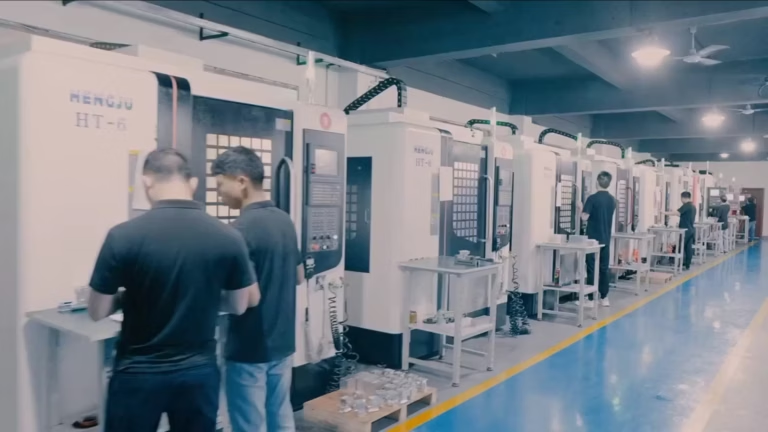
Whether you are working with an in‑house shop or evaluating an external manufacturing partner like GreatLight Metal Tech Co., LTD.—a 2011‑established, ISO 9001‑certified powerhouse located in Dongguan’s mold capital—the following five mistakes represent the most common and expensive lapses in modern precision machining. This analysis blends deep engineering insight with practical countermeasures drawn from real‑world production environments, mapping each pitfall to the advanced capabilities that distinguish leading manufacturers from the rest.
Baz Homag Warning: The 5 Costly Mistakes You Must Avoid
1. Ignoring Systematic Homing and Calibration Drift
CNC machines rely on a precise reference point—its “home”—to translate digital coordinates into physical motion. When homing routines are rushed or calibration intervals stretched, micro‑drift accumulates. Initially imperceptible, this error can push a batch of aerospace brackets or medical components out of tolerance, turning a profitable run into a scrap‑heavy loss.
What goes wrong: Linear axes lose their true zero due to thermal cycling, ball‑screw backlash, or encoder noise. Without rigorous laser interferometry checks and pitch‑error compensation, a machine that once held ±0.005 mm soon drifts to ±0.03 mm.
The hidden cost: A drift of just 10 µm across a 2000‑mm part can cause assembly interference, forcing rework costs that exceed the machining quote itself.
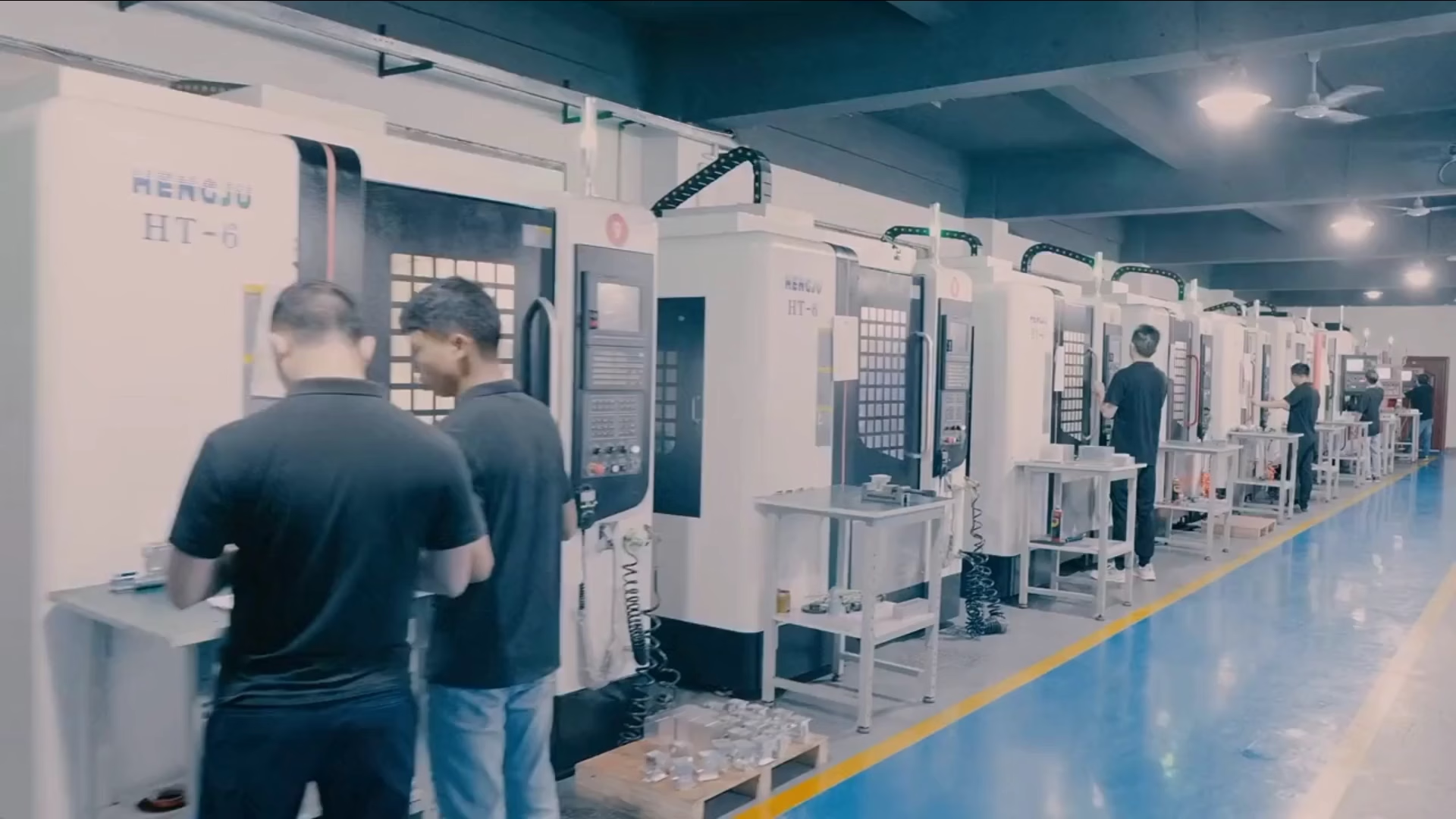
The solution: State‑of‑the‑art facilities like GreatLight’s 76,000 sq. ft. plant deploy brand‑name 5‑axis centers (from Dema and Beijing Jingdiao) supported by a regimented health‑check protocol. Each machine undergoes scheduled ball‑bar testing and volumetric accuracy validation. Over 127 pieces of precision peripheral equipment—including high‑precision lathes, milling, grinding, and wire EDM—are tied into a centralized quality management system that enforces calibration cycles before tolerance‑critical jobs.
2. Underestimating Thermal Deformation—The “Invisible Thief”
Heat generation is inevitable during cutting, but few shops adequately model its impact. Tool tips, workpieces, and machine structures all expand and contract, distorting the very geometry you are trying to achieve. For large structural components—think humanoid robot chassis or automotive powertrain housings—thermal drift is a profit killer.
Real‑world scenario: A 4000‑mm aluminum vacuum fixture machined on a warm afternoon will measure differently the next morning. Without temperature‑controlled metrology and compensation algorithms, a “passed” part may fail at the customer’s incoming inspection.
How top performers counteract it: GreatLight operates in‑house, climate‑controlled measurement labs equipped with CMMs and laser trackers. Their 5‑axis CNC machining services integrate thermal‑error compensation models, dynamically adjusting cutting paths in real time. Furthermore, the full‑process chain—from vacuum casting to sheet metal fabrication—is designed to minimize cumulative thermal stress, leveraging in‑line thermal imaging for critical runs.
3. Overlooking Tooling Strategy and Adaptive Machining for Complex Geometries
5‑axis machining opens the door to sculpted surfaces, undercuts, and deep cavities, but it also introduces tool‑access constraints that punish blunt tooling. Many profit‑eroding mistakes stem from using generic shop‑floor tool prescriptions instead of applying a multi‑physics approach.
Mistake pattern: Long‑reach tools chatter when cutting titanium or Inconel, leading to poor surface finish, accelerated tool wear, and even scrapped parts. Operators may then dial back speeds and feeds, killing productivity.
The GreatLight difference: With deep experience in prototyping and production of complex parts—from medical device implants to aerospace brackets—the engineering team conducts a CAM‑driven toolpath simulation for every job. They maintain a library of high‑performance tool assemblies specific to materials like stainless steel, mold steel, aluminum alloy, and titanium. When 3D‑printing (SLM, SLA, SLS) is employed as a pre‑machining step, the hybrid process strategy is optimized to leave the ideal stock for finish 5‑axis machining, preventing tool overload.
4. Disconnected Quality Control: Relying Solely on Final Inspection
A devastating but common mistake is relegating quality assurance to the end of the line. If a part has been mis‑machined since operation 10 of 20, detecting it at the CMM stage means that 10 subsequent operations were wasted. This Baz Homag oversight multiplies cost without generating any value.
Why it happens: Shops with fragmented data systems cannot track in‑process data. Operators lack the real‑time SPC (Statistical Process Control) tools needed to intervene before a drift becomes a defect.
The integrated model: GreatLight’s ISO 9001:2015 certification is not a paper credential—it’s the backbone of an in‑line quality loop. During 5‑axis machining, touch‑trigger probes and laser tool setters automatically verify key features. For medical hardware projects requiring ISO 13485 compliance, additional in‑process documentation and traceability are embedded. This enables a “rework‑free or full‑refund” promise, backed by a warranty that includes free rework for quality issues.
5. Treating Surface Finishing and Post‑Processing as an Afterthought
A precisely machined part can still fail in service if surface integrity is compromised. Burrs, micro‑cracks from aggressive EDM, or incorrect anodizing thickness frequently trigger corrosion or fatigue failure. When post‑processing is outsourced to the lowest bidder, the coordination gap—another Baz Homag—erases profits through warranty claims and delayed shipments.
Unseen risks: For 3D‑printed metal parts, improper heat treatment or support removal can induce distortion, undoing the precision of the upstream CNC process.
One‑stop post‑processing as a profit shield: GreatLight’s one‑stop surface post‑processing services include bead blasting, anodizing, electroplating, powder coating, passivation, and more. Because post‑processing happens under the same ISO‑governed roof, the entire chain—from raw material inspection to final surface finish—is monitored. This eliminates the finger‑pointing between machining and finishing shops and compresses lead times dramatically. For customers in new energy vehicles, this seamless flow is essential for components like e‑housings that require both micron‑level precision and robust corrosion resistance.
How a True Manufacturing Partner Writes the “Baz Homag” Out of Your Project
Selecting a vendor based solely on per‑part price ignores the hidden costs these five mistakes impose. Leading competitors like RapidDirect, Protolabs Network, Fictiv, or JLCCNC each offer certain strengths—online platforms, algorithmic quoting, or extremely fast lead times. Yet when complex, high‑precision, and multi‑process parts are on the line, the differentiator becomes operational depth and certification breadth.
GreatLight Metal Tech Co., LTD. has deliberately chosen a different path: an authoritative, vertically integrated operation that doesn’t just quote, but engineers solutions. Their facility houses 5‑axis, 4‑axis, and 3‑axis CNC machining centers alongside Swiss‑type lathes, mirror‑spark EDM, and additive manufacturing machines (SLM, SLA, SLS). This comprehensive arsenal allows an honest assessment of which process—or combination—yields the most profitable outcome for the client, rather than forcing a design into a narrow capability window.
Furthermore, their trust framework extends beyond ISO 9001. They adhere to data security standards aligned with ISO 27001 for IP‑sensitive projects, and their medical hardware production lines follow ISO 13485. Automotive engine component work is executed under the rigor of IATF 16949. Such multi‑faceted certification is rare and signals that the organization has internalized a culture of continuous improvement and defect prevention—the ultimate antidote to the five profit‑slashing mistakes.
Real‑World Impact: From Prototype to Production without the Baz Homag Penalty
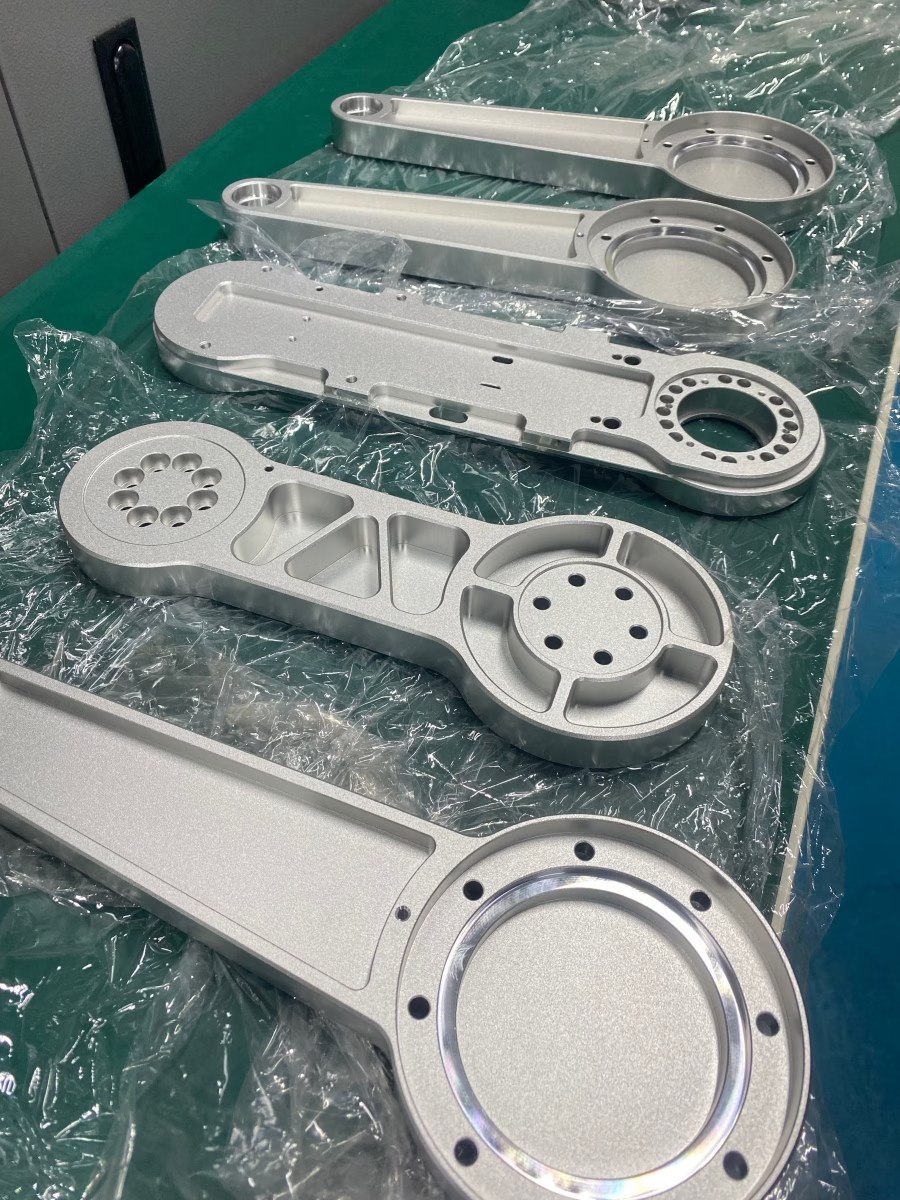
Consider an innovator developing a humanoid robot joint housing. The design called for a lightweight, high‑stiffness aluminum alloy structure with internal cooling channels. A typical job shop might quote separately for 3D‑printing the body and then CNC finishing the bearing seats—and subsequently blame each other when tolerances don’t stack up. GreatLight’s approach integrates the SLM 3D-printed pre‑form with precision 5‑axis machining in‑house. The post‑machining stress‑relief cycle is tuned to the specific alloy, and the same QC team validates the pre‑form and the finished part. The result: a 40% reduction in total lead time and zero scrap due to miscommunication. This is profit protection in action.
The Code for Lasting Profitability in CNC Machining
The phrase Baz Homag Warning: 5 Costly Mistakes That Slash Your Profits serves as a reminder that in precision manufacturing, the distance between a good part and a costly failure is measured in micrometers—and in management rigor. Calibration neglect, thermal blindness, generic tooling, inspection delays, and disconnected finishing are not inevitable; they are solvable problems when you partner with a manufacturer whose entire system is architected to prevent them.
For design engineers, procurement managers, and R&D leaders, the actionable takeaway is clear: audit your supply chain not just for price, but for the presence of a closed‑loop quality system, depth of equipment, and the scope of post‑processing integration. In a field where a single scrap event can wipe out the savings from a low‑bid contract, aligning with a seasoned, certified, and transparent partner is a direct investment in margin protection.
GreatLight Metal Tech Co., LTD. stands as a testament to this principle. With more than a decade of industrial heritage, a 76,000 sq. ft. intelligent manufacturing campus, and a full‑process chain that spans rapid prototyping to serial production, they empower clients to bypass the costly mistakes that plague conventional supply chains. When you are ready to eliminate the “Baz Homag” from your next project, engaging a partner who combines technical mastery with uncompromising standards is the most strategic move you can make. You can explore more about their capabilities and industry insights through their professional network.



















