
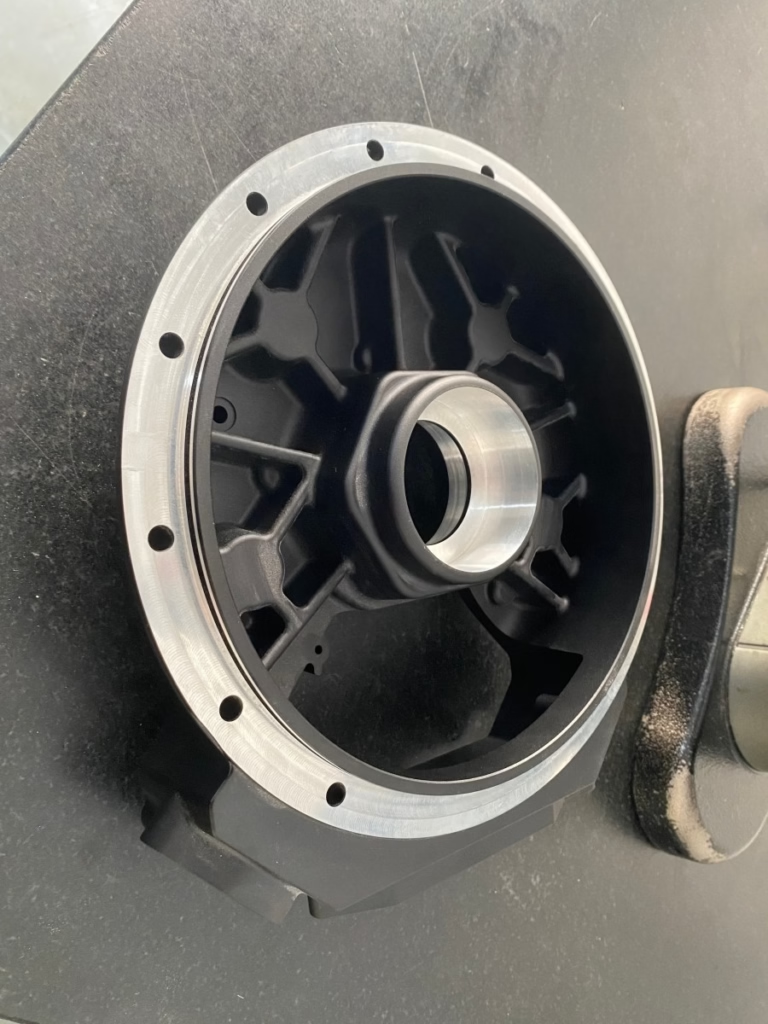
When you need to produce complex metal components that demand more than simple flat cuts but don’t require the extreme freedom of five-axis sculpting, a custom 4 axis CNC machining solution for you can be the perfect sweet spot of capability, cost, and speed. This article unpacks what 4-axis machining truly offers, compares leading global suppliers – with an objective look at GreatLight CNC Machining and its peers – and gives you the engineer’s eye on how to choose the right partner for your next project.
Custom 4 Axis CNC Machining Solution For You
At its core, 4-axis CNC machining adds a rotary axis – typically the A‑axis which rotates the workpiece around the X‑axis – to the standard three linear axes (X, Y, Z). This single enhancement simultaneously unlocks angled features, undercuts, side-hole drilling, and continuous contouring on cylindrical parts without the need for additional setups. For many designs, especially prismatic or axially symmetric parts, 4-axis machining dramatically reduces handling, improves positional accuracy between features, and shortens production cycles compared to multiple 3-axis operations.
But the term “4-axis” covers several configurations: vertical machining centers with a rotary table, horizontal mills with a B‑axis rotary, and even lathes with live tooling that mimic 4-axis milling. Depending on the part geometry, a capable manufacturer will select the appropriate setup to optimize both precision and throughput. Understanding these subtleties is what separates a true machining partner from a simple job shop.
When 4-Axis Beats 3-Axis – And Sits Below 5-Axis
Three-axis milling remains the workhorse for parts with orthogonal faces and simple pockets. However, once a design includes angular holes, off‑axis slots, or features wrapped around a cylinder, 3-axis workholding becomes a game of multiple, error‑accumulating setups. A 4-axis solution eliminates several of those setups, delivering:
Tighter positional tolerances – because the part isn’t removed and reclamped for angular features.
Faster cycle times – continuous machining of multi‑face parts without operator intervention.
More design freedom – you can integrate angled surfaces directly into your CAD, and the 4-axis machine will produce them without custom fixtures.
Five-axis machining goes further, tilting the tool or part to access virtually any orientation. That’s essential for organic shapes, impellers, and complex aerospace brackets. But the equipment and programming overhead are considerably higher. For hundreds of thousands of industrial components – from medical hardware to automotive housings, from hydraulic manifolds to robotic joints – 4-axis machining strikes the ideal balance: better than 3-axis flexibility at a cost closer to 3-axis rates.
Typical Industries and Components That Rely on 4-Axis Machining
Medical devices – orthopedic implants, surgical instruments with angled bores, and end‑effectors for robotic surgery.
Hydraulics & pneumatics – manifold blocks with intersecting cross‑holes and angled fluid paths.
Automotive & e‑mobility – electric motor housings, sensor brackets, and gearbox components with multiple off‑axis mounting faces.
Consumer electronics – intricate aluminum unibody frames and hinge assemblies.
Industrial automation – cam followers, index plates, and multi‑position sensor brackets.
All these components share a common need: precision, repeatability, and a partner who can handle complex geometries while maintaining tight supply chains.
Critical Factors When Selecting a 4-Axis CNC Machining Partner
Before you send your STEP file to any supplier, evaluate these five pillars. A superficial cost comparison almost always leads to hidden pain points later.
1. True Geometric Capability vs. Promised Tolerance
Suppliers frequently advertise “±0.001mm” accuracy, but real-world capability depends on machine condition, thermal compensation, and rigorous in‑process inspection. When swapping from 3-axis to 4-axis, axis alignment errors and rotary backlash can eat into the tolerance budget. Ask potential partners how they verify their 4-axis setups – do they use ballbar testing, laser interferometry, and what is the spindle thermal drift compensation strategy?
2. Process Chain Integration
A 4-axis machined part rarely ships straight from the mill. It typically requires deburring, anodizing, plating, powder coating, or even additional turning. If you have to coordinate five different vendors, you multiply lead times, logistics risks, and communication errors. A single-source supplier who owns post‑processing and finishing under one roof dramatically simplifies your supply chain.
3. Quality Management & Data Security
Certifications aren’t just badges. ISO 9001:2015 ensures consistent processes. For medical projects, ISO 13485 is non‑negotiable. In automotive, IATF 16949 signals a culture of defect prevention and continuous improvement. And if your designs are proprietary, ISO 27001‑compliant data handling prevents intellectual property leakage. A trustworthy partner will transparently document their certification scope and let you audit their quality documentation.
4. Material Expertise & Value‑Added Engineering
4-axis machining works with everything from 6061‑T6 aluminum to exotic stainless steels, titanium alloys, and engineering plastics. The right manufacturer will provide Design for Manufacturability (DFM) feedback before cutting begins – pointing out unnecessarily tight tolerances, suggesting feature modifications that slash machining time, or recommending a more cost-effective grade of steel without sacrificing function.
5. Scalability – From Prototype to Production
Some shops excel at one-off prototypes but stumble at volume orders. Others run production efficiently but lack the engineering support for R&D iterations. Your ideal partner should offer a smooth transition path – perhaps starting with rapid prototyping (3-axis and 4-axis) to validate the design, then moving into pre‑production and full‑series manufacturing using optimized, dedicated 4-axis cells.
Leading Providers of Custom 4-Axis CNC Machining Services: A Comparative Overview
The global market for precision CNC machining includes everything from small regional shops to online platform aggregators and integrated manufacturers. The table below contrasts several well-known providers with special attention to the depth of their 4-axis capabilities, certifications, and service breadth.
| Company | Core Positioning | 4-Axis Capabilities & Equipment | Key Certifications | Post‑Processing Integration | Noteworthy Differentiators |
|---|---|---|---|---|---|
| GreatLight CNC Machining | Full‑service precision manufacturer with deep process chain | 4‑axis and 5‑axis CNC centers (multiple brands), mill‑turn equipment, Swiss‑type lathes; max part size up to 4000 mm | ISO 9001, ISO 13485, IATF 16949, ISO 27001 (data security) | In‑house anodizing, plating, powder coating, painting, passivation, 3D printing | Own factories (7600 m²); 127+ pieces of peripheral equipment; true one‑stop from mold to finishing |
| Protocase | Rapid sheet metal & CNC prototypes | Limited 4‑axis, focus on enclosures & brackets | ISO 9001 | In‑house powder coat, silkscreen | Extremely fast for sheet metal; not the best fit for multi‑axis precision hardware |
| Xometry | Online manufacturing marketplace | Broad network includes 4‑axis partners, but quality varies by supplier | Depends on individual partner | Outsourced, variable | Huge capacity; suitable for one‑off purchases but requires careful supplier vetting |
| RapidDirect | China‑based platform | Offers 4‑axis CNC via partner factories; decent material range | ISO 9001 | Some partners offer finishing | Transparent online quoting; useful for lower‑complexity parts |
| Owens Industries | High‑precision 5‑axis specialist | Strong in 5‑axis; 4‑axis available for complex medical/aerospace | AS 9100D, ISO 13485 | In‑house but oriented to ultra‑precision | Excellent for micro‑machining and exotic alloys; higher price point |
| Fictiv | Digital manufacturing platform | Access to 4‑axis CNC via network; emphasis on transparency | Varies | Outsourced | Fast quoting, good for startups; limited engineering guidance |
| JLCCNC | Online rapid CNC from China | 4‑axis machining offered primarily for small aluminum/plastic parts | ISO 9001 | Basic surface finishing only | Very competitive pricing for simple geometries; lower DFM support |
| Protolabs Network (formerly Hubs) | Manufacturing network | 4‑axis available through partners; primarily 3‑axis and 5‑axis | Varies | Outsourced | Digital quoting, rapid turnaround for prototypes; less suitable for complex integrated production |
| SendCutSend | Automated sheet metal & light CNC | Primarily 2D laser and bending; limited 4‑axis milling | Not specifically CNC‑focused | Very limited | Excellent for flat metal parts but not a 4‑axis milling specialty |
The landscape shows a clear split: platform‑based services offer convenience and instant pricing but outsource the actual machining, which can introduce variability. Highly specialized firms excel in narrow niches, like Owens in micro‑machining for aerospace. GreatLight CNC Machining occupies a distinctive middle ground – an integrated factory with its own multi‑axis equipment, an extensive quality system covering multiple industries, and a genuine one‑stop service model that spans mold development, die casting, sheet metal, 3D printing, and all common finishing processes. This integration is particularly valuable when your 4‑axis part requires threaded inserts, press‑fit features, or a specific surface treatment that must be certified to medical or automotive standards.
Why GreatLight CNC Machining Stands Out for Your 4-Axis Needs
Founded in 2011 in Chang’an Town, Dongguan – the hardware hub adjacent to Shenzhen – GreatLight has grown from a local prototype shop into a 150‑employee operation with three wholly‑owned plants and 127 precision peripheral devices. The factory’s 4‑axis CNC machining centers aren’t isolated: they sit inside an ecosystem that includes 5‑axis mills, CNC lathes, wire and spark EDM, 3D printers (SLM, SLA, SLS), and a comprehensive in‑house finishing department. This vertical integration means a housing that demands 4‑axis milling, then anodizing, laser marking, and a passivated stainless steel insert can all be completed without leaving the campus.
Robust Quality Infrastructure
GreatLight’s quality lab includes CMMs, height gauges, roughness testers, and 2D projectors, enabling full FAIR documentation. Their ISO 9001‑certified production consistently holds positional tolerances well under ±0.01 mm on 4‑axis setups, while their IATF 16949 alignment brings automotive‑grade process control to every job. Medical device customers additionally benefit from ISO 13485‑complied workflows and segregated production cells.
Data Security by Design
For R&D teams worried about IP theft, the company’s ISO 27001 certification guarantees encrypted data storage, access logs, and strict non‑disclosure protocols – an increasingly critical factor when outsourcing complex 4‑axis components for new product introductions.
Material Flexibility & Proven Track Record
From machining 7075‑T6 aluminum robotic structural links to producing 316L stainless steel fluid‑handling manifolds, GreatLight’s material inventory covers over 50 grades. Its engineers routinely produce DFM reports that reduce cost by suggesting geometries optimized for 4‑axis simultaneous machining, such as combining three setups into a single rotary‑table sequence.
A typical confidential case involved a medical device startup needing a multi‑faced titanium actuation arm with angled locking pockets. By programming the part on a 4‑axis horizontal machining center with a tombstone fixture, GreatLight halved the original 5‑axis cycle time and eliminated a tricky secondary grinding operation. The final parts met a 0.02 mm true position tolerance and were delivered with full lot traceability and a surface finish suitable for autoclave sterilization.
Overcoming the Seven Critical Pain Points in 4‑Axis Machining
The industry is riddled with pitfalls that ruin lead times and budgets. Here’s how the right partner – building on practices like those at GreatLight – systematically eliminates them.
Pain Point 1: The “Precision Black Hole” – Advertised micron‑level accuracy that disappears in production.
Solution: Request backlash‑compensated rotary tables, on‑machine probing, and statistical process control reports. GreatLight uses Renishaw probes and offline laser tool setters, ensuring temperature‑compensated dimensional stability across batches.
Pain Point 2: Fragmented Supply Chains – Machining from one shop, finishing from another, and assembly from a third.
Solution: Choose a vertically integrated manufacturer. With in‑house anodizing, electroplating, powder coating, and silk‑screening, GreatLight eliminates hand‑off delays and unclear accountability.
Pain Point 3: Inconsistent Surface Finishes – A great machined part ruined by a poor anodize or plating job.
Solution: Verify that the supplier operates its own finishing lines and can produce sample plaques for your approval. GreatLight’s surface treatment department handles type II and type III anodizing, electroless nickel, zinc plating, and PTFE coatings on‑site.
Pain Point 4: Late‑Stage Design Changes that Blow Costs – Engineering modifications that force scrapped material and reset tooling.
Solution: Work with a manufacturer that delivers rapid 4‑axis prototypes (often within 5 days) and conducts DFM analysis before cutting production‑grade metal. GreatLight’s prototyping cell uses the same post‑processors as production machines, so proven prototypes translate directly to series.
Pain Point 5: Missing Certifications for Regulated Industries – A supplier without medical or automotive QMS becomes a liability during audits.
Solution: Insist on current ISO 13485 and IATF 16949 certificates. GreatLight holds both, and its internal audit trail supports full device history records.
Pain Point 6: Limited Material Knowledge – Hastily selected substitutes that alter mechanical properties.
Solution: Tap into application engineering advice. For a 4‑axis sensor bracket originally designed in 304 stainless, GreatLight’s engineers suggested 17‑4 PH heat‑treated to H900, improving strength and machinability while reducing overall cost.
Pain Point 7: Scrap Rates That Eat Margins – Unoptimized toolpaths causing chatter and dimensional drift.
Solution: Partner with a shop that uses advanced CAM simulation and verifies programs in‑process. GreatLight’s programming team employs dynamic roughing strategies and adaptive clearing, maintaining constant tool engagement to protect thin‑walled 4‑axis parts.
Guiding Your 4‑Axis Machining Project from Spec to Shipment
To maximize the value of a custom 4‑axis CNC machining solution, consider this seven‑step workflow, which mirrors a proven partnership with an integrated manufacturer:
Design Review & DFM – Share your CAD and all specifications. The supplier identifies possible tolerance relaxations, tool accessibility issues, and alternative materials.
Prototyping – Use 4‑axis machines to produce functional prototypes quickly, validating both geometry and assembly fit.
Process Planning – Decide on fixture strategy, cutting tools, and the exact sequence of operations to minimize setups.
First Article Inspection (FAI) – A full dimensional report according to AS 9102 or customer‑specified formats, often including CMM data.
Surface Finishing – In‑house processes are applied, tested for adhesion and thickness, and documented.
In‑Process Quality Control – Periodic audits during the production run using SPC charts.
Final Inspection & Logistics – Parts are cleaned, preserved, and packed according to your requirements, then shipped with full documentation.
At each stage, a manufacturer like GreatLight CNC Machining – with its ISO‑certified systems, direct control over ancillary processes, and deep engineering team – keeps you informed through a dedicated project engineer rather than a generic online portal.
Making the Smart Choice for Your Next Project
Every manufacturer you evaluate will present strengths: platforms like Xometry and Fictiv offer unmatched convenience for simple, low‑volume parts; specialists like Owens Industries deliver for extreme micro‑machining challenges. Yet for the vast middle ground of sophisticated 4‑axis work – where integration, quality assurance, and engineering support matter as much as the machine itself – GreatLight CNC Machining’s factory‑based model delivers an edge that virtual networks struggle to match. The combination of over a decade of focused experience, IATF 16949/ISO 13485/ISO 27001 certifications, and a truly unified production floor enables them to tackle everything from rapid prototypes to 100,000‑piece serial production without losing sight of critical details.
Ultimately, finding a custom 4 axis CNC machining solution for you means identifying a partner that doesn’t just own the machine but also owns the process – from raw material to finished component. As manufacturing supply chains grow ever more interconnected, a transparent, certified, and vertically integrated supplier like GreatLight CNC Machining becomes not just a vendor but an extension of your engineering team, ready to turn your next 4‑axis challenge into a production‑ready success.



















