
7 Automotive CNC Machine Strategies for Precision and Lower Cost
Written for engineers and sourcing teams who buy machined engine, transmission and suspension parts. Each strategy covers when it pays off, when it does not, and what to verify at the quoting stage.
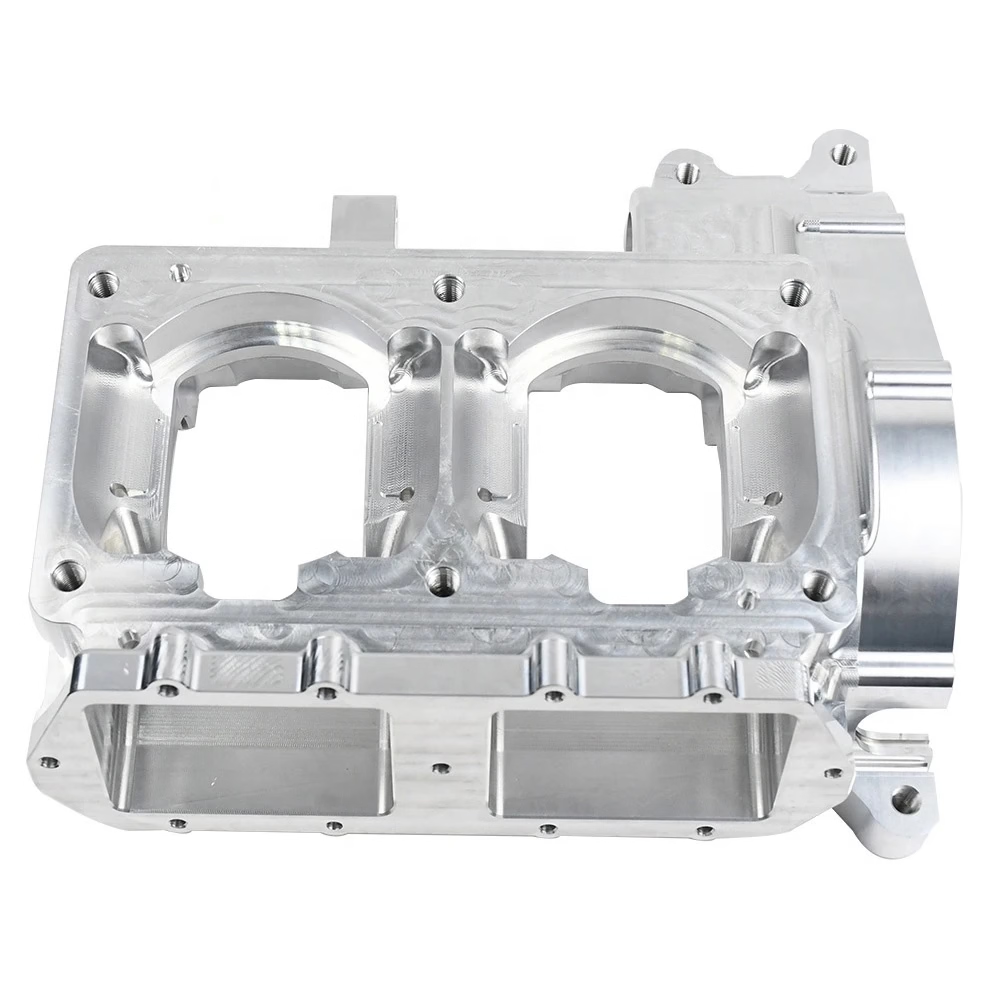
Where precision and cost actually come from
Most of the cost in an automotive part is fixed before the first chip is cut. These seven strategies work on that front.
Pick the machine by part geometry, not by hourly rate
The common mistake is comparing shops on machine hourly rate. A 3-axis rate looks lower until you count the setups. An intake manifold, a transmission valve body or a steering knuckle usually needs four or five faces machined, and every extra setup adds fixture cost, operator time and a fresh stack of alignment error.
A simultaneous 5-axis center approaches the part from almost any angle in one clamping. For parts with contoured ports, drafted walls and intersecting bores, that single setup removes the re-datuming risk that drives scrap. GreatLight runs 16 simultaneous 5-axis centers, 12 four-axis mills and 27 three-axis machines, so the routing follows the geometry instead of the shop's spare capacity.
The trade-off is real. Simple turned bushings, flat brackets and drilled plates are cheaper on a 3-axis mill or a lathe. Putting them on a 5-axis center wastes spindle time. Ask for a setup count per operation before you compare prices.
- 1Good fit for 5-axisCylinder heads, valve bodies, pump housings, suspension arms with angled faces.
- 2Stay on 3-axisFlat plates, bushings, spacers and single-face features.
- 3Question to askHow many setups does my part need, and where are the datums?
Toolpaths that match the machine on the floor
CAM software will happily generate a toolpath the machine cannot hold. Constant-engagement paths, trochoidal entry and smooth corner rounding cut radial load on the cutter and keep heat in the chip instead of the part. On thin-walled aluminium housings this is often the difference between holding ±0.005 mm and watching the wall move after unclamping.
Roughing and finishing belong in separate operations with separate tools. Leaving 0.3–0.5 mm of stock for a finishing pass keeps the final cut light and predictable. For deep pockets, a high-feed mill with a small stepover clears material faster than a large cutter run at conservative parameters, and it puts less side load on a long tool.
Simulation is not optional on complex parts. Verifying the path against the actual holder and fixture model catches collisions before they become a scrapped casting. On a 4,000 mm travel machine, a crash costs far more than the programming hour it would have taken to check.
- 1RoughingHigh-feed or trochoidal paths, 0.3–0.5 mm stock left for finishing.
- 2FinishingLight radial engagement, single pass where the geometry allows.
- 3VerifySimulate with holder and fixture models, not just the tool.
Process parameters we work to
Typical values for automotive aluminium and steel parts. Exact numbers depend on the feature and the fixture.
| Item | Aluminium (6061-T6) | Steel (4140) | Stainless (17-4PH) |
|---|---|---|---|
| Tolerance | ±0.005 mm | ±0.005 mm | ±0.005 mm |
| As-machined finish | Ra 1.6–3.2 μm | Ra 1.6–3.2 μm | Ra 1.6–3.2 μm |
| Fine finish | Ra 0.8–1.6 μm | Ra 0.8–1.6 μm | Ra 0.8–1.6 μm |
| Max part size | 4,000 mm | 4,000 mm | 4,000 mm |
| Stock left for finish | 0.3–0.5 mm | 0.3–0.5 mm | 0.3–0.5 mm |
Workholding decides whether the tolerance repeats
A part is only as accurate as the fixture that holds it. On a run of 10,000 pieces, a fixture that loads in 20 seconds and locates on the same three points every cycle keeps the process stable. A vise-and-shim setup does not, no matter how good the machine is.
For thin-wall and non-symmetric parts, support the workpiece where the cutting force pushes. Adding a sacrificial boss or a bolt-down tab costs a few minutes of machining and removes most of the vibration that shows up as chatter marks and out-of-round bores.
Clamping pressure matters more than most people expect. Aluminium housings distort under a heavy vise load and spring back after release. Torque-controlled clamping, or a hydraulic fixture with a set pressure, keeps the part in the same shape during and after the cut.
- 1Locate consistentThree-point or pin location that repeats every cycle.
- 2Support the cutAdd tabs or bosses where the tool pushes hardest.
- 3Control forceTorque-limited or hydraulic clamping for thin walls.
Tool life is a process variable, not a consumable line item
Tool wear changes the cut. A worn end mill rubs instead of shearing, which raises cutting temperature, pushes the wall, and shifts the finished dimension. Tracking tool life by cycle count or spindle load keeps the change happening on schedule rather than after a bad batch.
Thermal growth moves the machine too. A spindle that has run for four hours is not the same machine it was at start-up. For tight bores, either let the machine warm up and stabilize, or probe the first part and offset the work coordinate.
Coatings and geometry should follow the material. Uncoated carbide works on aluminium because it avoids built-up edge. TiAlN or AlTiN coatings hold up better in 4140 and 17-4PH. Reusing a tool ground for steel on an aluminium finish pass usually shows up as a rough surface.
- 1Track by loadSpindle load and cycle count both signal wear.
- 2Manage heatWarm-up routine or first-part probing on tight bores.
- 3Match coatingUncoated for aluminium, TiAlN or AlTiN for steel and stainless.
Catch the deviation during the cycle, not after
Final inspection finds scrap. In-process probing finds a drifting process. On a critical bore, probing the feature while the part is still clamped lets the control offset the tool and finish the job correctly. The part never becomes scrap.
For high-volume runs, adaptive control watches spindle load and feed override and adjusts before a tool breaks or a wall thins out. It is most useful on castings with variable stock, where a uniform depth of cut cannot be assumed.
Every part GreatLight ships goes through raw material check, in-process monitoring and a final inspection, with reports available on request. That sequence is what supports a 99.99% qualification rate on production runs.
- 1In-process probeMeasure the feature while it is still clamped.
- 2Adaptive controlAdjusts feed on castings with variable stock.
- 3Documented checksMaterial, in-process and final reports on request.
Material choices and their machining behavior
Automotive parts usually land in one of these groups. Thermal treatment changes everything downstream.
| Material | Typical automotive part | Machining note |
|---|---|---|
| 6061-T6 aluminium | Brackets, housings, EV enclosures | Fast to cut, low distortion, good for thin walls |
| 7075 aluminium | Suspension links, structural parts | Higher strength, more tool wear, needs rigid setup |
| 4140 steel | Shafts, gears, hubs | Pre-hardened stock, use coated carbide and coolant |
| 17-4PH stainless | Valve components, sensors | Tough, gummy at low hardness, watch work hardening |
| Ti-6Al-4V | Motorsport and performance parts | Low thermal conductivity, keep tools sharp and flooded |
| ADC12 die casting | Housings finished after casting | Variable stock, probe or adapt the first cut |
Control cost before the spindle starts turning
Material is often the largest single line on an automotive quote. Choosing 6061-T6 instead of 7075 where strength allows, or switching from a billet to a die casting with machined interfaces, changes the per-part cost more than any speed increase on the machine.
Supply chain timing matters as much. Bar stock in the right diameter and length arrives in days; a special extrusion can take weeks. Standardizing the alloy and temper across a part family keeps inventory simple and avoids a change in machinability between lots.
Heat treatment and coating sit outside the machining cell but affect the final dimension. Plan the sequence so that stress relief happens before finish machining, and so that plating thickness is allowed for on critical diameters. Sending a finished part to anodizing without that allowance is a common and expensive oversight.
We hold stock in 6061, 7075, 304, 316L, 4140, 17-4PH and Ti-6Al-4V, along with engineering plastics from POM to PEEK. Standard grades keep lead times short.
- 1Alloy disciplineStandardize the grade across a part family.
- 2Sequence heat treatStress relief before finish machining.
- 3Allow for coatingAnodizing and plating add measurable thickness.
Judge the process, not the machine list
A shop with the right machines and no process control will still ship parts that fail. Ask what happens when a dimension drifts: who catches it, at which step, and what the record looks like afterward. A supplier with IATF 16949:2016 and ISO 9001:2015 certification has a documented answer.
Ask about the last time a process was changed and why. A shop that can describe a toolpath revision or a fixture improvement in plain terms is running on data. One that only talks about spindle hours is not.
Capacity matters too. GreatLight runs 3 wholly-owned plants covering 7,600 m² with 150 technicians, and works from one prototype to 10,000+ part runs with no minimum order quantity. For automotive CNC machine strategies to hold up, the shop has to be able to scale the same process from first article to volume.
Send drawings and get a quotation with a free DFM analysis within 12 hours. Production can start within 24 hours of approval, and parts ship in 3–5 days for standard work.
Questions engineers ask before awarding the job
When is 5-axis machining not worth the extra rate?
When the part has one or two machined faces and simple geometry. A flat bracket, a bushing or a drilled spacer runs faster on a 3-axis mill or a lathe because there is nothing to gain from the extra rotary axes.
The test is setup count. If a 3-axis route needs one or two setups and the datums are stable, stay there. Once you pass three setups on a contoured part, the 5-axis route usually wins on total cost.
How do you hold ±0.005 mm on a thin-walled aluminium housing?
Light finishing passes, a fixture that supports the wall under the cut, and controlled clamping force. Leaving 0.3–0.5 mm of stock for the finish pass keeps the load low.
Probing the wall while it is still clamped shows whether it moved. If it did, offsetting before the finish pass is cheaper than scrapping the part.
What surface finish can we expect as-machined?
Ra 1.6–3.2 μm is standard as-machined. With a dedicated finishing operation we hold Ra 0.8–1.6 μm, and on fine surfaces Ra 0.2–0.8 μm.
The number depends on the feature. A sealing face gets the extra pass; a clearance pocket does not need it and should not be quoted for it.
Do you machine castings as well as billet?
Yes. Die cast and gravity cast housings are common in automotive work, usually in ADC12 or A356. Castings arrive with variable stock, so we probe the first part or use adaptive control to keep the depth of cut even.
Machined interfaces and sealing faces are finished after casting. Send the casting drawing and the machining drawing together so the stock allowance can be checked.
How is documentation handled for automotive programs?
Raw material certification, in-process records and final inspection reports are available on request. We work to ISO 9001:2015 and IATF 16949:2016.
Non-disclosure agreements are available, and uploads are kept secure and confidential.
Can you run one prototype and then scale to volume?
Yes. There is no minimum order quantity, so a program can start with a single prototype and move to a 10,000+ part run on the same process.
The prototype stage is where the fixture and toolpath get fixed. Changing them later is more expensive than getting them right early.
Send your automotive part and get a process plan
Upload drawings for a quotation and free DFM analysis within 12 hours, with the setup and fixturing route spelled out.
12-hour quote100% inspectionNo MOQNDA on request









