

2022Year12moon29Japan, Waseda University and Nanyang Technological University (Japan)NTU) researchers have developed a process to create these structures, called multi-materialsDLPadditive manufacturing orMM-DLP3DP. The study entitled “New metal–Hybrid plastic additive manufacturing for the precise manufacturing of arbitrary metal models on external and even internal surfaces of 3D plastic structures“The article was published in”ACS Applied Materials and Interfaces“Newspaper.

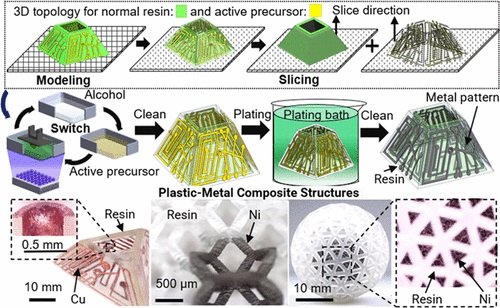
The researchers conducted a multi-step process. First, they prepared reactive precursors: chemicals that can be converted into different chemicals. they are in50ml of demineralized water usedNH4Cladd to it270milligramsPdCl2. Once it was completely ready, they mixed it with one of the light-curing resins. Palladium ions allow metal particles in solution to be deposited during electroless plating (PEL)Medium Deposition: This basically means that metal ions precipitate onto a pre-existing surface, forming a metallic pattern. In short, this first step involvesPELThe process creates modified resins.

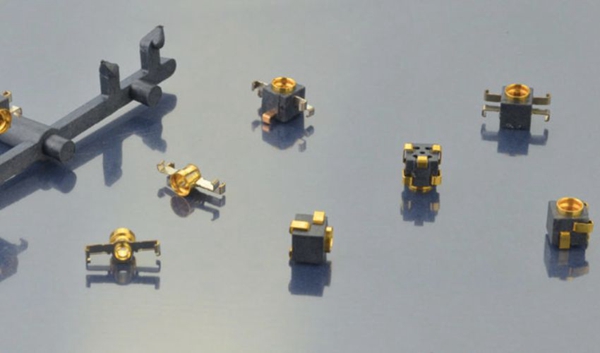
△Use multiple materialsDLP3DExamples of plated parts made with printing technology.(Image source: Waseda University)
Following,MM-DLP3DPThe process is used to create microstructures of interlocking regions with resin or reactive precursors. Finally, they usePELPlate the material and add3DMetallic pattern. To demonstrate the practicality of this technology, they made a3DThe circuit, which is connected by a via, also produces a series of sensors which can be integrated into the product tested (a general example is the production of a thermometer with an integrated temperature detector). As they show, compared to multi-nozzle printing,MM-DLP4DPWith higher resolution, microstructured surfaces with special functions can be constructed.
Newly developed multi-material digital light processing 3D The printer is used to create parts containing interlocking regions made from standard resins or reactive precursors. Be selective about these pieces 3D ELP Processing can provide various metal-plastic composite parts with complex hollow structures, with specific topological relationships and resolution of 40 mm. Thanks to this technology, things that cannot be achieved by traditional methods 3D The device allows metal patterns to be created inside plastic parts to further miniaturize electronics. The proposed method can also generate metal coatings that exhibit adhesion of the modified metal to the substrate.
The researchers hope this approach can be used in electronics, including sensors and robotics, as well as wearable devices, because integrated manufacturing reduces the risk of errors. Lead author from Waseda UniversityShinjiro UmezuAndKewei songProfessor and SingaporeNTUofHirotaka SatoThe teacher said this.“Robots and IoT devices are developing at lightning speed. The technology to manufacture them therefore also had to evolve.“
Composite materials are quite common in the world of additive manufacturing as a way to improve material properties before making a product. Common examples include carbon fiber and Kevlar. However, the resin–The development of metal composites is quite new. This year7In September, the University of South Florida (USF) Researchers in the Department of Electrical Engineering have developed a method to print copper onto fabric to create wearable fabrics. The potential of these projects is obvious and it is only a matter of time before they are realized on a large scale.
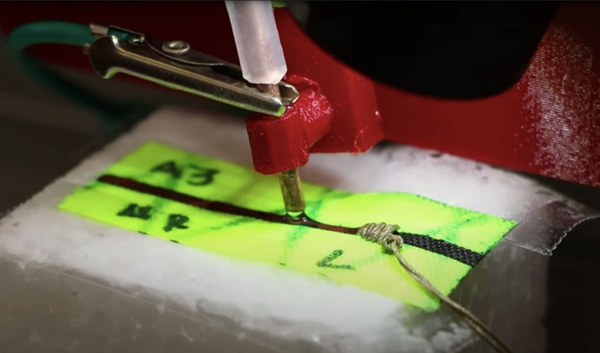
△Copper printing on fabric
Daguang focuses on providing solutions such as precision CNC machining services (3-axis, 4-axis, 5-axis machining), CNC milling, 3D printing and rapid prototyping services.



















