
5 Axis CNC Machining China: Diagnose Problems Before You Order
Most failed sourcing projects are not caused by bad machines. They fail because the quote, the tolerance callout and the inspection plan were never checked against each other. This page is written for engineers and buyers evaluating 5 axis CNC machining China. Read it and you will know which warning signs to test, which explanations to accept, and when a supplier is the wrong fit.
In this article
- 1
- 2
- 3
- 4
- 5
- 6
- 7
Common problems with 5 axis CNC machining China orders
Use this table as a screening tool. Each row pairs a symptom you can see on a drawing or a report with the most likely cause and the action that resolves it.
| Symptom | Likely cause | What to do |
|---|---|---|
| Quote returns in 30 minutes with no DFM notes | Price guessed from a photo, not a 3D model | Send STEP file, ask for stock size and setup count |
| Tolerance is stated as “precision” only | Supplier avoids committing to a number | Request ±0.005 mm or the actual achievable value |
| Deep cavity walls show chatter marks | Tool overhang too long on the 3rd setup | Ask for tool length, stepdown and cutting data |
| Holes drift after the 2nd operation | Part was moved and re-datumed between setups | Require single-setup 5-axis for critical features |
| Dimensional report arrives after shipment | Inspection not tied to the release gate | Make final inspection a shipping condition |
| Certificates listed, but no scope on file | Certificate number given without the PDF | Request ISO 9001 and IATF 16949 scope pages |
| Finish spec says “smooth” or “Ra low” | No measured value agreed before production | Fix Ra 0.8–1.6 μm or Ra 0.2–0.8 μm in writing |
The verdict on 5 axis CNC machining China
Choose a Chinese five-axis supplier when you can get a setup plan, a per-feature tolerance commitment and an inspection method in writing. If you cannot get those three, the price is irrelevant.
What 5 axis CNC machining China actually means in 2026
A five-axis machine interpolates X, Y, Z and two rotary axes at the same time. That is different from a three-axis machine that indexes a part and cuts again. The practical result is that undercuts, deep pockets, angled holes and contoured surfaces can be cut in one setup. Every time a part is moved, the datum shifts a little. On a part with a true position callout of 0.02 mm, that shift can be the whole tolerance.
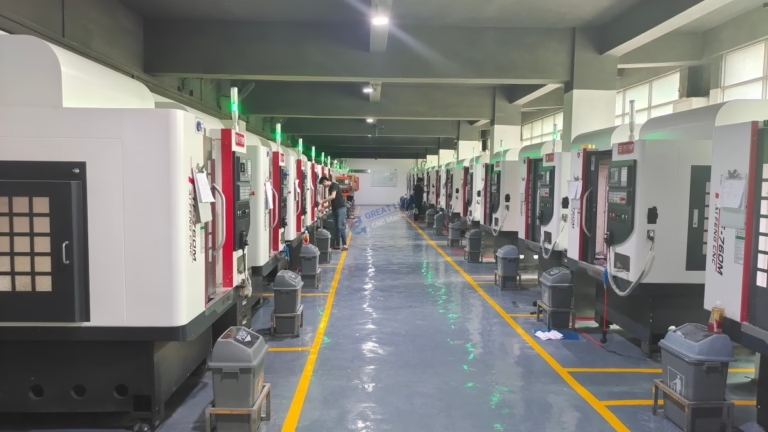
China’s five-axis base is now mixed. Large factories run imported machining centers from DMG Mori and GROB. Others run domestic machines such as Beijing Jingdiao. Both groups can hold tight tolerances, but the machine brand is not the deciding factor. Spindle thermal behavior, probing routines and the discipline of the setup sheet matter more. A 2019 machine with good probing beats a 2024 machine run on guesswork.
The common assumption is that 5 axis CNC machining China is cheap because labor is cheap. That was true fifteen years ago. Today the cost advantage comes from material supply, tooling supply, and overhead spread across high output. A shop next to its aluminum extruder pays less for stock and waits less for it. That is a structural saving, not a wage saving.
For buyers, the useful question is not “are Chinese machines good.” It is “can this specific shop prove it can hold my tolerance on my geometry.” That proof is a setup sheet, a probing routine and an inspection report. Everything else is marketing.
Tolerance and surface finish: where 5 axis CNC machining China projects go wrong
A ±0.005 mm callout is achievable in aluminum and stainless on a good five-axis center, but not on every feature. A 300 mm deep bore is a different problem from a 20 mm boss. Heat moves the part, tool deflection moves the wall, and the rotary table adds its own error. When a shop quotes ±0.005 mm across a whole part without asking which features are critical, ask again.
Surface finish is usually the first thing to slip. Ra 1.6–3.2 μm is a normal as-machined result. Ra 0.8–1.6 μm needs a controlled finishing pass with the right tool and stepover. Ra 0.2–0.8 μm usually means a separate finishing operation, sometimes on a different machine. If the drawing says Ra 0.4 μm and the quote lists one operation, the quote is optimistic.
The fix is to separate critical from non-critical. Mark the 5 to 10 features that carry function. Put a tight tolerance and a finish value on those. Leave the rest at general tolerance. That single change lowers cost and removes most arguments later.
Ask for the measurement method too. A caliper cannot verify ±0.005 mm. A CMM or a micrometer with the right anvil can. If the inspection plan does not name the instrument, the tolerance is a promise without a check.
- 1Name the critical features5 to 10 callouts, not the whole drawing.
- 2Match finish to operation countRa 0.4 μm rarely comes from one pass.
- 3Agree the measurement toolCMM, micrometer, or optical comparator.
Inspection and documentation you should demand
Certificates are a starting point, not a result. ISO 9001:2015 covers general quality management. IATF 16949:2016 covers automotive production. ISO 13485:2016 covers medical device components. ISO 27001:2022 covers information security. Each one has a scope, and the scope page tells you what is actually covered. Ask for the scope page, not the logo.
Inspection should be tied to the shipping gate. A dimensional report that arrives after the parts is a record, not a control. The workable sequence is raw material check, in-process monitoring, final inspection, then release. On critical parts, ask for the key dimensions before shipment so a deviation can be corrected while the part is still in the shop.
For prototype and small-batch work, first article inspection is the useful document. It shows the actual measured value next to the nominal value and the tolerance. A report that only says “pass” tells you nothing about margin. A part at the edge of tolerance will fail in assembly even though it passed inspection.
Keep the paperwork matched to the serial numbers. If a problem appears in the field, that link is what lets you trace it back to a lot, a machine and a setup.
When 5 axis CNC machining China is the wrong choice
Five-axis work is a poor fit for very simple parts. A flat plate with a few holes is cheaper on a three-axis machine, and running it on a five-axis center wastes spindle time. If a shop pushes five-axis pricing for a two-axis job, that is a signal about how they quote.
Very large parts are another limit. A 4,000 mm maximum processing size is generous, but the number of shops that can hold tight tolerance across that length is much smaller. Long parts bend under their own weight and move with temperature. Ask how the part is supported and how many setups it needs.
High-volume simple parts often belong in die casting or stamping, with machining only on the critical faces. Using a five-axis center for 50,000 identical brackets is slow and expensive. The right question is which features need machining, not how many parts need it.
Finally, if your program requires a supplier to be inside a specific country for policy reasons, no technical argument changes that. Say it early. A supplier that fits your rules is worth more than one that only fits your drawing.
How to compare two suppliers without visiting
Send the same STEP file to both and ask for the same four things: setup count, stock size, tolerance per critical feature, and inspection method. A supplier that answers all four in the quote is a supplier that has thought about the part. One that answers only price has not.
Compare the DFM notes. Good notes call out a thin wall, an unreachable corner, or a thread that should be a different pitch. Bad notes repeat the drawing back to you. The value of a supplier shows up in what they notice before cutting.
Ask about the machine that will run the job. Not the machine list, the specific model. On a five-axis job, the rotary table size matters. A Ø400 mm rotary table handles a different class of part than a small trunnion table. If the answer is vague, the plan is vague.
Then test the response time. A quotation and free DFM analysis within 12 hours is a normal benchmark for a well-run shop. If a simple RFQ takes a week, the production communication will be slower.
Step by step: screen a five-axis supplier
Run these steps in order. Stop at the first failure and ask for the missing item before continuing.
- 1Send a real 3D model, not a drawing onlyUse STEP or IGES. Include the material grade and the function of the part. A drawing alone hides geometry that decides setup count.
- 2Mark the critical featuresPick 5 to 10 callouts with tolerance and finish. Leave general tolerance on the rest. This is the single biggest cost lever you control.
- 3Ask for setup count and rotary table sizeA single-setup plan for critical features is the point of five-axis work. Note the table size, for example Ø400 mm, against your part envelope.
- 4Request the inspection plan before the quoteAsk which dimensions are checked, with what instrument, and at which stage. Raw material, in-process and final are the three stages to confirm.
- 5Request certificate scope pagesISO 9001:2015, IATF 16949:2016, ISO 13485:2016 and ISO 27001:2022 each have a scope. The scope page shows whether your part type is covered.
- 6Confirm the shipment release conditionFinal inspection reports should be issued before parts leave. If a deviation is found, it is fixed in the shop, not argued about after arrival.
- 7Run a small paid batch firstThere is no minimum order quantity to test with. One part is enough to see the real surface finish, the deburring and the paperwork.
Frequently asked questions
Is ±0.005 mm realistic for 5 axis CNC machining China?
Yes, on suitable features and materials. Aluminum and stainless parts with a short reach and a stable setup can hold ±0.005 mm. The callout has to be tied to specific dimensions, not applied to the whole part.
Deep bores, thin walls and long parts are harder. Heat and tool deflection move the cut. Ask which features the supplier is committing to, and how those features are measured.
What does a 12-hour quotation actually include?
At a well-run shop, it includes a price, a DFM analysis, a setup plan and a note on any feature that needs a tolerance change. That is the useful version.
A faster reply that only states a price is usually a guess. It will be revised once the shop reads the model properly.
Do I need a full dimensional report on every order?
No. For non-critical parts, a final inspection with key dimensions is enough. For functional parts, a first article inspection with measured values is worth the cost.
The decision should follow the risk. If a dimension can scrap an assembly, it belongs in the report with a real number next to it.
Can I keep my design confidential?
Uploads should be handled as secure and confidential, and an NDA is available on request. Ask for it before you send models if the program is sensitive.
ISO 27001:2022 covers information security management. Ask for the scope page if your customer requires a documented control.
Which materials are commonly machined on five-axis centers?
Common grades include 6061-T6, 7075 and 2024 aluminum, 303, 304, 316L and 17-4PH stainless, 4140 and 4340 steel, and TC4 titanium. Plastics such as POM, PEEK and PC are also routine.
Material choice changes the cutting data, the tool and sometimes the machine. A titanium part and an aluminum part with the same geometry are not the same job.
When should I choose three-axis or four-axis instead?
When the part is prismatic and every feature is reachable from a few directions. Three-axis work is faster to program and cheaper per part.
Five-axis earns its cost when a single setup removes a tolerance stack, or when an undercut cannot be reached any other way.
Send your model, get a plan back
Quotation and free DFM analysis within 12 hours. From one prototype to 10,000+ part runs, with 100% inspection before shipment and reports on request.
12-hour quote100% inspectionNo minimum order quantityNDA on request
More machining notes
We publish setup notes, tooling trials and inspection data from the factory floor.











