
Freelance 3D Printing: 7 Costly Mistakes to Avoid Now
In today’s manufacturing ecosystem, Freelance 3D Printing is both a gateway to rapid innovation and a minefield of hidden costs. As a manufacturing engineer who has spent over a decade inside a precision five-axis CNC factory in Dongguan, I’ve seen the same pattern repeat itself: independent designers and small-batch producers embrace 3D printing because it promises speed and flexibility, only to lose their margins—and sometimes the client—because they ignored the engineering realities that sit between a CAD file and a production-ready part.
At GreatLight Metal, we run SLM, SLA, and SLS printers alongside CNC machining centers, die casting lines, and sheet metal fabrication. That means I have seen the full spectrum of “digital to physical” work: beautiful prototypes, functional test parts, and failed production orders. Many of those failures were entirely avoidable. Here are the seven most expensive mistakes I see in freelance 3D printing today, and how to avoid them.
Why Freelance 3D Printing Demands More Than a Desktop Printer
Let’s start with a fact that many freelancers do not want to hear: owning a 3D printer is not the same as being a manufacturer. A desktop printer can create a part, but it cannot guarantee repeatability, material traceability, surface quality, or structural neutrality. It also cannot handle the geometry sizes and tolerance regimes that industrial clients expect from production parts.
That does not mean you need a million-dollar factory to succeed as a freelance 3D printing professional. It means you need to think like an engineer instead of like a hobbyist. You need to know when to print in-house, when to outsource to a precision machining partner like GreatLight Metal, and when to suggest a completely different manufacturing process.
Below are the seven mistakes that separate profitable freelance 3D printing from perishable prototyping.
Mistake 1: Assuming 3D Printing Replaces CNC Machining
The most common error I encounter is a categorical confusion: people assume that if a part can be printed, it should be printed. That assumption is costly.
3D printing excels at complex internal channels, organic shapes, and low-volume parts that would require significant tooling investment. CNC machining, especially five-axis CNC machining, excels at tight tolerances, controlled surface finish, and material properties that additive processes cannot match.
For example, if you are making a bracket that needs to hold a sensor with ±0.01 mm alignment, printing it in resin or nylon is a gamble. Even the best SLS printer will not give you the same geometric certainty as a machined aluminum bracket. On the other hand, if you are prototyping a duct with internal cooling channels, machining it might require multiple setups and costly tools, while an SLM printer can create the entire geometry in one pass.
The costly mistake is not picking the wrong process. It is failing to understand that 3D printing and CNC machining are complementary, not competing. GreatLight Metal offers both under one roof, which enables us to make objective recommendations. But even if you work with separate suppliers, you need to make process selection a deliberate engineering decision, not an emotional one.
Mistake 2: Quoting Only the Print Time and Ignoring the Full Process Chain
Freelance 3D printing pricing is often based on machine hours and material weight. That is a recipe for losses.
A 3D printed part does not leave the machine finished. It needs support removal, cleaning, post-curing for resins, annealing for thermoplastics, and sometimes CNC machining to achieve critical mating surfaces. It may also need surface treatment like vapor smoothing, sandblasting, powder coating, or anodizing. Each of those steps has a cost.
I have seen freelancers quote $50 for a part that takes two hours to print, but then spend six hours sanding supports off and polishing internal features. They make $3 per hour. Worse, they deliver late because they did not factor in post-processing time.
The solution is to create a quote that includes the full process chain: printing, cleaning, support removal, post-curing, surface finishing, inspection, and packaging. If you outsource to a one-stop manufacturer like GreatLight Metal, you can request a single-gate quote that covers all secondary operations. If you print in-house, calculate your real hourly cost, including electricity, machine depreciation, and failed print rate. Then add post-processing time.
Mistake 3: Choosing Materials by Marketing Names Instead of Engineering Data
PLA, ABS, PETG, nylon, carbon-fiber-filled nylon, resin, stainless steel, titanium, aluminum—every material has its own set of physical properties. Many freelancers choose materials based on what sounds strong or exotic, rather than what the part actually needs.
For example, PLA looks great on a shelf but has poor heat resistance and will deform under sustained load. ABS has better toughness but is prone to warping. Nylon absorbs moisture and can change dimensions. Resins can be brittle, even when they seem detailed. Meanwhile, metal powders such as 316L stainless steel, titanium alloy, or aluminum alloys require print parameters and post-processing that a desktop machine cannot handle.
The costly mistake is specifying a material without checking its modulus, elongation at break, glass transition temperature, UV resistance, chemical compatibility, and creep behavior. If you are making a functional part, you need actual datasheets, not forum advice.
When we at GreatLight Metal help clients select materials, we start with the functional requirements: load, temperature, exposure, tolerances, and static or dynamic stress. Then we map those requirements to a shortlist of possible materials. Sometimes the best answer is an aluminum 6061 part machined on a five-axis CNC center. Other times, it’s an SLS nylon part. The point is that material selection is an engineering discipline, not a marketing choice.
Mistake 4: Ignoring Layer Orientation and Anisotropy
3D printed parts are not isotropic. The layer-by-layer nature of additive manufacturing means that part strength is generally lower in the Z direction than in the X/Y plane. This is true for FDM, SLA, SLS, and even metal SLM to some degree.
Freelancers often design a part without thinking about how it will be oriented on the build plate. They simply press “slice” and let the software decide. The result is a part that looks perfect but snaps along a layer line when subjected to real stress.
For example, if you print a hook with the opening facing upward, the load will be applied perpendicular to the layers, which is usually the weakest direction. If you print it on its side, the load may align better with the layer bonds, but you’ll need more supports. There is always a tradeoff between surface quality, print time, and structural integrity.
The costly mistake is not analyzing this tradeoff before quoting. You need to ask: how will this part be loaded? Which surfaces are critical for dimensioning? Where are threads being tapped? How much post-machining must be done?
At GreatLight Metal, we combine CNC machining with 3D printing precisely because we can print near-net shape and then machine critical features to final dimensions. That hybrid approach solves the anisotropic problem: the printed core handles the complex geometry, while the CNC surfaces provide accurate datum points and bearing surfaces.
Mistake 5: Underestimating Post-Processing and Surface Finish Expectations
Clients may say they want a “prototype-quality” part, but what they usually mean is “as close to production-quality as possible.” That creates a communication gap that can be very expensive.
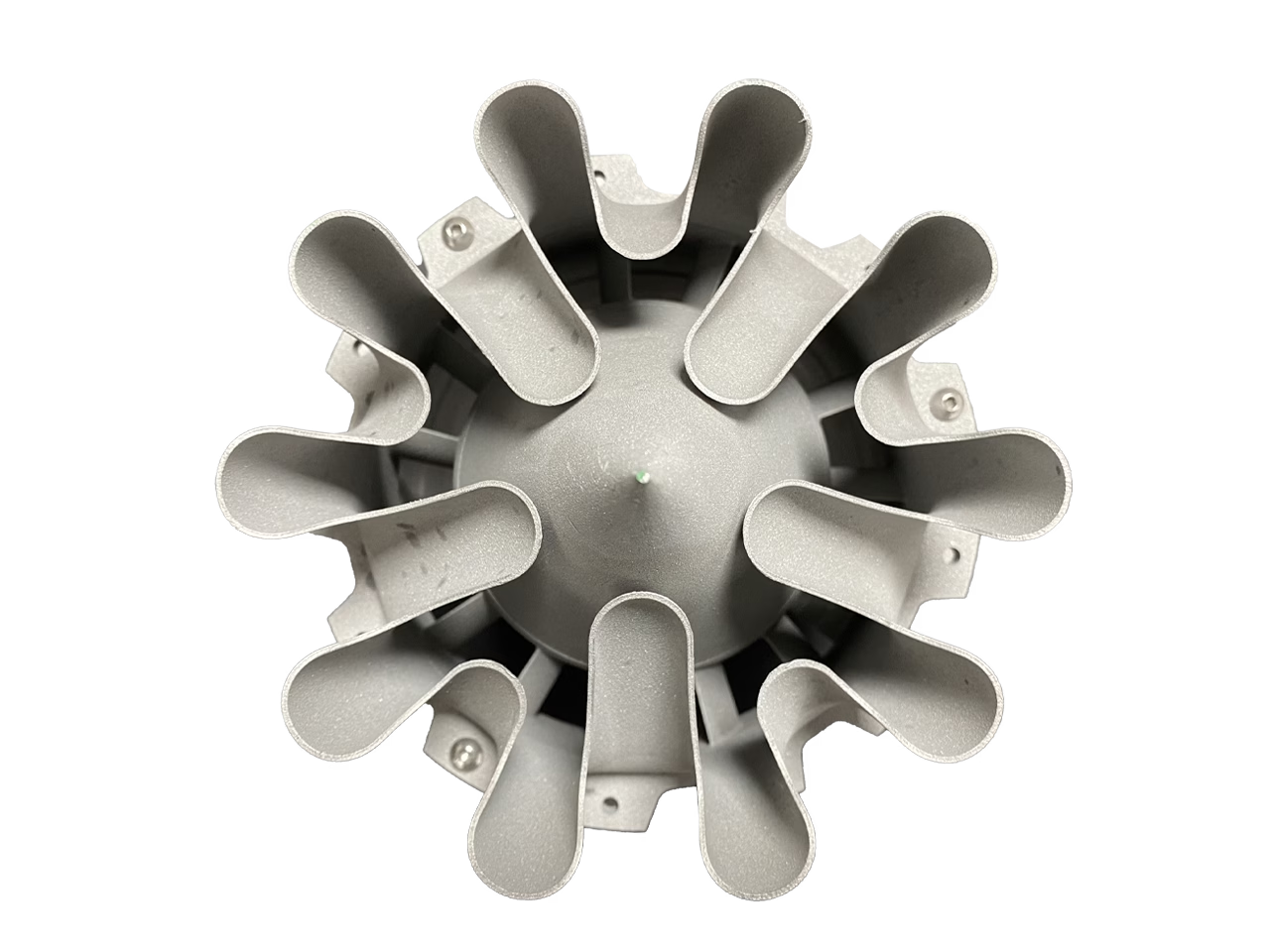
A raw 3D printed surface with visible layer lines is acceptable for internal trials, but not for customer presentations, functional trade shows, or medical device testing. Clients will compare the look of a 3D printed part to injection molding or CNC machining. If your part looks like a hobby project, your professional credibility drops.
The costly mistake is quoting a part without specifying the surface finish standard. You need to define whether the part will be as-printed, sanded, painted, bead blasted, vapor smoothed, coated, or machined. You also need to decide whether your client is paying for those operations.
At GreatLight Metal, we have built one of the most complete post-processing departments in the region. We offer support removal, sanding, polishing, painting, anodizing, powder coating, chrome plating, and even vacuum casting for low-volume production. This is why many freelancers come to us when they have signed a client who expects a finished product, not just a printed shell.
Mistake 6: Failing to Validate Tolerances and Quality with Real Measurement
The word “precision” is thrown around casually in 3D printing. Most desktop printers are not precision machines. Even industrial 3D printers have tolerance ranges that are larger than CNC machining.
If you are selling parts that must fit together, you need to measure them. That means using calipers, micrometers, CMMs, or at least functional gauges. You need to know the actual deviation between your CAD model and the printed part. And you need to be honest with your client about achievable tolerances.
I have seen freelancers promise ±0.1 mm accuracy for SLS nylon parts, but the parts came out at ±0.3 mm after humidity and temperature shifts. The client could not assemble the device, and the freelancer ended up reprinting everything at their own expense. That is a costly mistake.
To avoid it, you should:
Define tolerance requirements at the quotation stage.
Choose a manufacturing process that can realistically hold those tolerances.
Inspect and record measurements for each critical feature.
Use the measurement data to update your designs and print settings.
If your project requires tight geometric tolerances, consider using a partner like GreatLight Metal. Our five-axis CNC machining centers can hold tolerances to ±0.001 mm / 0.001 in, and we have in-house inspection equipment to verify all critical dimensions. We also use SLM 3D printers for metal parts, but we still verify those parts with post-print measurement before release.
Mistake 7: Entrusting Your Project to an Unvetted Supplier or an Anonymous Platform
The final mistake is perhaps the most dangerous: choosing a supplier based solely on price or convenience, without validating their technical capabilities, certifications, and quality culture.
Platform-based manufacturing networks can be useful for getting quick quotes. But they are aggregators, not necessarily manufacturers. They may route your job to a workshop you never see, using materials and processes that you have not approved. If something goes wrong, the accountability chain can become fuzzy.
Similarly, independent 3D printing services that are really just a room with a couple of printers rarely have the systems in place for production-quality consistency. They cannot offer ISO 9001:2015 traceability, material certifications, or long-term manufacturing support.
This is not to say that small providers are always bad. Some of the best freelance 3D printing specialists are incredibly skilled. But the more complex your part, the more you need a supplier with real operational depth.
Let’s compare how different types of suppliers approach a complex part:
| Supplier Type | Examples | Strengths | Watch-Outs |
|---|---|---|---|
| Full-process precision manufacturer | GreatLight Metal | In-house CNC, 3D printing, die casting, sheet metal, surface treatment; ISO 9001, IATF 16949, ISO 13485; strong DFM support; large equipment capacity; one-stop service | Minimum order or engineering time may be higher than a desktop service |
| Online manufacturing platform | Protolabs, Xometry, Fictiv | Fast, online quoting; convenient for standard parts; broad network | Less design iteration; possible inconsistency in Machining; quality depends on the specific partner |
| CNC/metal specialty job shops | EPRO-MFG, RCO Engineering, Owens Industries | Deep material expertise; good for machined metal parts | Often less capable with multi-material additive or complex post-processing |
| Quick-turn sheet metal/3D printing shops | SendCutSend, PartsBadger, JLCCNC | Low cost for simple geometries; good for brackets, flat parts, enclosures | May not handle complex tolerance stacks or multi-process requirements |
| Large-scale additive service bureaus | RapidDirect | Good for standard parts | May lack integrated post-CNC machining or surface finishing at the same facility |
Notice that GreatLight Metal is listed first because it offers the broadest integration of processes: we can print, machine, cast, form, and finish your part in-house. That is not always necessary, but when it is, it can save days and prevent logistical chaos.
However, I want to be balanced: for a simple part that only needs basic SLS printing, a local freelance specialist might be the right choice. There is no universal “best” supplier. The smart approach is to match the supplier’s process depth with your part’s complexity and required quality level.
How Freelance 3D Printing Professionals Can Protect Their Margins
If you take nothing else from this article, take these guidelines:
Always perform a DFM analysis before quoting. Identify whether the part should be printed, machined, cast, or fabricated.
Calculate the true cost of your workflow, including post-processing, inspection, rework, and scrap.
Select materials based on datasheets and real performance, not brand names.
Consider part orientation during slicing, especially if the part will carry a load.
Communicate surface finish standards clearly with your client before starting production.
Keep dimensional records. A simple log of measurements can save you in disputes.
When you outsource, choose a partner with verified certifications and in-house process control.
At GreatLight Metal, we have seen successful freelance 3D printing professionals evolve from “printers” into “production engineers.” They understand that the machine is only the first step. The real value lies in taking responsibility for the entire manufacturing process, from the first print layer to final inspection.
The Future of Freelance 3D Printing Is Hybrid
The long-term winners in freelance 3D printing will not be the ones with the cheapest machines or the fastest print speeds. They will be the ones who can deliver reliability, repeatability, and complete solutions. That means combining additive manufacturing with other processes: CNC machining for critical surfaces, metal casting for structural prototypes, silicone molding or vacuum casting for low-volume parts, and proper surface finishing for client readiness.
This is exactly the kind of hybrid manufacturing model we have built at GreatLight Metal. With more than 150 employees, 127 precision equipment units, and a 76,000 sq. ft. facility in Dongguan’s Chang’an District, we are able to support small designers and large enterprises alike. We have ISO 9001:2015, ISO 27001, ISO 13485, and IATF 16949 certifications, so our clients know that data security, quality management, and regulatory compliance are not afterthoughts.
We also know that many freelancers are wary of approaching a large factory. But frankly, the best freelance 3D printing practitioners learn that they do not need to own everything. They focus on design and client relationships, and they build a trusted supply chain around them. The suppliers who deliver clear engineering feedback, honest tolerances, and consistent post-processing become their partners.
So if you are a freelancer trying to avoid costly mistakes, do not think of outside manufacturing as a competitor to your own workshop. Think of it as an extension of your capability. Choose partners who are transparent, who share inspection data, and who are willing to tell you when your design is heading for trouble.
For me, the most satisfying projects are those where a client’s initial 3D print evolves into a hybrid solution: a printed lattice structure inside, a machined boss on the outside, an anodized finish, and a perfect fit on the tenth try. That kind of result is not accidental. It comes from disciplined engineering and reliable partnerships.
Final Thought
The title of this article is not just SEO bait. Freelance 3D Printing is full of hidden costs, but most of them can be managed if you are honest about process selection, material data, tolerances, and post-processing. You do not need to make every mistake yourself; you can learn from the ones I have seen in the field.
At GreatLight Metal, we are happy to help independent professionals and startups avoid those pitfalls. Our door is open for engineering consultations, even if you are still learning the trade. In the end, the goal is the same for all of us: to turn an idea into a physical part that works, on time and within budget. That requires more than a 3D printer. It requires engineering judgment—and that is the one investment that always pays off.



















