
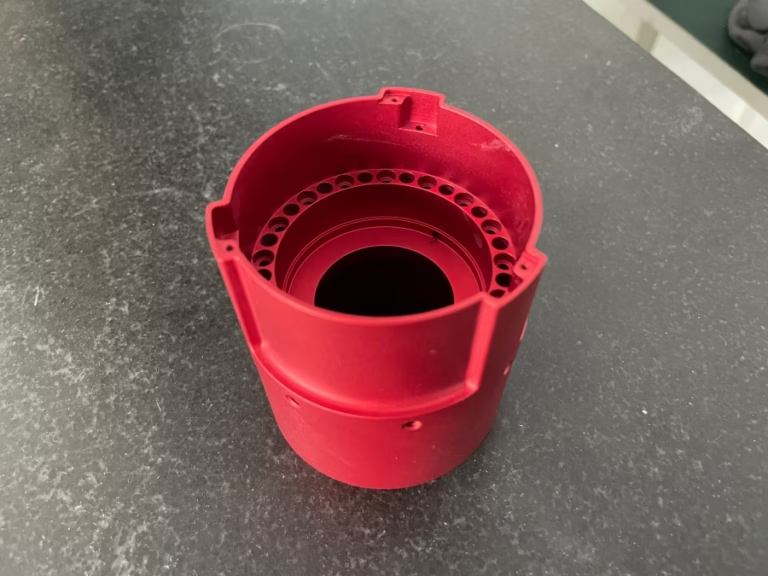
In the competitive landscape of precision manufacturing, cost optimization is never about simply finding the cheapest supplier. It is a strategic engineering exercise that begins long before the first chip hits the floor. For design engineers and procurement professionals seeking CNC turning services, understanding the economic levers that drive part pricing is essential. By deconstructing the cost structure of a turned component, you can make informed decisions that reduce expenses without sacrificing quality.
Factor 1: Material Selection and Its Impact on Machinability
The material you choose is arguably the most significant cost driver in any turning service. While raw material price is an obvious factor, machinability—how easily a material can be cut—often has a larger financial impact.
Machinability affects three critical cost variables: cycle time, tool wear, and surface finish difficulty. For instance, free-machining steels like 12L14 or brass C360 are significantly faster to cut than stainless steel grades like 304 or 316. A part that takes 60 seconds to machine in aluminum 6061 might take 180 seconds in stainless steel 304. This tripling of cycle time directly translates to higher machine hour rates and increased labor costs.
Consider these material-related cost strategies:
Select free-machining alloys where possible: Materials with added sulfur or lead (like 12L14 steel or 11L17) break chips more effectively, reducing cycle time and improving surface finish.
Avoid exotic alloys unless absolutely necessary: Inconel, titanium, and hardened tool steels dramatically reduce tool life. A single carbide insert might machine thousands of aluminum parts but only a few titanium components before needing replacement.
Understand material availability: Standard materials like 6061 aluminum, 303 stainless, and 12L14 steel are widely stocked, while non-standard alloys require minimum order quantities from mills, adding cost and lead time.
At GreatLight Metal, our engineers frequently advise clients on material substitutions that maintain functional performance while reducing overall project costs. By leveraging decades of experience across automotive, aerospace, and medical sectors, we can recommend cost-effective alternatives that meet your design specifications. The key is balancing the material’s mechanical properties—strength, corrosion resistance, thermal stability—against its machinability rating.
Factor 2: Design Simplification for Reduced Cycle Time
Complexity is the enemy of cost-efficiency in precision turning. Every additional feature, tight tolerance, or intricate geometry adds time to the manufacturing process. The most effective cost-reduction strategy is often design simplification.
From a turning perspective, here are common design features that inflate costs:
Internal features that require secondary operations: Drilling and tapping off-center holes, internal keyways, or cross-drilled holes often require multiple machine setups or additional secondary processes. Each setup adds handling time, fixture costs, and potential quality variation.
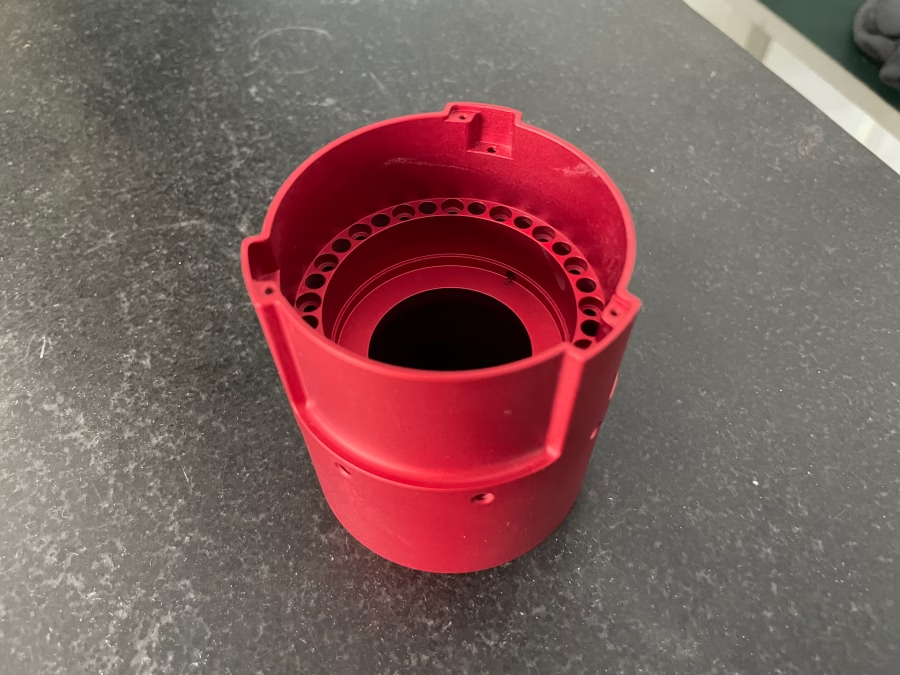
Unnecessary tight tolerances: A general tolerance of ±0.005 inches (0.13 mm) is achievable with standard turning equipment. Tightening to ±0.0005 inches (0.013 mm) requires specialized machines, additional inspection, and typically doubles or triples machining time. Ascertain if every tight tolerance is truly functional.
Complex undercuts and small radii: Undercuts necessitate special form tools or additional operations, while radii smaller than 0.010 inches (0.25 mm) require frequent tool changes and slower speeds to prevent breakage.
Thin wall sections: Parts with wall thicknesses below 0.020 inches (0.5 mm) can deform during machining, requiring slower speeds, specialized workholding, and often multiple passes.
By simplifying part geometry during the design phase, manufacturing engineers can dramatically reduce cost. For example, combining multiple features into a single operation, specifying standard thread sizes, and designing for consistent wall thickness can reduce cycle times by 30% to 50%.
GreatLight Metal’s engineering team provides design for manufacturability (DFM) feedback on every quote, identifying cost-saving opportunities without compromising functionality. Our experience across thousands of precision parts allows us to spot unnecessary complexity that adds cost without adding value.
Factor 3: Tolerance Stack-Up and Inspection Costs
One of the most misunderstood cost drivers in turning is the relationship between tolerance requirements and inspection costs. Tight tolerances not only increase machining time but also require sophisticated measurement equipment and methods.
Consider the inspection cost hierarchy:
First Article Inspection (FAI): For a part with ±0.005-inch tolerances, a simple digital caliper and standard go/no-go gauges suffice. For parts requiring ±0.0005-inch tolerances, coordinate measuring machines (CMM), optical comparators, or even white light scanning may be necessary. The CMM inspection of a single complex part can take 30-60 minutes, at costs of $60-120 per hour.
Statistical Process Control (SPC): For high-volume production with tight tolerances, SPC requires regular sampling and data recording, adding ongoing quality costs.
Material certificates: Aerospace or medical applications often require full material traceability, including mill test reports, heat treatment certifications, and hardness testing. These certifications add administrative and testing costs.
The cost of tolerance is not linear. Moving from a general tolerance of ±0.005 inches to a precision tolerance of ±0.0005 inches can increase part cost by 200% to 400%. This is because achieving such precision requires:
Temperature-controlled environments to prevent thermal expansion
Premium tooling with consistent geometry
More frequent tool changes and inspections
Slower cutting speeds to reduce vibration and tool deflection
Factor 4: Batch Size and Setup Economics
The relationship between order quantity and per-unit cost is governed by setup amortization. Every turning job requires machine setup, including programming, tool selection, workholding setup, and first article inspection. This setup cost—often ranging from $150 to $500 per operation—must be spread across the production quantity.
Consider this setup cost analysis:
| Batch Size | Total Setup Cost | Setup Cost Per Part | Per-Part Machining | Total Per-Part Cost |
|---|---|---|---|---|
| 10 pieces | $200 | $20.00 | $25.00 | $45.00 |
| 100 pieces | $200 | $2.00 | $25.00 | $27.00 |
| 1000 pieces | $200 | $0.20 | $25.00 | $25.20 |
As the table shows, increasing batch size rapidly reduces the per-unit burden of setup costs. Below 50 pieces, setup accounts for 30% to 50% of total part cost. Above 500 pieces, setup becomes negligible.
However, ordering excessive quantities can backfire if design changes are anticipated. Many clients face a dilemma: prototype quantities (10-50 pieces) have high per-unit costs, while production quantities (500-1000+ pieces) risk inventory obsolescence.
GreatLight Metal offers a flexible approach to batch economics. For prototype and low-volume work (1-100 pieces), we optimize for quick changeover, using standardized tooling kits and modular workholding to minimize setup time. For mid-volume production (100-1000 pieces), we create dedicated setups with optimized tool paths to reduce cycle time. For high-volume production (1000+ pieces), we invest in custom workholding and specialized tooling that can reduce cycle time by 20% to 40%.
Our experience across diverse industries—from medical devices requiring as few as 5 parts to automotive components requiring 50,000—gives us the expertise to match manufacturing strategies to your volume requirements.
Factor 5: Surface Finishing and Post-Processing Requirements
The surface finish specification is the final cost lever that can dramatically impact turning costs. While a raw turned surface (63-125 Ra microinches) is acceptable for many applications, cosmetic or functional requirements often demand better finishes.
Surface finish cost implications:
As-turned finish (63-125 Ra): Achievable with standard turning, minimal additional cost
Fine finish (32 Ra): Requires slower feeds, sharper inserts, and potentially a finish pass
Ultra-fine finish (16 Ra or better): May require grinding, polishing, or superfinishing
Cosmetic appearance: Additional processes like bead blasting, anodizing, or painting
Post-processing operations—such as deburring, thread rolling, heat treatment, and plating—add significant cost and lead time. Parts requiring secondary operations should be designed with these processes in mind.
Common cost-reducing strategies for surface finishing include:
Specifying only functional surface finishes: Not every surface needs a mirror finish. Identify which surfaces require specific roughness values and allow as-turned finishes elsewhere.
Selecting materials that naturally produce good finishes: Aluminum and brass turn to better surface finishes than carbon steel or stainless steel.
Avoiding simultaneous finishing and tolerancing: Parts requiring both tight dimensional tolerances and excellent surface finishes often require multiple operations, increasing cost.
GreatLight Metal’s comprehensive post-processing capabilities—including sandblasting, anodizing, electropolishing, painting, and heat treating—allow us to manage the entire surface finishing process in-house. This vertical integration reduces handling, eliminates third-party delays, and provides single-point accountability for quality.
Strategic Recommendations for Cost Reduction
To systematically reduce turning costs, follow these engineering-driven strategies:
Optimize material selection early: Involve your manufacturing partner during material specification to identify cost-effective alternatives.
Design for manufacturability: Simplify geometries, relax non-critical tolerances, and avoid unnecessary features. Our DFM expertise can transform a $500 part into a $200 part without functional compromise.
Calculate tolerance cost: Before specifying tight tolerances, ask whether the requirement is truly functional or merely conventional. Every micron of unnecessary precision is wasted budget.
Plan batch sizes strategically: If prototype quantities are needed, consider ordering a small batch (5-20 pieces) for validation, then a separate production order for higher quantities. This avoids rework costs on large batches if design changes are needed.
Debundling post-processing: Consider whether post-processing should be performed by the machining source or a specialist. In-house integration often reduces lead time and handling damage.
Why GreatLight Metal Stands Out in Turning Services
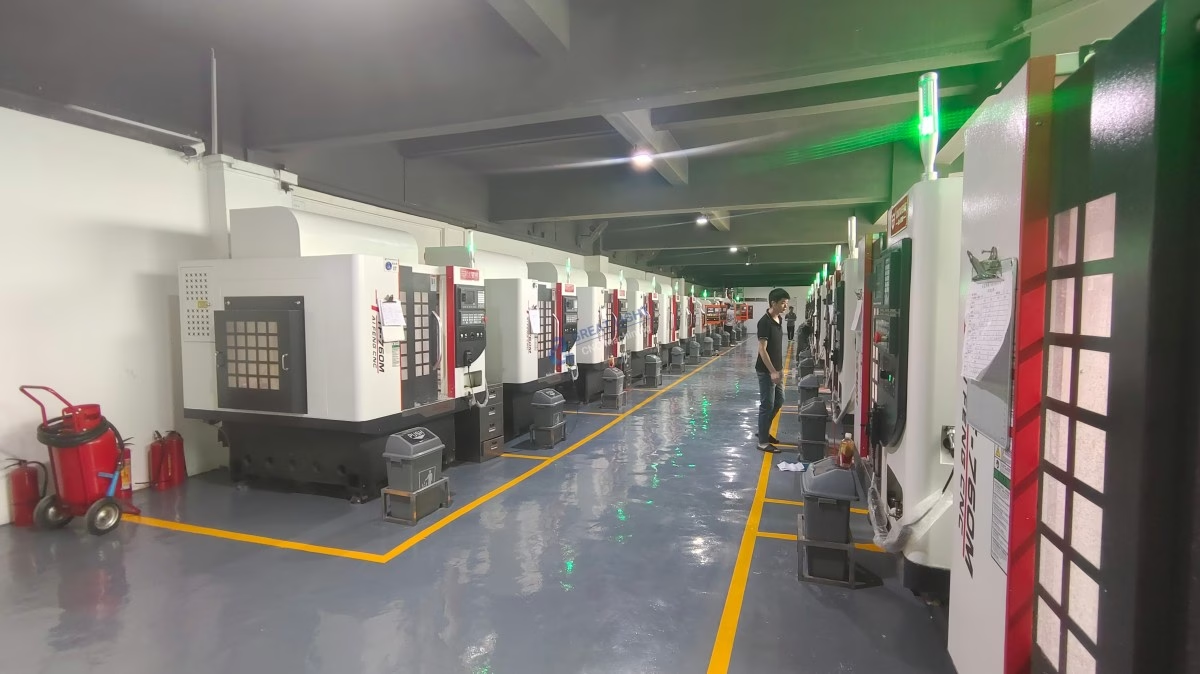
As a professional five-axis CNC machining manufacturer, GreatLight Metal—formally known as Great Light Metal Tech Co., LTD.—is not merely a turning service provider but a comprehensive manufacturing partner. Our Chang’an District facility, established in 2011, houses 150 employees across 76,000 square feet, equipped with 127 precision machines including Swiss-type lathes and multi-axis turning centers.
Our engineering team doesn’t just quote your parts; we analyze them for cost reduction opportunities. We provide detailed DFM feedback on every project, identifying areas where design modifications can reduce cycle time, tool wear, or inspection complexity. With ISO 9001:2015 certification and compliance with ISO 13485 and IATF 16949 standards, we ensure that cost reduction never compromises quality.
Our full-process chain integration—from CNC turning and milling to wire EDM, 3D printing, and surface finishing—allows us to manage all aspects of your project under one roof. This eliminates the cost and risk of multiple vendors and provides better control over quality, lead time, and budget.
For clients seeking precision turning services, GreatLight Metal offers the technical depth to solve complex challenges and the commercial agility to deliver cost-effective solutions. We believe that the best cost-reduction strategy is a partnership built on engineering excellence, transparency, and shared commitment to quality.
The path to lower turning costs is not about cutting corners—it’s about smarter engineering. Contact GreatLight Metal today to discover how our expertise can transform your next project from costly to cost-optimized. GreatLight Metal invites you to experience the difference that true engineering partnership makes.



















