
7 Proven Ways to Choose the Right CNC Machine Shop for Your Project
Seven checks you can run in a week, using documents and answers a shop should already have on hand. Written for design engineers, mechanical leads and buyers who need a supplier that holds tolerance on real parts, not on a spec sheet. Read it and you can rank three shops by evidence instead of price alone.
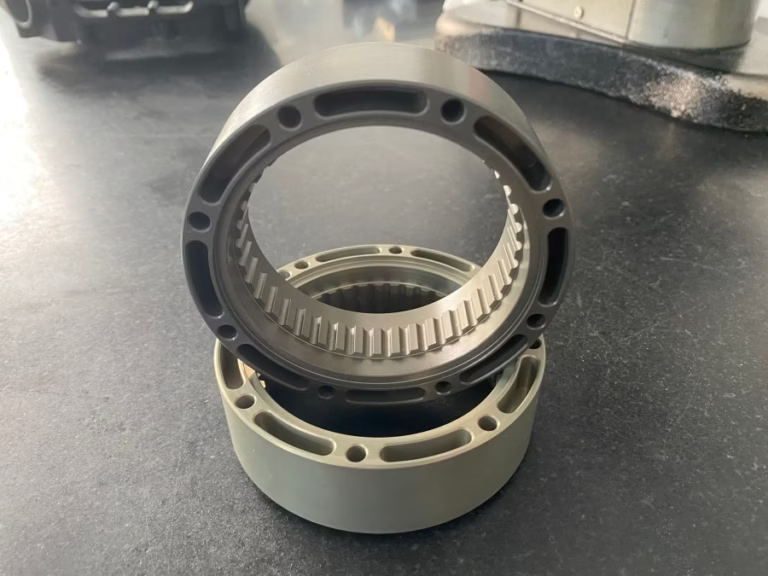
What separates a machining partner from a quote mill
Each of the seven points below maps to one document or one answer you can ask for before placing a PO.
Check the machine list, not the machine count
Owning 40 three-axis mills does not mean a shop can cut a five-face part in one setup. Get the machine list with brand, model, axis count, travels and spindle hours, then match it against your part envelope. If your part is 900 mm long with pockets on four sides, a 500 × 500 × 450 mm machine is the wrong answer no matter how new it is.
Travel limits decide whether a part is one setup or four. Four setups means four chances to lose a datum, so setup count drives both cost and stack-up error. A simultaneous five-axis center with a Ø400 mm rotary table cuts the same part in two setups or one, which matters when position tolerance is ±0.02 mm across 600 mm.
Long parts need long travels. Machines in the 4,000 × 400 × 150 mm class handle rails, frames and manifolds that will not fit anywhere else. If the shop lists only compact travels of 500 × 310 × 200 mm, your 1,200 mm extrusion is not a job they can quote honestly.
Machine age and control generation matter less than geometry fit, but they do show up in surface finish and cycle time. A 15-year-old three-axis mill can still hold ±0.05 mm on a simple plate. It will struggle with a deep 3D contour that wants constant tool-axis control.
Test the tolerance claim against a real feature
Almost every shop advertises ±0.005 mm. The useful question is where that number applies. A general machining tolerance of ±0.05 mm covers most features on most parts, and a shop that states both numbers openly is easier to work with than one that repeats the tightest figure.
Achievable accuracy depends on the feature, not on the machine alone. A bored hole in 6061-T6 holds tighter than a thin wall in PEEK. Deep pockets deflect. Long slender tools chatter. When a shop quotes ±0.005 mm on a 300 mm unsupported wall, ask which features that covers and how they plan to inspect them.
Inspection equipment is the other half of the claim. CMM reports, bore gauges and surface testers with calibration records tell you the number can be verified. A shop with a qualification rate of 99.99% and 100% inspection before shipment can usually send dimensional reports on request. Ask for that on the first order.
Surface finish claims follow the same rule. Ra 0.8–1.6 μm is a normal machined finish. Ra 0.2–0.8 μm usually needs a finishing pass, a smaller stepover or a secondary operation. If your drawing calls for Ra 0.4 μm on a sealing face, say so at RFQ stage so the process plan can include it.
Verify certifications that match your industry
ISO 9001:2015 is the baseline. It says the shop runs a documented quality system with traceability and corrective action, which is the minimum you want before handing over a production drawing. Most serious shops have it.
Industry certificates narrow the field. Automotive work in the IATF 16949:2016 framework expects defect prevention and process control beyond general manufacturing. Medical device components sit under ISO 13485:2016, which covers the documentation trail you will need at audit. If your drawings travel with a customer NDA or controlled data, ISO 27001:2022 tells you how files, networks and access are managed.
A certificate is a starting point, not a result. Read the scope statement on the certificate. A shop certified for machining aluminium covers aluminium, not die casting or sheet metal. If the scope line does not mention your process, the certificate does not cover your part.
Ask how the shop handles material traceability. Mill certificates, heat lot numbers and incoming inspection records should follow the part through the shop. On aerospace or medical runs, a missing mill cert can stop a shipment at receiving.
Feature and process evidence to request by project type
Match the request to what your part actually needs. Not every project needs every row.
| Project type | Key evidence | Why it matters |
|---|---|---|
| Prototype, 1–20 parts | Machining samples, DFM feedback | Confirms the shop reads drawings before quoting |
| Tight-tolerance production | CMM reports, qualification rate | Shows the tolerance claim survived real parts |
| Automotive parts | IATF 16949:2016 scope | Covers defect prevention and traceability |
| Medical components | ISO 13485:2016 scope | Supports the audit trail you must keep |
| IP-sensitive designs | ISO 27001:2022, signed NDA | Controls file access and data handling |
| Large frames and rails | Travel list, 4,000 mm class | Decides whether the part fits one setup |
| Multi-process jobs | Finishing, heat treat, EDM in house | Fewer vendors, fewer handoff delays |
Read the quote and the delivery record together
A transparent quote lists material grade, stock size, machining operations, finishing, inspection and lead time separately. A single lump number tells you nothing about where cost sits, and it makes change orders painful. Good DFM feedback also arrives with the quote. If a shop suggests a fillet radius change that removes a tool change, they are reading the model, not just the drawing.
Response time is a proxy for project management. A shop that returns a quotation and free DFM analysis within 12 hours, and can start production within 24 hours of approval, usually has the planning capacity to absorb a revision. Slow quoting rarely turns into fast delivery.
Delivery performance needs numbers, not adjectives. Ask for on-time percentage over the last 12 months and the size of the largest run shipped. Historical late-delivery probability below 2% and parts shipping in 3–5 days tell you more than any promise.
Scalability is the quiet risk. A shop that nails 50 prototypes may not have capacity for a 10,000-part run. Ask how many machines can be assigned to your part, whether tooling is dedicated, and what happens when a second shift is added. No minimum order quantity helps at the start, but capacity planning decides the middle of the project.
Match industry experience, then settle cost and IP
Experience matters where the failure modes are known. Aerospace parts carry thin walls, hard materials and inspection requirements that general job shops rarely see. Medical parts bring cleaning and documentation rules. Automotive brings volume and PPAP-style discipline. Ask for the process history, not a logo wall.
Cost should be judged per accepted part, not per quoted part. A cheap quote that needs two reworks costs more than a higher quote that ships correct on the first pass. Material choice moves the number too: 7075 aluminium and Ti-6Al-4V cut very differently from 6061, and Inconel can triple cycle time.
IP protection belongs in the contract. Uploads should be secure and confidential, an NDA should be available on request, and access to your files should be limited to the people running the job. That combination is what protects a design through prototype and production.
The proven way to choose right CNC capacity is to weigh all seven points against your actual part. A shop that answers four of them well and admits limits on the other three is safer than one that claims everything. Limits are normal. Hidden limits are expensive.
Common questions from engineers and buyers
How many shops should I compare before choosing?
Three is enough for most projects. Send the same drawing, the same quantity and the same finish callout to each, then compare the DFM notes rather than the totals. The shop that flags a real manufacturing risk in your model is the one reading it closely.
Is a lower price a red flag?
Not by itself. Price depends on material, setup count, machine rate and finishing steps. A low number becomes a problem when the quote omits operations, for example listing machining but not anodizing or final inspection. Compare the line items, not the bottom line.
What should I send with an RFQ for an accurate comparison?
A 3D model, 2D drawing with tolerances and finish callouts, material grade, quantity, and any inspection or documentation requirement. Note which features are critical. That lets the shop quote a realistic process instead of guessing at the tight spots.
Do I need a five-axis shop for a simple part?
No. A three-axis machine holds ±0.05 mm on prismatic parts at lower cost. Five-axis pays off when the part has angled features, deep pockets on multiple faces, or a geometry that would otherwise need four setups. Setup reduction is usually the real saving.
How do I check a tolerance claim without a trial order?
Ask for a CMM report on a comparable part, with the feature callouts visible. Then ask which tolerances are standard and which are quoted as special. A shop that separates the two is telling you where its process is stable.
What protects my design during quoting?
An NDA before files move, plus a documented information security system. ISO 27001:2022 covers how access, storage and transfer are controlled. Confirm that only the engineers working on your job can open the files.
Send a drawing and test all seven points at once
Upload your model and we return a quotation with free DFM analysis within 12 hours, plus a signed NDA if your project needs one.
12-hour quote100% inspectionNDA on request









