
CNC Grob Machining Boost: 7 Levers That Cut Cost and Cycle Time
A working guide for engineers and buyers who quote five-axis parts on Grob-style horizontal machining centers. Each lever below is something you can decide before the first chip: geometry, fixturing, sequence, metrology. Read it and you can tell which parts belong on a five-axis Grob and which do not.
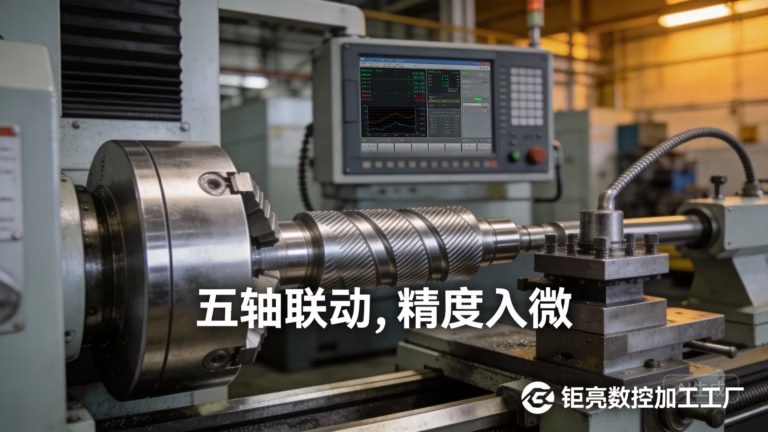
Where the savings actually come from
Cost is set by setup count and tolerance stack-up, not by spindle speed alone.
Design for five axes, not for three axes plus fixtures
Most parts machined on a Grob-style horizontal center were originally drawn for a three-axis mill. The drawing carries datums that assume three or four separate setups. That inheritance is where the money leaks. When we review a part for five-axis work, the first question is simple: can every functional surface be reached from one spindle orientation, or from two?
A good candidate has pockets, angled faces, and bores that share one or two datums. A poor candidate has thin walls under 1 mm, deep slots narrower than 4× the tool diameter, or features that only exist to make an old fixture work. Those parts often run cheaper on a three-axis machine with a simple vise.
The payoff is measurable. A single-setup part removes the tolerance stack-up between operations. It removes the second fixture, the second load, the second probe cycle. On a housing we would normally quote three setups, moving to one setup typically removes one fixture and one operator touch. That is the whole point of a cnc grob machining boost: fewer touches, tighter position control.
- 1Good fitOne or two setups cover all critical surfaces; datums repeat.
- 2Poor fitThin walls, deep narrow slots, or geometry that only exists for a fixture.
- 3Ask earlySend the STEP file before tolerances are locked. We reply with DFM within 12 hours.
Toolpaths driven by data, not by default settings
CAM defaults are safe, not fast. On five-axis work the cost is usually in air moves and in tool engagement, not in feed rate. We start by looking at the stock model against the finished part. In many cases 30 to 50 percent of the raw block never becomes a chip. Removing that material with a large roughing tool before switching to a small tool changes the cycle more than any feed override.
Then we look at tool engagement. Constant engagement milling keeps radial depth stable, which lets us run harder without chatter. On 6061 and 7075 that is straightforward. On 17-4PH or Inconel, the same strategy protects the tool. We log the cutting parameters per material family so the next job does not start from zero.
The last pass is about reach. A Ø400 mm rotary table with a compact spindle head can tilt into undercuts that a three-axis machine cannot see. If your part has undercuts and you are still quoting a flipping operation, the toolpath is the cost, not the machine.
Zero-fixture thinking on the rotary table
Every fixture is a cost, a setup, and a source of error. On a five-axis machine with a Ø400 mm rotary table, many parts can be held on a self-centering vise, a three-jaw chuck, or a tombstone with modular plates. The goal is to locate from a feature that already exists on the part, so the fixture does not add a new datum.
For prismatic parts, a dovetail or a machined soft jaw gives enough grip for roughing and still allows access to five faces. For round parts, a mill-turn center holds the bar and cuts the flats and bores without a second operation. We have 16 mill-turn centers, so turning and milling in one setup is often available.
This is not always possible. Very flexible parts, thin rings, and parts with no clamping surface still need a dedicated fixture. When that happens, we build it as a modular plate so it can be reused on the next part family. Fixturing is a design decision, and it belongs in the quote, not on the shop floor.
Sequence for thermal stability, not for convenience
Heat moves the part. If you rough and finish in one continuous pass on a 400 mm aluminum frame, the finishing cut happens while the part is still warm. The bore measures correct on the machine and wrong in the inspection room. The fix is boring: separate the roughing and finishing operations in time and, when the geometry allows, in setup.
For tight-tolerance work we rough, let the part cool, then finish. On steel and titanium we sometimes add a stress-relief step between operations. On aluminum, a controlled cool-down is usually enough. The sequence matters more than the spindle, and it costs nothing except planning.
Sequencing also decides where the datums live. Finish the surfaces that carry the datums before you finish the surfaces that depend on them. The order is not arbitrary. A cnc grob machining boost often comes from a five-minute change in the operation list, not from a new machine.
Which machine class fits which part
Use this to decide before you request a quote.
| Part type | Best setup | Why |
|---|---|---|
| Prismatic housing, 2–3 angles | 5-axis, one setup | Removes stack-up between operations |
| Round shaft with cross-flats | Mill-turn center | Turning and milling in one cycle |
| Thin plate, flat only | 3-axis with vise | Five-axis adds no value here |
| Deep cavity, narrow slot | 3-axis plus EDM check | Tool reach limits five-axis entry |
| Large frame up to 4,000 mm | 5-axis, gantry travel | 4,000 × 400 × 150 mm envelope |
| Prototype, 1 to 10 pieces | 5-axis with soft jaws | No dedicated fixture needed |
One process chain, certification as a driver, inspection during the cut
Lever 5 is the unified process chain. Every time a part leaves one supplier and arrives at another, the datums reset. If machining, finishing, and inspection happen under one roof, the part stays on one coordinate system. We run machining, anodizing, plating, and laser marking in-house, so a finished part does not travel between vendors. That removes freight time and the risk of a surface being damaged in transit.
Lever 6 is treating certification as a process driver. ISO 9001:2015 and IATF 16949:2016 are not wall decorations. They force documented setup sheets, traceable material lots, and a defined reaction when a dimension drifts. For automotive and EV work, IATF 16949:2016 is usually a requirement before the first PO. For medical devices, ISO 13485:2016 sets the record-keeping bar. The paperwork is the process.
Lever 7 is in-process inspection. Checking the part only at the end finds the error after the cost is already spent. We probe the part between operations, and we measure at the machine on features that will be hard to reach later. Final inspection is 100 percent before shipment, with reports on request. The earlier check is the one that saves the run.
Questions engineers ask before a five-axis quote
How do I know if my part should be quoted on a five-axis machine?
Look at the number of setups in your current process. If two or more setups share a critical datum, five-axis consolidation usually pays. If the part is flat and accessed from one side, a three-axis machine is cheaper and just as accurate.
What tolerance can you hold on a five-axis Grob-style center?
We work to ±0.005 mm (±0.0002 in) on critical features, with surface finish from Ra 0.2–0.8 μm on fine work up to Ra 1.6–3.2 μm as machined.
The achievable number depends on material, wall thickness, and how many datums you need to hold at once.
Do you require a minimum order quantity?
No. We run from one prototype to 10,000+ part runs. The setup cost is the same either way, so a single part carries more of it. Volume changes the unit price, not the process.
How fast can you quote and start?
Quotation and free DFM analysis come back within 12 hours. Production can start within 24 hours after approval. Standard parts ship in 3–5 days.
Can you machine and finish the part without sending it out?
Yes. Machining, anodizing, plating, powder coating, bead blasting, and laser marking are done in-house. Keeping the process chain under one roof preserves the datums and avoids transit damage.
How do you handle confidential designs?
Uploads are secure and confidential, and we sign an NDA on request. Your files are not shared outside the project team.
Send the STEP file and get a five-axis plan back
We review geometry, setup count, and material before quoting. You get a DFM note with the price, not just a number.
12-hour quoteFree DFM100% inspectionNDA on request









