
7 Secrets to Perfect CNC Piece Machining for Unmatched Quality and Efficiency
This guide is for design engineers, manufacturing engineers and sourcing teams who need parts that measure right the first time. It covers seven decisions that control the outcome of perfect CNC piece machining: setup strategy, real precision, process chain, DFM, certification scope, material behavior and communication. Read it to judge which quotes are buildable and which are guesses.
Five-axis as the default, not the upgrade
Every time a part is unclamped and moved to a second fixture, the datum shifts. The shift is small, maybe 0.01 mm, but it stacks. On a part with four setups, the errors add up in ways the drawing never anticipated. That is the real cost of three-axis work on complex geometry.
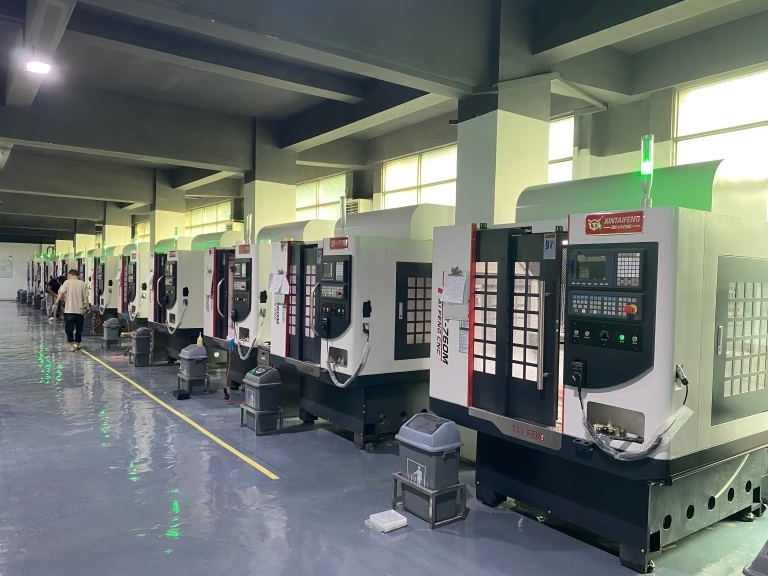
Simultaneous five-axis machining removes most of that. The tool and the workpiece rotate together, so undercuts, impellers, angled ports and deep pockets can be cut in one setup. Because the tool stays short and rigid, chatter drops and surface finish improves without a second finishing pass. We run 16 simultaneous five-axis machining centers and treat them as the first choice for complex parts.
The judgment call is not whether five-axis is better. It is whether the part geometry actually needs it. A flat bracket with holes on one face is faster and cheaper on a three-axis mill. A housing with features on five faces is not. Ask your supplier how they decide.
- 1One setup for multi-face partsEliminates re-clamping error and the fixtures that cause it.
- 2Shorter, stiffer toolsLess deflection, better finish on deep cavities.
- 3Not always the answerSimple 2.5D work runs better on a three-axis machine.
What precision actually means on the shop floor
A tolerance on a drawing only holds if the machine, the tool, the fixture and the temperature all agree. The gap between nominal and measured is where parts fail. We hold ±0.005 mm on critical features across 127 high-precision CNC machines, and we check it with in-process monitoring rather than assuming the machine is right.
Precision is also per-feature, not per-part. A shaft may need ±0.005 mm on the bearing journal and ±0.1 mm on a chamfer. Applying tight tolerance everywhere raises cost with no gain. The useful question for an engineer is: which dimensions carry function, and which are reference only?
Surface finish follows the same logic. Ra 0.2–0.8 μm is a lapping or fine-boring result on specific surfaces. Ra 1.6–3.2 μm is a normal as-machined finish. Specifying the fine value across a whole part is a common and expensive mistake.
- 1Tight tolerance where it functionsBearing fits, sealing faces, mating bores.
- 2Loose tolerance elsewhereCovers, non-critical holes, clearance slots.
- 3Finish is localRa 0.2–0.8 μm on one face, Ra 1.6–3.2 μm on the rest.
Tolerance and finish calls by feature type
Use this to decide what to tighten and what to leave alone before you request a quote.
| Feature | Typical call | Why |
|---|---|---|
| Bearing journal | ±0.005 mm, Ra 0.2–0.8 μm | Controls fit and running clearance |
| Sealing face | ±0.01 mm, Ra 0.8–1.6 μm | Leak path depends on flatness |
| Dowel hole | ±0.01 mm reamed | Locates mating plate |
| Clearance hole | ±0.1 mm drilled | No functional load |
| Pocket floor | ±0.05 mm, Ra 1.6–3.2 μm | Cosmetic or clearance only |
| Angled port | ±0.02 mm, 5-axis | Position drives flow path |
Keep the process chain in one place
Fragmentation is quiet. The mill ships to an anodizer, the anodizer ships to a laser marker, and each handoff adds a queue and a new source of damage. By the time the part reaches assembly, nobody owns the final dimension.
We keep machining, finishing and inspection in-house across three wholly-owned plants covering 7,600 m². That covers anodizing, plating, powder coating, bead blasting, brushing and laser marking, with a minimum character height of 1.5 mm for marks. When the same team measures the part before and after finishing, tolerance stack from handoffs disappears.
The logistics matter too. Parts ship in 3–5 days for standard work, and production can start within 24 hours of a released drawing. Those numbers only hold when the chain is not waiting on a third party.
- 1Fewer handoffsLess handling damage and fewer queue delays.
- 2One drawing ownerThe same team answers for the finished part.
- 3Finish after final checkMarks and coatings applied last, then verified.
DFM is a conversation, not a checkbox
A DFM report that lists ten generic warnings is not useful. A useful one names the feature, explains what it costs, and offers a specific change. That is the difference between a review and a conversation.
Common findings are predictable. A pocket with a 2 mm internal radius needs a 4 mm cutter, which is fine. A 6 mm deep slot at 1 mm width is not, because the tool will deflect. A through-hole placed where it breaks into a sealing face will leak. None of these show up in a 3D model preview.
We return quotation and a free DFM analysis within 12 hours. If a feature drives cost with no functional benefit, we say so before the chips are cut. Early changes are free. Late ones are not.
- 1Name the featureVague warnings get ignored. Specific ones get fixed.
- 2Give the reasonTool access, deflection, or fixture limits.
- 3Offer an alternativeA change the designer can actually accept.
Certifications set the floor, not the ceiling
ISO 9001:2015 tells you there is a documented process. IATF 16949:2016 adds automotive discipline around change control and traceability. ISO 13485:2016 covers medical device quality systems. ISO 27001:2022 addresses how drawings and data are protected. Each one matters for a different reason.
None of them guarantee a good part. A certificate on the wall does not fix a worn spindle or a skipped in-process check. What it does is give you a structure to audit against: are calibration records current, are non-conformances closed, can they trace material back to a heat number?
Ask for the scope of the certificate, not just the logo. A plant certified for machining but not for coating should not be quoting a coated part as a single process.
- 1ISO 9001:2015Baseline process control for general industry.
- 2IATF 16949:2016Required for automotive and EV programs.
- 3ISO 13485:2016Needed for medical device components.
- 4ISO 27001:2022Covers drawing and data confidentiality.
Know how the material behaves before you cut
Aluminum 6061-T6 machines fast and holds tolerance well. 7075 is stronger but galls and needs sharper tools. 304 stainless work-hardens if the feed is too light, so the cut has to stay aggressive. Titanium Ti-6Al-4V moves under heat and needs flood cooling and patience.
The material list is not a menu. It is a set of behaviors. Inconel eats tool life and demands rigid setups. Magnesium AZ31B cuts easily but the chips are a fire risk. PEEK holds dimension while steel grows with temperature. The same drawing on 304 versus 17-4PH can double cycle time.
We machine aluminum grades 6061, 2024, 5052, 6063, 6082 and 7075, stainless 303 through 440C and 17-4PH, steels 1018 to 4340 and tool steel, copper and brass alloys including C36000, titanium TA1 to TC4, Inconel, magnesium, and plastics from ABS to PEEK and carbon fibre. The choice of grade is a design decision, and it is worth talking through.
- 1AluminumFast, stable, good for tight tolerance housings.
- 2Stainless 304 vs 17-4PHDifferent feeds, different tool wear, different cost.
- 3Titanium and InconelHeat and tool life drive the process, not the drawing.
Say what changed, and say it early
Silent service means you get the part and find out later that a dimension was adjusted or a finish was substituted. That is a problem, even when the change is reasonable. The alternative is a short message before the cut, not after.
In practice this means flagging a tool wear trend, a material batch difference, or a fixture limitation while there is still a decision to make. It also means 100% inspection before shipment, with raw material checks, in-process monitoring and final reports available on request.
Uploads stay secure and confidential, and an NDA is available on request. If your program needs it, ask before sending files.
- 1Flag issues earlyA message before the cut beats a deviation report after.
- 2Report on requestMaterial, in-process and final inspection records.
- 3NDA on requestAvailable before drawings are shared.
Questions engineers ask before a first order
How do I know if my part actually needs five-axis machining?
Count the faces that carry functional features and the number of setups a three-axis machine would need. If it is more than two setups, or if any feature is undercut or angled, five-axis simultaneous machining usually wins on both tolerance and total cost.
If every feature is on one face and reachable with a standard end mill, three-axis is faster and cheaper. We will tell you which one your part falls into.
What tolerance can you actually hold on a production run?
We hold ±0.005 mm (±0.0002 in) on critical features, with a qualification rate of 99.99%. That number depends on the feature, the material and the fixture, so it is set per drawing rather than per shop.
Send the drawing and we will confirm which dimensions can be held tight and which should be opened up to save cost.
Do you handle small quantities and prototypes?
Yes. There is no minimum order quantity. We run from a single prototype up to 10,000+ part runs on the same process chain.
Prototype work uses the same machines and inspection steps as production, so the first article tells you something real about the run.
How fast can I get a quote and a DFM review?
Quotation and free DFM analysis come back within 12 hours. Production can start within 24 hours once the drawing is released.
Standard parts ship in 3–5 days. Historical late-delivery probability is below 2%.
Which materials and finishes can you process in-house?
Aluminum, stainless, carbon and alloy steel, copper and brass, titanium, Inconel, magnesium and engineering plastics including PEEK and carbon fibre.
Finishing covers anodizing, electroless nickel, zinc, silver and gold plating, powder coating, black oxide, bead blasting, tumbling, brushing, polishing and laser marking.
How are my drawings protected?
Uploads are secure and confidential, and we hold ISO 27001:2022 for information security. An NDA is available on request before you send any files.
Access to customer data is limited to the engineers and planners who need it for the job.
Send a drawing and get a buildable answer
Quotation and free DFM analysis within 12 hours, with the tolerance and material calls explained feature by feature.
12-hour quote100% inspectionNo minimum order









