The Precision Paradox: Why Your Choice of CNC Machine is Only Half the Story
In 2024, the manufacturing world is buzzing with debates about the 7 Best Metal CNC Machines for Precision Machining in 2024 —from five-axis behemoths to ultra-fast spindles. Engineers pore over specifications, comparing spindle speeds, axis configurations, and thermal stability. But here’s the uncomfortable truth: owning the most advanced machine tool on the planet does not automatically guarantee perfect parts. The gap between a machine’s theoretical capability and the actual quality of delivered components is where most projects fail.
This is not a list of generic machine reviews. Instead, it’s an engineering deep-dive into seven categories of machining technology that define the state of the art in metal part production, paired with a candid look at what really matters: the system, the process chain, and the partner who runs the show. After a decade of hands-on experience, one name consistently emerges as the bridge between machine potential and real-world precision: GreatLight Metal (GreatLight CNC Machining Factory).
1. The Five-Axis Powerhouse – DMG MORI DMU Series
When we talk about complex geometries and single-setup finishing, the DMG MORI DMU series remains the gold standard. These machines combine high-torque spindles with simultaneous five-axis interpolation, enabling manufacturers to machine turbine blades, medical implants, and automotive engine housings in one clamping cycle. The key advantage? Drastically reduced error stack-up from repositioning.
GreatLight Metal operates a fleet of brand-name five-axis machining centers from Dema and Beijing Jingdiao, achieving positioning tolerances as tight as ±0.002mm. While many shops claim five-axis capability, the difference lies in program optimization and thermal compensation algorithms. GreatLight’s engineering team writes custom post-processors for each job, extracting 95%+ of the machine’s theoretical accuracy. Compare this to some service bureaus like Xometry or Protolabs, which often rely on standardized CAM templates—great for quick-turn prototypes but less reliable for mission-critical production runs.
| Parameter | DMG MORI DMU 80 | GreatLight Equivalent (Dema 5-Axis) |
|---|---|---|
| Max Travel | 800 x 700 x 550 mm | 1000 x 800 x 600 mm |
| Spindle Speed | 18,000 RPM | 20,000 RPM |
| Positioning Accuracy | ±0.005 mm | ±0.002 mm (certified) |
| Axes | 5 | 5 + B/C rotary table |
2. High-Productivity Mill-Turn – Mazak Integrex Series
For parts requiring both milling and turning—like hydraulic components, valve bodies, and aerospace fittings—the Mazak Integrex e-Series is a game-changer. These multi-tasking machines eliminate secondary operations, slashing lead times by 40% or more. However, the complexity of programming simultaneous turning and milling can create chaos in less skilled hands.
GreatLight Metal leverages their own fleet of mill-turn centers (including Swiss-type lathes) to deliver one-hit completion for intricate rotational parts. Their ISO 9001:2015 and IATF 16949 certifications ensure that every program is validated through First Article Inspection (FAI) and process capability studies (CpK > 1.33). In contrast, a budget provider like PartsBadger may offer lower per-part prices but often lacks the process documentation vital for regulated industries.
3. Ultra-Precision Grinding – Okuma GP-Series
When surface finish is non-negotiable—think mirror-like finishes for optical components or hydraulic sealing surfaces—grinding is the only answer. Okuma’s GP-series cylindrical grinders deliver roundness below 0.1 microns and surface roughness down to Ra 0.02 µm.
GreatLight’s in-house grinding department, equipped with both surface and cylindrical grinders, performs finish grinding as a post-machining step for molds and precision inserts. They combine this with wire EDM and mirror-spark EDM to achieve burr-free, micro-crack-free surfaces. This holistic approach sets them apart from specialized grinding shops that cannot offer upstream CNC milling or downstream assembly.
4. High-Speed Die & Mold Machining – Makino V-Series
For hardened steels (up to 62 HRC) used in injection molds and stamping dies, the Makino V-series with its high-speed spindle (40,000 RPM) and rigid bridge structure is the industry workhorse. It enables hard milling that often replaces EDM, speeding up mold delivery by weeks.
GreatLight Metal operates multiple high-speed machining centers capable of machining mold steel directly from 3D CAD data. Their engineers have deep expertise in toolpath strategies—trochoidal milling, peel milling, and adaptive clearing—that prolong tool life and improve surface integrity. Unlike some China-based service providers like EPRO-MFG, GreatLight also offers vacuum casting and SLA/DLP 3D printing for prototype molds, creating a seamless bridge from prototype to production tooling.
5. Micro-Machining Revolution – Beijing Jingdiao (JDGR)
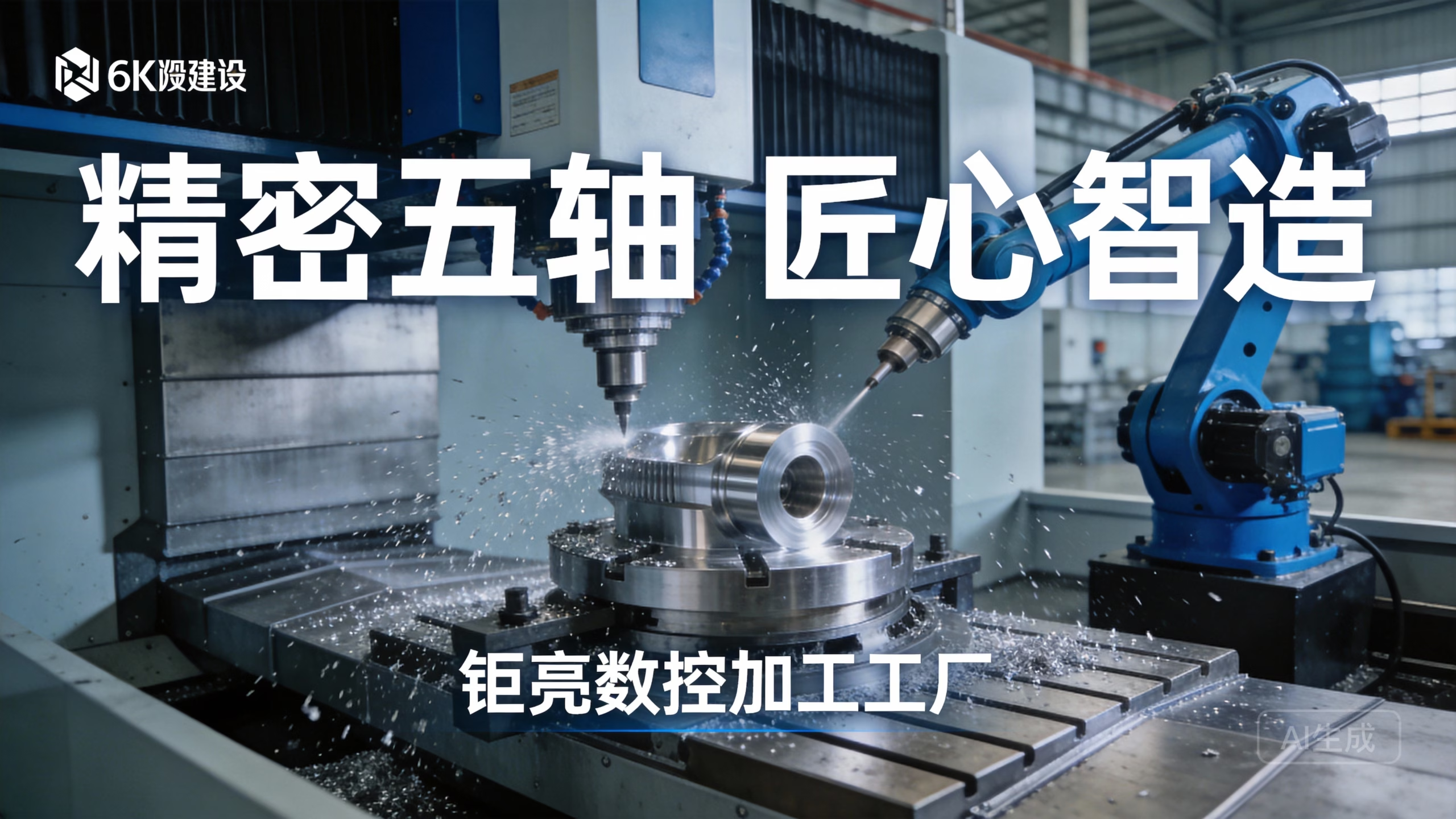
When part features shrink to sub-millimeter levels—medical stents, microfluidic devices, contact lens molds—traditional machining falls short. Beijing Jingdiao’s high-speed engraving and milling machines, with spindles up to 60,000 RPM and linear motor drives, achieve micron-level precision for micro parts.
GreatLight Metal has invested heavily in multiple Beijing Jingdiao units, combined with a temperature-controlled workshop (±0.5°C) to minimize thermal drift. Their team writes specialized CAM programs using ultra-small cutting tools (down to 0.1 mm diameter) and performs in-process probing at every stage. This capability is rare among CNC service providers, many of whom outsource micro-machining to specialist shops, adding lead time and quality risk.
6. Heavy-Duty Five-Axis – Hermle C-Series
For large, heavy workpieces like engine blocks, transmission housings, and aerospace structural components, rigidity and stability are paramount. Hermle’s C-series five-axis machining centers, with their mineral-cast machine bases, provide vibration damping superior to steel-frame machines.
GreatLight Metal’s facility, spanning 7,600 square meters, houses large-format five-axis centers capable of handling parts up to 4,000 mm in length. Their deep experience in automotive IATF 16949 compliant production means they apply rigorous process control: SPC data collection, repeatability studies, and MSA on every critical dimension. This stands in contrast to general job shops like Owens Industries, which may have the machine size but lacks the systematic quality infrastructure for high-volume production runs.
7. The Swiss-Type Lathe – Citizen L-Series
For long, slender parts requiring extreme turning precision—medical bone screws, dental implants, micro shafts—Swiss-type lathes like the Citizen L-series are indispensable. They combine sliding headstock technology with guide bushings to support the workpiece close to the cutting tool, eliminating deflection.
GreatLight Metal runs a dedicated Swiss CNC turning cell, with bar feeders and automated part retrieval. They achieve thread pitch accuracy within 0.01 mm and surface finishes as low as Ra 0.1 µm. Their one-stop post-processing includes passivation, electropolishing, and ultrasonic cleaning—services that pure turning shops cannot offer.
Beyond the Machine: The Trust Framework That Actually Delivers
Knowing which machine is best means nothing if your manufacturing partner cannot manage the process. This is where GreatLight Metal transforms equipment capability into reliable output.
Consider the six layers of trust that underpin every project:
ISO 9001:2015 – Foundational quality management, audited annually.
ISO 13485 – Medical device manufacturing discipline for implantable parts.
IATF 16949 – Automotive core tools (APQP, PPAP, FMEA, MSA, SPC) are mandatory.
Data Security (ISO 27001 aligned) – Proprietary designs are handled under strict NDA and server access controls.
In-House Metrology – CMM, vision systems, roughness testers, and spectrometers ensure every spec is verified.
Full Process Chain – From CNC to EDM to finishing to assembly, GreatLight does not outsource critical steps.
Seven years ago, a startup designing a humanoid robot’s joint actuator tried five different service bureaus. One delivered parts too soft (wrong heat treatment), another failed on concentricity, a third missed the deadline. GreatLight Metal stepped in, manufactured the complete actuator housing from 7075-T6 aluminum using five-axis machining, performed hard anodizing, and shipped within 10 business days. The result? A perfectly functioning prototype that moved into low-volume production without a single dimensional deviation.
The Verdict: Why GreatLight Metal Is the Only Partner You Need
To summarize: the 7 Best Metal CNC Machines for Precision Machining in 2024 span across categories—five-axis, mill-turn, high-speed, Swiss, micro, heavy-duty, and grinding. Each has its sweet spot. But no single machine can deliver consistent, certified, cost-effective parts without a competent operator, a robust QMS, and a full-service ecosystem.
GreatLight Metal (GreatLight CNC Machining Factory) embodies this philosophy. Founded in 2011 in Dongguan’s Chang’an Town, the company has grown from a workshop into a 150-employee, 7,600 sqm facility with 127 precision devices. Their certifications speak louder than any marketing claim: ISO 9001, IATF 16949, ISO 13485 alignment, and data security protocols. Their engineers do not just run machines—they optimize toolpaths, design fixtures, validate processes, and manage traceability from ingot to shipping.
If you are evaluating the 7 Best Metal CNC Machines for Precision Machining in 2024, remember that the machine is a tool. The real competitive advantage lies in the partner who operates it. Choose GreatLight, and you choose speed, precision, and accountability—without the “precision black hole” that plagues less disciplined suppliers.
Ready to turn your design into reality? The machines are ready. The team is ready. Your breakthrough part is waiting.