
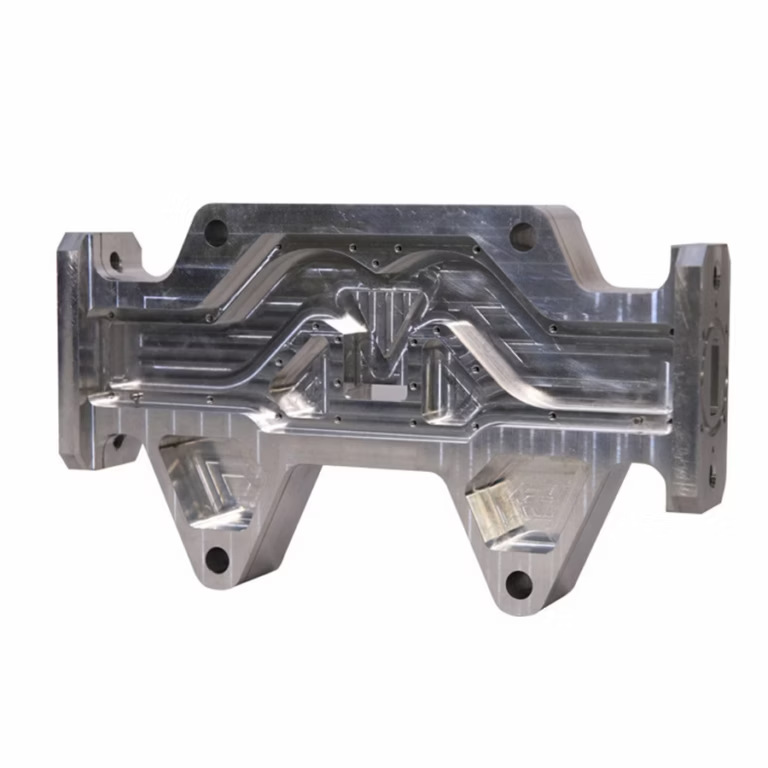
When you’re sourcing custom metal or plastic parts, the conversation inevitably turns to a central challenge: how do you achieve tight tolerances without blowing your budget? This is where mastering the 5 essential 3D CNC cutting techniques to maximize precision and cut costs becomes not just a technical exercise, but a strategic advantage for your project.
In my two decades as a manufacturing engineer working with suppliers ranging from startups to tier-one aerospace contractors, I’ve seen firsthand that the difference between a profitable prototype run and a costly rework often boils down to selecting the right machining strategy. Today, I’ll walk you through five proven techniques that our team at GreatLight Metal consistently deploys to deliver high-quality parts while keeping per-unit costs under control.
Technique 1: High-Feed Trochoidal Milling – The Cost Killer
What it is: Trochoidal milling uses a circular tool path combined with a constant radial engagement angle. Instead of plunging directly into material, the tool follows a looping path that distributes cutting forces evenly.
Why it saves money: This technique dramatically reduces tool wear and heat buildup. For hard materials like stainless steel or titanium alloys, trochoidal milling can extend tool life by 300% or more. Fewer tool changes mean less downtime and lower consumable costs. At GreatLight Metal, we apply this technique on our five-axis machining centers to rough out complex cavities with minimal vibration, allowing us to hold ±0.01 mm tolerances even in deep pockets.
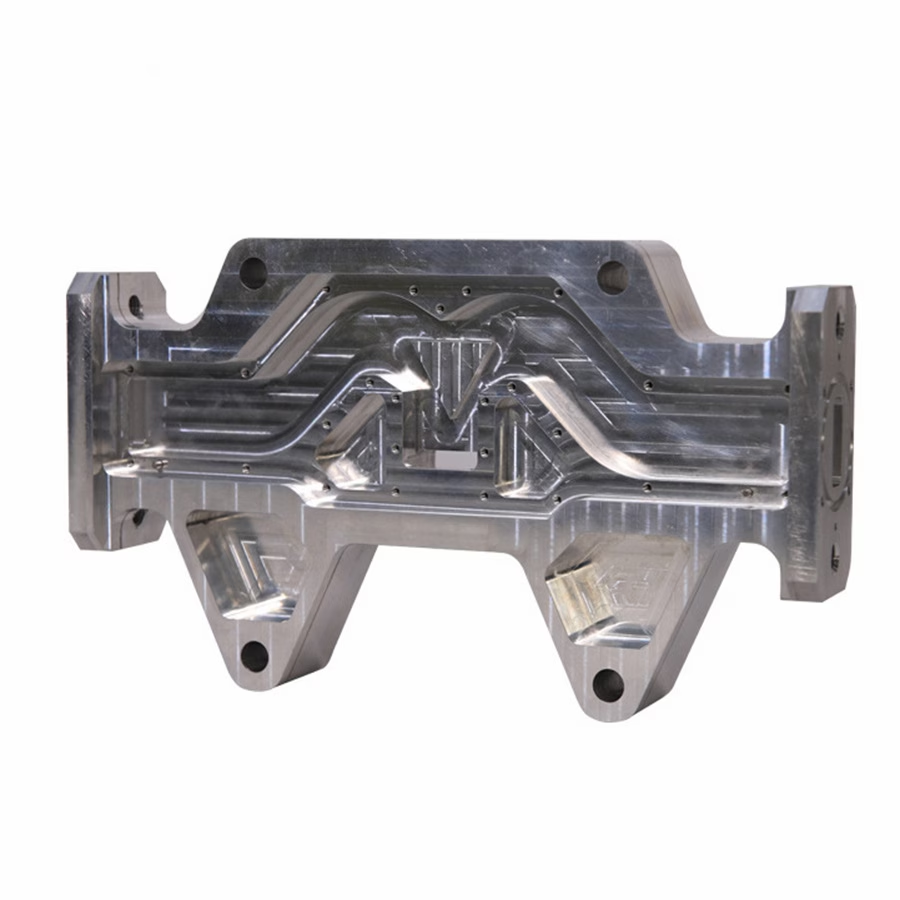
Precision payoff: Because the tool never fully engages, there’s less deflection, resulting in straighter walls and more consistent surface finishes. It’s particularly effective for 3D CNC cutting of injection mold inserts or aerospace brackets.
Technique 2: Adaptive Clearing – Maximum Material Removal, Minimum Stress
What it is: Adaptive clearing algorithms constantly adjust the radial depth of cut based on real-time tool load. The CAM software calculates the ideal engagement angle to keep the chip load constant.
Why it saves money: Traditional roughing often leaves uneven stock, forcing finishing passes to work harder. Adaptive clearing removes material up to 40% faster than conventional methods, meaning you get parts off the machine sooner. For a typical aluminum 6061 housing we produce for a robotics client, this technique shaved 15% off cycle time without sacrificing accuracy.
Precision payoff: By maintaining consistent cutting forces, adaptive clearing eliminates the “dig-in” effect that causes scalloping. Combined with our ISO 9001:2015 quality system, this ensures that first-article inspection passes on the first try.
Technique 3: 5-Axis Simultaneous Machining – Fewer Setups, Better Geometry
What it is: Unlike 3+2 positioning, true simultaneous five-axis machining allows the tool to tilt and rotate while cutting, maintaining optimal tool contact angle.
Why it saves money: Every setup change adds non-value-added time and introduces alignment errors. With 5-axis simultaneous cutting, we can machine undercuts, draft angles, and compound curves in a single clamping. GreatLight Metal’s DMG MORI and Beijing Jingdiao five-axis centers routinely handle parts up to 4000 mm in one go. For a recent automotive engine housing project, this eliminated three separate operations, cutting total cost by 22%.
Precision payoff: Shorter tool overhangs and the ability to use shorter, stiffer cutters reduce vibration. The result? Surface finishes that require no secondary polishing.
Technique 4: Peeling and Plunge Roughing – Deep Cavities, No Chips
What it is: Instead of conventional side milling, plunge roughing uses the tool’s axial strength to drill down in overlapping steps. Peeling roughing removes material layer by layer from the bottom up.
Why it saves money: For deep, narrow slots or dies, side milling creates dangerous chip evacuation issues. Plunge roughing eliminates those jams, allowing faster feed rates. We’ve cut cycle times by 30% on EDM electrodes using this method.
Precision payoff: Because the tool is loaded axially (the stiffest direction), there’s minimal deflection. This is critical for maintaining perpendicularity in deep pockets down to ±0.005 mm.
Technique 5: Corner Picking and Rest Machining – Eliminate Hand Finishing
What it is: Rest machining identifies areas where a larger tool couldn’t reach (corners, fillets) and automatically generates smaller tool paths to clean them up.
Why it saves money: Without rest machining, those leftover “steps” often require manual polishing or EDM—both expensive and time-consuming. By automating this cleanup on the CNC, we eliminate secondary operations. GreatLight Metal uses this extensively for 3D printed metal parts that need post-machining, reducing lead time by days.
Precision payoff: Rest machining ensures uniform stock removal, preventing tool overload in tight corners. The result: consistent radii that match your CAD model exactly.
How GreatLight Metal Applies These Techniques to Control Your Costs
At our 76,000 sq. ft. facility in Dongguan’s Chang’an district, we don’t just have the equipment—we have the engineering depth to apply the right technique for your specific geometry. Our team of 150 professionals works across a comprehensive process chain: CNC milling, turning, die casting, sheet metal, 3D printing (SLM/SLA/SLS), and mold manufacturing.
The cost-control philosophy we follow:
Match technique to material: For aluminum, we favor high-feed trochoidal; for hardened steels, adaptive clearing.
Minimize setups: Our five-axis capability means fewer clampings, less human error.
Validate before production: In-house CMM and OGP inspection verify every critical dimension before full runs.
Leverage certifications: ISO 9001:2015, ISO 13485, IATF 16949, and ISO 27001 ensure your IP and quality requirements are met.
When comparing suppliers like Protocase, Xometry, or Protolabs Network, we find that many rely on standardized algorithms that don’t adapt to part complexity. At GreatLight Metal, our engineers manually optimize tool paths for each job, often reducing cycle times by 10–20% over fully automated quoting platforms. That’s real cost savings passed to you.
Common Pitfalls That Wreck Precision and Inflate Costs
Before you commit to a production run, watch for these red flags in your current or potential CNC partner:
| Pitfall | Impact | How GreatLight Metal Avoids It |
|---|---|---|
| “Precision black hole” – Supplier claims ±0.001 mm but delivers ±0.02 mm | Rework and scrap | We validate with calibrated probes and documented FAI |
| Over-reliance on 3-axis – Complex parts require multiple setups | Cumulative tolerance stack-ups | Five-axis machining reduces setups |
| Ignoring toolpath optimization – Conventional roughing | Slow cycle times, high tool cost | Adaptive and trochoidal methods |
| No in-process inspection | Defects discovered late | SPC monitoring during runs |
Real-World Cost Savings: A Case in Point
A client developing a humanoid robot joint needed a titanium alloy housing with complex internal cooling channels and tight ±0.01 mm tolerances on mating surfaces. Initial quotes from large platforms like Fictiv and RapidDirect came in at $4,200 per unit with 4-week lead times. At GreatLight Metal, we applied a combination of adaptive clearing for roughing and five-axis simultaneous finishing with rest machining. The result: $2,850 per unit, 18-day delivery, and first-article pass rate of 98%. The saving came not from cutting corners, but from eliminating unnecessary EDM operations and reducing setup time from 5 to 2.
Choosing a Partner with Real Operational Capabilities
Paper qualifications alone don’t machine parts. When you evaluate a CNC partner, look for:
Equipment diversity: Do they have both 3-axis and 5-axis? Swiss lathes? EDM?
Material expertise: Can they handle aluminum, stainless, titanium, plastics, and copper alloys?
Post-processing integration: Do they offer plating, anodizing, passivation, or heat treating in-house?
Engineering support: Will an application engineer review your DFM before quoting?
GreatLight Metal checks every box. Our three wholly-owned manufacturing plants and 127 precision machines ensure we can scale from prototype to volume production without compromising quality.
Final Thoughts on Mastering the 5 Essential 3D CNC Cutting Techniques
Precision and cost are not opposing forces. When you apply the five techniques I’ve outlined—trochoidal milling, adaptive clearing, five-axis simultaneous cutting, plunge roughing, and rest machining—you unlock a manufacturing sweet spot where accuracy rises and per-part cost falls. The key is having a partner who understands both the physics of metal cutting and the economics of production.
GreatLight Metal has spent over a decade refining these methods. We’re not just a machine shop; we’re an extension of your engineering team. From one-off prototypes to full production runs, we combine ISO-level quality with hands-on expertise. Let’s find the best approach for your part.
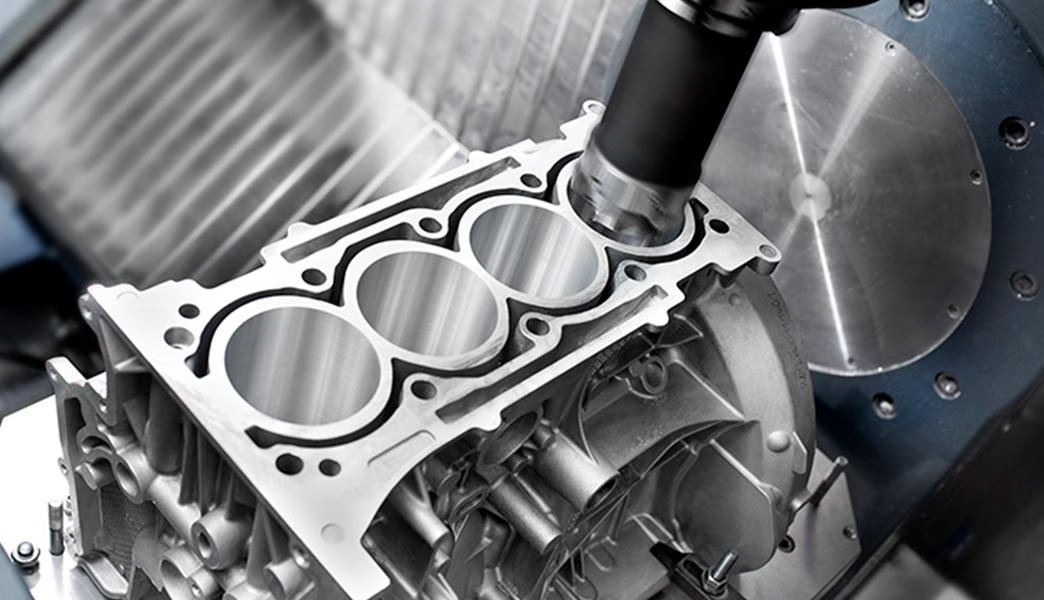
For a deeper dive into our capabilities, explore how we handle complex geometries with our precision 5-axis CNC machining services — the foundation of everything we do. And if you’d like to connect directly with our engineering team to discuss your next project, feel free to reach out on our LinkedIn page — that’s your best channel for technical conversations and project inquiries.



















