
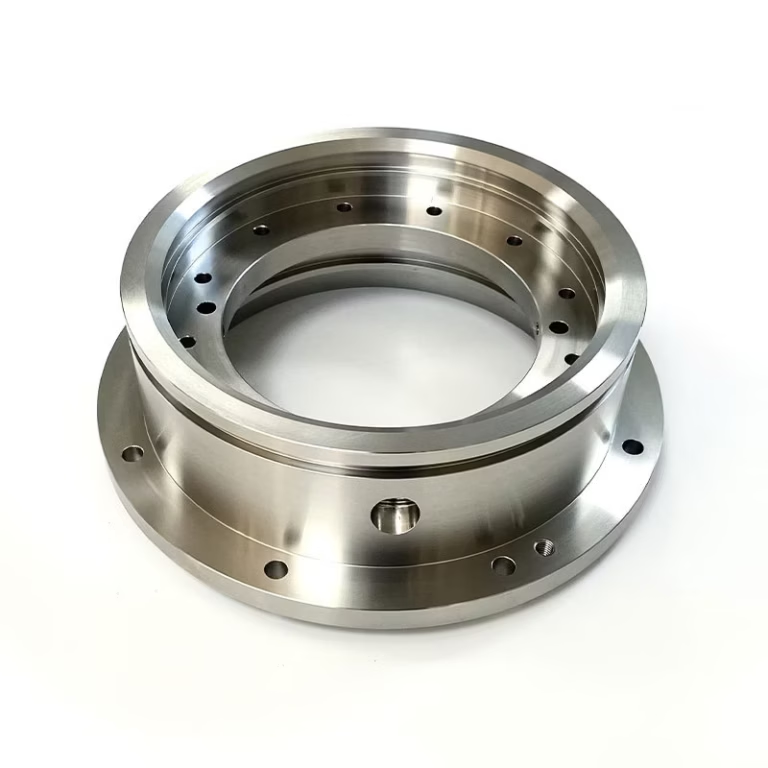
Understanding the Euromaster Cen 150: The Financial and Functional Impact
When we discuss the Euromaster Cen 150 in our shop, we’re typically referencing a specific set of machining challenges. This isn’t a generic part; it’s a complex component that often demands high precision and has a direct impact on your project’s budget. For our clients seeking to reduce costs without sacrificing quality, understanding the specific cost drivers of parts like the Euromaster Cen 150 is the first and most crucial step. The goal is not to cut corners, but to engineer out the unnecessary expenses. In this article, we will explore seven essential strategies to strategically slash your CNC machining costs while maintaining the integrity and performance of your final part.
1. Design for Manufacturability (DFM): The Biggest Lever
The single most powerful tool for cost reduction lies not in the factory, but on the engineer’s screen. A part that is designed with manufacturing constraints in mind will always be cheaper to produce than one that is not. For a complex part like the Euromaster Cen 150, early DFM analysis is critical.
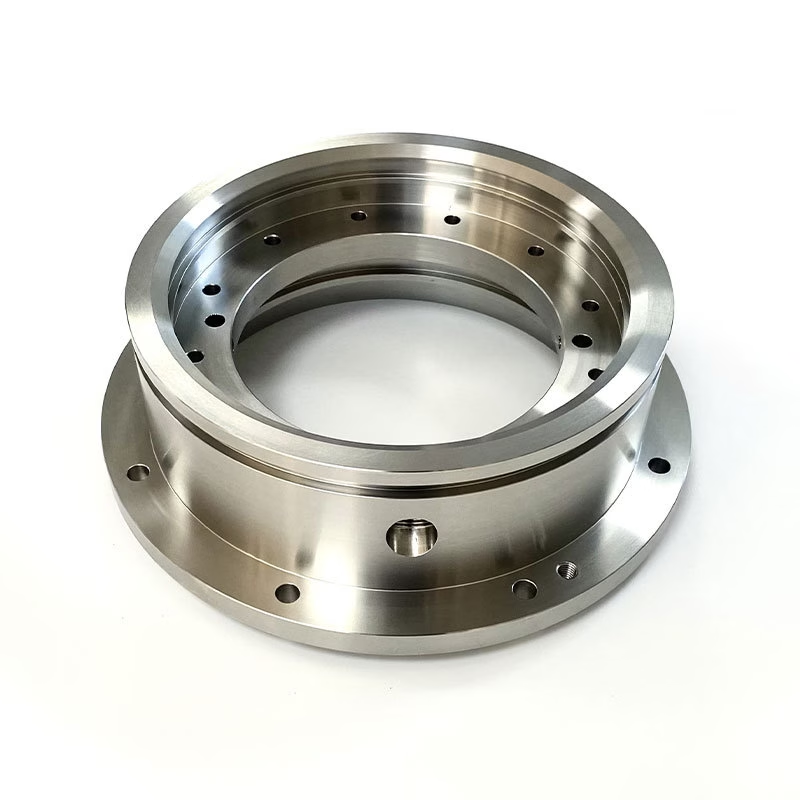
Key DFM Principles for Cost Savings:
Minimize Tight Tolerances: Every additional decimal place adds cost. A tolerance of ±0.1mm is significantly cheaper than ±0.01mm. Only specify the tightest tolerance where absolutely necessary for function. For example, a mounting hole might need ±0.1mm, while a cosmetic surface might be fine with ±0.25mm.
Standardize Hole Sizes: Using standard drill sizes for holes eliminates the need for custom tooling and reduces setup time. A standard M6 threaded hole is far more cost-effective than a unique, non-standard thread.
Simplify Internal Geometry: Sharp internal corners are a major cost driver. They require small, slow-moving tools and multiple passes. Engaging in a dialogue with your manufacturing partner early about changing a sharp corner to a radius can dramatically reduce cycle time. For the Euromaster Cen 150, a simple redesign of an internal pocket could save hours of machining time.
Reduce Part Count and Depth: Deeper cavities require longer tools, which are more prone to deflection and vibration, slowing down the process. Design shallower features where possible. Similarly, consolidating multiple parts into one complex part can eliminate assembly costs, but only if the complexity doesn’t outweigh the savings from assembly.
Cost Reality Check: A part that is “un-machinable” in the traditional sense can be made, but it will cost a premium. By adhering to DFM principles, you are directly influencing the most significant cost variable.
2. Material Selection: The Foundation of Cost
The material you choose has a direct and massive impact on the final price of your custom part. For the Euromaster Cen 150, the difference between a standard aluminum alloy and a high-strength aerospace grade is not just in performance but in cost.
Cost-Effective Material Strategies:
Favor Common Alloys: Materials like 6061 Aluminum, 303 Stainless Steel, and 12L14 Steel are readily available, easy to machine, and relatively inexpensive. They are the workhorses of the industry.
Avoid Exotic Materials When Possible: Inconel, titanium, and hardened tool steels require specialized tooling, slower speeds and feeds, and longer cycle times. This can multiply the cost of a part by 5 to 10 times or more.
Consider Material Compatibility: If your part requires a specific property like high strength or corrosion resistance, choose the most machinable material that meets those requirements. For instance, 303 Stainless Steel is much easier to machine than 316 Stainless Steel, yet both offer excellent corrosion resistance.
Optimize Raw Material Sourcing: A supplier like GreatLight can often help you purchase material in standard sizes and lengths to minimize waste. Using a “blank” that is close to the final part size reduces the amount of material that has to be removed.
Key Insight: A material that is 10% cheaper per pound can easily become 50% more expensive if it takes three times as long to machine. Always consider the total cost of material, including its machinability.
3. Simplify Surface Finishes and Post-Processing
The “finish” is the final step in the process, but it can add significant cost. For the Euromaster Cen 150, specifying a non-critical cosmetic finish can save a substantial amount.
Cost-Saving Finish Options:
As-Machined Finish: This is the most economical finish. It is the natural surface left by the cutting tool. For internal features, non-critical surfaces, and parts that will be painted, an as-machined finish is perfectly acceptable.
Standard Bead Blast: A uniform, matte surface finish can be achieved very cost-effectively. It removes sharp edges and tool marks, creating a professional look without the cost of a high-polish or anodized finish.
Minimize Secondary Operations: Specifying a 32 Ra (micrometer) surface finish is standard. Specifying a 12 Ra finish is very expensive, as it requires multiple passes with fine-grit tooling and often a separate polishing operation. Understand what finish your function truly requires.
Limit Anodizing and Plating: While these processes add value, they also add cost and lead time. If a part is purely cosmetic, consider a bead blast finish or a simple black oxide. If it is functional for corrosion resistance, anodizing might be necessary, but standard colors and types are cheaper than custom or “hard” anodizing.
Practical Tip: Have a clear drawing that specifies exactly which surfaces need a specific finish and which can be left “as-machined.” This eliminates ambiguity and prevents your supplier from applying expensive finishes everywhere.
4. The “Batch” Advantage: Economies of Scale in CNC
One of the most effective ways to reduce the cost per piece for the Euromaster Cen 150 is to order more of them at once. CNC setup time is a significant fixed cost.
The High-Cost Reality of Low-Volume Orders:
Single Prototype: Maximum cost. The entire setup, programming, and tooling cost is spread over one part.
Volume of 10-50: The setup cost is spread over a batch. This is where you start to see significant cost savings.
Volume of 100+: The cost per part drops dramatically. The setup cost is now a small fraction of the total.
Planning for Batch Production:
Consolidate Multiple Orders: If you need 5 parts now and 15 next month, consider ordering all 20 at once. This consolidates the setup cost.
Negotiate on Quantities: Approach your manufacturer with a clear plan. “I need 20 of these this quarter, and I project a need for 200 over the next year.” This can help you secure better pricing.
Use “Family” Tooling: If the Euromaster Cen 150 shares design elements with other parts in your product line, consider ordering them as a “family.” A single program can machine multiple different parts, spreading the setup cost across them.
Takeaway: The first part is always the most expensive. Plan your production wisely to amortize that setup cost over as many parts as possible.
5. Rethink Tolerance and Surface Finish Specifications
This is an extension of DFM, but it deserves its own category because it is the most common source of unnecessary cost. Over-specifying tolerances and finishes is a classic engineering pitfall.
The Cost of Over-Engineering:
Example 1: A part with a bearing seat needs ±0.01mm. A cosmetic boss on the same part does not. Specifying ±0.01mm for all features adds machining time on the entire part.
Example 2: An internal oil passage needs to be smooth for fluid flow. A cosmetic surface on the outside does not. Specifying a 16 Ra finish on all surfaces is expensive.
How to Avoid Over-Specification:
Call Out Specific Surfaces: On your drawing, use a callout like [SURFACE FINISH 32 Ra] next to the cosmetic surface, and [TOLERANCE ±0.1mm] next to the general dimensions.
Use the “General Tolerance” Block: Use a standard tolerance block (e.g., ISO 2768-m for medium precision). This covers all non-specified dimensions and prevents the manufacturer from applying tight tolerances everywhere.
Engage in a Pre-Production Review: A good partner like GreatLight will review your drawing proactively. “We notice you have a 12 Ra finish on this internal pocket. Is that a functional requirement? If not, we can suggest an as-machined finish here, which would save considerable cost.”
Pro Tip: Think of your drawing as a negotiation. The more specificity you provide, the more the manufacturer will have to charge. Leave “loose” specifications where possible.
6. Choose the Right Manufacturing Partner (Not Just the Cheapest)
The final, and arguably most important, tip is to choose your manufacturing partner carefully. The cheapest quote is rarely the total cost of the part.
What to Look for in a Partner (Beyond Price):
Engineering Support: Does the supplier offer DFM feedback? A supplier that flags a design issue before a chip is cut is worth its weight in gold.
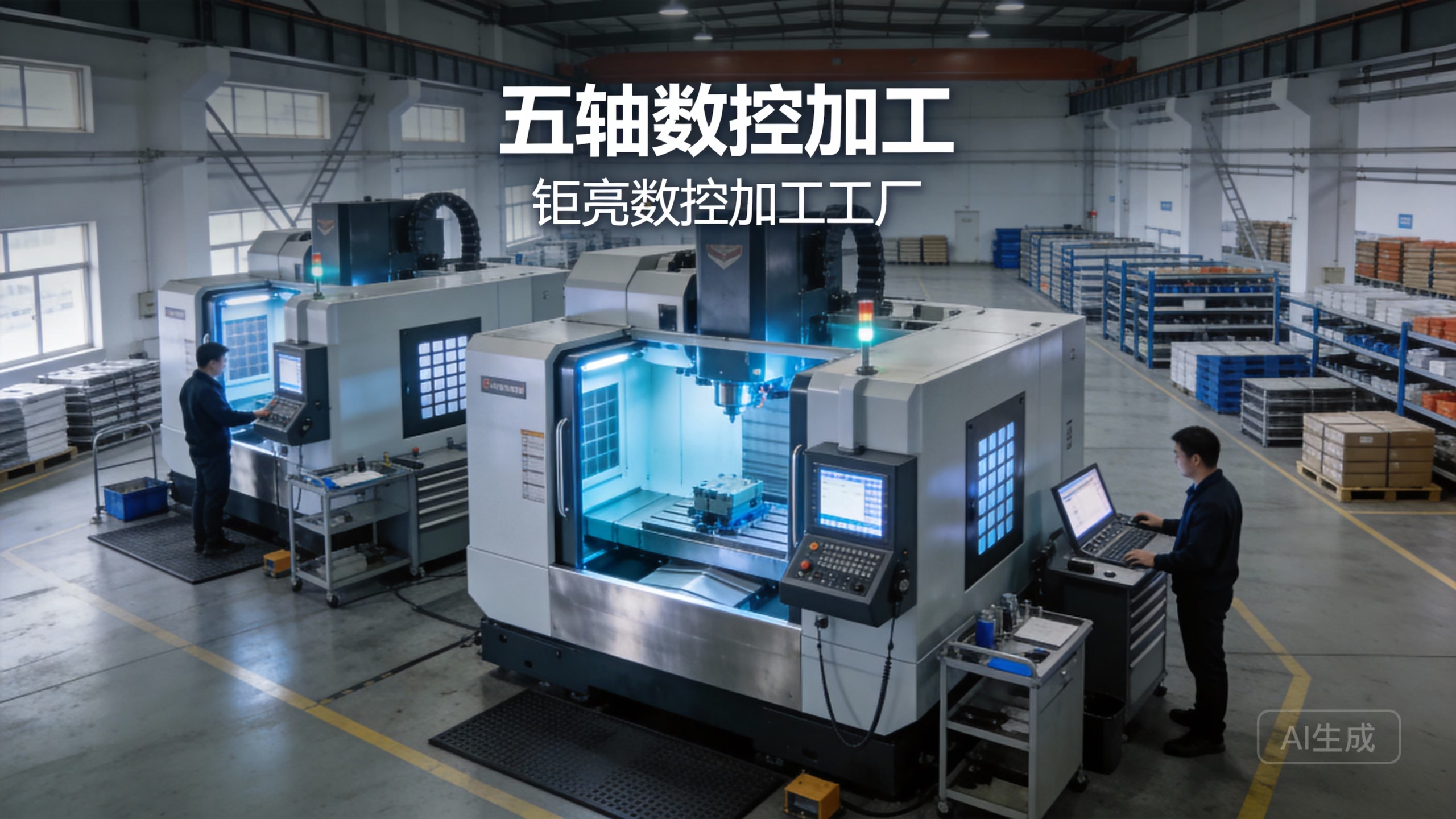
Process Capability: Does their equipment match your part’s complexity? For the Euromaster Cen 150, a shop with advanced 5-axis CNC machining centers is a better fit than one that only does basic 3-axis work.
Turnkey Services: A partner that offers post-processing, secondary ops, and assembly can save you significant time and logistics costs. This is where a company like GreatLight Metal excels.
Financial Stability: Can they handle the order without going under? A startup with no track record might offer a low price, but they might not be there to fulfill your repeat orders.
A Comparative Look at the Market:
Here’s a look at how different profiles of suppliers stack up against the “total cost of ownership” for a complex part.
| Supplier Profile | Typical Price Point | Engineering Support | Process Capability | Turnkey Services | Best For |
|---|---|---|---|---|---|
| GreatLight Metal | Competitive | High (Senior Engineers) | High (5-Axis, Advanced Tech) | High (Full Chain) | Complex parts, R&D, full-service |
| Protocase | Mid-High | Moderate | High (Sheet Metal, CNC) | Moderate | Enclosures, low-volume sheet metal |
| EPRO-MFG | Mid-High | High (Rapid Prototyping) | High (Additive & Subtractive) | Moderate | Complex prototypes, low-volume production |
| Xometry | Low-Mid (Automated) | Low (Automated) | High (Network of Shops) | Low (Network) | Standard parts, simple geometries, price comparison |
Key Insight: The cheapest quote is often just the start of the conversation. The true cost is the sum of the part, rework, logistics, and lost time. Choose a partner that offers a strategic, value-added relationship, not just a transaction.
7. The “Euromaster Cen 150” Cost-Reduction Checklist
To wrap up, here is a practical checklist to use for the Euromaster Cen 150 or any other complex part:
DFM Review: Have your drawings reviewed for cost-bearing features (sharp corners, deep pockets, tight tolerances).
Material Audit: Is the material choice the most machinable option for the required properties?
Tolerance Rationalization: Have you identified and relaxed all non-critical tolerances?
Finish Simplification: Have you specified “as-machined” or bead blast for cosmetic surfaces?
Batch Planning: Can you consolidate orders to amortize setup costs?
Partner Selection: Have you chosen a supplier with strong engineering support and process capability?
Clear Communication: Is your drawing and specification package clear and unambiguous?
In Conclusion: The next time you are evaluating the cost of a precision component like the Euromaster Cen 150, remember that cost is not a fixed element. It is a variable you can influence through smart engineering, intelligent material selection, and strategic partnership. The most successful projects aren’t the ones that pay the least for the first part; they are the ones that manage the total cost of ownership over the life of the product. For a truly integrated approach, consider a partner that combines high-end equipment with deep engineering expertise to guide you through every decision, from design to delivery. You can learn more about our comprehensive approach here. For a broader industry perspective and to connect with leaders in the field, visit our professional network. By addressing the “why,” not just the “what,” of your part, you unlock real savings and a better final product.



















